
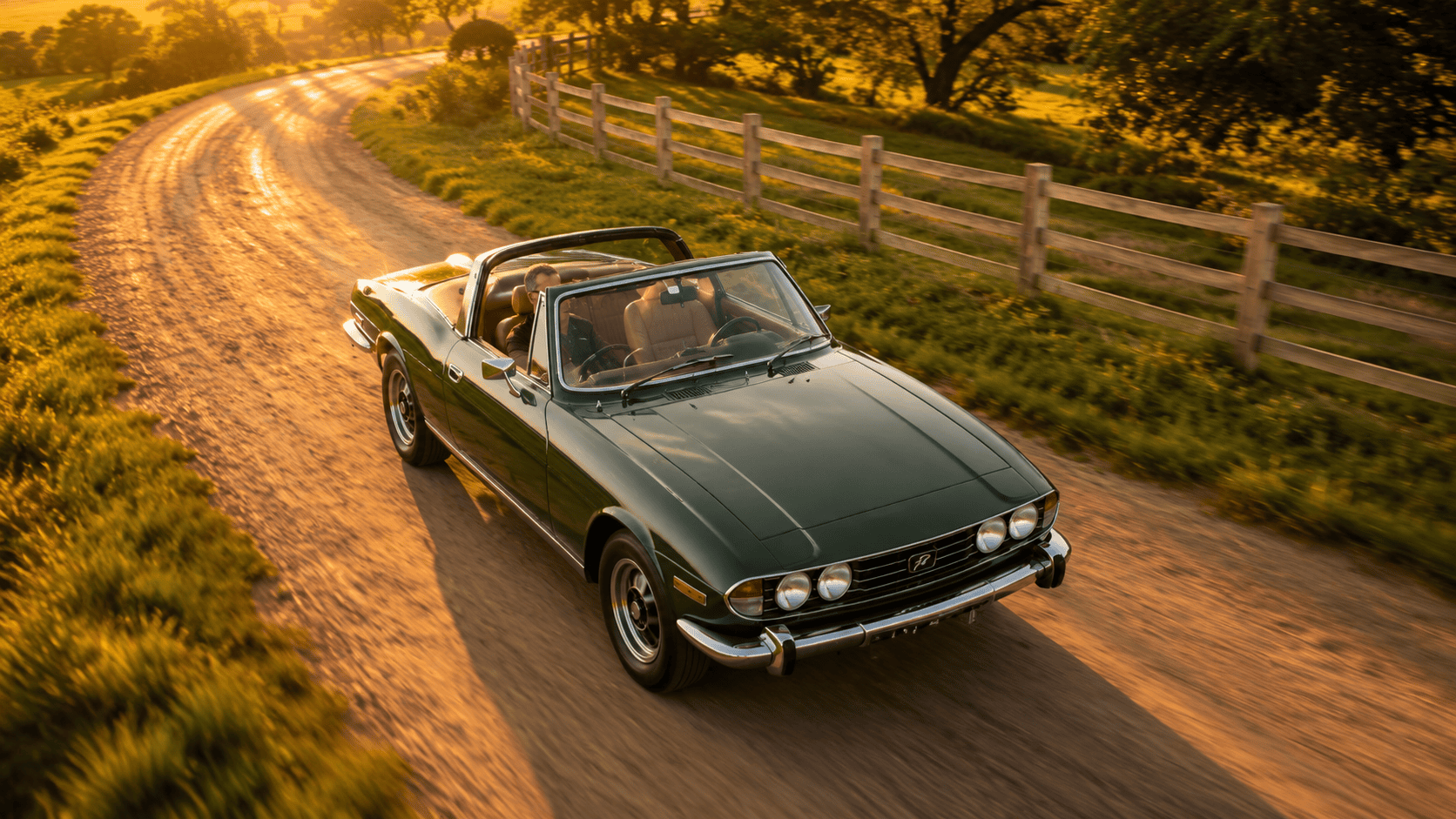
The Triumph Stag is one of those cars that everybody has an opinion about and very few of the people offering those opinions have actually driven one. The reputation precedes it so thoroughly that the car itself gets lost behind decades of pub wisdom about head gaskets and overheating. Some of it is earned. Quite a lot of it is not. What gets lost in the noise is that 25,939 Stags were built at Canley between 1970 and 1977, and the Stag Owners Club estimates that around 46% of all UK-registered cars survive, a figure that would be remarkable for any classic and is frankly astonishing for one with a reputation this bad. People do not fight that hard for cars that are not worth fighting for.
This guide is about what to actually look for when you go to buy one, rather than what to worry about from behind a keyboard. The Stag rewards the prepared buyer and punishes the impulsive one, and the difference between those two outcomes is almost entirely about knowing where the costs can hide before you hand any money over.
What a Stag actually is
The Stag started life as a Giovanni Michelotti styling exercise, cut from a pre-production Triumph 2000 saloon in 1963 or 1964 and loaned to him by Harry Webster, Triumph’s Director of Engineering. It evolved from a convertible 2000 into something altogether more ambitious: a 2+2 grand tourer aimed squarely at the Mercedes-Benz SL, at around half the price. Underneath, it sat on a shortened 2000/2500 floorpan with fully independent suspension all round (MacPherson struts at the front, semi-trailing arms at the rear), power-assisted rack-and-pinion steering, front disc brakes and rear drums. Structural rigidity came from a distinctive B-pillar roll hoop connected to the windscreen frame by a T-bar, which gave the Stag its signature profile and met the proposed American rollover standards of the day. A removable hardtop was offered as a factory option from the outset and became standard fitment later in the run.
The car was built exclusively at Triumph’s Canley works in Coventry and was never assembled anywhere else. Of the total production, 17,819 were destined for the UK market and 6,780 were exported, of which only 2,871 reached the United States before import was discontinued in 1973.
The engine: reputation versus reality
Every Stag buyers guide has to deal with this, so let us get it done properly rather than either dismissing the problems or overblowing them. The Stag’s 3.0-litre V8 was Triumph’s own design, developed from two of its slant-four engines joined at 90 degrees. It used a cast iron block with aluminium cylinder heads and a single overhead camshaft per bank, producing 145bhp at 5,500rpm and 170lb ft of torque at 3,500rpm, fed by twin Stromberg carburettors. It was a genuinely smooth, characterful engine with a lovely V8 burble that is a large part of why people want the car in the first place.
It was also, in period, let down by a combination of design decisions and maintenance ignorance that created a self-reinforcing spiral of failures. Three things sit at the heart of the Stag’s engine reputation, and all three are worth understanding precisely rather than vaguely.
- Cooling. The water pump was mounted high on the engine, which made it vulnerable to airlocks and reduced its self-priming ability. The radiator was marginal for the job and the fan cowling, fitted from the Mk2 onwards, was often removed by owners when sagging engine mounts caused the fan to foul it. More fundamentally, the iron block and aluminium head combination required corrosion-inhibited antifreeze all year round, which was not widely understood in the 1970s. Many owners and even franchised dealers ran plain water or failed to use the correct inhibitor, leading to internal corrosion, silted waterways, overheating, warped heads and blown gaskets.
- Timing chains. The Stag used single-roller chains to drive the camshafts, and these had a finite life. Triumph’s own service literature specified replacement intervals, but many owners and garages ignored or were unaware of the requirement. A stretched or failed chain causes immediate and expensive damage. The widely cited replacement interval is around 25,000 to 30,000 miles, though with modern quality chains and proper oil changes some engines go considerably further.
- Head gaskets. Often a consequence of the cooling problem rather than a separate fault. Overheating warps the aluminium heads, which Triumph allowed only a very small margin for skimming (approximately 0.010 inches), and a blown gasket can cause coolant to seep between the head and the steel studs, triggering an electrochemical reaction that seizes the studs into the block and makes head removal extremely difficult.
Here is the important part, though: every one of these problems has been engineered out by specialists and informed owners over the past four decades. Modern head gasket materials are vastly better. Uprated radiators and electric fans are widely available. Correct coolant practice is now well understood and well documented by the Stag Owners Club. The timing chains can be replaced on a schedule rather than left until they fail. A Stag with a properly rebuilt and maintained V8, looked after by someone who understands it, is not the liability its reputation suggests. The question when buying is not whether the engine is fundamentally flawed (it is not), but whether the specific car in front of you has been looked after by someone who knew what they were doing.
TR Tony from the ‘Arry The Stag channel walks through his reconditioned 3.0-litre V8 in detail, covering the rebuild work, the key improvements made, and what a properly sorted Stag engine actually looks like up close. Worth watching before you view a car, so you know what good looks like.
Mk1, Mk2, and the one in between
Triumph never officially used the Mk1 and Mk2 designations, but the community universally does. The differences are largely cosmetic rather than mechanical, but knowing which is which matters when assessing originality and value.
The Mk1 (1970 to 1972/73, commission numbers up to around LD14158) has Rostyle-look steel wheel trims, a fully body-coloured finish with no coachlines, and downward-pointing instrument needles. The Mk2 (1973 onwards, from commission number LD20001) brought twin coachlines, a matt black rear panel and sills, clearer instruments with upward-pointing needles, revised seats, a smaller steering wheel, and the GKN alloy wheels which have become the look most people associate with the car (a popular option at first, standard fitment on late cars). Late Mk2 cars (from around 1975, commission numbers from LD40001) reverted to body-coloured rear panels and gained aluminium sill covers. The automatic gearbox also changed late in production, from the Borg-Warner Type 35 to the Type 65.
There is also an informal “Mk1.5” designation used for cars in the LD20001 series (late 1972 to late 1973), which have Mk1 bodyshells but Mk2 interior trim, instruments, hoods and engines. These cars are a genuine production crossover rather than evidence of parts-bin raiding, though parts-bin raiding was also a known Triumph habit.
On value, the Mk1 currently commands a slight premium of around 10% over the equivalent Mk2, though in an ironic twist the late Mk2s (with alloys and aluminium sill covers) are the ones most buyers instinctively find attractive. Many Mk1s have been fitted with Mk2 cosmetics over the years, so check the commission plate if originality matters to you.
A practical walk through the visual differences between the Mk1 and Mk2, covering the exterior details, trim changes and what to look for when identifying which variant you are actually standing in front of.
Manual or automatic
The majority of Stags left the factory with the Borg-Warner three-speed automatic, which suits the car’s grand touring character well enough but feels dated by modern standards. The manual option was a four-speed unit descended from the TR2 gearbox (updated with needle roller bearings on the layshaft and a revised first-gear ratio), available with either an A-type or J-type Laycock overdrive. Almost all manual cars were fitted with overdrive as standard, and a manual without it is unusual enough to raise questions about the car’s history.
A manual with overdrive commands a premium of around £1,000 over the equivalent standard automatic. A popular and worthwhile modification is the conversion to a ZF 4HP14 four-speed automatic, which transforms the driving experience and typically adds around £1,500 to a car’s value. If this matters to you, our overdrive guide covers the Laycock units in detail.
What to check: the bodywork
This is where the expensive surprises hide, more so than the engine on a well-maintained car. Replacement panels are available but they are not cheap, and structural repairs to a monocoque body are skilled, time-consuming work. The key areas to examine are all places where water sits, mud collects, or two panels meet.
- The sills and outriggers are the primary structural concern. There are two outriggers on each side, with the fronts typically failing first; once they go, the rot spreads into the sills and floorpans. Check these from underneath on a ramp or over a pit if at all possible rather than relying on a glance from wheel-arch height.
- The A-post and B-post bases can rust badly, and repairs in these areas are structurally critical and not straightforward.
- Door bottoms corrode from the inside out, which means the first visible evidence appears late.
- The front valance and the seams between the front wings and the panel ahead of the bonnet are worth checking, as is the equivalent seam at the rear between the wings and the boot panel.
- Check the trailing edge of the boot lid and the boot floor, and if a hardtop is fitted, examine the side window apertures, header rail and guttering carefully.
- The rear subframe mountings can corrode, and failure here is both dangerous and expensive to rectify.
Our rust prevention guide and welding guide for beginners both cover the general principles, but on a car of this value and structural complexity, any significant corrosion is a job for a specialist rather than a weekend with a MIG.
What to check: the engine
Beyond the headline cooling and timing chain issues covered above, here is a practical pre-purchase checklist for the V8 specifically.
- Take it for a long drive, not a lap of the car park. Get the engine properly up to temperature and then let it idle for several minutes afterwards. Watch the temperature gauge throughout: a car that runs fine at speed but climbs at idle may just need a viscous fan coupling, but it may also be masking a deeper cooling issue.
- After the run, check the oil for water contamination (milky residue on the filler cap or dipstick) and the coolant for oil. Check the coolant level: if it has dropped noticeably since before the run, something is leaking or venting.
- Listen for timing chain rattle from the front of the engine, particularly on start-up and at idle. A light rattle may simply mean the chains are due; a heavy rattle with associated running issues means the job is overdue and may have caused further damage.
- Listen for bottom-end knocks at idle and tapping from the cam covers, which can indicate worn camshafts.
- Check whether the thermostat has been removed (it sits in the inlet manifold). A missing thermostat is a red flag that someone has been treating a symptom rather than fixing the cause.
- Ask about the engine’s history: has it been rebuilt, and if so, by whom, how recently, and what was done? A properly rebuilt V8 with documented work by a known Stag specialist is worth considerably more than an engine of unknown provenance.
What to check: the rest
- Interior. Factory seats were trimmed in expanded knit vinyl, not leather, despite what many sellers imply. Leather is a popular and perfectly acceptable upgrade but should not command a premium. Check the seat frames: sagging or collapsing seats are common and the frames need attention before simply recovering them. The wood-veneer dashboard can lift and crack, and a good original or properly restored one is worth preserving.
- Soft top and hardtop. If the hardtop is fitted, ask the seller to remove it (a two-person job without a hoist) so you can confirm there is actually a soft top in the well and that it works. The original specification was black mohair; a grey double-duck replacement is less durable. Check the soft-top frame for distortion or damage and the catches for effective closure.
- Steering. Power-assisted rack-and-pinion: check for fluid leaks around the rack and the pump. It should feel precise if slightly over-assisted by modern standards. Vagueness suggests worn rack bushes or a tired steering column.
- Driveshafts. The original splined driveshafts are a known weakness. A clunk or shudder through the transmission on the overrun, particularly noticeable when lifting off in a bend, is the telltale of what the community calls “Triumph Twitch.” Replacement CV-jointed driveshafts are available from specialists and are a well-established upgrade; a car already fitted with them is a genuine plus.
Engine swaps: the elephant in the room
You will find Stags fitted with Rover V8s, Ford V6s, Triumph straight-sixes and occasionally more exotic alternatives. In the 1980s and 1990s, re-engined cars sometimes sold for a premium because buyers feared the original V8. That has reversed: a Stag with its correct Triumph V8, properly rebuilt and maintained, is now worth more than one with an engine swap, and the consensus among specialists and the club is firmly that the original engine is the one to have. If you are looking at a re-engined car, be aware that the diff ratio may not have been changed to suit the replacement engine’s rev range, which can cause poor fuel consumption and a lack of top-end performance, and that reverting to a Triumph V8 is an expensive and time-consuming project.
The club and parts support
The Stag Owners Club, founded in November 1979 by specialist Tony Hart of Hart Racing Services, describes itself as the largest single-model classic car club in the UK and has an active membership exceeding 5,000. Hart, who passed away in December 2023, had been specialising in the Stag since 1974 and is widely credited with keeping the model alive through the decades when its reputation was at its lowest. The club runs more than forty area groups across the UK, publishes a monthly magazine, maintains an extensive technical archive and forum, and operates the Stag Owners Club Tooling Fund Limited (SOCTFL), a limited company in which every member is a shareholder, dedicated to remanufacturing obsolete parts.
Parts availability is, as a result, genuinely good. There are very few replacement parts for the Stag that cannot be obtained new, and dedicated Stag specialists (including Robsport International and Stag Classics among others) hold significant stock. Joining the club before buying is actively recommended by the club itself: the contacts, technical knowledge and access to the forum will almost certainly save you more than the membership fee on your first purchase.
For broader Triumph context, our history of Triumph covers the wider marque story, and our Triumph paint and colour codes guide is a useful reference for confirming whether a car’s colour is original to its commission number. The Herald and Vitesse, GT6, Spitfire, TR6 and 2.5 PI buyers guides cover the rest of the Triumph range if you are weighing up alternatives, and our insurance guide is worth reading before you agree a value with anyone.
References and further reading
- Stag Owners Club: history of the Stag, the club’s own account of the car’s development, production and survival.
- Stag Owners Club: differences between Mk1 and Mk2, the definitive visual reference for identifying variants.
- Stag Owners Club: buyers guide, the club’s own pre-purchase inspection guidance.
- British Motor Museum, Gaydon, the official archive for Triumph and British Leyland engineering history, and home to the last Stag off the production line.
This page contains affiliate links. If you click a link and make a purchase, Classic Car Hub may earn a small commission at no extra cost to you.