
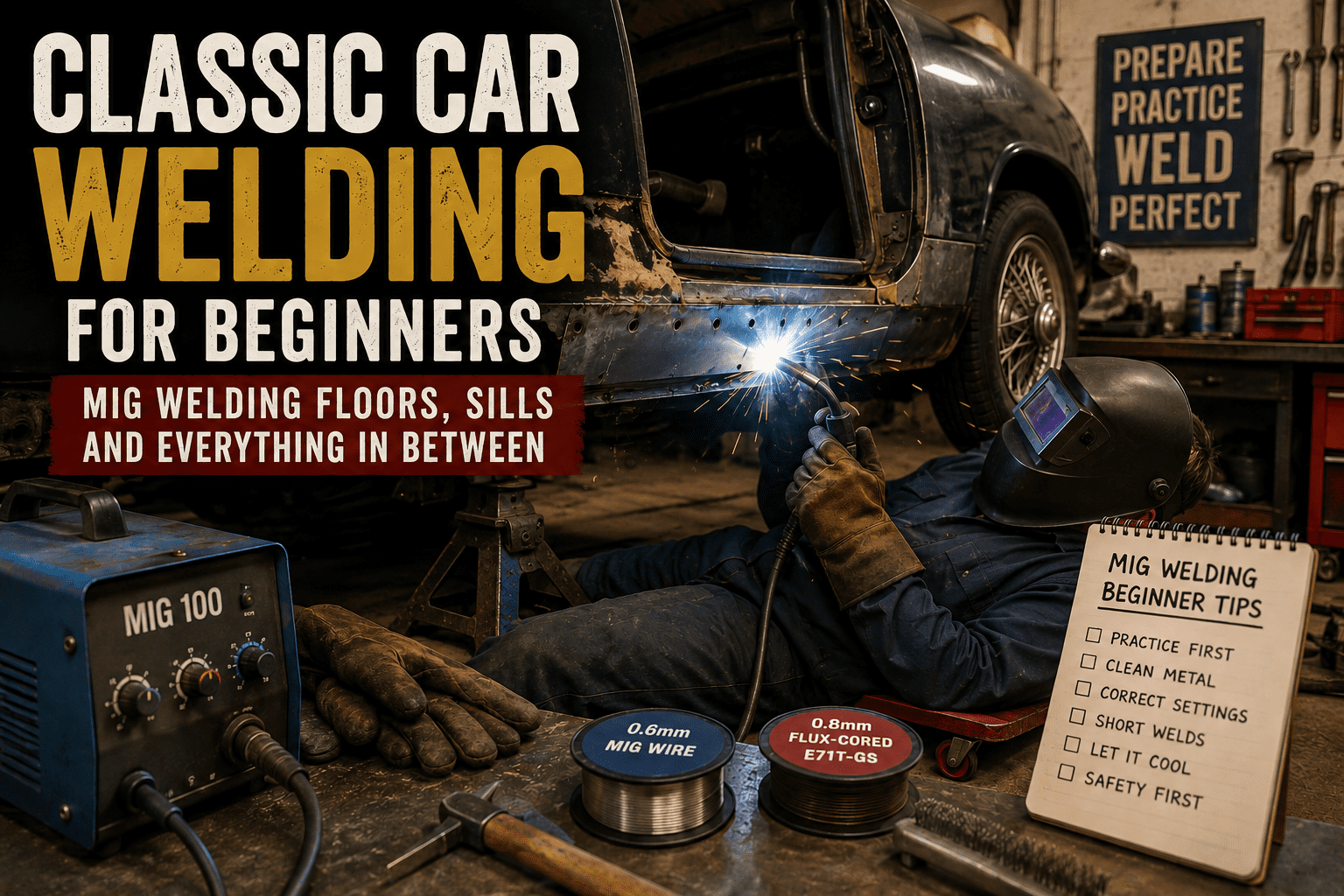
At some point in every classic car owner’s life, the moment arrives. You are lying under the car with a torch, prodding at something that used to be a sill, and a piece of it falls off and lands in your eye. You stare at the hole where the metal was. The metal stares back. And you think: someone is going to have to weld that, and the quotes you have had suggest that someone had better be you.
The good news is that MIG welding is a genuinely learnable skill. Not in the theoretical sense that anything is learnable if you spend several thousand hours on it, but in the practical sense that most people can produce a decent weld on a flat piece of scrap steel within an afternoon and a passable floor panel repair within a weekend of focused practice. The welder you need costs less than a professional’s callout fee. The wire costs a few pounds a reel. The main ingredient is confidence, and the main obstacle to confidence is the widespread belief that welding is a dark art practised only by people with seventeen years of experience and forearms like ham shanks.
It is not. This guide will take you from knowing nothing to being able to weld floor panels, sills, and the sort of awkward overhead spots that make even experienced owners look at the car and briefly consider selling it.
Why MIG, and not the other kinds
MIG stands for Metal Inert Gas, and it is the method of choice for classic car bodywork for reasons that are entirely practical. The welder feeds a spool of thin wire continuously through a torch while simultaneously providing a shielding gas to protect the weld pool from the atmosphere. You point the torch, pull the trigger, and metal joins to metal. It is fast, controllable, and produces clean welds on the thin sheet steel that floors, sills, and repair panels are made from.
TIG welding produces beautiful results but requires two hands, considerable skill, and a learning curve that is genuinely steep. It is not where you start. Gas welding is traditional, largely irrelevant for structural bodywork, and involves an open flame in close proximity to things that once contained petrol. Arc welding, sometimes called stick welding, uses electrodes and works beautifully on structural steel, chassis legs, and anything over about 3mm thick, but will blow through floor panel steel like it is made of particularly optimistic tissue paper. MIG is the tool for this job. Everything else can wait.
What you need: the basic setup
The setup for a beginner doing classic car bodywork has four components: the welder, the gas, the wire, and the safety equipment. The safety equipment is not optional and is covered separately below in terms that are hard to miss.
The welder
For floor panels, sills, and repair patches on steel typically 0.8mm to 1.2mm thick, you need a welder that can run at low enough power not to blow holes in thin metal. This is actually the critical specification, because many cheap 150-amp welders have their lowest setting too high for delicate bodywork. What you want is a welder with variable voltage control and wire speed adjustment, capable of running comfortably at the lower end of its power range.
Three welders that are consistently well-regarded for this job and available without selling a kidney: the Clarke MIG 100EN from Machine Mart (around £180), which has been the beginner’s staple for roughly two decades and welds thin steel reliably in the right hands; the SIP Migmate 130 available at Screwfix (around £160), which includes everything needed to start and runs happily on a standard 13-amp socket; and the Sealey Mighty MIG 100 on Amazon (around £130 to £160), which is compact, straightforward to set up, and has earned a reputation for being harder to kill than most of its rivals.
All three run on a standard 13-amp household socket. All three will handle floor panels and sills. None of them will weld a 6mm chassis rail, and if that is eventually on your list, budget for a step up in due course. For now, the task at hand is bodywork, and for that purpose any of the above is entirely adequate.
A note on gas versus gasless from the outset: this guide covers both methods. Gas MIG produces cleaner welds with less spatter and is the preferred choice when working in an enclosed garage. Flux-cored (gasless) welding uses wire with a flux compound in its core that generates its own shielding, requires no gas bottle, works outdoors in a breeze, and produces perfectly sound structural welds on bodywork steel. It is not a compromise method. It is a different method, with different characteristics and different strengths. Both are covered fully in the sections below.
The gas
For mild steel bodywork, use a mixture of argon and CO2, typically sold as C25 or Argoshield Light, containing roughly 75 percent argon and 25 percent CO2. This combination gives a stable, smooth arc with minimal spatter and produces cleaner welds than pure CO2, which is cheaper but more aggressive and produces significantly more mess. Both Toolstation and Screwfix sell disposable mixed gas cylinders suitable for getting started. These will last a few hours of welding and cost around £15 to £20 each. Once you are confident this is a tool you will use regularly, move to a refillable cylinder from a local BOC or Air Products supplier: the gas itself becomes much cheaper per litre and the regulator that controls flow is more precise than the simple adapters on disposable cans.
The wire: gas MIG
For gas MIG welding on classic British car bodywork, use 0.6mm diameter mild steel MIG wire. This is thinner than the 0.8mm wire supplied with many welders and makes a meaningful difference when welding thin sheet steel: it gives finer control, burns at lower amperages, and reduces the risk of burning through. A 0.5kg reel costs around £5 from Toolstation and will last a long time for occasional bodywork use. The specification to look for is ER70S-6: it is the standard for mild steel MIG welding and is what every supplier will have on the shelf. Make sure your welder’s drive roller has a groove for 0.6mm wire before ordering.
The wire: flux-cored (gasless)
Flux-cored wire contains a flux compound in its hollow core that burns as the wire melts, producing a shielding gas cloud around the weld pool. No external gas supply is needed. For bodywork use, choose 0.8mm self-shielded flux-cored wire, typically specified as E71T-GS or E71T-11. Avoid the 0.9mm and 1.2mm sizes for thin panel work: they run hotter and are harder to control on bodywork gauge steel. Toolstation, Screwfix, and Amazon all stock suitable 0.5kg and 1kg reels at around £8 to £15.
One critical point that catches more beginners out than almost anything else: when switching from solid wire with gas to flux-cored wire, you must reverse the polarity on the welder. Gas MIG runs DCEP (electrode positive, sometimes labelled DC+ or just positive). Flux-cored self-shielded wire runs DCEN (electrode negative, DC-). Running flux-cored wire on the wrong polarity produces a weld that spatters violently, sits on the surface of the metal without fusing, and looks as though it was applied by someone who gave up. Most budget MIG welders have a simple polarity reversal procedure involving swapping two connections inside the wire feed compartment. Check your welder’s manual before switching wire type. This is not optional. Correct polarity is the difference between a sound weld and an expensive mess.
Flux-cored welds leave a layer of slag residue on the surface, similar to stick welding. This needs to be chipped and/or wire-brushed off before inspecting the weld, applying any treatment, or continuing with further welding passes. It is a minor extra step and not the inconvenience it sounds. The underlying weld, properly done, is entirely sound.
⚠ Safety: the bit you actually have to read
Welding is not especially dangerous if you understand what it does. It is moderately dangerous if you ignore what it does. It is significantly dangerous if you ignore what it does while also doing it near petrol, near things that used to contain petrol, or near things that might catch fire. Read this section once, do it properly, and you will be fine.
Eye and face protection
A MIG arc produces ultraviolet radiation intense enough to damage your eyes within seconds without a proper welding mask. Do not use safety glasses. Do not use a cheap fixed-shade visor. Buy an auto-darkening welding helmet: the lens darkens the instant the arc strikes, so you can see what you are doing before and after each weld. Budget around £40 to £80 for a decent one. It is the most important piece of equipment on this list. Anyone else in the garage must also look away or use protection. The UV does not care whose eyes they are.
Skin and clothing
Welding produces UV and infrared radiation that will burn exposed skin. Wear welding gloves (available from Toolstation and Screwfix for around £8 to £15), and cover your arms. Leather welding sleeves or a welding jacket are ideal. Avoid synthetic fabrics near the arc: nylon and polyester melt rather than burn, which is exactly as bad as it sounds. Natural fibres and leather are correct.
Fumes
MIG welding mild steel produces fumes you do not want to breathe regularly. Flux-cored welding produces considerably more smoke than gas MIG, and the flux burning in the arc adds compounds to the fume that are not present in gas MIG. Both methods require ventilation. Work with the garage door open, position a fan to move fumes away from your face rather than toward it, and take breaks in fresh air during longer sessions. Do not weld near paint, solvents, fuel, underseal, or wax injection products without removing them first or thoroughly shielding them. Do not weld galvanised steel without a proper respirator: it produces zinc oxide fumes that cause metal fume fever and are not a minor matter.
Fire
Welding produces sparks that travel further than they look. Remove or cover anything flammable in the area. Keep a fire extinguisher in the garage. If you are welding on or near a fuel tank, the tank must be completely empty, purged of vapour, and either removed from the car or professionally confirmed safe. A tank that contained petrol but looks empty is not safe. Petrol vapour is heavier than air and lingers.
Earthing
Attach the earth clamp directly to the workpiece or as close to the weld as practical, on clean bare metal. A poor earth produces a poor arc and makes everything harder. If the car is on axle stands, earth directly to the panel you are welding, not to the stands or the bodywork at the other end of the car. Disconnect the battery before welding anywhere near electrical components.
Understanding the settings: what those knobs actually do
Most beginner MIG welders have two main controls: a voltage setting and a wire speed setting. Understanding what each one does, and how they work together, is the difference between spending an afternoon making productive welds and spending an afternoon making educational holes.
Voltage: heat and bead width
Voltage controls the heat of the arc and, broadly, how wide and flat the resulting weld bead is. Higher voltage produces a hotter, wider, flatter bead that spreads into the surrounding metal. Lower voltage produces a narrower, more rounded bead with less heat input. For thin bodywork steel (0.8mm to 1.2mm), you want low voltage: typically around 15 to 17 volts on most budget machines. Too high and you burn through. Too low and the weld sits on top of the metal like a slug that has not been properly introduced to its surroundings.
On budget welders with stepped rather than continuously variable voltage (positions marked 1, 2, 3 or Min/Max), bodywork on floor panel steel typically sits on position 1 or the lowest available setting. This is counterintuitive to beginners who assume more power produces better welds. It does not. More power on thin metal produces more holes.
Wire speed: amperage and arc stability
Wire speed controls how fast the wire feeds through the torch. Because the arc melts wire to produce the weld, faster wire feed effectively increases the amperage and deposits more metal. Too slow and the arc becomes erratic and the wire burns back to the tip. Too fast and the wire studs into the weld pool, the torch kicks back in your hand, and the weld looks like a succession of blobs rather than what you were hoping for.
The correct wire speed for a given voltage produces an arc that sounds like bacon frying in a pan. Not popcorn (too fast, too erratic), not a slow pop-pop-pop (too slow), but a steady, continuous sizzle. Listen to your welds. The sound tells you more than the dial does. When you hear that consistent frying sound you have the two settings balanced correctly.
For 0.8mm to 1mm car bodywork steel with 0.6mm wire: start with voltage on its lowest setting and wire speed at approximately 30 to 40 percent of its range, run a bead on scrap steel of the same thickness as your repair panel, and adjust from there. Increase wire speed if the arc is spitting and inconsistent. Decrease voltage if you are burning through. The relationship between the two is what you are tuning, not either one independently.
The stickout: a setting nobody mentions
Stickout is how much wire extends beyond the tip of the torch nozzle before it reaches the work. The correct distance is approximately 6 to 10mm for gas MIG bodywork: roughly the length of your fingernail. Too long and the arc becomes unstable and spatter increases. Too short and you get arc flare and the nozzle picks up spatter rapidly. Keep the nozzle clean (anti-spatter spray from Toolstation helps enormously) and the stickout consistent, and half your arc stability problems disappear before they start.
Flux-cored settings: what changes and what does not
Flux-cored wire runs differently from solid wire with gas, and the settings that worked for one will not transfer directly to the other. A few specific differences to understand before you start.
Flux-cored wire generally requires slightly higher voltage and wire speed than equivalent gas MIG on the same material thickness. Where gas MIG on 1mm bodywork steel might sit at position 1 and 35 percent wire speed on a budget machine, flux-cored on the same steel will typically want position 2 and 40 to 50 percent. This is because the flux needs heat to burn correctly and generate adequate shielding. Too cold and the flux does not vaporise properly, shielding is incomplete, and the weld is porous. Start higher than you think you need and reduce if you are burning through, rather than starting too cold.
Stickout is longer with flux-cored wire than with gas MIG: aim for 10 to 15mm rather than 6 to 10mm. This longer stickout preheats the wire before it reaches the arc, which helps the flux compound activate correctly. Shorter stickout with flux-cored produces spatter, erratic arc, and poor shielding.
Flux-cored wire is slightly less forgiving of contamination than gas MIG on perfectly clean steel, but it tolerates slightly imperfect surface preparation better than gas MIG does, partly because the flux has some deoxidising effect on the weld pool. This does not mean you can weld into rust. It means that the occasional bit of mill scale or light surface oxidation is less catastrophic than it might be with gas MIG. Proper clean metal preparation is still the correct approach for structural repairs.
The arc sound for well-tuned flux-cored welding is slightly different from gas MIG: a deeper, rougher crackle rather than the smooth bacon-frying hiss. Some spatter is normal and unavoidable with flux-cored on bodywork steel. Significantly more spatter than that, or a violent popping sound, indicates settings or polarity that need attention before continuing.
Before you weld anything on the car
Practice on scrap steel first. This is not optional advice for timid people. It is what every professional welder does when setting up for a new material or thickness. Find steel of the same gauge as your repair panel (floor panels on most classic British cars are typically 0.9mm to 1.2mm: close to the thickness of a baked bean tin but somewhat stiffer), spend an hour running beads on flat scrap, and do not touch the car until the settings are producing welds you are satisfied with. You will save yourself a great deal of grinding.
When you are ready to move to the car, prepare the metal properly. Cut away all rust, scale, and paint from the area to be welded, back to clean shiny steel, using an angle grinder with a flap disc or a cutting wheel. Weld into rust and you get a porous, weak, contaminated weld that will fail quickly and embarrassingly. Clean the area of the earth clamp location to bare metal too. Grind a slight bevel on thick repair sections to improve penetration. Fit the repair panel and test the fit before striking the arc: you cannot adjust the fit after welding, and a gap that is too wide to bridge with a single pass will require filling that makes subsequent grinding considerably harder.
Plug welding: how floors and sills are joined
Most floor panel and sill repairs on classic British cars are not continuous butt welds along exposed edges. They are plug welds: the repair panel overlaps the original metal by 20 to 25mm, and the two are joined through holes drilled in the repair panel, exactly as the factory did with a spot welder. This is stronger than a butt weld on thin steel and produces a much better result for a beginner because short plug welds are considerably more forgiving than trying to run a continuous bead along a joint that is moving thermally as you go.
The process: drill 6mm to 8mm holes through the repair panel at approximately 25mm intervals (an actual spot weld drill is the tidiest option, available on Amazon for around £8, but a standard drill produces perfectly adequate holes). Clamp or tack the repair panel to the original metal. Position the torch over the first hole, point the wire through the hole at the metal beneath, and pull the trigger. Hold the arc until the hole fills and a visible weld pool forms on the original metal below. Release. Move to the next hole. Let each plug weld cool before making the next one to avoid building up heat that will warp the panel.
When all plug welds are complete, weld the outer edge of the repair panel to the original metal with a series of short tack welds: lay a tack, skip along 30mm, lay another tack, skip back and fill between. This is stitch welding, and it is how you avoid distortion on thin panels.
Stitch welding: avoiding the dreaded warp
Heat distorts metal. This is a truth that thin sheet steel demonstrates with particular enthusiasm, and the beginner who runs a continuous bead along a seam in one go will produce a repair section that resembles a relief map of the Brecon Beacons. The solution is stitch welding: short welds applied at intervals across the joint, allowing heat to dissipate between passes.
The rule of thumb: weld no more than 20 to 30mm at a time, skip to a different part of the joint, and do not return to a section until it is cool enough to touch. Work in a pattern that distributes heat evenly rather than progressing steadily along the joint. A damp cloth can be used to cool the metal between passes if you are impatient, though you should not quench the weld itself. The finished stitch weld is ground back flush with a flap disc and the result, if the heat was managed sensibly, should be a panel that lies flat.
Getting into the awkward spots
Flat welding on a bench is one thing. Lying on your back under a car with the torch pointed upward at a sill, in a space that was clearly designed by someone who had never met a welder, is another. The good news is that the physics do not change, only the discomfort.
Overhead welding
Welding overhead (torch pointing upward) requires the settings to come down slightly from flat position: reduce wire speed by around 15 to 20 percent and consider dropping the voltage half a step. The reason is gravity: the weld pool has no assistance staying where you put it, and too much heat produces a pool that drips rather than sets. Shorter bursts, slightly lower power, and patience. The sparks fall toward your face, which is why the auto-darkening helmet and covering your arms are particularly non-negotiable for overhead work. Use a welding cap or beanie to protect your hair (or bald spot) from spatter. Nylon fleece hats are, again, not appropriate.
The torch angle for overhead work: keep the torch perpendicular to the work surface as much as the space allows, with a slight drag angle (tilting the torch back 5 to 10 degrees in the direction of travel). This helps push the shielding gas over the weld pool and maintain coverage. Work in short sections, check your position and the result between each one, and resist the urge to extend into an angle you cannot comfortably hold for several seconds.
Vertical welding
Vertical welding on sills and inner wings is something you will encounter frequently. The choice is between welding vertically upward (vertical-up) or downward (vertical-down). For the thin steel of bodywork repairs, vertical-down is generally preferred: you travel faster, the heat input is lower, and the weld is less likely to sag. Keep the torch angled slightly downward in the direction of travel, move steadily, and reduce your wire speed by around 20 to 25 percent from your flat setting. If the weld pool sags or runs ahead of you, either move faster or reduce the heat.
Tight spaces around inner sills, outriggers, and wheel arches require a smaller nozzle angle and sometimes an extended torch reach. Most MIG torches will accommodate 45-degree bends at the nozzle end: use them. Position yourself so you can see the weld pool at all times rather than welding blind. A weld you cannot see is a weld you cannot control, and a weld you cannot control becomes a hole that requires considerably more explanation than the original rust did.
Gaps, corners, and the things that always catch you out
Gaps between panels wider than about half the material thickness are the enemy of clean welds on thin steel. Where the fit is not perfect, reduce the voltage to its minimum and use a series of very short trigger pulls rather than a continuous arc: build up the gap in layers, allowing each tack to cool before adding the next. Filling a gap with a continuous bead on low-power bodywork settings produces an overheated mess. Patience and short pulses produce a fillable surface that can be ground back and dressed.
Inside corners and box sections require the torch angled at approximately 45 degrees to both faces, pointing into the corner. Reduce power slightly to account for the heat accumulating in the corner geometry. External corners are easier but need care not to melt the edge of the thinner panel: lead with the torch pointing more toward the thicker material to direct the majority of the heat where it can be absorbed without burning through.
Reading the weld: what good and bad look like
A good MIG weld on thin bodywork steel is flat or very slightly proud of the surface, has a consistent ripple pattern, blends into the surrounding metal at its edges without undercut or overlap, and shows no porosity (holes or craters in the bead). The colour should be silvery-grey with a slightly iridescent heat tint at the edges. Clean the spatter off with a wire brush after each weld and inspect before moving on.
Common problems and what they mean:
- Porosity (holes and pitting in the bead): contaminated metal, insufficient gas coverage, or a gas leak. Clean the base metal, check your gas flow is correct (8 to 10 litres per minute for indoor work), and inspect the torch for damage to the gas diffuser.
- Excessive spatter: voltage and wire speed are mismatched, typically wire speed too high for the voltage setting. Also caused by a dirty or blocked nozzle. Clean the nozzle and adjust settings.
- Burning through: too much heat for the material thickness. Reduce voltage or move faster. Burning through is extremely common when learning and is not a failure: it is information. Reduce the power and continue.
- Weld sitting proud with no penetration (cold lap): insufficient heat. The weld has not fused to the base metal and will peel off. Increase voltage or slow your travel speed to allow the pool to wet into the metal properly.
- Wire feeding erratically, torch kicking: blocked or worn contact tip, kinked liner, or incorrectly set drive roller tension. Check and replace the contact tip (they are pennies each, keep a handful spare) and ensure the wire feeds smoothly from the torch without resistance.
A final word on making mistakes
Every welder burns through something they did not mean to burn through. Every welder produces at least one repair that looks, on inspection, as though it was welded by a confident labrador. This is not failure. It is calibration. The hole you accidentally made can be filled with careful tack welds and patience. The blobby repair that looked dreadful until it was ground back with a flap disc will be completely invisible under seam sealer and paint. The classic car does not know whether this is your first weld or your thousandth, and neither will anyone else when the job is finished.
What the car does know is whether the metal has been properly joined or just approximately aimed at. Preparation, clean metal, correct settings, short sections, and patience produce results that will outlast the car’s next owner and probably the one after that. The repair you are about to make with a modest welder and a Saturday afternoon of focused effort is the same repair that makes a car safe, preserves the structure, and extends the life of a vehicle that would otherwise become a memory and a disappointing eBay listing. That is not a small thing, and it is entirely within your reach.
Our rust prevention guide covers what to do once the new metal is in, our paintwork restoration guide covers the finishing process, and our springtime safety check will tell you exactly where to go looking for the next area that needs the welder’s attention. There is almost always a next area.
This page contains affiliate links. If you click a link and make a purchase, Classic Car Hub may earn a small commission at no extra cost to you.