
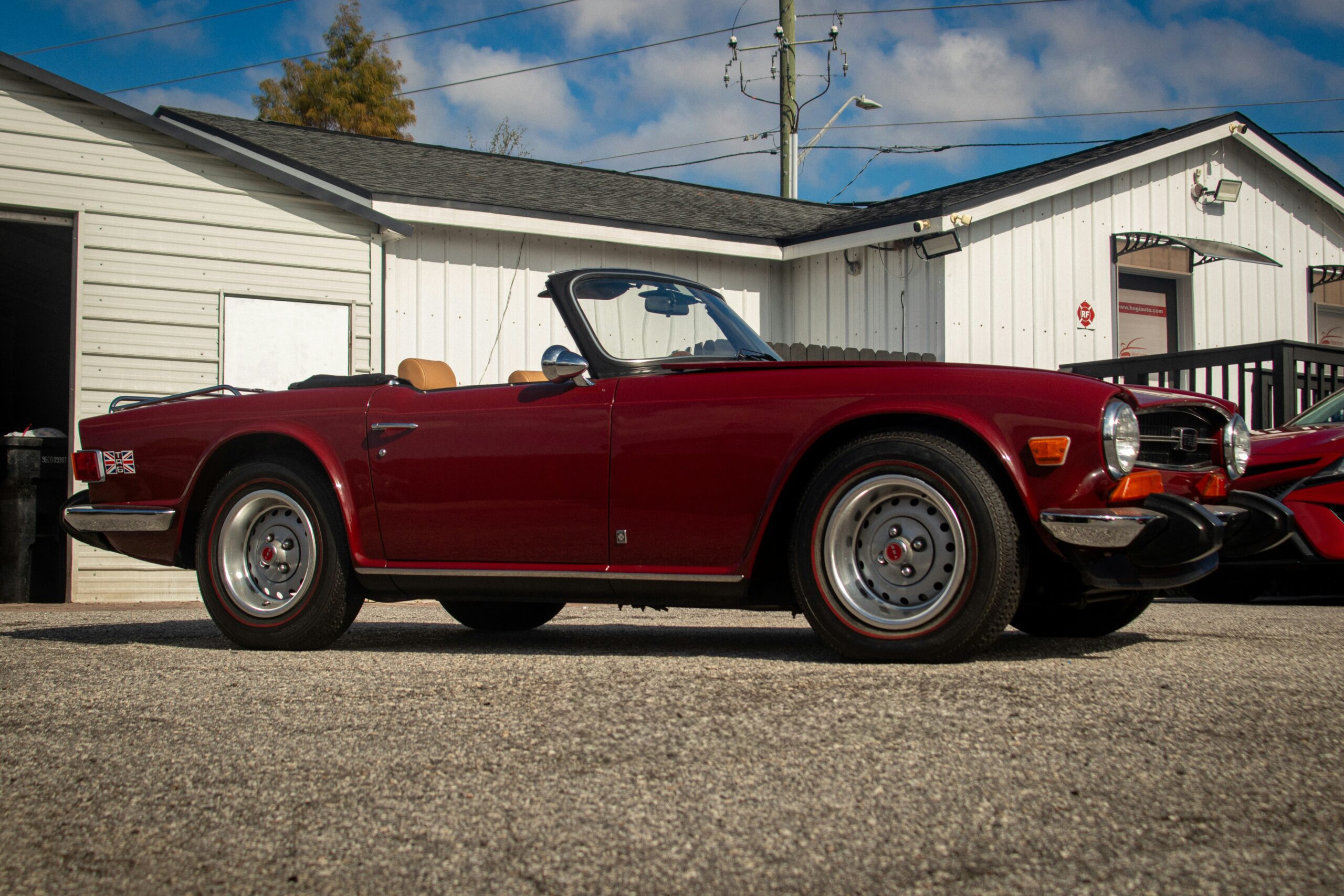
James May once called the Triumph TR6 the blokiest bloke’s car ever built. This is not an insult. It is a precise and accurate description of a car that arrived in 1969 looking as though it had been designed by someone who had grown tired of delicate things and wanted to make something that looked like it could start a fight with a Lotus Elan and win on pure attitude alone. The Karmann-styled body was all flat planes, squared-off corners, and muscular looking haunches. The engine was a torquey 2.5-litre straight-six that sounded magnificent. The driving experience was honest to the point of being blunt. The Autocar, reviewing the car at its launch in 1969, called it the last of the real sports cars. They were right, and they knew it at the time, which makes the TR6 rather more historically significant than its sales numbers alone would suggest.
Those numbers, incidentally, are substantial. A total of 94,619 TR6s were built between 1969 and 1976, making it the best-selling Triumph sports car of them all. The majority, 86,249 in total, went to export markets, most of those to the United States. Only 8,370 were sold in the UK, which is why finding a good right-hand drive example today requires patience. The TR6 that consumes the second-hand market is predominantly left-hand drive, frequently imported, and needs understanding before purchase. This guide covers all of it.
How the TR6 came to exist
The TR6 was not a clean-sheet design. Triumph’s development budget in the late 1960s was not generous, and the TR6 was created by asking the German coachbuilder Karmann to restyle the existing TR5’s body from the centre section outward. The centre section, including the doors, the sills, and the fundamental structure of the car, remained unchanged from the TR4. The nose and tail received Karmann’s treatment: flatter, more angular, more contemporary. The result was a car that looked substantially new while sharing the fundamental architecture of a machine whose chassis lineage stretched back, via continuous evolution, to the TR2 of 1953. The engineers at Triumph were pragmatic people.
What the TR6 inherited from that evolution was a separate chassis with independent rear suspension (introduced with the TR4A) and rack and pinion steering (standard since the TR4). The separate chassis is both the TR6’s greatest advantage and its greatest vulnerability, and understanding it is the single most important thing a prospective buyer can do before viewing any car.
The TR6 also inherited, and was at least partly responsible for the end of, the Austin-Healey 3000. When British Motor Holdings merged with Leyland Motors in the late 1960s, the combined group found itself with two six-cylinder sports cars: the Healey, which was reaching the end of its development cycle and struggling to meet tightening American emissions regulations, and the TR6, which was newer and more compliant. The decision was straightforward, and the Austin-Healey name disappeared from new car production in 1968. For buyers who cannot stretch to a Big Healey today, the TR6 is the closest affordable alternative in character if not in absolute rawness.
The engine: fuel injection, carburettors, and what it means for you
All TR6s used the same fundamental engine: a 2498cc overhead-valve straight-six derived from the 2.0-litre unit found in the Triumph Vitesse and 2000 saloon. It was long-stroke, torquey, and smooth in a way that four-cylinder sports cars of the era were not. Where the TR6 became complicated was in how that engine was fuelled, and the answer depended entirely on which market the car was sold into.
UK and most export market cars received Lucas mechanical fuel injection and produced 150 brake horsepower in the car’s early years. This gave a 0-60 time of 8.9 seconds and a top speed of approximately 118 miles per hour, both of which were impressive figures for a two-seat sports car in 1969. In 1973, UK-market TR6s were detuned to 125 brake horsepower, but changes to how power outputs were measured at that time mean the real-world difference between the two figures is considerably smaller than it sounds.
American market cars received twin Zenith-Stromberg carburettors to meet emissions regulations, producing 104 brake horsepower and a top speed of around 107 miles per hour. This is important for two reasons. First, a US-specification TR6 is a noticeably different car to drive from a fuel-injected example. Second, many US cars have since been imported to the UK, and a left-hand drive TR6 at an apparently attractive price may be a US-specification carburettor car rather than the injected version the uninformed buyer assumed they were purchasing.
The fuel injection system
The Lucas mechanical fuel injection fitted to UK cars has a reputation for unreliability that belongs largely to the past. The stories of TR6s stranded at the roadside on hot days while the injection system vapourised fuel and refused to restart are historically accurate, but they relate to cars in original condition forty or fifty years ago. Almost everything wrong with the Lucas system is now understood and fixable. The most significant improvement available is replacing the original Lucas metering unit with a Bosch equivalent, which is more reliable, less prone to heat soak, and eliminates most of the system’s characteristic problems in one change. When viewing any injected TR6, ask whether this conversion has been carried out. If not, budget for it and factor the cost into your offer.
The original mechanical fuel pump’s rubber diaphragm will also fail with age, accelerated by the ethanol content of modern unleaded fuel. Our fuel system guide covering E10 compatibility is relevant reading here. A pump that has not been replaced or rebuilt is overdue attention on any TR6 of this age.
Engine wear and what to look for
A well-maintained TR6 engine will cover 150,000 miles before needing a rebuild. The cylinder sleeves are removable and replaceable, and all components are available. Blue exhaust smoke on the overrun indicates worn cylinder bores or piston rings. Black smoke from an injected car suggests the fuel injection is running rich, which accelerates bore wear if left unaddressed. These are symptoms rather than death sentences, but they should be reflected in the price.
One specific failure deserves emphasis. The crankshaft thrust washers can wear to the point where they fall out of position. When this happens the crankshaft moves fore and aft in the block, and the engine is almost invariably destroyed in the process. A simple check: with the engine warm, press the clutch pedal firmly and watch for any movement in the engine. Any fore-and-aft rocking indicates thrust washer wear. Walk away or price a full engine rebuild into your offer.
Gearbox, overdrive, and drivetrain
The TR6’s four-speed manual gearbox is not the strongest unit in the car. It was not quite equal to the engine’s torque when new and is considerably less so now. The characteristic failure is worn layshaft bearings, which announce themselves as a rumbling noise in the intermediate gears that disappears once the car is in fourth and the layshaft is unloaded. A gearbox that is quiet in third but noisy in second has bearings on the way out. Rebuilds are straightforward and all parts are available, but the cost should inform your negotiation.
Clutches on the TR6 are not renowned for longevity either. If a replacement is needed, invest in a quality item. A cheap clutch on a TR6 will be replaced again within a few thousand miles, which is an educational experience the first time and an irritating one thereafter.
Overdrive: worth having, worth understanding
Overdrive was an optional extra on the TR6 and one worth actively seeking. It transforms the car for modern road use, dropping the engine revs at motorway speeds to a level where relaxed cruising becomes possible rather than merely theoretical. Two types were fitted over the production run, and they behave differently. The A-type overdrive, fitted to CP, CC, and CR series cars up to commission number CR641, engages on all gears except first. The J-type, fitted to CF and CR series cars from CR567 onwards, engages only on third and fourth. Both work well when serviceable. Overdrive problems are almost always electrical: a failed relay, a faulty solenoid, a poor connection, or insufficient oil in the unit. Check operation in both eligible gears before purchase and have the electrics investigated if it misbehaves rather than assuming the unit itself has failed.
The difference between UK and US final drives
This is one of the most practically significant differences between a UK-specification TR6 and an American import. UK cars have a 3.45:1 final drive ratio. US cars have a 3.71:1 ratio. The higher UK ratio produces notably more relaxed high-speed cruising, better fuel consumption on longer journeys, and a more appropriate character for British roads. An imported US car with the lower ratio will feel busier and will return noticeably worse fuel consumption on motorways. It is not wrong, but it is worth knowing.
What to look for: rust and structure
The TR6 has a separate chassis, which means structural rust is not merely a cosmetic problem: it is a safety issue, a geometry issue, and a very expensive issue when severe. The good news is that repair sections are available and replacement Heritage bodyshells exist for the most extreme cases. The bad news is that a TR6 that has been well undersealed from new can conceal substantial structural corrosion beneath an apparently solid surface. Approach every car with a torch, a magnet, and no romanticism.
The critical areas, in order of structural importance:
- The sills: the most important rust check on any TR6. Check inside and outside, and particularly the joint between sill and floor. Sound metal is rigid metal. Any flexibility when you push on the sill indicates corrosion that needs addressing before the car should be driven.
- The rear axle mounting points: the T-shaped pressing that goes over the top of the rear axle, and the two trailing arm attachment points on either side, are known to rust from the inside outward. The first visible sign is swelling around the bolts. If those bolts let go completely, rectification can involve separating the body from the chassis. Check carefully and treat any swelling as serious.
- Where the rear wings meet the deck: three layers of metal come together at this junction, trapping dirt and moisture with considerable efficiency. It is a tricky area to repair properly given the three-way join. Inspect carefully and protect with wheel arch liners once sorted.
- The chassis crossmembers: the rear suspension mounting points on the chassis are vulnerable, as is the cover plate of the X-cross brace in the centre of the chassis. Get the car on a ramp if at all possible.
- The floor panels: lift the carpets and look. A floor that taps hollow may have rusted from beneath with the surface still superficially intact.
- Panel gaps and chassis sag: the TR6 was never assembled to the most exacting standards, so imperfect panel gaps are normal. What is not normal is door gaps that open up at the B-post. Unlike most open-topped cars, the TR6 carries weight at the rear, and a sagging chassis manifests as widening gaps at the rear of the door aperture rather than the front. Treat this as a significant finding.
- Secondary rust areas: around the headlight edges, around the inside of the tail lights, the top edge of the rear wings, the rear of the boot lid, and the battery box all rust with enthusiasm. Less structurally critical but expensive to address on a car that is otherwise straight.
Buying an imported TR6
Given that 86,249 of the 94,619 TR6s built went to export markets, a significant proportion of the cars available in the UK today have been imported. This is not automatically a problem, but it requires specific awareness.
The most important checks for any imported car: confirm whether it is fuel-injected or carburettor-equipped before viewing, since many buyers arrive expecting the injected UK specification and find a US-spec carburettor car. Establish the final drive ratio. Check whether any modifications have been made to bring the car to UK specification and whether those modifications have been done properly. Confirm that the conversion to right-hand drive, if applicable, has been completed to a professional standard and not improvised. Steering conversions on imported classics range from thoroughly engineered to genuinely alarming.
American rust patterns can differ from UK cars. The southern and western US states produced cars that are often in better structural condition than their UK counterparts, having avoided salt and damp winters. Cars from northern US states or Canada may have rust of a different character: sometimes severe on the underside while the bodywork appears clean, thanks to the widespread use of road salt in American winters. Do not assume an import is rust-free because the paint looks good.
Values and what to pay
The TR6 market softened slightly after its peak in 2023 but remains above pre-2020 levels. Current values for UK cars run broadly as follows: rough projects and restoration candidates between £3,000 and £12,000; usable drivers in honest condition between £12,000 and £18,500; excellent examples where imperfections take some finding between £18,500 and £25,000; concours cars above £25,000. The average recorded sale price from recent data sits at approximately £15,600, which provides a useful reference for the middle of the market.
Fuel-injected cars command a premium over carburettor equivalents. Overdrive cars command a premium over non-overdrive. Right-hand drive UK-specification cars command a premium over left-hand drive imports in the UK market. A car with documented history and a known ownership record commands a premium over one without. These are all logical and defensible premiums. Pay them for the right car rather than saving money on one where the history is vague.
Check current market values with our classic car price checker, which shows live eBay listings alongside estimated values by condition grade so you can see what cars are changing hands for right now.
Ownership: clubs, parts, and support
The TR6 is one of the best-supported classic cars available at any price. Club Triumph provides technical resources, a spares scheme, and a community of owners with accumulated knowledge about every problem the car can develop. Parts availability is excellent across the full range of mechanical, electrical, and body components, and Heritage bodyshells are available for the most ambitious restorations. The TR6 Drivers Club specialises specifically in the model and is particularly useful for those new to TR6 ownership.
The TR6 is mechanically straightforward and well-suited to competent home maintenance. Our springtime safety check guide covers the annual inspection sequence, our electrical fault finding guide is relevant given the Lucas electrics, and our classic car insurance guide covers what to look for in a specialist policy. Our history of Triumph article covers the wider story of the company that built this car.
Verdict
The TR6 is a car that makes no attempt to disguise what it is. It is a separate-chassis, body-on-frame, rear-wheel drive British sports car with a straight-six engine, a four-speed gearbox, and no interest whatsoever in being refined, comfortable, or apologetic about any of this. What it offers in return is an honest, involving driving experience, one of the best engine sounds available from a classic British car, and the practical advantages of a model produced in sufficient numbers that finding parts is straightforward and finding expertise is easy.
Buy the best rust-free structure you can find. A TR6 with a sound chassis and questionable cosmetics is a project with a finish line. A TR6 with beautiful bodywork and structural corrosion is a project that will cost considerably more than you planned, take considerably longer than you anticipated, and involve at least one conversation with a specialist about separating the body from the chassis that you will not enjoy. The engine, gearbox, and mechanical components are well-supported and manageable. The structure is where the TR6 will either reward you or educate you. Choose accordingly.
This page contains affiliate links. If you click a link and make a purchase, Classic Car Hub may earn a small commission at no extra cost to you.