
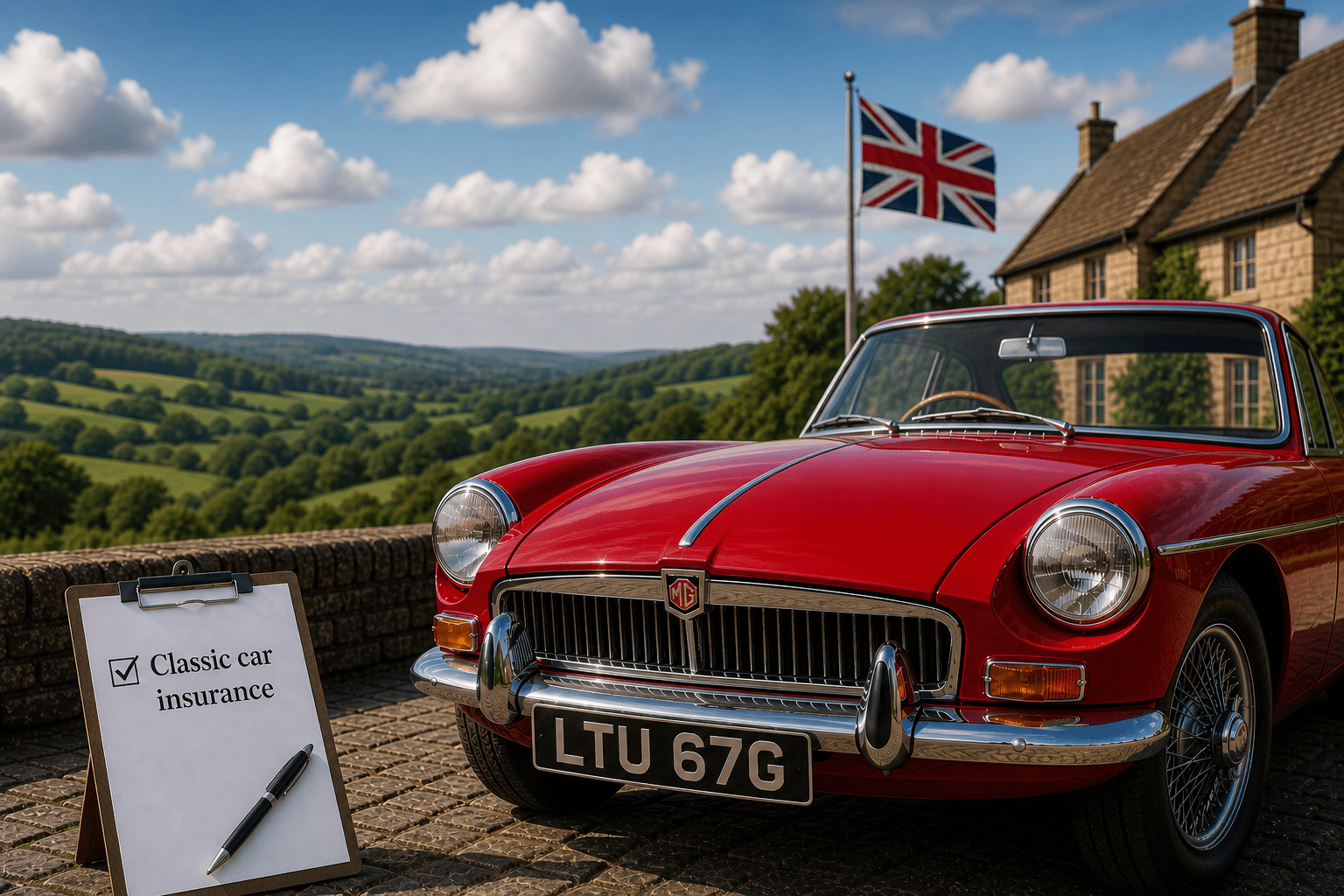
Car insurance is nobody’s favourite subject. It sits in the same category of necessary adult activities as filling in tax returns and attending meetings that could have been an email. But classic car insurance is, quietly and against all reasonable expectation, rather more interesting than the ordinary kind. It is also considerably more important to get right, because the difference between a good classic car policy and a bad one is not merely a matter of a few pounds on the premium. It is the difference between being properly compensated when something goes wrong and discovering, at the worst possible moment, that your insurer has assessed the current market value of your restored 1972 MGB at what it would have fetched in a barn sale in 2003. This guide exists to help you avoid that particular discovery.
Why classic car insurance is different
Mainstream car insurance operates on the principle of market value. If your modern hatchback is written off, the insurer pays what a broadly equivalent car would cost to buy at the time of the claim. Depreciation, condition, and the general direction of the used car market all factor in. For a modern car this is usually a reasonable approximation of what you actually need to replace it. For a classic car it is frequently a disaster.
Classic cars do not depreciate in the conventional sense. Many of them appreciate. A well-restored MGB that cost you twelve thousand pounds and has since risen in value to eighteen thousand is not going to be usefully compensated at market value if the insurer’s idea of market value is what the last tired example sold for on an auction site. This is why classic car specialists use agreed value policies instead.
Agreed value insurance
An agreed value policy is exactly what it sounds like. Before the policy is issued, you and the insurer agree on the value of the car. In the event of a total loss, you receive that agreed amount. No arguments, no market surveys, no insurer ringing round to find the cheapest comparable example currently listed on a classic car website in Cornwall. The agreed sum. This is not a premium product available only to collectors with concours-winning show cars. It is the standard approach among specialist classic car insurers and it is what every classic car owner should have.
Setting the agreed value correctly is your responsibility. Underinsure and you receive less than the car is worth. Overinsure and you are paying more premium than you need to. Obtain a current valuation from a marque specialist, check recent sales at auction and through dealers, and use our free classic car price checker to get a sense of current UK market values before agreeing a figure with your insurer. Review the agreed value annually. Classic car values move, sometimes significantly, and a figure agreed three years ago may bear little resemblance to what your car would actually cost to replace today.
Road use insurance
A road use classic car policy covers the car while it is being driven on public roads, as one might reasonably expect. What varies considerably between policies is what else it covers, and the details matter.
Limited mileage policies
Most classic car owners do not use their cars as daily transport. The classic sits in the garage through winter, comes out for weekends and shows from spring to autumn, and accumulates perhaps two or three thousand miles in a good year. Mainstream insurers charge premiums calculated on the assumption that a car is used regularly throughout the year. Classic specialist insurers offer limited mileage policies that reflect how these cars are actually used, and the premium reduction can be substantial.
Typical mileage bands offered by specialist insurers include 1,500 miles, 3,000 miles, 5,000 miles, and occasionally 7,500 miles per year. The lower the declared mileage, the lower the premium, because the statistical relationship between miles driven and the probability of a claim is well established. A car driven 1,500 miles a year is simply not exposed to road risk in the same way as one covering 15,000. Choose the mileage band honestly and accurately. Declaring 1,500 miles when you regularly attend shows across the country and drive to Scotland each summer is not a saving: it is a reason for your insurer to decline your claim when something goes wrong. Chose the band that genuinely reflects your typical usage, then add a modest margin for the unexpected.
Some insurers offer mileage verification by odometer photograph at the start and end of the policy year. Others operate on a declaration basis. Either way, keeping a simple mileage log in the glovebox costs nothing and provides clear evidence that you stayed within the declared limit if the question ever arises.
What a good road use policy should include
Before accepting any policy, check it covers the following. Some are standard, others vary by insurer and some are optional extras that are worth paying for.
- Agreed value settlement on total loss: as discussed above. Non-negotiable.
- Salvage rights: if the car is written off, do you have the right to retain the salvage? On a classic car with rare or valuable components, retaining a written-off car can be worth considerably more than the scrap value the insurer would otherwise pocket. Check the policy wording carefully.
- European cover: if you ever drive the car abroad, does the policy extend to European roads? Many classic owners take their cars to France for touring or to continental shows. Check the territory of cover and the minimum level of protection provided outside the UK.
- Breakdown and recovery: some specialist classic policies include breakdown cover or offer it as an add-on. A specialist recovery service that understands classic cars and will not drag yours onto a flatbed with a winch and a general attitude of indifference is worth having.
- Laid-up conversion: can the policy be converted to laid-up cover during the winter months without cancellation fees? More on this below.
- Legal expenses: covers the cost of legal representation in the event of an accident that is not your fault. Often inexpensive to add and occasionally very useful.
- Club and show cover: does the policy cover the car while on display at a show or club event? Most classic specialist policies do include this, but check rather than assume.
Winter storage and laid-up insurance
Many classic car owners store their cars over winter. The British climate between October and March is not the natural habitat of a 1969 Triumph Spitfire, and anyone who has spent a January afternoon scrubbing road salt out of a chrome bumper will understand why the garage beckons. A car in winter storage is not being driven, which means it is not exposed to road risk, which means the full road use premium is paying for cover you are not using. This is where laid-up insurance comes in.
Laid-up insurance, sometimes called storage insurance, covers the car while it is off the road and not in use. It provides fire and theft cover and usually covers malicious damage and weather-related events such as a tree falling on the garage. What it does not cover is any incident involving the car being driven on a public road, because the car is declared off the road and is not supposed to be driven on a public road. A SORN (Statutory Off Road Notification) is required by the DVLA for any vehicle kept off public roads, unless it is kept entirely on private land. A laid-up policy and a SORN are not the same thing: the SORN is a legal declaration to the DVLA, the laid-up policy is the insurance cover while in that state. You need both.
The cost of laid-up insurance is considerably less than a full road use policy, typically somewhere between thirty and fifty percent of the road use premium depending on the insurer and the car’s agreed value. The saving over a five or six month storage period is meaningful. Many specialist classic insurers allow you to switch between road use and laid-up cover within the same policy, sometimes by a simple phone call or online request, without cancellation or administration fees. This flexibility is one of the genuine advantages of specialist insurers over mainstream providers, who are often baffled by the concept entirely and may require a new policy to be issued, which is both inefficient and occasionally expensive.
One thing to check before laying the car up: does the laid-up policy cover the car while being moved within private land, such as from the garage to the driveway for a wash? Some policies specify the car must be in a locked building at all times. Others are more flexible. Read the wording rather than assuming. Our winter storage guide covers the practical side of laying a classic up for the cold months, including what to do before switching to laid-up cover.
How to reduce your premiums
Classic car insurance is already considerably cheaper than mainstream cover for most owners, largely because the risk profile is so much lower. A car driven three thousand miles a year by an experienced owner who keeps it garaged and maintains it carefully is not the same risk as a car driven thirty thousand miles a year by whoever happens to be named on the policy that week. The following measures can reduce the premium further without compromising the cover.
- Club membership: membership of a recognised marque club or classic car organisation often qualifies for a direct discount with specialist insurers. The discount is not enormous, typically five to ten percent, but it costs nothing when you are already a member and every saving adds up. If you own an MGB, for example, membership of the MG Owners Club or the MG Car Club is both useful for technical support and marginally good for the insurance bill. A reasonable combination.
- Accurate mileage declaration: declare the mileage you actually drive rather than the highest available band. If you genuinely drive fewer than two thousand miles a year, declare that honestly and take the appropriate band. Do not pad it unnecessarily on the grounds that you might occasionally drive a bit further. The appropriate band for occasional extra miles is the next band up, not the highest option available at maximum cost.
- Correct security: a garaged car costs less to insure than one kept on a driveway, which costs less than one kept on the street. If the car lives in a locked garage, say so explicitly when obtaining quotes. A Thatcham-approved alarm or immobiliser may qualify for a further reduction. A tracker device qualifies for a reduction with some insurers and provides genuine peace of mind on a valuable car.
- Named drivers only: an any-driver policy costs more than one restricted to named drivers. If the car is driven by one or two people and nobody else, restrict the policy accordingly. An any-driver policy on a classic car driven exclusively by its owner is paying for flexibility that will never be used.
- Pay annually: monthly payment plans for insurance premiums typically involve an interest charge that adds between ten and twenty percent to the annual cost. Pay the full premium annually and avoid this. If the annual premium is a significant sum, factor it into the overall ownership budget rather than spreading it monthly at additional cost.
- Accurate agreed value: overinsuring does not pay. Insurers will not pay more than the market value of a car regardless of what the agreed value states, in most cases. Setting an agreed value significantly above what the car would actually sell for in the current market inflates the premium without providing corresponding benefit.
Choosing a specialist broker
The single most effective thing you can do to get the right classic car insurance is to use a specialist broker rather than a mainstream comparison site. This is not anti-competitive sentiment. It is a straightforward observation that a comparison site optimised for selling annual cover on Ford Fiestas is not the natural home of nuanced conversations about agreed value, laid-up conversion, and salvage rights on a 1973 Ford Capri.
Specialist classic car insurers and brokers understand the market they are operating in. They know that a car’s agreed value may be higher than its purchase price. They know what a limited mileage policy is without requiring an explanation. They know the difference between a daily driver and a show car, and they price accordingly. The premiums are often lower than mainstream equivalents for the same level of cover, because the risk profile is genuinely understood rather than fed through an algorithm designed for commuters.
Well-regarded specialist classic car insurers and brokers in the UK market include Adrian Flux, Footman James, Hagerty, ClassicLine, and Lancaster Insurance. Each has its own strengths and it is worth obtaining quotes from more than one to compare both price and the specific policy terms. The cheapest premium is not always the best value: a policy that pays an agreed value and includes salvage rights is worth more than one that does not, even if it costs slightly more.
Before calling any broker, have the following information to hand: the car’s make, model, and year; its current agreed value with justification if it has been recently restored; your annual mileage; where the car is kept overnight; any modifications; your no-claims history; and the names of any additional drivers. Having this ready makes the conversation considerably more efficient and ensures the quote you receive is accurate rather than a rough estimate that changes when the full details emerge.
A note on modifications
Modifications must be declared to your insurer. All of them. A period-correct upgrade that improves the car’s value, such as a professionally rebuilt engine to a higher specification or roller rockers as part of a sympathetic tune, adds to the agreed value and should be reflected in it. A modification that affects the car’s performance or safety characteristics must be declared regardless of whether it increases or decreases the premium. Failing to declare a modification is grounds for a policy to be voided at the point of claim, which is expensive timing for a discovery. If in doubt, declare it. The consequences of not declaring are considerably worse than the consequences of declaring something that turns out to make no difference to the premium.
Important notice
The information in this article is provided for general guidance only and does not constitute regulated financial or insurance advice. Every owner’s circumstances are different, and the appropriate cover for your car, your usage, and your situation may differ from the general principles described here. Always obtain quotes from regulated insurers and brokers, read policy documents in full before purchasing, and seek independent advice if you are unsure about any aspect of your cover. Classic Car Hub is not authorised by the Financial Conduct Authority to provide regulated insurance advice.
This page contains affiliate links. If you click a link and make a purchase, Classic Car Hub may earn a small commission at no extra cost to you.