
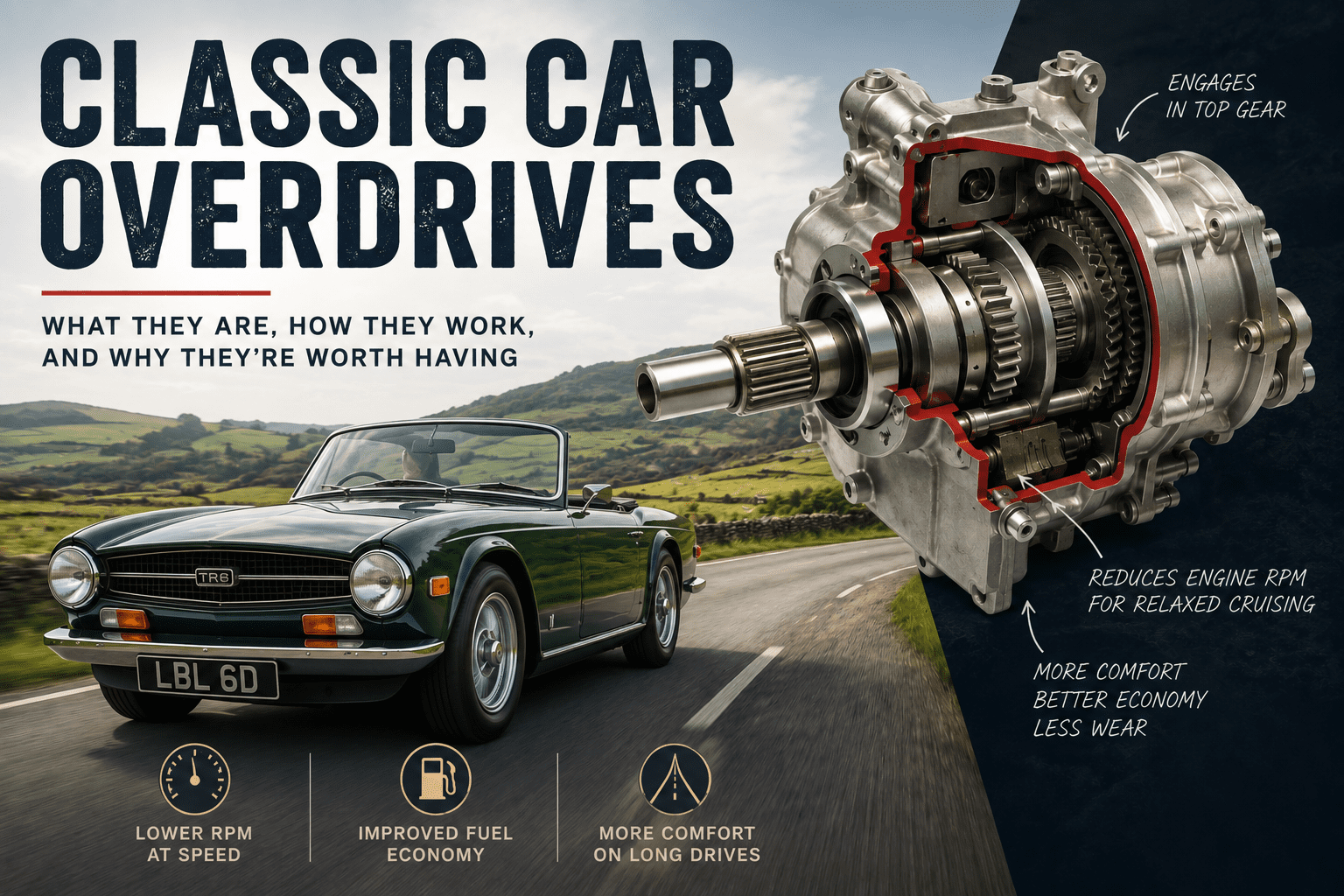
At some point in the ownership of a Triumph TR, an MGB, a Dolomite Sprint, or a Big Healey, someone will casually mention that the car would be significantly more pleasant on a motorway if it had overdrive. They will say this in the tone of someone who has made a discovery. If the car already has overdrive, the owner in question will smile. If it does not, the owner will spend the next few weeks reading about the Laycock de Normanville epicyclic overdrive unit and wondering whether that is as complicated as it sounds. It is not. It is one of the most elegant solutions to a genuine problem that the British engineering industry produced in the twentieth century, and understanding how it works makes owning one considerably more rewarding.
The problem the overdrive solves is straightforward: most classic British cars were designed before the motorway network existed, with gearbox ratios suited to the road speeds of the 1950s. An engine running at 4,000 rpm at 70 miles per hour on a motorway is not being damaged by the experience, but it is working harder than necessary, generating more noise than necessary, and consuming more fuel than it would at 3,000 rpm covering the same ground. The overdrive reduces engine speed by approximately 20 to 28 percent at any given road speed, without changing gear. The result is quieter, more relaxed motorway cruising, improved fuel economy, and an engine that arrives at the destination having worked less hard than one without overdrive. It also impresses passengers, which is a benefit that the Laycock Engineering sales literature from 1955 was too restrained to mention but which is entirely real.
Edgar de Normanville and how it came to be
The Laycock de Normanville overdrive was invented in 1948 by Edgar de Normanville, an engineer who was also a motoring correspondent for The Motor magazine and The Daily Express. The combination of technical knowledge and journalistic sensibility produced a man who understood both how to make something work and how to explain why it mattered, which may explain why the overdrive was so well articulated to the buying public. De Normanville licensed the design to Laycock Engineering of Sheffield, who manufactured the units and supplied them to British car manufacturers as a factory option throughout the 1950s, 1960s, and 1970s. The last units were supplied to Volvo, who remained enthusiastic customers long after the British manufacturers had stopped specifying them, eventually taking over a million units before the design was finally retired.
How it works
The Laycock overdrive is a self-contained epicyclic (planetary) gearbox bolted to the back of the main gearbox and ahead of the propshaft. An epicyclic gearset uses a central sun gear, planet gears rotating around it, and an outer annulus (ring gear) to achieve different ratios depending on which element is held stationary and which is driven. In the overdrive engaged state, the sun gear is held and the planet gears walk around it, driving the annulus at a higher speed than the input shaft. In direct drive, all the elements rotate together as a solid unit and the ratio is 1:1.
The mechanism that switches between these states is hydraulic, and the hydraulic pressure comes from a small pump driven by the overdrive unit’s own output shaft. This pump pressurises the gearbox oil to approximately 400 to 450 psi and stores it in an accumulator within the overdrive casing. The oil pressure is therefore always available whenever the car is moving, charged and waiting. When the driver operates the overdrive switch, an electrical solenoid opens a valve, releasing the stored oil pressure to operate pistons that engage a cone clutch. The cone clutch locks the sun gear, and the epicyclic gearset produces the overdrive ratio. The whole operation takes less than half a second.
The electrical switch controls the solenoid, not the clutch directly. This is an important distinction: what feels like a simple electrical on-off switch is actually triggering a hydraulic event through an electrical valve. The mechanical work is done by oil at high pressure; the electrical system only opens the door. This explains why a low oil level prevents engagement even when everything electrical is working correctly: there is no pressure to operate the pistons.
The types: which car has which unit
Four main types of Laycock overdrive are encountered on classic British cars, and identifying which type is fitted matters for both maintenance and fault finding. The simplest identification method is the position of the solenoid: units with the solenoid on the right-hand side of the casing are A-type or D-type; units with the solenoid on the left are LH-type or J-type.
A-type: the original and longest-serving unit, fitted to the Triumph TR2, TR3, TR3A, TR4, TR4A, TR5, TR250, and TR6 (until approximately 1972), the Austin-Healey 3000, the Triumph Herald and Vitesse, and various Jaguar models. The A-type operates on second, third, and fourth gears on most TR applications, effectively giving the car seven forward ratios. Solenoid on the right. There are five sub-variants of the A-type with minor internal differences, but the external identification and maintenance procedure is the same across all.
D-type: a more robust unit used on the MGB Mark 1 from 1962 to 1967 (the three-synchromesh gearbox period) and early Volvos. Solenoid on the right, externally visible rather than under a cover plate. Operates on third and fourth gears on the MGB application.
LH-type: the most robust Laycock unit, fitted to the MGB from 1968 to 1976 (the four-synchromesh gearbox period). Available in Black Label and Blue Label variants, identified by a label beneath the solenoid. Solenoid on the left. Operates on third and fourth gears. The LH-type is the unit most often encountered on MGBs today, as the later four-synchro cars are more numerous than the early three-synchro examples.
J-type: standardised across all Triumph products from 1974, including the Spitfire (from commission number FH60000), all Dolomites, later 2000 and 2500 models, the late TR6, and the Stag. Solenoid on the left. More compact than the LH-type with a similar operating principle. The J-type gives an overdrive ratio of approximately 0.72:1, representing a 28 percent reduction in engine speed at any given road speed. This is one of the more significant overdrive ratios available and produces a correspondingly noticeable change in the driving experience when engaged.
Which gears does overdrive operate in?
The overdrive does not operate in all gears, and engaging the switch in the wrong gear does nothing. The inhibitor switch on the gearbox prevents engagement in the gears where the manufacturer did not intend it to be used: typically first gear and reverse, and on some applications second gear also. On TR applications with the A-type, overdrive operates in second, third, and fourth. On MGB applications with the LH-type, it operates in third and fourth only. On J-type Triumph applications, third and fourth.
The practical consequence for driving is that the overdrive switch can be left in the on position while working through the gears, engaging automatically when the appropriate gear is selected. Many drivers leave the switch permanently on and treat the overdrive as a higher ratio that the gearbox logic manages. On applications where overdrive operates in third gear, this effectively means a six-speed car: third, third overdrive, fourth, fourth overdrive, with the switching handled by the column-mounted switch rather than the gear lever.
The driving experience
Engaging a correctly functioning overdrive is a small but satisfying moment. The switch operates, the unit engages within half a second, and the engine note drops noticeably as the revs fall. On a TR6 at 70 miles per hour without overdrive, the engine is running at approximately 3,600 rpm. With the J-type overdrive engaged, that figure drops to around 2,600 rpm. The car is quieter, the engine feels more relaxed, and the steering lightens slightly as the mechanical drag reduces. It is the feeling of a car that has found the gear it was always looking for.
Disengaging is equally clean. The switch off, the clutch releases, and within half a second the direct drive is restored and engine revs rise to match road speed. On a car with a properly maintained overdrive, the transition in both directions is immediate and smooth. On one that needs attention, the hesitation, slip, or failure to engage that precedes a fault finding session begins here.
Overdrive versus five-speed conversion
The classic alternative to a factory overdrive on classic British cars is a five-speed gearbox conversion, usually using a Rover SD1 five-speed or a Toyota or Ford unit adapted to fit. These conversions are competent and produce a genuinely usable result. The overdrive still beats them in one meaningful respect: the fifth gear ratio in a typical five-speed conversion sits at approximately 0.80:1 or 0.82:1. The J-type overdrive gives 0.72:1. That additional ratio reduction is not theoretical: at 70 miles per hour on a TR6, the difference between a five-speed fifth and J-type overdrive is approximately 300 to 400 rpm, audible and measurable in fuel consumption on a long run.
The overdrive also has the advantage of being entirely period correct and mechanically appropriate to the car, which matters for concours and originality-focused owners. A five-speed conversion is a modification; overdrive is a factory option. Both solve the same problem. The overdrive solves it more completely at the top end.
Maintenance
The overdrive and the gearbox share the same oil in all Laycock applications, which means the overdrive oil level is checked and changed via the gearbox filler and drain plugs. This shared oil arrangement is both convenient and important: the oil that lubricates the gearbox is also the oil that the overdrive pump uses to generate its working pressure, and keeping it clean and at the correct level is the primary maintenance requirement.
Oil specification matters more than it does for a simple gearbox. Do not use straight gear oil (GL4 or GL5) in any Laycock overdrive unit: the high sulphur content in GL5 especially attacks the yellow metal (brass and bronze) components in the overdrive and causes progressive damage. The correct lubricant for A-type and J-type units is engine oil, typically SAE 30 non-detergent or a good quality 10W-40 in colder climates. The MGB LH-type units have historically been run on 20W-50 engine oil, and some specialists recommend adding a small quantity of automatic transmission fluid (ATF) to the gearbox oil on LH units where the cone clutch is known to be prone to sticking.
Change the oil every 12,000 miles or annually, whichever comes first. When the oil is drained, clean or replace the internal strainer or filter that sits in the base of the overdrive unit: it collects metallic particles and degraded oil residue, and a blocked strainer restricts oil flow to the pump. This is not a difficult task and is often overlooked, but a clean strainer is part of the reason some overdrives run reliably for decades while others develop hydraulic problems. For the complete fault finding procedure when things do go wrong, see our companion Classic Car Overdrive Fault Finding guide.
Adding overdrive to a car that does not have it
Retrofitting overdrive to a car that was built without it is possible on most applications where overdrive was a factory option. For TR2 through TR6 owners, complete overdrive gearboxes appear regularly at autojumbles and through the Triumph Register and TSSC, and the fitment procedure is well documented by both clubs. For MGB owners, the same applies through the MG Car Club and the specialist MGB parts suppliers. The main requirements are the overdrive gearbox itself, the correct propshaft for the overdrive gearbox output flange dimensions, the wiring loom modifications to add the switch circuit, and the overdrive switch. The conversion is a worthwhile afternoon for anyone who drives their car on A-roads and motorways regularly and has not yet discovered why overdrive owners smile when the subject comes up.
For related reading: our Classic Car Overdrive Fault Finding guide covers systematic diagnosis for every overdrive symptom, our Triumph TR6 buyers guide covers the car on which the overdrive most transforms the ownership experience, our MGB buyers guide covers the most numerous classic British car fitted with an LH-type unit, and our gearbox and differential oil guide covers the oil specification in more detail alongside other drivetrain lubrication requirements.
This page contains affiliate links. If you click a link and make a purchase, Classic Car Hub may earn a small commission at no extra cost to you.