
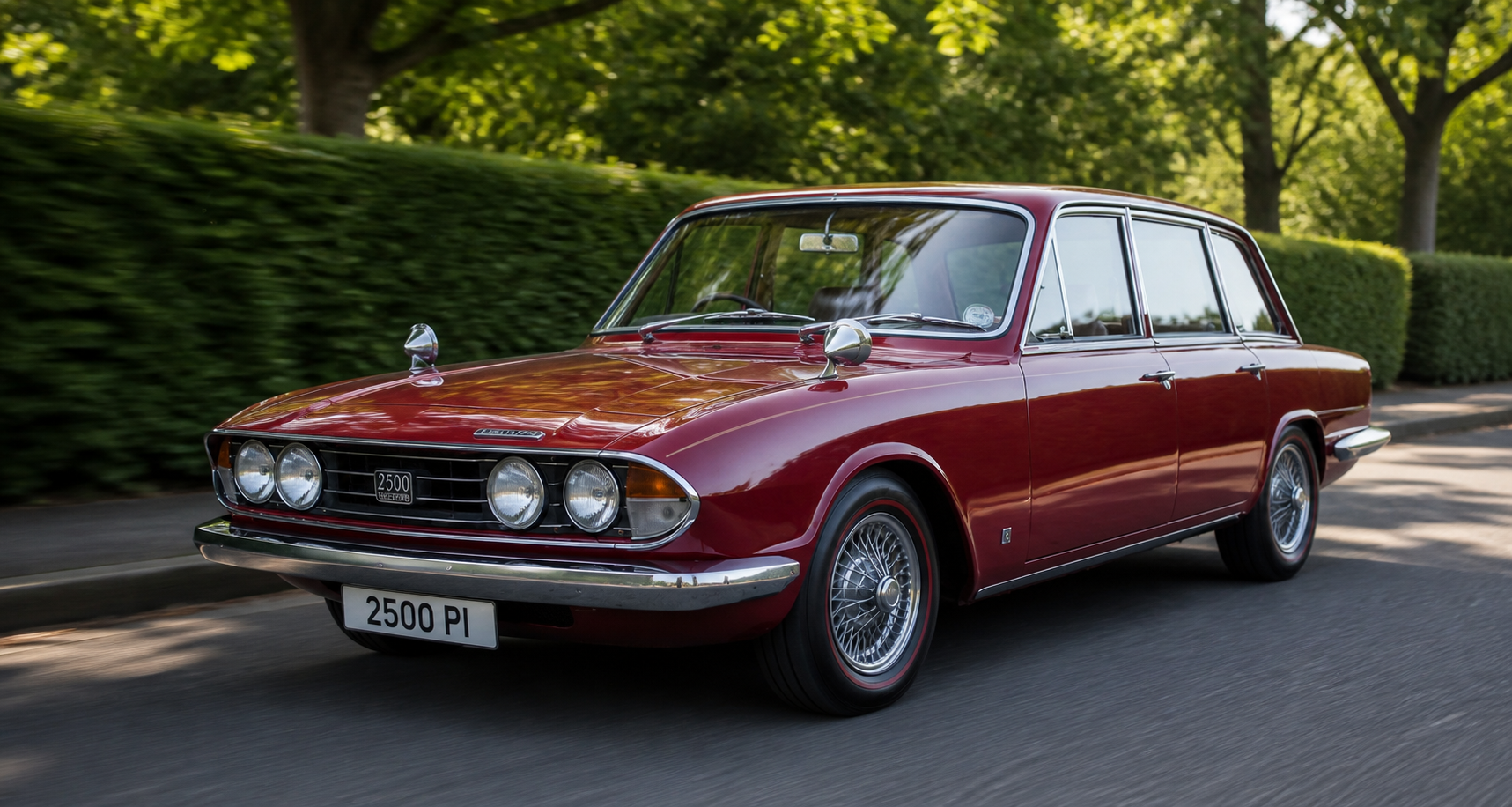
The Triumph 2.5 PI is one of those cars that almost nobody outside the classic car world has heard of and almost everybody inside it has a strong opinion about. It is a large, comfortable, rear-wheel-drive six-cylinder saloon that was simultaneously Britain’s most sophisticated family car and its most reliably unreliable one. It ran petrol injection at a time when most British cars were still coming to terms with the idea of reliable windscreen washers. It finished second and fourth in the 1970 London to Mexico World Cup Rally, one of the most brutal motorsport events ever conceived, covering over 16,000 miles across three continents. And its fuel pump was adapted from a windscreen wiper motor. These things are all true.
The case for the prosecution, and the defence
Let us be honest about the 2.5 PI from the start, because buying one without a clear view of what you are getting into is not something we would wish on anyone. The Lucas mechanical fuel injection system that gives the car its name and its performance was genuinely ground-breaking. Triumph launched the 2.5 PI in October 1968 as Britain’s first fuel-injected family saloon (the TR5 had preceded it as the first fuel-injected British production car overall, but that was a sports car, and this was something for the morning school run and the long drive to Scotland). Impressive. Pioneering. Absolutely subject to vaporising its fuel pump on a warm day and leaving you stranded in a layby outside Stafford wondering what you have done with your life.
The fuel pump in question runs at over 110 psi and was, if you are sitting comfortably, adapted from what was originally a windscreen wiper motor. It did not cope especially well with sustained high pressures in warm ambient temperatures. This was known. If you are the sort of person who finds this charming rather than alarming, you are going to enjoy the 2.5 PI considerably. If you are not that sort of person, there are other options in our guide to choosing your first British classic.
The engine and injection system
The 2.5 PI engine is a 2,498cc straight-six with an overhead valve configuration and a long stroke (74.7mm bore, 95mm stroke), producing 132bhp at 5,450rpm in original Mk1 form. Torque is 153lb/ft at 2,000rpm, which is a very healthy figure for a six-cylinder saloon of the late 1960s and the reason the car feels as muscular as it does in use. Zero to sixty was around 10 seconds. Top speed was approximately 110mph. In 1968 this was rapid for a family saloon, and the comparison with the contemporary Rover P6 2000TC, which could only manage four cylinders and a lower top speed, was not lost on the motoring press, who gave the PI a thorough and largely favourable reception.
The Lucas Mk2 mechanical fuel injection system is a multipoint mechanical arrangement with a separate injector for each of the six cylinders and a complex vacuum-controlled metering unit governing fuel delivery based on engine load. It is sophisticated, it works well when properly set up, and it requires a specialist to set up properly. That last point is not a minor qualification. Triumph’s own service notes instructed technicians not to attempt adjusting or opening the metering unit and recommended simply replacing it instead, which was fine as a solution, provided the replacement unit was correctly calibrated, which was not always a safe assumption. Welcome to late 1960s British Leyland quality control.
In 1973, the camshaft was revised to a milder profile shared with the contemporary TR6 PI, which trimmed peak power slightly but improved tractability and reduced the rough idle that had been a persistent criticism of the earlier engine. Cars from 1973 onwards are generally considered more pleasant to live with. The injection system was dropped entirely when the 2.5 PI quietly disappeared from showrooms in April 1975, replaced by the twin-carburettor 2500S the following June.
The good news, all these years later, is that the PI injection system is now reasonably well understood. Specialists including the Triumph 2000 Register can point you towards competent technicians, and the community knowledge of how to maintain and restore the system is considerably more developed than it was when these cars were new. It is still not something you fix with a Haynes manual and an optimistic attitude. But it can be made to work reliably with proper attention.
The body and the chassis
The Triumph 2000 on which the 2.5 PI is based launched in October 1963, styled by Giovanni Michelotti and immediately recognised as one of the best-looking British saloons of its generation. The original Mk1 shape is elegant and restrained. The Mk2, which arrived in October 1969, extended the body slightly and adopted a front end treatment that anticipated the Triumph Stag, giving it a more assertive appearance. Both are good looking cars. Both rust.
The 2.5 PI uses a unitary monocoque body with independent suspension all round: MacPherson struts at the front and semi-trailing arms at the rear, all on coil springs. The handling is more competent than the car’s executive saloon image might suggest. Rack and pinion steering, servo-assisted front disc brakes, and a suspension setup that was genuinely well engineered for the period produces a car that can be driven with real enthusiasm on the right road. Given that the car weighs around 1,220kg and is producing 132bhp, there is more than enough performance to make the most of it.
The brakes, and a useful footnote
The 2.5 PI’s front disc brake setup deserves a specific mention, not merely because it works well (it does, with the servo providing a pleasingly progressive pedal), but because the Girling calipers fitted to the 2000 and 2500 range were larger and more capable than those fitted to many of Triumph’s other models of the period. The front brake assemblies from the 2000 and 2500 range became a popular donor upgrade for owners of smaller Triumph models including the Herald, Vitesse, and various TR models looking for improved stopping power beyond what their standard equipment could provide. If you own a Triumph Herald or Vitesse, there is a reasonable chance the person who owned it before you spent time researching exactly which 2000 series brakes would fit. The 2.5 PI, in other words, donated its stopping ability to half of Triumph’s range. That is either a testament to the quality of the engineering or evidence that the smaller Triumphs needed all the help they could get, depending on your point of view.
The rear brakes are drums, which was entirely conventional for the period and remains perfectly adequate for road use. The front disc, rear drum arrangement is also shared with the Triumph Spitfire and the GT6, making brake components relatively straightforward to source through suppliers including Rimmer Bros and Canley Classics.
Mk1 or Mk2?
The Mk1 2.5 PI was produced for barely a year, launching in October 1968 and giving way to the Mk2 in October 1969. The Mk1 is therefore considerably rarer in PI form than the Mk2 and commands a premium for that reason. Mechanically the two are similar though the Mk2 incorporated various detail improvements. The longer Mk2 body is generally considered the better resolved of the two but the Mk1’s cleaner lines have their devotees, and a good Mk1 PI in original condition is a genuinely rare car. If you are offered one at a surprisingly reasonable price, ask why.
The estate variant of both generations is rare and highly sought after. The PI estate combines the mechanical interest of the injection system with practicality that the saloon cannot match. If you find a clean original PI estate with a documented history, buy it immediately and worry about the logistics later.
What to look for
Rust
The 2.5 PI uses monocoque construction and rusts in the places that monocoque construction always rusts. Sills are structural and the most critical area: check both inner and outer sill sections carefully, probing firmly at the lower edges and the ends. Floor pans deteriorate where water sits under carpets from deteriorated door seals or windscreen seals. The front inner wings rot around the base and near the suspension mounting points. Check the rear wheel arches and the boot floor around the spare wheel well. None of this is unusual for a British car of the period, but on a car where the mechanical restoration is already going to be interesting, buying one with serious structural rust as well is a commitment that deserves very careful thought.
The injection system
This is where you spend your attention before anything else. The injection system must be assessed by someone who understands it; a general classic car mechanic will not suffice. The engine should start without excessive cranking, idle reasonably evenly when warm, and pull cleanly through the rev range without hesitation or hunting. A rough idle on a cold engine that clears once warm is characteristic. A rough idle that persists when warm, or stumbling under load, indicates injection work is needed.
Listen for the constant background drone of the high-pressure fuel pump at idle. It should be present and steady. Silence means the pump has failed. An intermittent tone suggests a pump that is marginal. Check the fuel filter service history, as the system is sensitive to contamination and a blocked filter starves the metering unit of clean fuel, which causes all manner of running problems. Ask specifically about when the filter was last changed and treat vague answers with appropriate scepticism.
Converting a tired 2.5 PI to carburettor induction is technically straightforward and many cars have been modified in this way over the years. A converted car will run more reliably and cost less to maintain. It will also be worth considerably less than a correctly running original injection car and is philosophically missing the point of buying a 2.5 PI in the first place. If you want a twin-carburettor Triumph 2500, there are plenty of those available. Decide which you are buying before you start looking.
Cooling system
The 2.5 PI engine runs warm and the cooling system needs to be in good order to keep it there. Watch the temperature gauge throughout any test drive. A thermostat or water pump past its best will cause overheating, and an overheated 2.5 PI engine is not a cheap problem. Our cooling system maintenance guide covers what to inspect and how to maintain it properly.
Overdrive and gearbox
The four-speed manual gearbox should change cleanly through all four gears. The Laycock de Normanville overdrive, where fitted, is worth seeking out for modern road use and transforms the car’s motorway character. Check that overdrive engages and disengages cleanly at speed. An automatic gearbox was also offered (the Borg-Warner Type 35 three-speed), and while perfectly serviceable, it removes some of the engagement that makes the 2.5 PI interesting to drive. The manual with overdrive is the combination to find. The conversion to electronic ignition is a straightforward and worthwhile improvement on any car where the original points ignition has been allowed to deteriorate.
What to pay
The 2.5 PI market has been gradually appreciating as the cars become better understood and the supply of original injection examples shrinks. A running but tired saloon needing work asks £3,000 to £6,000 depending on condition and completeness. A good usable example with sorted injection and solid structure is £7,000 to £12,000. Excellent restored cars command £14,000 to £20,000. Mk1 PI saloons in good condition command a meaningful premium over equivalent Mk2 cars. PI estates of either generation in good condition are rare enough to be valued individually rather than by formula.
Before you make an offer, check current market values with our free classic car price checker, with estimated UK values by condition grade and live eBay listings alongside, so you can see what cars are actually selling for right now.
Before you buy
The Triumph 2000 Register is the essential resource for any prospective 2.5 PI buyer. The club holds technical knowledge, member contacts, and the kind of collective expertise that comes from decades of keeping these cars on the road. A pre-purchase inspection by a member or recommended specialist is strongly advised on any car where the injection history is unclear.
Parts availability for mechanical components is reasonable through Rimmer Bros and specialist suppliers. The injection system requires more specialist sourcing but the community is knowledgeable and parts can generally be found. The 2.5 PI qualifies for free historic vehicle road tax, which provides a modest annual saving that helps offset the occasional expensive afternoon with the injection system.
The Triumph 2.5 PI is not an easy car. It is not the obvious choice for a first classic, and if low maintenance costs are your primary concern there are better options. What it is, when properly maintained and correctly running, is one of the most characterful and distinctive British saloons of the 1960s and 1970s: fast, comfortable, technically fascinating, and entirely unlike anything else you can buy for the money. The injection system that causes all the trouble is also the thing that makes the car special. A windscreen wiper motor pump and all.
Before setting off to view one, it is also worth doing your pre-season safety checks on any car that has been standing, as the injection system in particular benefits from a careful examination before the ignition goes on.
This page contains affiliate links. If you click a link and make a purchase, Classic Car Hub may earn a small commission at no extra cost to you.