
The Triumph Spitfire is one of the great accessible classics. Small enough to be manageable, simple enough to maintain at home, and rewarding enough to make every journey feel like an occasion. They are also, if you know what to look for, one of the more honest buys in the classic car market. The problems are well documented, the parts supply is excellent, and there is a large and active community of owners who have seen every possible variation of rot, bodge and neglect and can tell you exactly what it costs to fix. This guide covers what to look for, what to avoid, and what to expect to pay.
A car that nearly never was
The Spitfire’s origin story is one of the better ones in British motoring history. The project was conceived in the late 1950s under the internal code name “Bomb”, intended from the start as a rival to the Austin-Healey Sprite. Italian designer Giovanni Michelotti was commissioned to style the body around a shortened version of the Triumph Herald’s chassis, and the prototype was shipped back to Coventry in 1960. Then Standard-Triumph ran into serious financial trouble and the prototype was simply parked up and forgotten about under a dust sheet in a corner of the Canley factory.
When Leyland Motors took over the company in 1961, their officials found Michelotti’s covered prototype during a stock-take of their new acquisition and were reportedly immediately taken with it. Development resumed, and the Spitfire was launched at the London Motor Show in October 1962, barely changed from the prototype that had been gathering dust for the best part of two years. The name came from the Supermarine Spitfire fighter aircraft of World War Two, continuing Triumph’s habit of naming their cars after military hardware.
Which Spitfire?
The Spitfire was produced from 1962 to 1980 across six distinct variants, with over 314,000 built during that eighteen year run. The basic car changed substantially over that period and the choice of which mark to buy is worth thinking about before you start looking.
Mk1 and Mk2 (1962 to 1967)
The earliest cars have the best looking bodywork, with the smooth curved tail and clean lines that Michelotti designed. The 1147cc engine is willing but modest. These are the most sought after by purists and consequently the most expensive for a given condition. Good examples are becoming genuinely rare. The separate chassis means structural repairs are more straightforward than on a monocoque, but it also means there is more to inspect and more places for rust to hide.
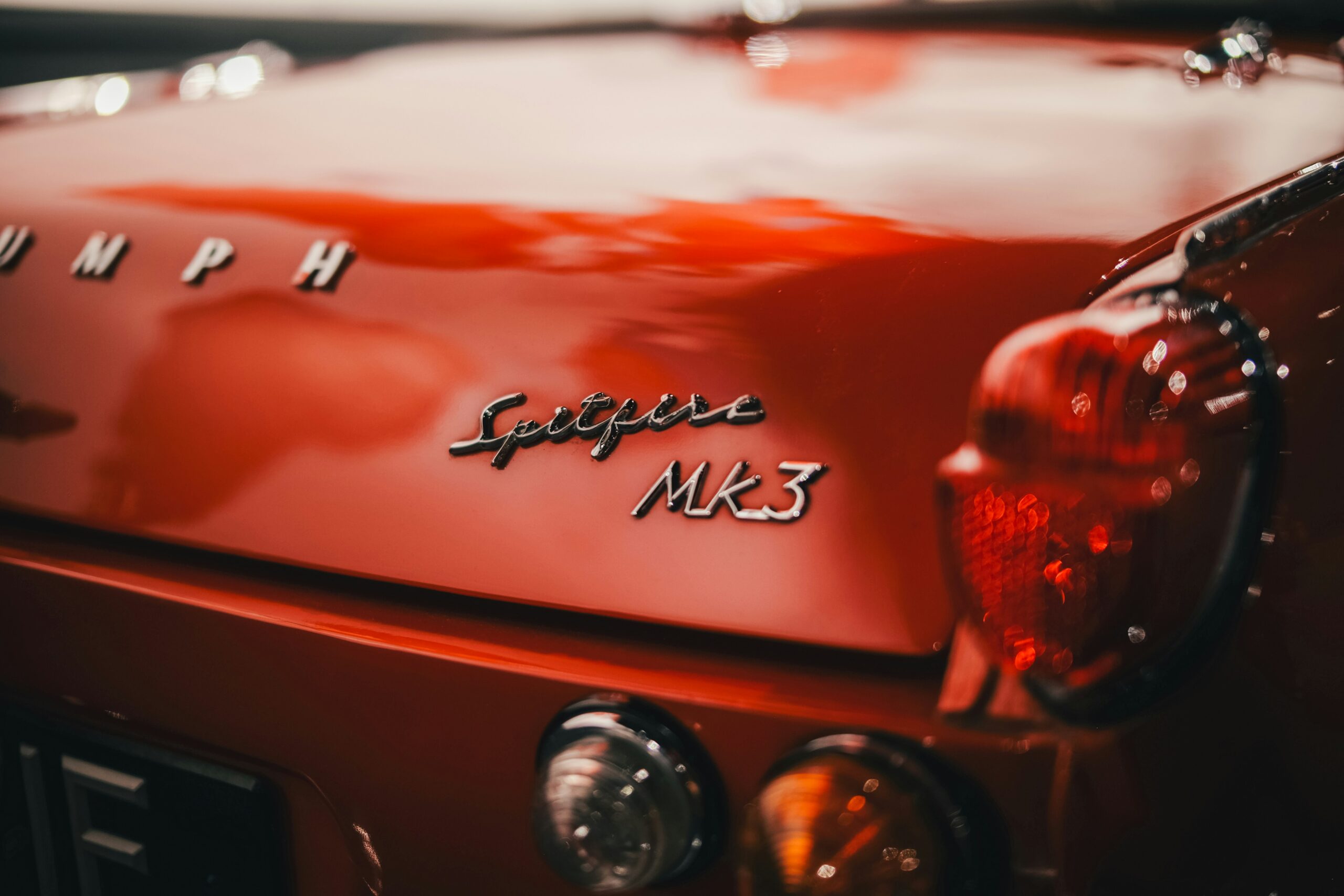
Mk3 (1967 to 1970)
The 1296cc engine arrived with the Mk3 along with a full width front bumper and various other refinements. A noticeable step up in usability over the earlier cars without losing the essential character. Generally regarded as the sweet spot between originality and driveability by many Spitfire enthusiasts. In February 1968 the 100,000th Spitfire was personally driven off the Canley production line by Standard-Triumph’s General Manager, a milestone that confirmed the little cars commercial success. Good supply of cars available at sensible prices.
MkIV (1970 to 1974)
The MkIV brought a restyle by Michelotti, with a squared off tail intended to bring the Spitfire into visual line with the Stag, the 2000 and the Dolomite as part of a coordinated Triumph family. Opinions on the styling are divided but it is a cleaner car in some respects. The swing axle rear suspension was finally updated to a rotoflex coupling system, which greatly improved the handling. The rotoflex couplings themselves are a known wear item and should be checked carefully on any MkIV.
1500 (1974 to 1980)
The 1500cc engine gave the Spitfire proper usable performance for the first time, though at the cost of some reliability compared to the earlier units. The 1500 engine has a known weakness with crankshaft and bearing wear, particularly on cars that were not properly maintained. A well maintained 1500 is a fine car. One that has been neglected is significantly more likely to need an engine rebuild than an equivalent earlier car. The later cars also carry the large rubber bumper overriders that divide opinion sharply, though these can be removed and replaced with earlier style chrome items on many cars.
Le Mans and the racing connection
One aspect of Spitfire history that surprises many people is its genuine motorsport pedigree. The works racing programme ran from 1964, using modified Spitfires fitted with fibreglass fastback bodies, a design that Michelotti had originally created for a shelved GT road car version. The aerodynamic fastback body, rejected as too heavy for road use with the small engine, proved ideal for competition. In 1965 a works Spitfire finished thirteenth overall at the 24 Hours of Le Mans and first in class in the 1.15 litre GT category, beating the MG Midgets in the process. That Le Mans class win directly led to the development of the GT6, as Triumph decided the Spitfire platform was worth developing into a proper GT car with a six cylinder engine. So in a roundabout way, the Spitfires racing success is responsible for the GT6’s existence.
What to look for: bodywork and structure
Rust is the defining challenge of Spitfire ownership and the single biggest factor in a car’s value. The good news is that the separate chassis construction means a body that is structurally compromised can in theory be replaced. The bad news is that chassis rot is just as common as body rot and the two together can make a car genuinely uneconomic to restore.
Chassis
The chassis is the most critical structural element and the first thing to check properly. The main chassis rails run the full length of the car and are prone to rot particularly around the outriggers and crossmembers. Get underneath and probe everything with a screwdriver. Sound metal resists. Rotten metal crumbles or gives way. Pay particular attention to the areas around the body mounting points and the front crossmember where the suspension attaches. A chassis with serious structural rot is expensive to repair properly and some cars are simply not worth the investment.
Sills and floors
The sills on the Spitfire carry significant load from the body and are a very common rust location. It is worth knowing that the Spitfire’s sills were designed as structural elements from the outset, partly compensating for the stiffness lost by removing the Herald chassis’s outer side rails. Probe both the outer sill and the inner sill structure, as cars are frequently found with a new outer sill welded over a rotten inner, which looks fine from outside but is structurally worthless. The floor pans rust from inside, particularly under the mats where water collects. Lift the mats and look carefully. Replacement floor sections are available and not prohibitively expensive, but it is work that needs doing properly.
Front wings and bonnet
The front wings rot at the bottom edges and in the corners behind the wheels. The bonnet, which hinges forward as a single piece to give outstanding engine access, is prone to cracking and splitting along its length. The one piece forward hinged bonnet was one of the features Triumph specifically designed to beat the Sprite, whose bonnet mechanism was less practical. Cracks in the bonnet are a common cosmetic issue but replacement bonnets are available. The area around the headlamp bowls and the inner wings behind them should be checked carefully for rust and accident damage.
Rear body
The rear of the car rots around the wheel arches and behind the rear valance. On the later squared off cars, the area where the tail meets the rear wings is a known rust trap. Check the boot floor and the spare wheel well, which holds water effectively if the drain hole is blocked. The battery tray also corrodes badly if batteries have leaked over the years, which is extremely common on older cars.
What to look for: engine and drivetrain
The 1147cc and 1296cc engines
The earlier engines are generally robust and long lived if properly maintained. They run SU carburettors which are simple to tune and rebuild. A healthy engine should start readily when warm, idle smoothly, and pull cleanly without hesitation. Blue smoke on the overrun indicates worn valve stem seals or guides. White smoke from the exhaust that continues once warm suggests a head gasket. A lumpy idle that cannot be cured by carburettor adjustment often means worn camshaft lobes, which is a known issue on higher mileage examples of all the engine variants.
The 1500cc engine
The 1500 engine deserves extra scrutiny. Check the oil pressure with a gauge if possible, as low oil pressure on a warm engine at idle is a warning sign for bearing wear. Listen for any knocking from the bottom end. The 1500 crankshaft can develop wear in the thrust washers which allows excessive end float, evidenced by a knock that comes and goes with clutch operation. Any 1500 with suspect bottom end noises should be walked away from unless the price reflects a full engine rebuild in the immediate future.
Gearbox and overdrive
The four speed gearbox is generally reliable. Check for baulking on second gear engagement and any jumping out of third under load, both of which are signs of synchromesh or selector wear. Overdrive was a factory option on many cars and is well worth having for comfortable modern road use. Test the overdrive by engaging it at speed and checking it engages and disengages cleanly without slip or judder. Non-functioning overdrives are often a simple electrical or solenoid issue rather than a mechanical failure, but verify before assuming its an easy fix.
The swing axle and what it means in practice
The swing axle rear suspension on Mk1 to Mk3 cars is one of the most discussed aspects of Spitfire ownership. The design was inherited directly from the Triumph Herald saloon, where its handling characteristics were entirely acceptable. In a sports car driven more enthusiastically, the outside rear wheel can tuck under in hard cornering, producing a snap oversteer that requires quick reactions. This is not a reason to avoid the car. It is a reason to learn its limits, which most owners do quickly and without drama. On MkIV and 1500 models, check the rotoflex rubber couplings for cracking and deterioration. Failed couplings cause vibration and eventual driveshaft separation. Replacement couplings are available and not expensive but the job requires the car to be raised and the driveshafts removed.
What to look for: hood and interior
The hood on the Spitfire is a simple affair and replacement hoods are readily available at reasonable prices. It is worth noting that the Spitfire was designed from the outset with wind-up windows rather than the side curtains used by its MG Midget rival, which was considered a significant selling point when the car was new. Check the hood frame for broken or bent bows, which are harder to source than the hood material itself. On later cars with wind-up windows, check the mechanisms work smoothly and that the door seals are intact, as failed door seals allow water into the footwells and under the carpets where it does its damage quietly over years.
Check the hood fits properly and does not leak at the top corners, which is a common issue on cars where the hood frame has been bent or the car has had any structural work. A hood that leaks consistently leads to damp interior trim, mouldy carpets and eventually rust in the floor and sills. The interior itself is simple and most trim components are reproduced and available new.
A note on brown Spitfires
There is a long standing observation in the Spitfire community that brown cars, particularly those in Russet Brown and Maple Brown from the mid to late 1970s, tend to be found in better condition than cars in more popular colours. Some people attribute this to a property of the paint itself, but the more likely explanation is simpler. Brown cars were unpopular and harder to sell, which means they tended to be bought by more committed enthusiasts who actually looked after them rather than casual buyers who let them deteriorate. The rusty brown ones were scrapped or resprayed years ago. The ones that survive tend to be the cherished examples. So if you come across a tidy Russet Brown 1500, do not let the colour put you off. It may well be in better overall condition than a red one of the same age, though for reasons that have nothing to do with the paint.
The American market connection
A significant proportion of the Spitfires built were exported to North America, where the car sold extremely well throughout the 1960s and 1970s. Many of these cars has since returned to the UK as enthusiasts seek out well preserved examples. American market cars are identifiable by various differences including larger overriders, side marker lights on the wings, different emission equipment and in some years Zenith Stromberg carburettors in place of the SUs. US spec cars are not inherently better or worse than home market cars, but the differences are worth knowing if you are buying one. The carburettors in particular are less tuneable than SUs and many owners replace them with a proper SU setup as a first modification.
What things cost
The Spitfire parts supply is one of the best of any classic British car. Rimmer Bros, Canley Classics and TSSC members suppliers between them cover almost everything. Body panels, mechanical parts, trim, hoods, seals and rubber are all available new. This means that a car in poor condition but with a solid structure and good mechanicals is genuinely restorable without hunting for unobtainium parts. It also means that there is no excuse for a car in poor condition to be priced as if the parts are hard to find.
Prices to expect
At the time of writing, a solid usable Spitfire in average condition can be found for between £4,000 and £8,000 depending on age, mileage and specification. Good restored or well maintained examples command £10,000 to £16,000. Concours quality cars at shows can reach £20,000 or more for the right early car. Cars described as restoration projects with structural issues should be below £3,000 and often represent poor value unless you have the skills, time and facilities to carry out proper bodywork restoration. A car that needs a full chassis and body restoration will cost significantly more to put right than the difference in purchase price between it and a sound driver.
Before you buy
Join the TSSC (Triumph Sports Six Club) before you start looking. Membership gives you access to a large community of experienced owners, a dating certificate service, technical advice, and a members forum where you can ask about specific cars. The club runs registered inspections through approved inspectors and can often put you in touch with knowledgeable local members who can accompany you to view a car. The annual subscription is one of the best investments you can make in the buying process.
Get a Heritage Certificate from the British Motor Museum for any serious purchase. This confirms the original factory specification including colour, trim and engine number, and is the only way to verify whether a car is matching numbers and originally the colour it claims to be. The cost is modest and worth every penny on a car of this age.
Finally, budget for insurance before you buy rather than after. Classic car insurance on a Spitfire is generally excellent value, particularly on an agreed value policy from a specialist insurer. An agreed value policy means that in the event of a total loss you receive the insured value rather than a depreciated market value, which on a cherished and restored car can make a very significant difference. Get a quote before you commit so there are no surprises.
Before you make an offer, check current market values with our free classic car price checker — estimated UK values by condition grade with live eBay listings alongside, so you can see what cars are actually selling for right now.
This page contains affiliate links. If you click a link and make a purchase, Classic Car Hub may earn a small commission at no extra cost to you.