
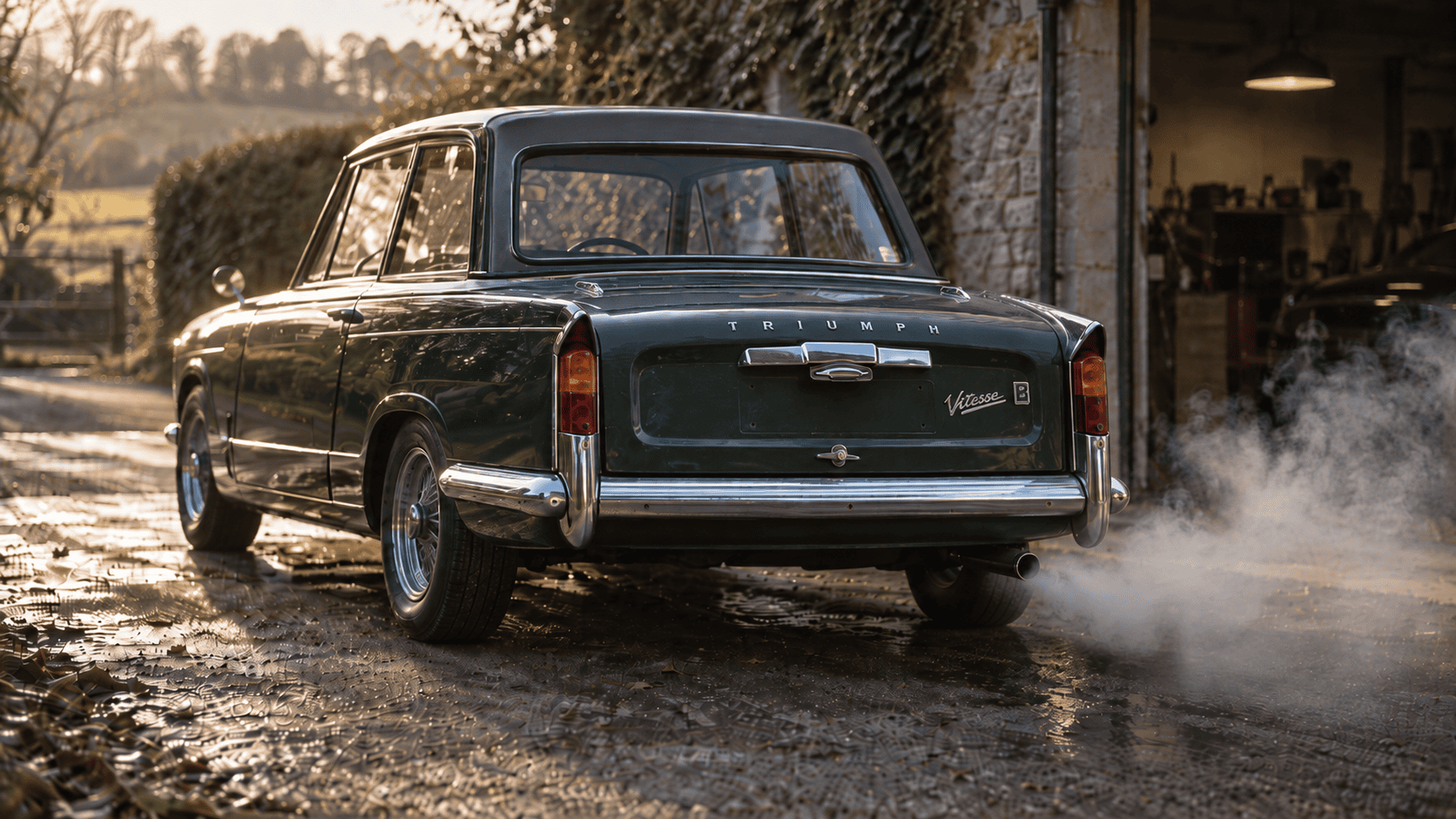
Every October, a great many perfectly healthy classics get diagnosed with a blown head gasket by their own owners.
The mornings turn cold, the car sits ticking over on the drive producing a cloud of white vapour that was not there in August, and a reasonable person concludes the worst. In almost every case it is water, which is what an engine makes when it burns petrol, condensing in a cold exhaust. It will clear in two minutes and there is nothing wrong at all.
At the other end of the scale, people drive around for months with a steady blue haze behind them, topping the oil up and telling themselves it has always done that. Sometimes it has. Sometimes it is an engine quietly grinding its way towards a rebore.
Exhaust smoke is one of the most useful diagnostic tools you have, and one of the most consistently misread. What follows is arranged by how worried you should be, starting with the things that are not faults at all and ending with the things that need a decision rather than a top-up. Use the table below to jump to whichever section matches what you are looking at.
Quick Triage: Find Your Symptom
| What you are seeing | When | Most likely | Worry level |
|---|---|---|---|
| White vapour, clears in a minute or two, no smell | Cold mornings, idling from cold | Condensation. Normal. Read more | None |
| Brief puff of blue, gone in seconds | First start after the car has stood | Oil past the guides overnight. Read more | Low |
| Haze or oily mist from under the car, not the tailpipe | Any time, worse when hot | Road draught tube or a leak. Not exhaust smoke. Read more | Low |
| Black, sooty, smells of raw petrol | Worst on cold start or acceleration | Running rich. Almost always fuelling. Read more | Cheap to fix |
| Blue puff when you reopen the throttle after coasting | Downhill, then accelerate | Worn inlet valve guides. Read more | Plan for it |
| Continuous blue, worse under load, oil level dropping | Acceleration, sustained speed | Rings and bores. Read more | Significant |
| Thick white, sweetish smell, coolant disappearing | Any time, does not clear when hot | Coolant entering a cylinder. Read more | Stop and investigate |
| Whitish or grey smoke on an automatic, no coolant loss | Constant, engine oil level unchanged | Possible vacuum modulator. Read more | Investigate |
Tier One: Not a Fault at All
Burning petrol produces carbon dioxide and water. Quite a lot of water. On a cold exhaust system that water condenses into visible vapour, and on a cold damp morning you will see it leave the tailpipe as a white cloud.
The identifying features are simple. It clears once the exhaust warms through, usually within a couple of minutes. It has no smell to speak of. It disperses quickly rather than hanging in the air. And on a warm afternoon, it is not there.
You may also see water dripping from the tailpipe, which alarms people even more and is equally normal. On a car doing short runs it never gets hot enough to drive that moisture out, which is why exhausts on little-used classics rot from the inside. Our exhaust guide covers why that happens and what to do about it.
A little steam after driving through standing water or a wash is the same story, and usually coming off the outside of the manifold rather than out of the pipe.
The thing to remember is that condensation goes away as the engine warms up. Coolant getting into a cylinder does not. That single distinction separates tier one from tier five.
Tier Two: Normal For a Classic
Here is where modern advice stops being useful. An engine designed in 1955 does not behave like one designed in 2015, and several things that would be genuine faults on a modern car are simply how these engines work.
The startup puff
Leave a classic standing for a fortnight and oil drains down from the valve gear, sits on the back of the valves, and gets burnt in the first few seconds of running. One brief blue puff, then nothing, is extremely common and is not in itself a reason to worry.
It matters because it tells you about guide clearance rather than about the bores, and guide wear progresses slowly. A car that has puffed on startup for five years and is not using much oil can carry on doing exactly that. It becomes a tier four problem when it gets worse, or when it starts happening in other conditions too.
Smoke that is not coming from the exhaust
This one catches people out regularly, and it is worth checking before you diagnose anything.
Engines built before the early 1960s generally had no positive crankcase ventilation. They used a road draught tube: a pipe running down from the crankcase, cut at an angle at the bottom, so that the car’s forward motion created a slight depression and drew crankcase fumes out into the atmosphere. Underneath your car rather than through the exhaust.
So an oily haze and a distinct smell from beneath a 1950s car, with nothing much coming out of the tailpipe, may be the ventilation system doing precisely what Ford or Austin designed it to do. It is a fault only if it has become excessive, which points at blow-by past the rings.
Similarly, oil weeping from a rocker cover or a tappet chest onto a hot manifold produces smoke, smell and a certain amount of panic, and has nothing to do with combustion at all. Get underneath with a torch before you start costing up a rebuild.
Choke enrichment and cold running
A cold engine on full choke is deliberately running rich, and a little black haze for the first thirty seconds is the system working. The question is whether it clears. If the car is still sooty once warm and off choke, that moves down to tier three.
Bedding in after a rebuild
New rings need to bed to the bores, and a freshly rebored engine can use noticeable oil and show some blue for the first few hundred miles. Assembly lubricant, preservative oil and machining residue all burn off in the early running too.
This is normal, temporary and should be steadily improving. If a rebuilt engine is still smoking at a thousand miles, something was wrong at assembly and you want to know about it while the builder still remembers the job.
Worth knowing that the received wisdom about babying a fresh engine can work against you here. Rings are pressed against the bore partly by combustion pressure, so they need some load to bed in. Run a newly rebored engine too gently for too long and the bore can polish smooth before the rings have seated, which leaves you with an engine that smokes permanently. Follow whatever regime your engine builder specifies rather than simply being kind to it.
Tier Three: Black Smoke, Which Is Usually Cheap
Black smoke is soot, and soot is unburnt fuel. The engine is getting more petrol than it can burn with the air available. Good news: almost nothing in this category requires the head to come off, and most of it is adjustment rather than parts.
Sooty black deposits round the tailpipe, a smell of raw fuel, and fuel consumption that has quietly got worse all point the same way. So do the spark plugs, which is why reading plugs and reading smoke are really the same investigation. Our spark plug diagnosis guide covers what the deposits are telling you and is the natural companion to this section.
On SU carburettors
Working roughly from cheapest to worst:
- A choke or mixture enrichment that is not returning fully. Cables stretch and stick. Check it goes properly home.
- A blocked or filthy air filter. Less air, same fuel, richer mixture. Often overlooked on a car that does 500 miles a year.
- Excessive fuel pressure. SUs want somewhere around 2 to 3psi and no more. A modern electric pump fitted without a regulator will push past the float valve and flood the carburettor, and no amount of fiddling with the jet will fix it. Our SU fuel pump guide covers pressure and pump choice.
- A sunken or punctured float, or a worn float needle and seat. Shake the float next to your ear. Any sloshing means fuel inside it, and the level will be wrong.
- A needle clip in the wrong position, which can richen the mixture beyond anything the adjusting nut can correct.
- A worn needle and jet. The jet wears oval over years and the needle thins at the lower end. These are replaced as a pair, and no adjustment will compensate for them.
One correction worth making, because it goes round the forums in the wrong direction: a low dashpot lets the piston rise too quickly and gives you a weak mixture and a flat spot, not black smoke. Our guide to setting up and tuning SU carburettors covers the lifting pin method properly, and SU performance optimisation goes further on needle selection.
On other carburettors the principles are identical even though the parts are not. See our Weber DCOE and Zenith-Stromberg guides for the specifics.
Timing and ethanol, and one myth to retire
Ignition timing is worth checking, but be careful what you expect from it. “Retarded timing causes black smoke” gets repeated constantly and it comes from diesel injection timing, where late injection genuinely does leave fuel unburnt. On a petrol engine the effect is different: retarded spark raises exhaust gas temperature, and that extra heat tends to burn residual hydrocarbons in the exhaust rather than produce soot. It was used deliberately as an emissions strategy for exactly that reason.
So retarded timing on a classic gives you lost power, poor economy, running hot and, over time, burnt exhaust valves. What it does not reliably give you is a sooty tailpipe. If your car is genuinely blowing black, the mixture is the place to look. Check the timing anyway, because a car that is down on power and heavy on fuel invites people to richen the mixture to compensate, and then you have two faults instead of one. Our ignition timing guide covers doing it properly.
And ethanol. E10 petrol attacks older rubber and can degrade float needle seats, hoses and diaphragms, which shows up as flooding and rich running on cars that were fine three years ago. Our guide to E10 and classic fuel systems covers what to replace.
Tier Four: Blue Smoke, and What It Is Really Telling You
Blue means oil is getting into the combustion chamber. The useful question is not whether it is oil. It is which way the oil is getting in, because the answer is the difference between a head off and an engine out.
Oil can arrive from above, down the valve stems past worn guides. Or from below, past worn rings and bores. The mechanism that separates them is manifold vacuum.
On a closed throttle, particularly coasting downhill, manifold vacuum is very high. That vacuum pulls oil down past the inlet guides and it pools in the port. Reopen the throttle and it goes straight into the cylinder and burns in one go. Under load, by contrast, vacuum is low and cylinder pressure is high, which is the condition that forces oil past tired rings.
So the timing of the smoke tells you the route:
| When the blue appears | Points towards |
|---|---|
| Brief puff on cold start after standing, then clear | Inlet guides, or stem seals where fitted. Monitor. |
| Puff when you accelerate after a long idle | Inlet guides. Oil has pooled while idling. |
| Puff when you reopen the throttle after coasting downhill | Inlet guides. The classic test. |
| Continuous and heavier under acceleration or sustained load | Rings and bores. |
| Constant regardless of conditions, with heavy oil use | Both, and the engine is tired. |
Two points specific to older engines here, and both matter.
First, plenty of older designs had no true valve stem seals at all. Some had nothing but guide clearance. Others had an O-ring on the valve stem below the collets, which deflects oil away rather than sealing anything, or an umbrella seal that rides up and down with the stem. Positive seals, the type that clamp to the top of the guide and wipe the stem, only became general fitment as emissions rules tightened. So when modern advice tells you to replace the valve stem seals, on a good many classics the honest answer is that the guides themselves are worn and the head needs new guides fitting and reaming. That is a considerably bigger job than a set of seals, and it is worth establishing which you are dealing with before anybody quotes you.
Second, and this one goes against instinct: it is almost always the inlet guides that cause oil consumption, not the exhausts. The inlet port sees manifold vacuum, which actively draws oil down the stem. The exhaust port sees positive pressure, which pushes the other way, and the exhaust stem and guide are the hottest, most poorly lubricated part of the valve gear. Fitting tight positive seals to exhaust guides on a classic can therefore starve them and accelerate wear on the stem, the guide and eventually the seat. If you are having a head done, that is a conversation worth having with whoever is doing it rather than assuming more sealing is better.
Measure the oil consumption properly
“It uses a bit of oil” is not data. Record the mileage, fill precisely to the mark on level ground with the engine cold, and record it again when you next top up. Now you have a figure in miles per pint, and more importantly you can repeat it in six months and see whether it is getting worse.
A trend matters far more than a number. An engine steadily using a pint every 500 miles for a decade is telling you something quite different from one that has gone from 1,000 to 400 miles per pint in a season.
Two quick things to eliminate first. Check you have not simply overfilled it, because an overfull sump gets churned by the crank and forced past the rings. And check the oil is actually being burnt rather than dripping onto your garage floor, which is a different and much cheaper problem.
Falling oil pressure alongside rising consumption is the combination that should concentrate the mind, since it suggests bearing wear as well. Our oil pressure guide explains what the gauge is actually measuring.
Tier Five: White Smoke That Is Not Condensation
This is the one to stop for.
Coolant entering a combustion chamber produces white smoke that behaves quite differently from condensation. It does not clear as the engine warms up. It is thicker and hangs in the air. It has a faintly sweet smell, which is the glycol in the antifreeze. And critically, the coolant level is going down.
Supporting evidence to look for:
- Coolant loss with no visible external leak
- A pale mayonnaise-like emulsion under the oil filler cap or on the dipstick, though a little of this on a car doing only short cold runs is condensation and not automatically a gasket
- The top hose going hard very quickly, or the expansion tank pressurising
- Bubbles in the radiator or header tank with the engine running
- One spark plug noticeably cleaner than the rest, steam-cleaned by coolant
- Unexplained overheating, or a heater that has gone cold because the system is full of gas
The confirming test is a combustion gas tester, sometimes called a block tester. It is a hand-held device holding a chemical fluid which is drawn through gas from the top of the cooling system; if combustion gases are present the fluid changes colour. They are inexpensive, available to hire, and they answer the question definitively rather than by argument.
A head gasket is the common cause but not the only one. A cracked head, a corroded head face, a cracked block or a dropped liner all produce the same symptom, which is why the head coming off is an investigation rather than a fix. Alloy heads on cars that have run on plain water or the wrong antifreeze concentration corrode internally, and the corrosion is often the underlying reason the gasket let go in the first place. Our cooling system maintenance guide covers inhibitor strength and why it matters more on older engines than modern ones.
One other cause worth knowing on automatics. Some period automatic gearboxes use a vacuum modulator, mounted on the gearbox casing and connected to the inlet manifold by a pipe, which senses engine load to control shift quality. If its diaphragm ruptures, manifold vacuum draws transmission fluid up that pipe and the engine burns it. The result is persistent whitish or grey smoke with no coolant loss and no change in engine oil level, and owners chase head gaskets for months over it.
The test takes two minutes. Pull the vacuum pipe off the modulator and look inside it. Any transmission fluid in the pipe at all, even a single drop on the vacuum side, means the diaphragm has gone. You can also block the engine end, run it, and see whether the smoke stops.
Worth knowing which box you have before you go looking, since not every period automatic works this way. Several transmissions common in British classics control shift pressure through a throttle cable rather than a vacuum signal, in which case there is no modulator and no pipe to check.
How to Read It Properly
A method, roughly in order of cost and invasiveness.
- Establish that it is actually exhaust smoke. Underbonnet leaks, manifold weeps and draught tubes account for a surprising share of reported cases.
- Observe under controlled conditions. First start of the day from cold. Warm idle. A gentle rev. Acceleration under load. Deceleration then reopening the throttle. Note what happens at each. A phone video is better than memory and lets you look again.
- Get a follower. You cannot see your own exhaust while driving, and trying to do it in the mirror at speed is a genuinely bad idea. Have someone follow you for the overrun test.
- Smell it. Raw petrol means fuelling. Sweetish means coolant. Acrid burnt oil means oil. This is cruder than it sounds and it is usually right.
- Read the plugs. One plug different from the others localises the problem to a cylinder immediately, which is worth a great deal before anything comes apart.
- Check valve clearances. Cheap, quick, and rules out a whole set of running problems. See our valve clearance guide.
- Compression test, then a wet test. Squirt a little oil into a low cylinder and retest. If the reading jumps, the rings are the problem; if it barely moves, look at the valves or the gasket.
- Leak-down test. More informative than compression alone, because you can hear where the air is escaping: the carburettor means an inlet valve, the exhaust means an exhaust valve, the oil filler means rings, and bubbles in the coolant mean the gasket or the head.
- Combustion gas test, if coolant is in question.
Work through that and you will usually know what you are dealing with before you spend anything meaningful.
Patterns Worth Knowing on Older Engines
Rather than repeat marque folklore, here are three structural points that genuinely change how you interpret smoke on a classic.
Oil control in the valve train was crude. Budget for guides rather than seals, and remember the asymmetry: the inlet guide is drawn on by vacuum and is the one that costs you oil, while the exhaust guide runs hot and wants the lubrication it gets.
Alloy heads on iron blocks. Dissimilar metals plus a cooling system that has been run on plain water equals internal corrosion of the head face and waterways. This is why cooling system neglect on a classic shows up years later as a white smoke problem, and why inhibitor strength is not an optional extra.
Light loads and short runs. This one is better understood than most owners realise. Piston rings are pressed against the bore partly by combustion pressure, so an engine that spends its life idling, pottering and never working produces low cylinder pressures and poor ring sealing. Hot gases then slip past and bake the oil onto the bore as a hard varnish, filling in the honing crosshatch that was there to hold oil. That is bore glazing, and it is self-feeding: worse sealing produces more glazing produces worse sealing. Caught early it shows as lost power, rising oil consumption and blue smoke, and a spell of proper hard work on a cheap mineral oil can sometimes scrape it back. Once it is advanced, the cure is a rebore.
Add to that the moisture that never gets driven out of a cold engine and exhaust, and the picture is clear enough: the kindest thing you can do for a classic engine is work it properly at operating temperature now and again. Our winter storage guide and springtime check cover getting a laid-up car back into service without harm.
Where the MOT Stands
Briefly, because it is less relevant to most classic owners than they expect.
Vehicles over 40 years old and not substantially changed are generally exempt from statutory MOT testing, though owners may still request a test and many sensibly do. Separately, the metered emissions check applies to spark ignition engines first used on or after 1 August 1975, so a petrol car older than that is not subjected to a CO and hydrocarbon measurement even when it is tested voluntarily.
A visual smoke assessment does still apply, and it applies to all petrol vehicles regardless of age. The tester raises the engine to around 2,500rpm, holds it for roughly twenty seconds, lets it settle back to idle and then assesses the tailpipe. The failure criteria are dense blue or clearly visible black smoke for a continuous five seconds at idle, or excessive dense blue or clearly visible black smoke during acceleration that would obscure the view of other road users.
Note what that does not say. Thin blue haze is not the test. Brief puffs are not the test. Five continuous seconds of dense smoke at idle is a meaningfully higher bar than most worried owners assume.
And there is a carve-out that deserves to be better known among classic owners. The manual states that in exceptional cases, particularly on vehicles manufactured before 1960 where smoke emission is unavoidable because of the engine design, those vehicles will not fail. Two-stroke engines get similar latitude, failing only where the smoke is excessive during acceleration to the point of obscuring other road users’ view.
One thing that is frequently quoted at classic owners and is actually a diesel rule: the “excessive smoke or vapour of any colour to an extent likely to obscure the vision of other road users” wording, which carries a Dangerous rating, sits in the compression ignition section of the manual. It does not apply to a petrol classic.
Separately, a tester is entitled to refuse to test a vehicle emitting substantial quantities of avoidable smoke, which is a refusal rather than a failure but gets you no further.
The practical point is this. Exemption from testing is not exemption from the car being roadworthy, and a classic that leaves a blue cloud at every junction is doing your own engine and the hobby’s reputation no favours.
One Safety Note
Most of the observation in this guide involves a running engine. Exhaust gas contains carbon monoxide, which you cannot smell and which kills people in closed garages every year. Run the engine outside or with the door fully open and decent through-draught, never in a confined space, and never while you are under the car. Our garage and workshop safety guide covers ventilation properly.
The Short Version
White that clears is water. Black is fuel and is usually cheap. Blue is oil, and the timing tells you whether it is coming from above or below. White that does not clear, smells sweet and takes your coolant with it is the one that stops the day.
Beyond that, the single most useful habit is paying attention to change. A classic that has always puffed a little on startup is telling you it is a classic. The same car puffing more than it did last summer, using oil it did not use before, is telling you something worth acting on while it is still a decision rather than an emergency.
References and Further Reading
- DVSA MOT inspection manual, section 8: nuisance, noise and exhaust emissions
- DVSA MOT inspection manual introduction, covering historic vehicle exemption and refusal to test
- Moss Motoring on road draught tubes and crankcase ventilation on classic engines
- Moss Motoring: SU carburettor maintenance, flooding causes and fuel pressure limits
- SU Carburettors: official FAQ on damper oil, jets, needles and mixture faults
- Engine Builder: valve stem seal types, including umbrella and deflector seals on older pushrod engines
- Cox Engineering on bore glazing, bore polishing and the loss of the honing crosshatch
- How a Car Works: stripping and checking an SU carburettor, including jet wear
This page contains affiliate links. If you click a link and make a purchase, Classic Car Hub may earn a small commission at no extra cost to you.