
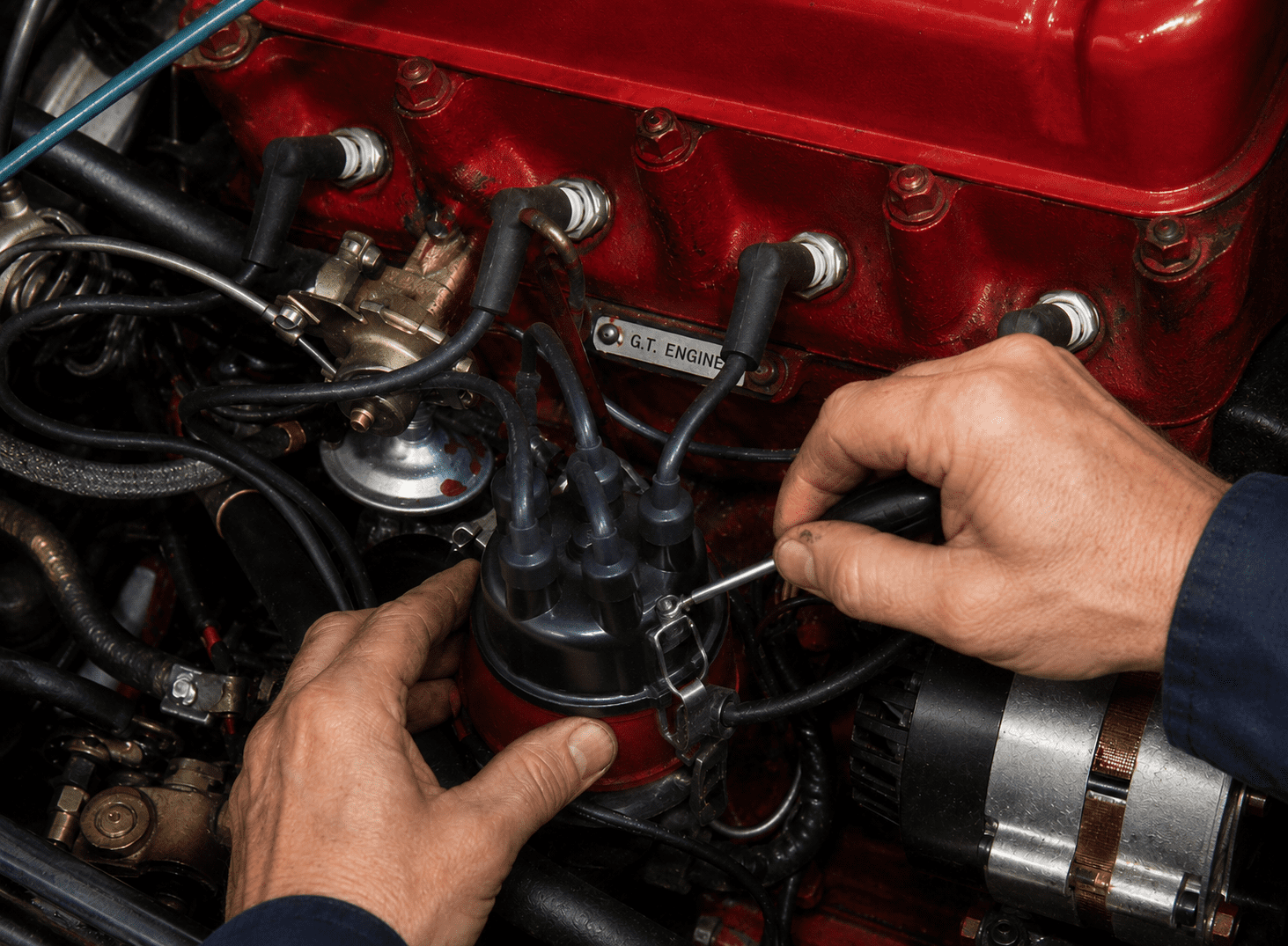
Ignition timing is one of those settings that affects almost everything about how a classic car drives, and yet it is one of the most commonly neglected items on the maintenance list. Get it right and the engine pulls cleanly, starts willingly, returns reasonable fuel economy, and runs at the correct temperature. Get it wrong and the car can be sluggish, reluctant to rev, prone to overheating, or in the most unfortunate direction, producing that metallic tinkling sound under load that means the mixture is detonating rather than burning, which is one of the more efficient ways of destroying an engine from the inside. None of this is complicated to avoid. A basic understanding of what timing does, the right tools, and thirty minutes of methodical work is all that is required.
What ignition timing actually means
When the spark plug fires, the air and fuel mixture in the cylinder does not explode instantaneously. It burns, progressively and rapidly, with the pressure rising as the flame front spreads across the combustion chamber. This process takes a small but meaningful amount of time, and because the engine is rotating, that time translates into crankshaft degrees. The spark needs to happen before the piston reaches the top of its stroke, so that by the time peak combustion pressure has built, the piston is just beginning its power stroke downward and in the best position to be pushed by that pressure.
This is what ignition timing measures: how many degrees before top dead centre (TDC) the spark fires. A setting of ten degrees BTDC means the spark fires when the crankshaft is ten degrees away from TDC on the compression stroke. If the spark fires too early, the timing is over-advanced: the pressure builds before the piston can use it, fighting the upward movement of the piston and causing detonation. If it fires too late, the timing is retarded: the mixture is still burning as the piston is well into its downward stroke, wasting energy as heat rather than mechanical work and producing poor power, high exhaust temperatures, and the sort of sluggish, flat performance that makes driving a classic car feel like a disappointment rather than an event.
Why timing needs to advance with engine speed
At low engine speeds, the mixture has relatively more time to burn, so the spark can fire closer to TDC. At high engine speeds, the mixture has far less time to complete combustion before the piston is well down the bore, so the spark must fire earlier to achieve the same result. A distributor fitted with centrifugal advance weights automatically increases the timing advance as engine speed rises, providing the right setting across the rev range rather than a compromise at one particular speed. A vacuum advance mechanism adds further refinement, advancing timing under light throttle and cruise conditions where the dilute mixture burns more slowly and benefits from additional advance. Both systems must be functioning correctly before you attempt to set the base timing figure.
What you need
Setting timing accurately requires a stroboscopic timing light, sometimes called a timing gun. These connect to the number one cylinder high-tension lead and flash in synchronisation with each spark, effectively freezing the timing marks on the crankshaft pulley so you can read the current timing against the pointer on the engine. A basic timing light costs between fifteen and forty pounds from most motor factors and is a worthwhile investment for anyone who plans to maintain more than one classic car. More expensive models with a built-in dial-back advance function are convenient but not necessary for straightforward timing checks.
You also need: a socket or spanner to fit the distributor clamp bolt, a white paint marker to make the timing marks visible, and the correct timing figures from the workshop manual for your specific engine. The figures vary considerably between engines and between manual and automatic gearbox versions of the same car, so do not guess or borrow figures from a different specification. The workshop manual is not optional here.
If you do not have a timing light and need to set a basic static figure to get the car running, a twelve-volt test lamp wired between the distributor low-tension terminal and earth can be used, with the ignition switched on and the engine stationary. The lamp lights when the points are open and extinguishes when they close. This method establishes a static timing figure accurately enough to get the engine running and to the workshop, but it cannot account for the dynamic advance curve and is not a substitute for setting the timing properly with a timing light on a warm running engine.
Before you set the timing: check the dwell angle first
This is the step most owners skip, and it matters considerably more than they realise. The dwell angle is the period in crankshaft degrees during which the contact breaker points remain closed, measured on a points-equipped distributor. It affects the coil’s charging time and, critically, the relationship between point opening and the timing mark reading. If the dwell is incorrect, the timing reading you take will be incorrect even if the distributor is set precisely to the specified figure. Always set the dwell angle before setting the timing. Doing it the other way around is setting the timing twice.
Dwell angle is set by adjusting the contact breaker gap. A larger gap produces a smaller dwell angle; a smaller gap produces a larger one. Most workshop manuals specify both the point gap in thousandths of an inch and the corresponding dwell angle in degrees. A dwell meter, often combined with a tachometer in inexpensive multimeter-style units available from most motor factors, reads the dwell directly with the engine running. On most common British four-cylinder classic engines fitted with a Lucas 25D or 45D distributor, which covers BMC A-series and B-series engines as well as Triumph’s Spitfire, Herald, GT6, and Dolomite four-cylinders, the dwell angle specification is around 60 degrees. Ford Kent-engined cars typically run a lower figure, closer to the high 40s. The workshop manual gives the correct figure for your engine.
If the car has already been converted to electronic ignition, the dwell concern is removed entirely, since electronic systems do not use contact breakers. If you are still running a points distributor and have never changed the points, check them while you are here. Worn or pitted points affect both dwell and timing stability and cost very little to replace. Fitting a new set and then setting the timing correctly is a better afternoon’s work than repeatedly adjusting ageing points that are never going to behave themselves. Our electronic ignition conversion guide covers the benefits of upgrading if you are considering removing the points system altogether.
Finding and reading the timing marks
Classic British cars typically have one of two timing mark arrangements. Most common is a pointer fixed to the timing cover with a scale of degrees marked on the crankshaft pulley or vibration damper, or a notch in the pulley that lines up with degree marks on the cover. The alternative arrangement has a single mark on the pulley or flywheel that aligns with various pointers. Either way, top dead centre is marked and the degrees before TDC (BTDC) are marked in sequence from it.
Before starting the engine, mark both the relevant degree mark and the pointer with a white paint pen. Chalk looks adequate in daylight but is easily blown off by a running engine and disappears entirely under strobe illumination. The timing light’s strobe makes unmarked metallic marks difficult to read even in good light, and under the bonnet of an older car in anything less than ideal workshop conditions it is essentially impossible. A bold white line on each reference point takes thirty seconds and saves a disproportionate amount of frustration.
Locating the timing marks requires rotating the engine to find the correct mark. Remove the spark plugs to make this easier, and rotate by hand using a socket on the crankshaft pulley bolt, turning clockwise when viewed from the front of the engine. Confirm that cylinder number one is on its compression stroke before reading the marks: with the plug removed, place your thumb over the plug hole and rotate the engine until you feel compression building, then continue slowly until the timing mark aligns with the pointer. Number one cylinder is typically the cylinder nearest the timing cover at the front of the engine, but confirm this in the workshop manual. Timing marks on some cars, the early BMC A-series Mini being a notable example, are on the flywheel and visible through an inspection hole in the bellhousing rather than on the front pulley.
Setting the timing: the procedure
The engine must be at normal operating temperature before setting the timing dynamically. A cold engine runs with a richer mixture and behaves differently in several respects, and will give a reading that does not reflect normal running conditions. Run the car until the temperature gauge settles at its normal position, then proceed.
- Step 1: With the engine off, connect the timing light. The inductive pickup clips around the number one cylinder HT lead. The power leads connect to the battery: red to positive, black to negative. Route the leads away from the cooling fan and any rotating components before starting the engine. A timing light lead caught in a fan is an experience nobody needs.
- Step 2: Before slackening anything, make a reference mark on the distributor body and the adjacent engine casing with a paint pen. This gives you a visual starting point and means that if adjustment goes further than expected, you know where you started from.
- Step 3: Disconnect the vacuum advance pipe from the distributor and plug it with a short bolt or a dedicated vacuum cap. Most workshop manuals specify the base timing figure with the vacuum disconnected. Leaving it connected gives a reading influenced by manifold vacuum rather than the base centrifugal advance alone, which makes it impossible to set the base figure accurately.
- Step 4: Slacken the distributor clamp bolt just enough to allow the distributor body to rotate with firm hand pressure. Do not remove it. Keep it snug enough that the distributor holds its position unless deliberately moved.
- Step 5: Start the engine and allow it to settle at idle. Point the timing light at the timing marks. The strobe will illuminate the marks each time the plug fires, effectively freezing their position. Read which degree mark aligns with the pointer and compare to the base timing figure in the workshop manual.
- Step 6: If adjustment is needed, rotate the distributor body with the engine running. Rotating the body against the direction of rotor rotation advances the timing and increases the BTDC figure. Rotating it in the direction of rotor rotation retards the timing. The change is immediate and visible in the timing light reading. Small movements produce significant changes, so work in small increments.
- Step 7: When the correct figure is achieved, hold the distributor firmly in position and tighten the clamp bolt. Recheck the timing immediately after tightening, as the act of tightening can shift the distributor slightly. This is not a theoretical possibility; it happens regularly enough to always warrant a recheck.
- Step 8: Reconnect the vacuum advance pipe. With the vacuum still disconnected, blip the throttle and watch the timing marks. The advance should increase promptly as the revs rise and return cleanly as they drop, confirming the centrifugal advance mechanism is working freely. Sticky or absent centrifugal advance means the advance weights or springs inside the distributor need attention.
Workshop note: Some Lucas distributors, including the 25D4 fitted to many BMC engines, have a vernier adjustment on the clamp that allows fine timing changes without a spanner, by rotating a knurled ring. This is a useful feature that makes small adjustments considerably easier once the main clamp bolt is set. If your distributor has this adjustment, familiarise yourself with it before starting the procedure.
Pinking: what it is and why it matters
Pinking, also called knocking or detonation, is the sound of the air and fuel mixture igniting before the spark fires, triggered by heat and pressure rather than by the controlled spark. It manifests as a metallic tinkling or rattling sound under load, most noticeable when accelerating uphill at low revs in a high gear, the condition that generates the highest cylinder pressures. Even light pinking should be taken as a signal to investigate promptly rather than accepted as part of the car’s character. Sustained pinking causes real damage. The shock waves generated by detonation can crack piston crowns, erode combustion chamber surfaces, and destroy big-end bearings with a thoroughness that renders even a brief episode worth taking seriously.
Over-advanced ignition timing is the most common cause of pinking on a classic car, but it is not the only one. A lean fuel mixture, carbon deposits in the combustion chamber raising the effective compression ratio, and fuel with an octane rating too low for the engine’s compression ratio all produce the same symptom. If pinking persists after setting the timing correctly, check the fuel specification against what the engine requires and consider whether the combustion chambers need decarbonising. Our spark plug reading guide helps identify whether the mixture is contributing to the problem.
The effect of fuel grade on timing
Modern fuel has changed the timing equation for some classic engines. E10 standard fuel, which has been the default 95-octane grade at UK pumps since September 2021, has slightly different combustion characteristics from the E5 fuel it replaced, and the lower effective octane rating combined with ethanol’s combustion properties can push engines with higher compression ratios towards pinking at timing settings that were perfectly correct on the older fuel. If pinking has appeared or worsened since switching to E10, retarding the timing by a degree or two is a pragmatic short-term response. Using 97 or 98-octane super unleaded, which remains at the E5 standard, is the more complete solution for engines that were tuned on the older fuel specification. Our classic car fuel systems guide covers the E10 issue in full.
Vacuum advance: the frequently ignored component
The vacuum advance capsule on the distributor advances the timing under light throttle and cruise conditions, where the dilute mixture burns more slowly and benefits from more advance. It is frequently disabled on classic cars because the pipe has perished or been removed at some point in the car’s history and nobody has bothered to reinstate it. This is a mistake. A working vacuum advance improves fuel economy, reduces exhaust temperatures at cruise, and makes the engine run more smoothly at part throttle. Check that the pipe is connected, that it is not cracked or split, and that the diaphragm inside the capsule is intact by applying a brief vacuum to the capsule with the engine running and checking that the timing advances in response.
If the capsule is inoperative and a replacement is not immediately available, plug the manifold connection and set the base timing to the figure specified with vacuum disconnected. The car will run acceptably, though with slightly increased fuel consumption and reduced part-throttle refinement until the vacuum advance is reinstated. Do not leave it indefinitely. It is there for a reason.
What to do if the distributor position has been completely disturbed
If the distributor has been removed entirely, or if the timing has been so badly disturbed that the procedure above produces nothing useful, the starting point is finding top dead centre on the compression stroke of cylinder number one from scratch. Remove the number one plug, place your thumb over the hole, and rotate the engine until compression pushes firmly against your thumb. Continue rotating slowly until the TDC mark on the pulley aligns with the pointer. Drop the distributor in with the rotor pointing towards the number one plug lead position in the cap, set the distributor to approximately the correct static timing position by rotating the body until the points are just opening, refit the cap, and start the engine. It will not be perfectly timed but it will run, at which point the full procedure above can be carried out properly with a warm engine and a timing light.
Timing and performance modifications
Any modification that alters the engine’s breathing or compression will affect the optimal timing setting. A performance camshaft with more duration and overlap, a higher compression ratio, a ported head, or a carburettor upgrade can all shift the point at which maximum power is produced, and the correct timing figure for a modified engine may differ from the one in the workshop manual for the standard unit. If the engine has been modified, establishing the correct timing by road testing and careful listening for pinking is the right approach rather than simply following the standard specification. A rolling road session with a qualified operator who can read the power output while varying the timing is the most accurate method for a significantly modified engine. Our performance camshaft guide discusses the wider implications of engine modifications including their effect on ignition timing requirements.
How often to check timing
On a car with a points distributor, timing should be checked every time the points are replaced or adjusted, since point wear affects the dwell angle which in turn affects timing. As a general rule, checking and confirming the timing as part of the annual service is good practice. If the car has been converted to electronic ignition, the timing is considerably more stable over time and an annual check is sufficient for most purposes. Our springtime safety check guide includes ignition timing as part of the full pre-season inspection. The distributor cap, rotor arm, and HT leads should all be inspected at the same time, since deteriorated ignition components produce symptoms that closely resemble incorrect timing and can lead to unnecessary adjustment of a distributor that is actually set correctly. Check the components before blaming the setting.
Setting ignition timing correctly is not a glamorous task. It involves crouching at an awkward angle over a running engine, pointing a flashing light at a small mark on a rotating pulley, and making minute adjustments to a component that tries to shift every time you tighten the bolt. What it produces is an engine that runs as it should: responsive, economical, and free of the subtle deterioration that incorrect timing introduces so gradually that most owners simply come to accept it as normal. It is not normal. It is an afternoon’s work, and it is worth every minute of it.
This page contains affiliate links. If you click a link and make a purchase, Classic Car Hub may earn a small commission at no extra cost to you.