
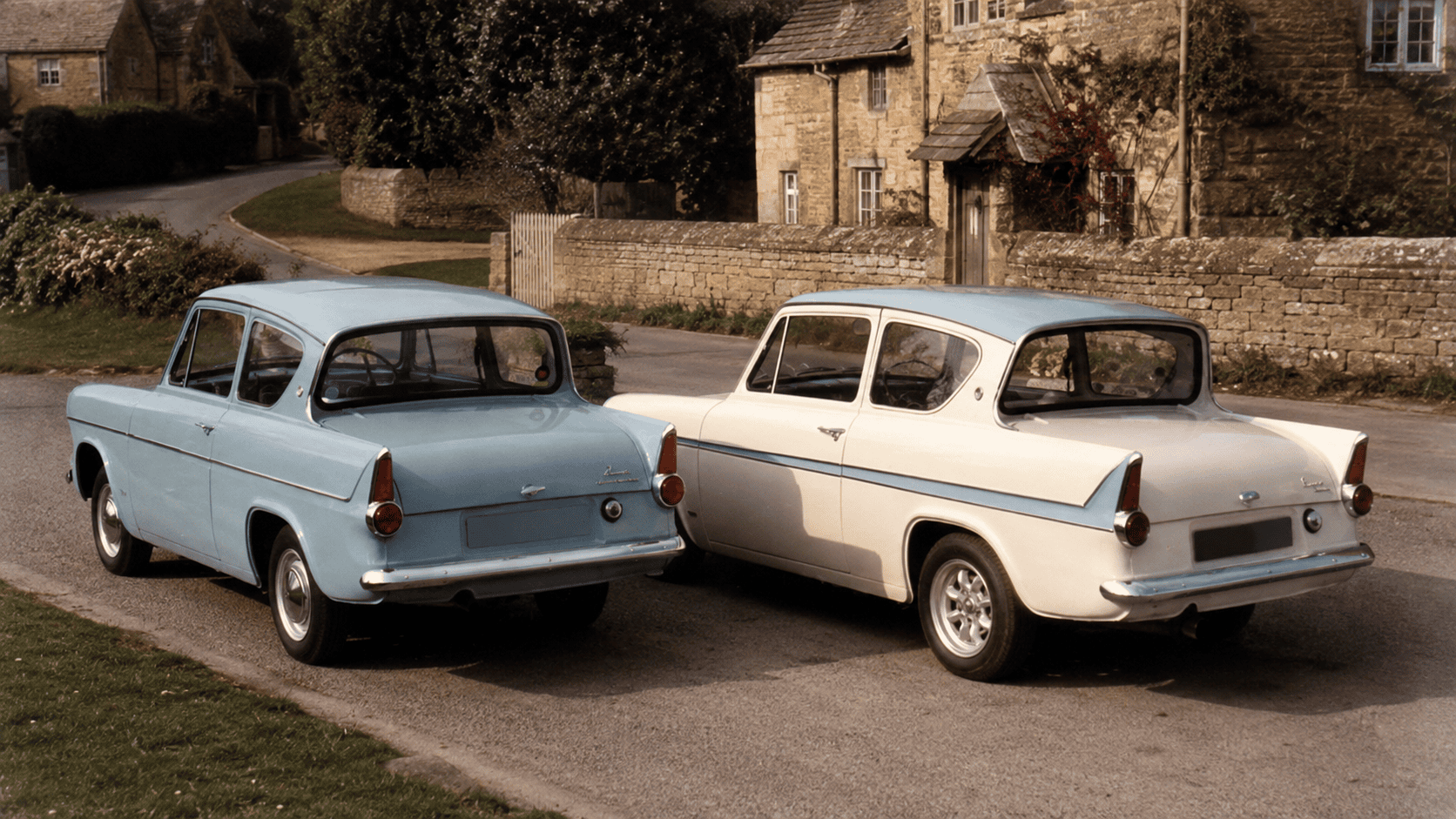
The Ford Anglia spent twenty-eight years doing what British cars of the period did best: getting people to work, getting them home again, and teaching an entire generation how to swear at a sidevalve engine in the rain. Between 1939 and 1967, Ford built 1,594,486 of them, mostly at Dagenham and later Halewood, with further assembly in Australia, New Zealand, South Africa and Rhodesia. It was never glamorous. It was never fast. But it was cheap, it was everywhere, and it has, thanks to a certain flying turquoise example in a film about wizards, become one of the most recognised classic cars on the planet.
The Anglia name covers five distinct cars. The first, the E04A of 1939, accounts for just 55,807 of that total and is now vanishingly rare. This guide covers the four you are realistically likely to encounter: the pre-war hangover E494A, the modernised-but-still-sidevalve 100E, the transformative 105E that changed Ford’s reputation in Britain overnight, and the 123E Super that gave it a proper engine to go with the looks. Each is a different car in character, price and practicality, and what you need to check before buying one differs accordingly.
The E494A (1948 to 1953): honestly, basically, a pre-war car
The E494A Anglia arrived in late 1948 as a facelift of the pre-war E04A, which was itself a facelift of the Ford 7Y, which was a rebodied Model Y. By this point, the basic design was sixteen years old and looked it. The twin-lobed grille gave it a slightly more 1940s appearance than its predecessor, but everything underneath remained firmly rooted in 1932: a 933cc sidevalve four-cylinder producing 23bhp, a three-speed gearbox, mechanical rod brakes, transverse leaf springs front and rear, and vacuum-operated wipers that slowed alarmingly under acceleration, though a vacuum reservoir went some way towards stopping them giving up altogether. Not that the problem arose very often, given the car’s 57mph top speed. A larger 1,172cc sidevalve, the Ford Ten unit, was fitted for export markets and became a home-market option from 1950.
In 1948, it was Britain’s cheapest four-wheeled car at £309 including tax. The Motor magazine tested one and recorded a 0 to 50mph time of 38.3 seconds and fuel consumption of 36.2mpg, both figures that suggest a car in no particular hurry to get anywhere but happy enough to take its time about it. Ford built 108,878 E494As before replacing the model in October 1953, at which point the old body soldiered on as the even more spartan Ford Popular 103E, which remained in production until 1959, meaning that a design from 1932 was still being sold new alongside the Space Age styling of the 105E.
Survivors are rare and tend to be cherished. If you find one, check for the usual pre-war Ford concerns: chassis and body mount corrosion, cracked king pins, and the condition of the mechanical brakes, which were never more than adequate in period and are considerably less than adequate by modern standards. Parts support comes through the Ford Sidevalve Owners’ Club, established in 1969 and covering all sidevalve-engined small Fords from 1932 onwards, with around 1,200 members worldwide and a parts remanufacturing operation.
The 100E (1953 to 1959): new clothes, old engine
The 100E looked like a new car and, in most respects, it was. A modern ponton-style body with integrated wings, individual front seats and a floor-mounted gear lever replaced the upright “sit up and beg” silhouette overnight, and Ford had clearly been watching what the rest of the industry was doing, particularly its German cousin the Ford Taunus and the larger Ford Consul. Underneath, the changes were more significant than the model is usually given credit for. The 100E abandoned the separate chassis for a unitary bodyshell, and its front suspension used coil springs and telescopic dampers in what would later be universally known as the MacPherson strut, with an anti-roll bar and semi-elliptic leaf springs at the rear. Brakes were now hydraulic, though still drums all round. None of this was a Ford first: the larger Consul and Zephyr of 1950 had brought both unitary construction and the strut to the British range, and were the first production cars anywhere to use the latter. But it was the first time any of it had reached a small Ford.
The problem was the engine. It was still a sidevalve, and although the 1,172cc unit fitted to the 100E was newly manufactured, with larger bearings and pump-assisted cooling, it shared its bore and stroke with the pre-war Ford Ten engine and produced just 36bhp. The three-speed gearbox was retained, as were the vacuum-operated wipers, which by the mid-1950s were an embarrassment. Morris had launched the Minor at the October 1948 Earls Court show, five years earlier, with rack-and-pinion steering that gave it handling the Anglia never quite matched; Ford stayed with recirculating ball to the end. On the chassis, the 100E was competitive. On the engine and gearbox, it was already a decade behind.
None of which stopped it selling. Ford shifted 345,841 100E Anglias before production ended in 1959, plus estate versions built on the shorter van shell (the basic Escort and the better-appointed Squire, which carried wood trim down the sides until 1957) and the four-door Prefect on the same platform. If you are looking at a 100E today, corrosion points include the sills, floorpans and the area around the rear spring hangers, all of which can rot without being immediately visible. Our rust prevention guide covers the principles; on a monocoque 100E, structural corrosion is a more involved repair than on the older separate-chassis cars. On the front suspension, forget king pins: check the strut top mounts, lower ball joints and track control arm bushes instead, and budget for a strut rebuild if the car wanders or knocks over bumps.
The 105E (1959 to 1967): the one that changed everything
If Ford’s earlier Anglias were cars that existed despite their engineering, the 105E was the first one that existed because of it. Launched on 30 September 1959, it was a clean-sheet design in almost every respect that mattered. The engine was Ford’s all-new 997cc overhead-valve Kent unit, the first of a family that would go on to power everything from the Cortina to Formula Ford for the next four decades. It was over-square, free-revving, and transformed the Anglia from something you endured into something you could actually enjoy driving. A four-speed gearbox (three-synchro, with first as a crash gear) replaced the old three-speed, and the vacuum wipers finally gave way to an electric motor. The MacPherson strut front suspension carried over from the 100E, so the real change in the way the car drove came from the engine and the extra ratio rather than from anything new underneath it.
And then there was the styling. The reverse-raked rear window, angled backwards in defiance of every convention of the time, is usually credited to Elwood Engel, a visiting designer from Ford USA who would later be responsible for the 1961 Lincoln Continental, though the attribution is contested and Ford of Britain’s own Birmingham studio and wind tunnel did much of the work. The feature itself was lifted from the 1958 Lincoln Continental, where it had been a by-product of a retractable rear window. Ford’s official justification was practical: it gave usable rear headroom, allowed a larger boot opening, used cheaper flat glass, and was said to stay cleaner in the rain than a conventional screen. The real reason was probably simpler. It looked like nothing else on the road, and people remembered it. They are still remembering it now.
The 105E was offered in Standard and Deluxe forms, the Deluxe distinguishable by its full-width chrome grille (the Standard had a narrower, painted version), heater and screen washers as standard, and better interior trim. The Thames 307E van arrived in June 1961 and the estate that September, taking over from the 100E-based Escort. Ford built 1,004,737 105Es in all body styles excluding vans, of which around 129,500 were factory estates, putting saloon production at roughly 875,000. In 1960, the model’s first full year, 191,752 Anglias left Dagenham, a production record for Ford of Britain; from October 1963, assembly moved to the new Halewood plant on Merseyside.
On price, the Anglia was competitive rather than cheapest. The Standard saloon launched at £589 0s 11d and the Deluxe at £610 5s 11d, against £496 19s 2d for the basic Mini and £494 2s for Ford’s own Popular. What Ford was fond of pointing out was not the price but the margin: BMC was losing money on every Mini it sold, and Ford was not.
The 123E Super (1962 to 1967): the one to have
The Anglia Super arrived in September 1962 with the 1,198cc version of the Kent engine, shared with the newly released Consul Cortina and producing 48.5bhp at 4,800rpm, a 25% increase over the 997cc unit with a weight penalty of only 12lb. It came with the Cortina’s all-synchromesh gearbox (first gear finally getting the synchro it had always needed), larger drum brakes, and a level of interior trim that would have been unthinkable on an Anglia five years earlier: carpets instead of rubber mats, a padded dashboard top, a cigarette lighter, twin horns, screen washers, and the option of leather seat trim. Externally, the Super was identifiable by its two-tone paint finish, with a contrasting colour on the roof and a side flash, plus distinctive wheel trims.
Top speed rose to around 84mph and the 0 to 60mph time dropped to a still-leisurely but noticeably improved 20 seconds or so. Ford built 79,223 123E Supers alongside continued production of the standard 105E, and the two ran in parallel until production of both ended in November 1967. The Ford Escort that replaced it was announced the following January. If you are buying a 105E-generation Anglia today, the 123E Super is the better car in almost every measurable respect, and it is not significantly more expensive. The all-synchro gearbox alone makes it a more pleasant daily proposition.
What to check before you buy (105E and 123E)
The 105E and 123E share the same bodyshell and most of the same concerns. These are the ones most buyers will be looking at, so this is where the detail matters.
- Bodywork. Inner and outer sills on both sides are the primary structural concern, along with all four jacking points. There is also a central sill section, hidden from view, that rots independently. The rear leaf spring mounting points, rear crossmember and boot floor are all prone to corrosion, as are the front corners and outer edges of the floorpans. The A-pillars rot from the base upwards, which eventually affects the door hinge mountings. None of this is unusual for a 1960s monocoque, but replacement panels for some areas can be costly, so check thoroughly. Our rust prevention guide and welding guide cover the general principles.
- Engine. The Kent engine is fundamentally strong and well understood. The 997cc version is widely held to be the more durable of the two, the 1,198cc unit having gained its extra capacity through a longer stroke. Listen for knocking at around 50mph, which indicates worn main bearings, and check for excessive fumes from the oil breather, which suggests bore wear. The tuning aftermarket for the Kent engine is enormous: Cosworth, Alexander, Holbay, Allard, Willment and others were offering performance parts within two years of launch, and the supply has never dried up.
- Gearbox and drivetrain. Gearboxes and rear axles are strong. Clutches are straightforward to replace. If the gearbox on a 105E crunches on first, that is by design (no synchro on first until the 123E); if it crunches on second or third, that is wear.
- Steering and suspension. Shimmying through the steering can indicate tracking out of true, worn front struts, or tired steering components. MacPherson strut rebuilds are a known job and parts are available. Our suspension upgrade guide covers the broader principles.
- Trim and brightwork. Chrome and stainless trim pieces can be difficult to source, particularly for the Standard model where fewer were made. Interiors are simpler: PVC seat trim is reproducible, but the dashboard and instrument cluster, if damaged, can be harder to replace to original specification.
A buying guide walk-through of the 105E, covering condition, the faults that matter and what to look at on a viewing. Worth watching before you commit to a trip to see one.
The Anglia on screen
No Anglia buyers guide can avoid Harry Potter, so we might as well enjoy it. The turquoise 105E Deluxe that flies, crashes into the Whomping Willow, and eventually goes feral in the Forbidden Forest in Harry Potter and the Chamber of Secrets (2002) is probably the single most famous classic car in British cinema that is not an Aston Martin. J.K. Rowling chose the Anglia because her school friend Séan Harris, to whom Chamber of Secrets is dedicated, owned a turquoise and white 105E that represented freedom during their teenage years in rural England. “That turquoise and white car meant FREEDOM,” she said.
The film’s special effects team, led by supervisor John Richardson, used sixteen different 105Es during production. Some were gutted and mounted on gimbals for flying sequences, others were cut in half for interior filming, others fitted with racing engines for high-speed driving, and several were progressively destroyed by the Whomping Willow. One of the surviving cars was stolen from South West Film Studios at St Agnes in Cornwall in October 2005 and later recovered, abandoned at the ruins of Carn Brea Castle; that same car is now on display at the National Motor Museum at Beaulieu.
The Anglia’s screen career extends well beyond Hogwarts, and for most British viewers of a certain age the associations are televisual rather than cinematic. Roland Rat drove a bright pink Anglia dubbed the “Ratmobile” through his TV-am years. Vyvyan in The Young Ones drove a yellow 105E with red flames painted down the sides and VYV daubed across the rear window. Ford supplied 105Es to the BBC for Z Cars from its first episode in 1962, and in Heartbeat, the ITV period drama set in 1960s North Yorkshire, an Anglia panda car became one of the show’s most recognisable props, serving alongside the black 100E used by Sergeant Blaketon. A 105E Deluxe also appears in the James Bond film Dr. No (1962) as John Strangways’ car, though he is shot getting into it rather than seen driving it, and sources disagree over whether it is green or blue. Among its more unlikely owners, Margaret Thatcher told the Daily Telegraph in October 1969, shortly after becoming Shadow Transport Minister, that she drove an eight-year-old 105E Deluxe and was “not a car snob”.
The Harry Potter effect on Anglia values is real and documented. A clean 105E Deluxe in the right shade of light blue commands a premium that has nothing to do with its mechanical specification and everything to do with a generation of viewers who grew up watching it fly. Whether that premium is a reason to buy or a reason to look at other colours is a matter of personal philosophy.
Why people buy them
The Anglia, particularly the 105E, occupies a genuinely unusual position in the classic car market. It is cheap enough to be a first classic (decent examples still come in under £10,000, and project cars well below that), simple enough to work on in a single-car garage with hand tools, and well enough supported by clubs and parts suppliers that nothing should be unobtainable for long. The Kent engine is one of the most widely understood and extensively documented powerplants in British motoring history, and a well-sorted 105E is a surprisingly enjoyable car to drive: light, responsive, and far more willing than anything with 39bhp has any right to be.
It is also, for better or worse, one of the most recognisable classic cars on the road. Whether that recognition comes from Heartbeat, Harry Potter, or simply from being a car that virtually every British family had some connection to in the 1960s depends on the age of the person doing the recognising. Either way, an Anglia draws attention that cars twice its value often do not, which is either a selling point or a drawback depending on whether you enjoy conversations with strangers at petrol stations.
Clubs, parts and support
Two clubs cover the full Anglia range between them. The Ford Anglia 105E Owners’ Club, established in 1982, covers the 105E, 123E, and their estate, van and Prefect 107E derivatives, with a spares operation, bi-monthly magazine and an active membership. The Ford Sidevalve Owners’ Club, established in 1969, covers the E04A, E494A, 100E and all earlier sidevalve Fords, maintains a database of over 5,000 surviving vehicles, and runs its own parts remanufacturing programme for components that would otherwise be unavailable. Between them, there is very little about the Anglia that is not documented, supported, and available.
For broader Ford context, our Ford Capri buyers guide and Ford Cortina buyers guide cover the cars that followed the Anglia in Ford’s UK range, and our Ford Escort specs and values guide covers its direct replacement. If you are weighing up the Anglia against other small classics of the same era, our classic Mini buyers guide, Morris Minor buyers guide and Hillman Imp buyers guide cover the main competition, and our insurance guide is worth reading before you agree a value with anyone. For the nuts and bolts of keeping one running, the electrical fault finding guide and E10 fuel system guide are both relevant regardless of which generation you end up with.
References and further reading
- Ford Anglia 105E Owners’ Club, the dedicated club for all 105E, 123E and related models, established 1982.
- Ford Anglia 105E Owners’ Club: original UK price lists, year-by-year list prices for the Standard, Deluxe and Super saloons, estates and vans.
- Ford Sidevalve Owners’ Club, covering all sidevalve-engined small Fords from 1932 onwards, including the E04A, E494A and 100E Anglia.
- National Motor Museum, Beaulieu: Ford Anglia Super 1200 123E, the museum’s notes on the top-of-the-range Anglia.
- National Motor Museum, Beaulieu: Ford Anglia 105E ‘Flying Car’, the museum’s record of the screen-used Chamber of Secrets car, including its theft and recovery.
- Classics World: Ford Anglia 105E buyers guide, a detailed inspection guide with rust-point specifics.
- Classic & Sports Car: Ford Anglia 105E/123E buyer’s guide, model-by-model timeline, trim differences and period tuning specialists.
- British Motor Museum, Gaydon, the official archive for the British motor industry, including Ford UK’s competitors.
This page contains affiliate links. If you click a link and make a purchase, Classic Car Hub may earn a small commission at no extra cost to you.