
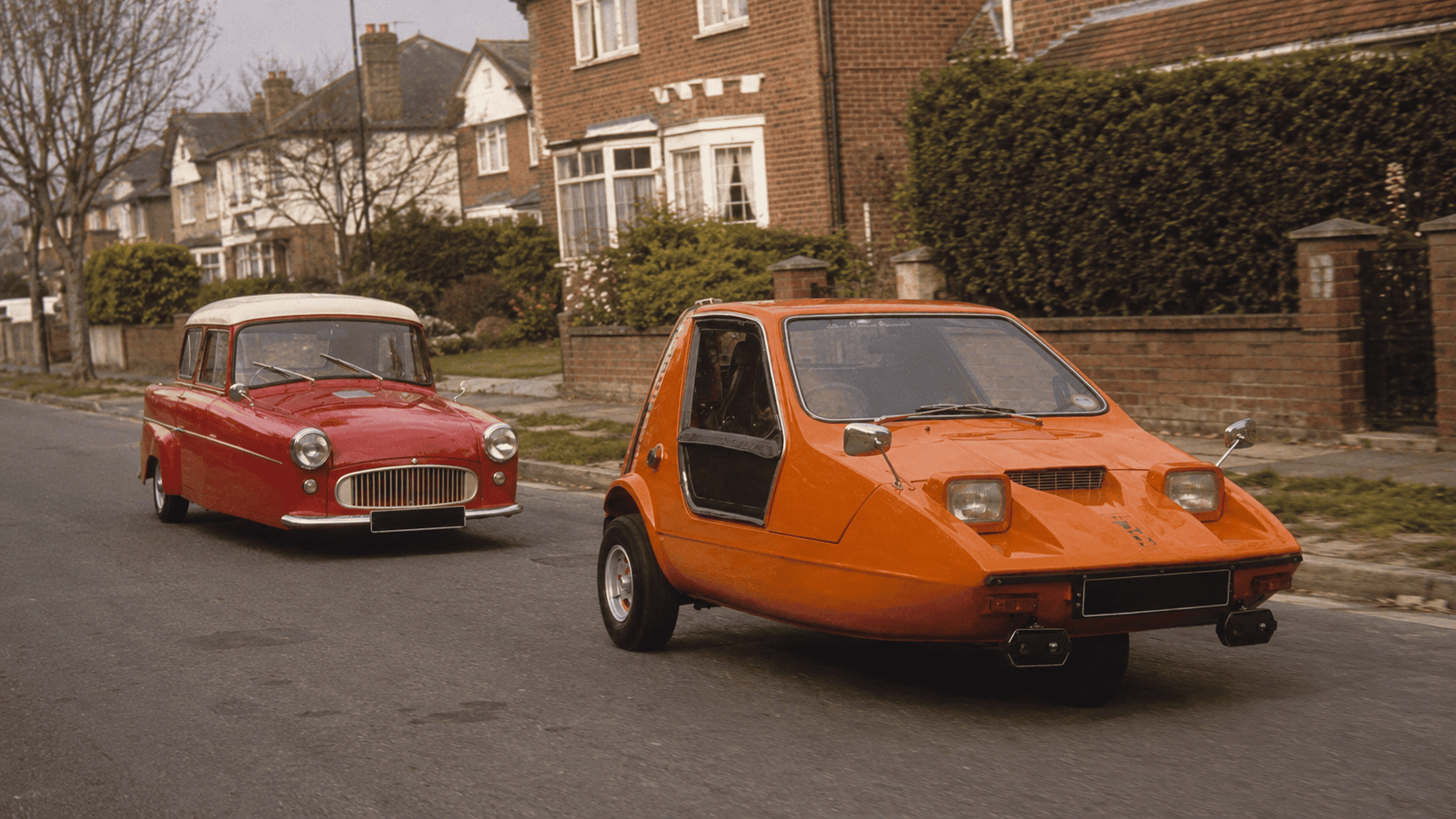
The Bond name means two completely different things depending on which decade you are standing in. Say it to someone who was young in the early 1950s and they picture a spindly, doorless, two-stroke austerity machine that their dad drove because he could not afford a proper car and it ran on practically nothing. Say it to someone who was young in 1970 and they picture an orange wedge so low and strange-looking that people turned around in the street. Both are three-wheelers. Both are Bonds. Beyond that, they share almost nothing except a company name and the engineering trick that made three-wheelers commercially attractive in Britain: the tax and licensing rules that let you run one on a motorcycle licence and pay motorcycle duty.
This guide covers the Bond Minicar in its Mark A through Mark G form (1949 to 1966) and the Bond Bug (1970 to 1974), with a note on the Bond 875 that bridges the gap. They are grouped here because they share a marque and a wheel count, but if you are seriously considering one, understand that the buying experience, the ownership culture and the practical realities are very different. Read both sections before you decide which one fits your idea of a good time.
The Bond Minicar (1949 to 1966): austerity motoring taken to its logical extreme
Lawrie Bond was an aeronautical engineer who had spent the war with Blackburn Aircraft, and it shows in the Minicar’s bones. The prototype he unveiled in 1948 was a lightweight semi-monocoque body, aircraft-thinking applied to the cheapest possible motoring. Sharp’s Commercials of Preston bought the rights and started production in December 1948, selling the first cars in 1949 for just under £200, less than half the price of a Ford Anglia E494A, which at around £310 was then Britain’s cheapest four-wheeled car. The Mark A had no doors, no front brake, no reverse gear and no roof. What they did have was the ability to return around 100 miles per gallon and a turning circle so tight you could swap ends in your own driveway. Given the post-war national mood, that was quite enough.
The Minicar’s trick is the engine mounting. The single-cylinder Villiers two-stroke engine, gearbox and drive all attach directly to the front wheel assembly, which pivots dramatically with the steering: the entire powertrain turns as one. You cannot really reverse, but you rarely need to: swing the wheel to a stop, inch forward, repeat. It is one of the most peculiar driving experiences in any classic car, and that is saying something.
The marks and what changed
The Mark A (1949 to 1951) is the raw one. Around 1,973 were made. Open body, no doors, 122cc Villiers engine producing around 5 bhp. Brakes on the rear wheels only. Aluminium bodywork throughout. Primitive in a way that is now charming if you are not the one driving it in February.
The Mark B arrived in 1951 as a modest refinement, and the Mark C of October 1952 is the point at which the Minicar became something you might actually take seriously: headlamps moved from the bonnet flanks into the front wings, a 197cc Villiers engine arrived, brakes were added to all three wheels (finally), and the steering could now swing 180 degrees, making that zero-radius U-turn genuinely possible. A single side door became standard. By 1955 production was running at a hundred cars a week.
The Mark D (from May 1956) brought a new 197cc 9E engine good for 8.4 bhp and a top speed creeping up to around 51 mph. The Mark E and Mark F continued the refinement, with fibreglass gradually replacing aluminium on the outer panels from 1955, an electric starting Dynastart system available as an option, and the choice of saloon, estate or tourer bodies. The Mark G, which arrived in August 1961 and ran until late 1966, was the finished article: winding windows, lockable doors, semi-hydraulic brakes, 10-inch wheels and, eventually, either the 11.5 bhp single-cylinder 35A Villiers unit or the 14 bhp twin-cylinder 4T Villiers giving a genuine 60 mph. An estate, a Ranger van and a tourer were all offered. Around 24,482 Minicars were built in total across all marks.
The Bond 875: the overlooked bridge model
Worth a brief mention is the Bond 875 (1965 to 1970), which bridged the Minicar and the Bug. It used the rear-mounted 875cc Rootes Imp van engine, with the same running gear as the Hillman Imp, which put it in a completely different mechanical world from the Minicar: four-stroke, water-cooled, 34 bhp, actually capable of keeping up with traffic. The fibreglass body weighed under 400 kg, and the 875 was consequently quicker than the contemporary Hillman Imp itself. Only 3,431 were made. They are rare and tend to attract a premium from those who know what they are looking at.
The Bond Bug (1970 to 1974): wedge-shaped, tangerine, and rather brilliant
By 1969 Reliant had bought Bond Cars, and the question was what to do with it. Reliant already made sensible three-wheelers for people who wanted cheap motoring. The Bond brand needed to mean something different. The answer was Tom Karen of Ogle Design, the man behind the Raleigh Chopper bicycle and the Bush TR130 radio, who produced one of the most startling shapes to come out of British automotive design in the 1970s. A wedge so aggressively low that even now it makes people stop and look, with a lift-up canopy in place of doors and side screens that pop in and out. The colour was Tangerine, because of course it was, and with rare exceptions they were all Tangerine.
The Bug was based on a chassis by John Crosthwaite, whose CV included Lotus and Cooper, using a mixture of Reliant Regal parts and running gear developed for the forthcoming Reliant Robin. The 700cc alloy four-cylinder is front-mounted and notably protrudes into the cabin, which contributes to the Bug’s famously snug interior. At 373 kg it is extraordinarily light, and despite what the power figures suggest, it does not feel slow. A top speed of 76 mph was quoted, and that is 76 mph in something nine feet long that you enter by lifting the roof. The experience is more involving than any number on paper can convey.
The variants
Three variants were offered. The basic 700 was a stripped car without side screens, with the hinged canopy held open by a simple prop rather than a proper damper or lock, and none of the deluxe fittings. Exactly one is known to have been built. The 700E was the mainstream model: side screens, heater, opening canopy with a lock and damper, polished hub caps and an interior light. The 700ES was the top of the range, distinguished by a tweaked cylinder head raising compression and power from 29 to 31 bhp, low-profile Decathlon tyres, headrests, wing mirrors, a rubber front bumper, mud flaps and a spare wheel (still an optional extra on the 700E). The alloy wheels that most Bugs seem to have today were a factory-fitted cost option on all variants. In late 1973 the 750E and 750ES arrived with the engine bored out to 748cc and power rising to 32 bhp, but fewer than 200 were made before Reliant ended production in May 1974. Total output across all variants was 2,270 cars, of which 2,264 were Tangerine and six were white, built for a Rothmans cigarette promotional campaign.
The Bug’s brief afterlife is worth knowing. Its chassis and canopy packaging turned out to be a near-perfect fit for Luke Skywalker’s Landspeeder in Star Wars (1977): an angled mirror fitted beneath the vehicle disguised its wheels to give the illusion of hovering, and the Bug’s profile became one of cinema’s more improbable immortalities. A Wheeler Dealers restoration episode gave it another generation of fans in the 2010s. New four-wheeled versions were built by the Webster Motor Company from 1990 using original moulds, and a handful of BRM-engineered 850cc overhead-cam versions were developed but never reached production.
What to check before you buy
The two cars have almost nothing mechanically in common, so the pre-purchase priorities are very different. Both reward a long look underneath and a conversation with the relevant owners’ club before you hand over any money.
Bond Minicar
The Minicar’s aluminium body does not rust in the conventional sense, but aluminium does corrode and it fatigues, particularly around the stressed areas of the front wheel assembly and the body mounting points. On the earlier open cars, check the floor section and the bulkhead where the engine pivots: this is where stress concentrates. On the later fibreglass-panelled cars the outer panels are fine, but check the aluminium inner structure and the chassis rails underneath, which can corrode from inside where water sits.
The Villiers engines are simple motorcycle units and in principle straightforward, but parts are not the same as popping to a motor factor. The Bond Owners Club is the main hub for parts and knowledge, and they are genuinely helpful, but do not assume you can cure a sick engine on the strength of common sense alone. Check for good oil pressure (what little the small sump provides), clean exhaust and a smooth, even idle. The gearbox is also Villiers motorcycle-derived and takes getting used to: there is no synchromesh in the conventional sense, and these are positive-stop units. Dynastart systems on the equipped cars often need attention on anything that has been sitting.
Crucially, the front wheel assembly on a Minicar is not just the steering, it is the entire drivetrain. Check the wheel bearings, the chain drive from the engine, and the pivot mechanism itself for wear. A worn pivot is not a minor inconvenience, it is a fundamental safety issue. Take a knowledgeable club member with you if you are new to these cars.
Bond Bug
The fiberglass body does not rust, which is reassuring, but that does not mean it is trouble-free. Check carefully for cracks and stress marks, particularly around the canopy hinge, the body-to-chassis mounting points, and the front strut attachments. Fiberglass cracks propagate, and a crack around a structural mounting is a more serious matter than a crack in a cosmetic panel. Wavy or misaligned panels are a sign of previous impact damage poorly repaired, and a fibreglass specialist is the right person to assess anything uncertain.
The steel chassis is the Bug’s Achilles heel. Reliant built to a weight limit, so the box-section chassis rails are thin, and water gets in through the rivet holes that secure the body to the frame. Once in, it rusts from the inside out. Check the chassis rails along their full length, the suspension mounting blocks, and the steering box mounting, which is a known weak point: the alloy mounting plate on the steering box has been known to crack, and cases of Bugs being driven with the box held by a single bolt are genuinely documented. New chassis are available but expensive; repair sections are an option for localised rot. Our guide to rust prevention has more on protecting a chassis once it is clean.
The Reliant 700cc engine is a known and robust unit, derived from the Austin Seven’s architecture and well understood by Reliant specialists. Check for oil leaks around the wet liners (the engine uses removable wet liners rather than a conventional bored block), overheating from a blocked or dirty radiator, and any sign of ignition or carburettor malaise from long storage. First gear has no synchromesh, which surprises new owners. The electrics use old Reliant wiring that often needs a full loom rebuild on any car that has sat for years: this is straightforward given the simplicity of the car, but plan for it. Check the front stub axle for play, the rear shock absorbers for leaks, and all the steering joints for wear.
Parts and clubs
The Bond Owners Club covers all Bond models and is the essential first stop for either car. For the Bug specifically, the Bond Bug community forum at bondbug.com and the Reliant parts world are both useful, as many mechanical components are shared with the Reliant Regal and Robin and are reasonably easy to find. For the Minicar, the Villiers engine parts situation is more specialist but the club has accumulated considerable knowledge of what is available and from where.
What to pay
Both markets are small and relatively illiquid: there are never many examples for sale at any one time, which means values can be volatile and negotiation is always worth attempting.
Bond Minicars vary enormously by mark and condition. Early Mark A and B cars in restorable condition start from a few thousand pounds and rarely reach high five figures even in exceptional order, because the ownership experience is so demanding that the buyer pool is small. Later Mark F and G cars, which are more practically usable, are more expensive and more sought after. The twin-cylinder Mk G estate is the most desirable and commands a premium. A running, usable Mk G in honest condition typically sits somewhere between £5,000 and £12,000; exceptional cars with competition history or perfect provenance have sold for more.
Bond Bugs run from around £1,500 to £2,000 for a genuinely rough project that needs everything, through £5,000 to £6,000 for a decent running car with some cosmetic work needed, to £10,000 or more for a mint, well-documented example in original specification. The 750 variants command a slight premium for their rarity. Originality matters: most Bugs have been modified in various ways over the years, and a fully original car with matching numbers is worth finding. Our classic car price checker is worth running against current listings to get a feel for the live market.
So which Bond should you buy?
They are genuinely different propositions. The Minicar is an enthusiast’s car in the deepest sense: it rewards the people who find its primitiveness interesting rather than inconvenient, who enjoy the engineering puzzle of the pivoting front wheel, who do not mind that driving it anywhere fast or far is essentially out of the question. A Mark G is the pragmatist’s entry point, the one that most closely resembles a car, with doors and windows and something approaching a heater. But it is still a machine from a different world, and you should drive one well before committing to it as a daily or even a regular-weekend vehicle.
The Bug is a different proposition entirely: it is weird enough to turn heads at every car show but practical enough, in decent weather, to actually use. The Reliant engine is easier to support than the Villiers units, spare parts are more accessible, and the club and specialist scene is active. If you want an unusual, genuinely fun classic that will prompt more conversations at a show than anything it is parked next to, this is it. The 700ES is the one to find, with its better engine tune and improved equipment, though any well-sorted Bug will deliver the experience. The 750 ES, if you can locate one, is the rarest and most capable of the originals.
Neither car is remotely sensible. Both are entirely wonderful. That is rather the point of a Bond.
Technical specifications
| Minicar Mk A | Minicar Mk C | Minicar Mk G | Bond 875 | Bug 700E / 700ES | Bug 750ES | |
|---|---|---|---|---|---|---|
| Years | 1949–1951 | 1952–1956 | 1961–1966 | 1965–1970 | 1970–1973 | 1973–1974 |
| Engine | 122cc Villiers 2-stroke single | 197cc Villiers 2-stroke single | 249cc Villiers single (35A) or twin (4T) | 875cc Rootes/Imp 4-stroke 4-cyl (rear) | 700cc Reliant alloy 4-cyl (front) | 748cc Reliant alloy 4-cyl (front) |
| Power | c.5 bhp | c.7 bhp | 11.5 bhp (single) / 14 bhp (twin) | 34 bhp | 29 bhp (700E) / 31 bhp (700ES) | 32 bhp |
| Drive | Front-wheel drive (engine pivots with wheel) | Front-wheel drive (engine pivots with wheel) | Front-wheel drive (engine pivots with wheel) | Rear-wheel drive | Front-wheel drive | Front-wheel drive |
| Gearbox | 3-speed, no reverse | 3-speed, reverse optional | 4-speed, reverse optional | 4-speed manual | 4-speed manual | 4-speed manual |
| Body | Open tourer, aluminium | Tourer/saloon, aluminium with some fibreglass | Saloon/estate/tourer, fibreglass/aluminium | Fibreglass saloon / van | Fibreglass wedge coupe with lift-up canopy | Fibreglass wedge coupe with lift-up canopy |
| Brakes | Cable/rod, rear only | Cable/rod, all three wheels | Semi-hydraulic, all three wheels | Hydraulic drums | Drums front and rear | Drums front and rear |
| Top speed | c.30–40 mph | c.45 mph | c.60 mph (twin) | c.80 mph | c.76 mph | c.78 mph |
| Weight | not documented | not documented | c.375 kg (estate) | c.395 kg | c.373 kg | c.373 kg |
| Production | c.1,973 | c.9,786 (A, B and C combined) | Part of 24,482 total Minicar production | 3,431 | c.2,070 (700 variants) | c.200 |
References and further reading
- The Bond Owners Club, covering all Bond models including the Minicar and Bug, with technical resources and spares
- Bond Bug community site and forum, the primary online resource for Bug-specific technical and buying advice
- Science Museum Group collection record for the 1950 Bond Minicar Mk A, with detailed technical description
- Octane Magazine’s Bond Bug buying guide, with detailed chassis and mechanical assessment
- Auto Express Bond Bug buyer’s guide, covering variants, production dates and parts
- Austin Counties Car Club, relevant for the Bond Bug’s Reliant engine heritage, which traces back to the Austin Seven
This page contains affiliate links. If you click a link and make a purchase, Classic Car Hub may earn a small commission at no extra cost to you.