
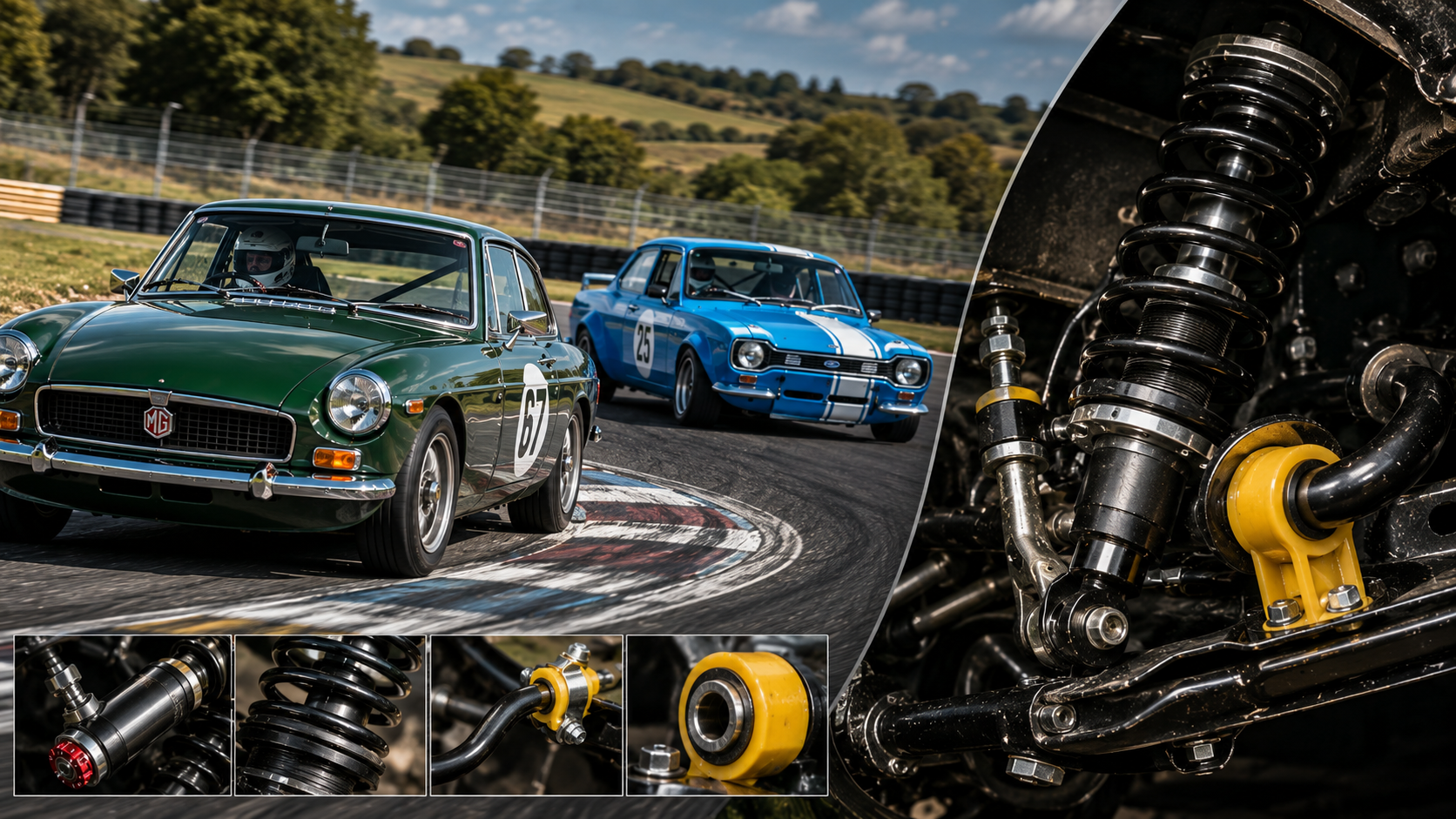
The suspension on a classic British car is one of those things that works better than you expect when it is original and correctly maintained, and significantly worse than it should when it is original and has not been maintained. The combination of fifty-year-old rubber bushes that have cracked and compressed, springs that have sagged to somewhere between the original specification and the floor, dampers that are now more decorative than functional, and anti-roll bar end links with sufficient play to qualify as a universal joint, is not a handling setup so much as a suggestion of one. The good news is that addressing all of these things is entirely achievable, moderately priced, and produces a car that handles noticeably better than the system it replaced. The less good news is that there is no natural stopping point, and the temptation to keep going toward the hardest available “everything” produces a car that is magnificent on a smooth circuit and absolutely miserable on anything the Ordnance Survey classifies as a B-road. This guide covers all of it: what each component does, how to upgrade each one sensibly, and where the road-car limit actually lies.
Understanding the suspension as a system
Before upgrading any individual suspension component, it is worth understanding how the components interact, because this is the piece of knowledge that separates a suspension upgrade that works from one that makes things worse. Springs support the car’s weight and determine ride height. Dampers control the rate at which the springs move: without dampers, a spring hit by a bump oscillates continuously, which is not a driving experience anyone has praised. Anti-roll bars connect the two sides of the suspension at one end of the car and resist body roll in cornering. Bushes allow the suspension joints to move through their designed range of motion while isolating vibration and noise from the structure.
The critical principle: these components are matched at the factory for a specific balance of ride quality and handling. Changing one without considering the others produces results that are frequently worse than the original worn setup. Fitting uprated springs to original worn dampers is the most common example: the stiffer springs move faster than the worn dampers can control, producing a car that bounces more aggressively than it did with the worn original springs. The sensible upgrade sequence runs from the bottom up: worn bushes first, then dampers, then springs, then anti-roll bars. Each layer is more effective when the layer beneath it is in order.
Dampers: what they do and what to do with them
Classic British cars used two main types of factory damper. Lever arm dampers, made by Armstrong and others, were fitted to the front of most classic British cars of the 1950s and 1960s, including the MGB and most Triumphs. On the MGB the front lever arm units double as the top wishbone of the front suspension, which means replacing them with conventional telescopic dampers requires a conversion kit rather than a simple swap. Telescopic dampers were used on the rear of many cars and in some front applications from the 1960s onwards.
The lever arm damper has a specific advantage that is often overlooked in its comparison with modern telescopic units: it is rebuildable and revalvable. Koni and Spax both offer rebuilt lever arm units for many classic British applications, with uprated valve assemblies that provide significantly better damping control than a worn original unit. Fitting these to an otherwise standard car in good condition is a worthwhile improvement that maintains the original suspension geometry. For the front of an MGB specifically, lever arm units rebuilt with the uprated Koni valve assembly transform the car’s responses without any modification to the suspension mounts or geometry.
For cars with telescopic dampers, the upgrade path is more straightforward: adjustable telescopic units from Spax, Koni, or Avo allow the damping force to be tuned to the car’s spring rate and intended use. Koni yellow adjustable units are widely regarded as the best balance of adjustability and road manners for classic British cars used primarily on the road. The adjustment range covers anything from mild road use to spirited driving, without reaching the extremes that a competition-only setup would require. Set the adjustment before fitting, starting at the softest setting and increasing by one quarter turn at a time, with a test drive between adjustments, until the response feels correct. The correct setting is the softest one at which the body motion feels controlled: it is not the hardest setting available.
Road versus track on dampers
A track car wants firm damping that keeps the tyre in contact with a smooth, consistent surface. A road car needs dampers that can deal with surface changes, expansion joints, poorly repaired potholes, and the specific lumpy inconsistency of the British road network, which was not designed with classic car handling setups in mind. The fully firmed setting on an adjustable damper that produces impressive cornering on a smooth track surface will transmit every road imperfection directly through the seat of the driver’s trousers on the drive home. There is no single setting that does both jobs equally well. Set for road. Adjust for track. Reset for road afterward.
Springs: rate, height, and the matching problem
Springs support the weight of the car and determine the relationship between wheel travel and body movement. A stiffer spring (higher spring rate, measured in pounds per inch or Newtons per millimetre) requires more force to compress by a given amount: this means less body roll in corners, more immediate response to steering inputs, and a firmer but more controlled ride. A softer spring does the opposite. Original classic car springs were generally biased toward comfort, which means they were softer than the springs on a more performance-focused car of the same era, and they were designed to work with the specific damper rates of the original equipment.
After thirty to sixty years, springs sag. A spring that has been carrying the same weight since 1965 is not providing the same resistance it did when new: it has settled, the ride height has dropped, and the suspension geometry has moved away from its design position. Fitting new springs to the original specification restores the handling to what the car was designed to deliver, and this alone often feels like a significant improvement on a car whose springs have been quietly sagging for decades without anyone noting that they were doing so.
Uprated springs for road use are typically 10 to 20 percent stiffer than the original specification and may also lower the car slightly, usually by 15 to 25 millimetres. The lowering reduces the centre of gravity and improves the suspension geometry on many classic British cars, which were designed with relatively high ride heights for the road conditions of their era. Beyond 25 to 30 millimetres of lowering, the original suspension geometry begins to operate outside the range for which it was designed, producing diminishing returns on handling and potentially adverse effects on tyre wear and steering behaviour. Lower is not always better. Lower is sometimes worse and accompanied by a bill from a tyre specialist.
The matching principle is non-negotiable: uprated springs must be matched with uprated or at minimum rebuilt dampers. Fitting stiffer springs to worn original dampers produces worse handling than the worn springs did, because the dampers cannot control the faster movement of the stiffer springs. This specific mistake is made regularly by owners who have been told that uprated springs improve handling without being told that the statement is only true when the dampers can cope with them. Do the dampers first.
Anti-roll bars: the most misunderstood component
An anti-roll bar is a torsion spring connecting the left and right sides of the suspension. When the car rolls in a corner and one side of the suspension compresses more than the other, the bar resists by transmitting some of the load to the opposite side. The result is reduced body roll. This is useful and straightforward. What is less intuitive is the effect on handling balance.
Increasing the stiffness of the front anti-roll bar relative to the rear increases understeer: the front outside tyre is loaded more heavily in corners, which reduces its ability to generate lateral grip, which pushes the front of the car toward the outside of the corner. Increasing the stiffness of the rear anti-roll bar relative to the front increases oversteer tendency. The balance between front and rear anti-roll bar rates therefore determines whether the car wants to push wide at the front or step out at the back, and getting this balance wrong when upgrading anti-roll bars is one of the more common ways of making a car handle worse than it did before the upgrade.
For the MGB, the factory competition department worked to a “hard front, soft rear” principle that balanced the car with a firmer front setup than rear. Fitting a larger rear anti-roll bar without also addressing the front, or fitting a disproportionately large rear bar, risks upsetting this balance. The rear ARB upgrade that transforms an MGB’s cornering composure is a genuine and worthwhile modification, but it works best when the front setup is already in order: uprated front lever arm dampers, original or mildly uprated front springs, and the factory front anti-roll bar in good condition with fresh bushes.
One point that is often overlooked before the anti-roll bar itself is examined: the end links and the ARB bushes. The end links connect the anti-roll bar to the suspension components it is supposed to be influencing. Worn rubber end links with significant play are effectively disconnecting the anti-roll bar from the suspension during the first few degrees of body roll, which means the bar is not doing much of anything. Replacing worn end links and ARB bushes costs a modest amount and takes an afternoon. On many cars this single job produces a noticeably more tied-down cornering response without any increase in stiffness, because the anti-roll bar is finally doing the job it was there to do all along. Check this before buying an uprated bar.
Polyurethane bushes: the compound question nobody explains
Rubber suspension bushes on a classic car age badly. The combination of UV exposure, heat cycling, ozone, and the oil that finds its way into places it was not intended to go produces bushes that are cracked, compressed, and no longer providing the geometry support they were designed for. Replacing them improves the precision of the steering and suspension response, restores the geometry to its designed position, and makes the whole front end feel tighter and more connected. This is true regardless of what material the replacement bushes are made from.
The polyurethane bush is the standard upgrade choice, and here the compound of the polyurethane matters considerably more than most guides acknowledge. Polyurethane is not a single material: it covers a spectrum of compounds from a softness similar to original rubber through to a firmness approaching metal. Race-compound polyurethane bushes, the type sold in kits marketed with the words “performance” and “handling” prominently, are at the hard end of this spectrum. They are appropriate for competition vehicles running on smooth circuits. On a road car, they transfer vibrations and harshness that the original rubber absorbed, they can produce a low-frequency thrum through the structure at certain speeds, and they require periodic greasing at the interface to prevent the squeak that develops when polyurethane moves against metal without lubrication.
The better choice for a road car is a road-compound polyurethane, of which Superflex ‘classic blue’ is the most widely recommended for classic British cars. This compound is approximately 10 percent stiffer than original rubber: enough to provide improved durability and marginally better geometry stability, but not enough to fundamentally change the car’s character or introduce harshness. At 10 percent stiffer than rubber, the improvement in precision is perceptible but subtle. The improvement in durability over rubber is substantial: polyurethane does not crack, does not degrade with oil exposure, and does not compress over time in the way that aged rubber does. The road-compound bush is the correct choice for any classic car that is used on public roads and expected to provide a civilised driving experience.
All polyurethane bushes require grease at installation. This is not a step that can be skipped in the name of cleanliness: without grease at the bush-to-metal interface, the polyurethane squeaks under load with a persistence that is difficult to live with. Use a proper polyurethane-compatible grease (most bush kits include a small sachet; if not, Copaslip or a red rubber grease works adequately). Apply to both the inside bore of the bush and the outer sleeve. Reapply at the recommended intervals: most polyurethane bush manufacturers specify regrease every two to three years, accessible via the grease nipples fitted to quality bush kits.
Road versus track: the honest conversation
There is a specific type of classic car owner who has fitted the stiffest available springs, the hardest polyurethane bushes in the catalogue, the largest available anti-roll bars at both ends, and fully firmed adjustable dampers, and who drives their car with the conviction that this is an improvement. On a smooth circuit, they are correct. On the B4044 in January, they are correct in a different sense entirely.
A track-specification setup on a road car produces a vehicle that follows the camber of the road aggressively, transmits surface texture to the steering and seat simultaneously, becomes genuinely tiring over distance, and invites the occupants to experience every drain cover as a personal message from the road surface. This is not handling. It is stiffness, which resembles handling on smooth surfaces and reveals itself as something else entirely on typical British roads.
The honest road-car recommendation is modest by the standards of the suspension upgrade market: fresh road-compound polyurethane bushes, rebuilt or uprated dampers (lever arm or telescopic depending on the car), springs to the original specification if sagged or mildly uprated (10 to 15 percent) if the original rate was always softer than the driving style demands, and well-maintained anti-roll bars with correct bushes and end links. This produces a car that handles noticeably better than standard without having been made uncomfortable. It is also the setup from which any further upgrade is meaningful, because the baseline is correct. Going beyond this point requires a clear purpose and an honest answer to the question of what the car is actually used for.
Where to start: the sensible upgrade path
If the car has never been touched and is running on original suspension components of unknown age, start here: inspect every bush visually and by feel. Cracked, compressed, or oil-contaminated rubber should be replaced. Check anti-roll bar end links for play. Check the ride height: if the car sits lower at one corner than the others, a spring has sagged. Bounce each corner and confirm the damping feels progressive and controlled rather than bouncy or dead.
Replace like-for-like first. If the car after fresh bushes, rebuilt dampers, and new springs to the original specification still does not handle as well as you want it to, then consider mild uprating of the damper settings and a 10 to 15 percent spring rate increase. Add an uprated rear anti-roll bar if the car does not have one and you are specifically finding the rear end loose in fast corners. Assess the result before continuing.
The suspension component suppliers with the best coverage of classic British cars are Superflex (bushes), Koni and Spax (dampers), and the marque specialists for application-specific springs and anti-roll bars. For the MGB, Brown and Gammons and Frontline Developments both offer comprehensively specified suspension upgrade kits that take the matching question out of the equation. For Triumph applications, Rimmer Bros and the TSSC spares operation cover the full range. Buying matched kits from a specialist is considerably more reliable than selecting individual components from different suppliers and hoping the rates are compatible.
For related reading: our adding lightness guide covers the performance gains from weight reduction that complement a suspension upgrade, our rust prevention guide covers treating the suspension mounting points and chassis areas exposed during a bush replacement, our workshop safety guide covers correct procedures for supporting the car during suspension work, and our tool kit guide covers the specific tools that make bush replacement and damper work manageable rather than frustrating.
This page contains affiliate links. If you click a link and make a purchase, Classic Car Hub may earn a small commission at no extra cost to you.