
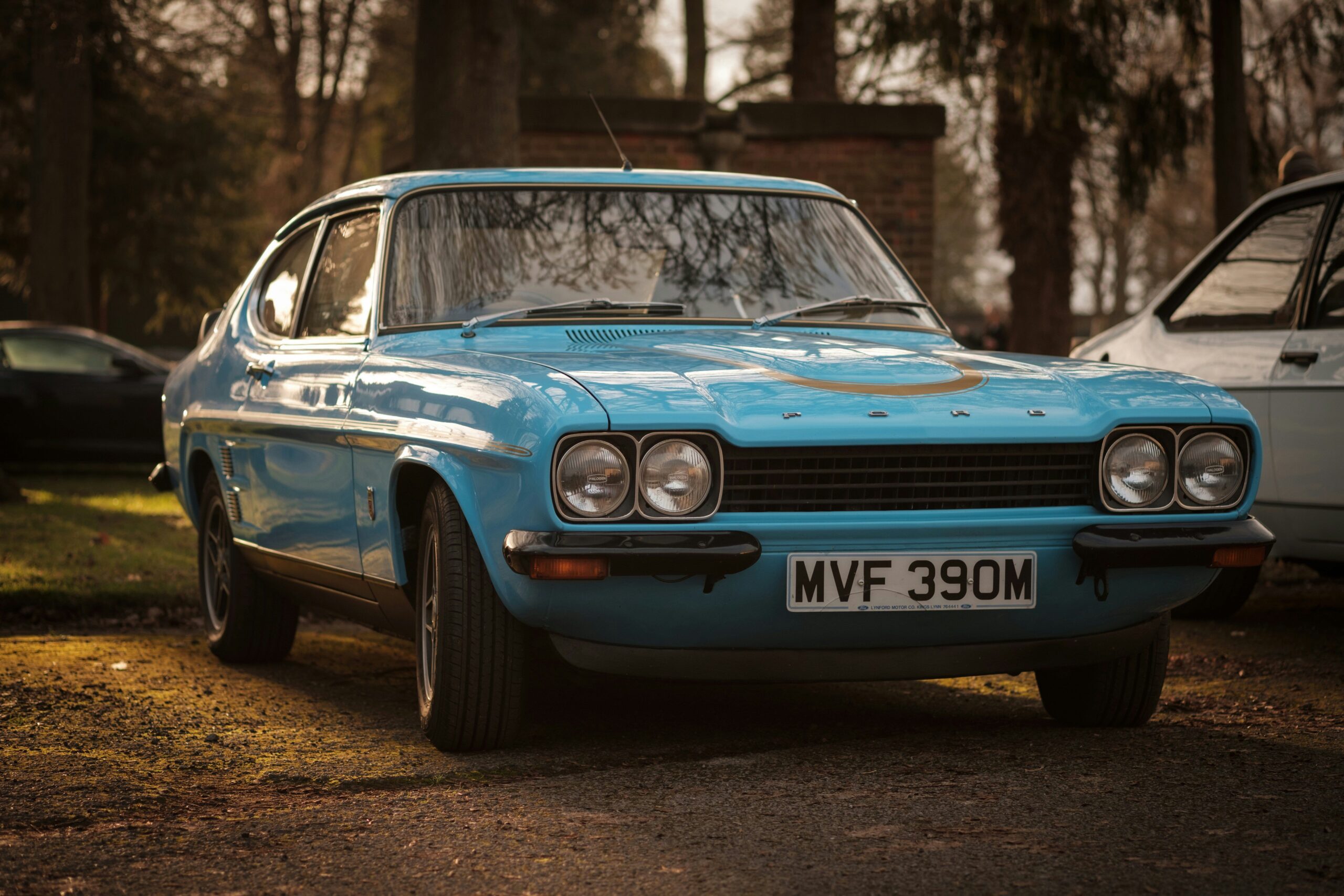
There are cars that are merely good, and then there are cars that mean something. The Ford Capri falls firmly into the second category. Launched in 1969 with the tagline “the car you always promised yourself” it was not underselling itself. Here was a proper fastback coupe with a long bonnet, a sporting interior, rear wheel drive, and a range of engines that went from economical to genuinely exciting, all at a price that ordinary working people could actually afford. Nearly two million were sold before production ended in 1986. If you want to understand why that number is so significant, consider that the E-Type, which was considerably more glamorous and received considerably more press attention, sold fewer than 73,000 over a similar period. The Capri was a car for everyone. That was its genius and it remains its appeal today.
The story behind the car
The Capri’s origins lie with the Ford Mustang, which had caused something close to hysteria when it launched in the United States in 1964. Ford’s European management watched the American sales figures and drew the obvious conclusion: Europe needed its own version of the affordable sporting coupe formula. Work began in 1965 on a car originally codenamed the Colt, a nod to its American inspiration. The styling was handled by American designer Philip T. Clark, who had also worked on the Mustang, which explains why the Capri’s long bonnet, short tail and fastback roofline feel transatlantic rather than purely European.
The Colt name had to be abandoned when it was discovered that Mitsubishi had already registered it. Ford lost the subsequent court case and the car was renamed the Capri, borrowing the name from an earlier Ford Consul Capri of the early 1960s. Production began at Halewood in Liverpool and at Ford’s Cologne factory in November 1968, and the car made its official public debut at the Brussels Motor Show in January 1969. UK sales began in February 1969 with a starting price of £890 for the entry level 1300, which is roughly £14,000 in today’s money. For that you got a genuinely attractive sports coupe. Ford had done their sums correctly.
The response was immediate and emphatic. Ford had to double production at both factories to keep up with demand. A quarter of a million cars had been built within little more than a year. The millionth Capri rolled off the line in August 1973, fittingly an RS2600 built in Germany. By the time the last car was produced on 19 December 1986, the total stood at 1,886,647. The Capri had also become, by that point, one of the most stolen cars in Britain, which is its own kind of compliment.
The three generations
Mk1 (1969 to 1974)
The original Capri was built around a platform borrowed from the Cortina and Escort, which kept costs down and gave Ford’s engineers a proven and well-understood starting point. UK market cars were offered with 1.3 and 1.6 litre Kent four-cylinder engines at the lower end of the range, a 2.0 litre Essex V4, and from September 1969 the 3.0 litre Essex V6, the engine that made the headlines and gave the Capri its hairy-chested reputation. The first major facelift came in 1972, bringing a new bonnet with a bulge as standard, a redesigned dashboard that would serve the car for the next fourteen years, revised rear suspension, and larger lights front and rear.
Mk1 cars have the most distinctive styling with the longest bonnet and cleanest early proportions. Good original examples are increasingly scarce. They are the most desirable to purists and priced accordingly. The fake rear air vents on the rear wings, which served no functional purpose whatsoever but looked tremendous, are at their most pronounced on early cars and were a detail that owners either loved or found faintly ridiculous. Most loved them.
Mk2 (1974 to 1978)
The Mk2 was a significant reworking rather than a minor refresh. The tail was shortened and a proper tailgate hatchback replaced the Mk1’s fixed rear, making the Capri considerably more practical for everyday use. The interior was improved and widened. The Mk2 is the least loved of the three generations by many enthusiasts, partly because the shortened tail reduced the visual drama of the long-bonnet-short-tail proportions that defined the original, and partly because it arrived just as the oil crisis was making large-engined sporting cars briefly unfashionable. This makes it the most accessible of the three generations at present, which is another way of saying it represents good value. The 3.0 S in Mk2 form was capable of 0-60mph in 8.9 seconds and 123mph, figures that were seriously competitive for the money.
All UK production moved to Ford’s Cologne factory in 1976. Halewood’s involvement with the Capri was over.
Mk3 (1978 to 1986)
The Mk3 arrived in March 1978 with revised aerodynamics, a redesigned bonnet that hung forward over the headlamps giving the car a scowling, purposeful front end, twin halogen headlamps, and a front spoiler. The aerodynamic changes reduced drag and improved fuel consumption by around ten percent, which was exactly the right message for the late 1970s. The Mk3 is the most commonly available of the three generations and the most familiar to most people, partly because it survived the longest and partly because it featured heavily in popular culture throughout the 1980s.
The Mk3 is also where the most interesting engines live. The 2.8 litre Cologne V6 fuel injected engine arrived in 1981 producing 160bhp, good for 0-60mph in 7.9 seconds and a top speed of around 130mph. At its asking price this made it a genuine rival to the Porsche 924. The 2.8i is the engine most serious Capri buyers want, and values for good examples reflect that consistently.
Which engine?
The Capri’s engine range across its production life was extensive, and knowing which unit you are looking at matters considerably when assessing a car.
Kent 1.3 and 1.6
The entry level engines, fitted to base model cars primarily in the Mk1 and Mk2 era. Reliable enough, simple to work on, and with the parts availability you would expect from a Ford unit used across a range of models. The 1.3 in particular is genuinely too slow for modern road use and is best described as a car for sunny Sunday mornings at modest speeds. The 1.6 Kent is more usable but still falls short of what the car’s styling promises. These are the cheapest cars to buy and insure, and they have their own following among purists who want an original low-specification car. Everyone else should look at the larger engines.
Pinto 1.6 and 2.0
The overhead cam Pinto engine arrived with the Mk2 facelift of 1972 and remained available through the Mk3. The 2.0 litre version is the four cylinder engine of choice for most buyers, offering a genuine step up in performance over the Kent units with enough torque to make the Capri feel properly alive on a country road. It is also easy to tune and widely understood, with a thriving aftermarket. The single-choke Ford VV carburettor fitted to L specification models is notoriously difficult to set up and prone to cold starting issues. Most surviving examples have been replaced with a twin-choke Weber, which is a sensible and reversible modification that transforms the engine’s manners. The Pinto’s known weakness is camshaft wear, which shows up as a distinctive rattle from the top end, and timing belt condition should be checked carefully on any example.
Essex V6 3.0
The 3.0 litre Essex V6 is the engine that made the Capri famous and it remains the one most buyers aspire to. It is an all-iron unit that is heavy but extremely robust, and it pulled the Capri from motorway speeds in top gear, which is a quality that never gets old. The Essex V6 was available throughout the Mk1, Mk2 and early Mk3 production and was replaced by the Cologne 2.8i in 1981. Known weaknesses include warped cylinder heads and blown head gaskets, particularly on engines that have overheated at some point, and the plastic timing gears which are often upgraded to steel replacements. The steel replacements are noisier but considerably more durable.
Cologne 2.8i
The 2.8 litre Cologne V6 with Bosch K-Jetronic fuel injection is the engine that defines the later Capri for most enthusiasts. 160bhp, 130mph, 0-60 in 7.9 seconds, and a sound that makes the most mundane journey feel like an occasion. It is the engine to have if budget allows. The K-Jetronic injection system is reliable in normal use but has a well-known vulnerability: if the car has been standing unused for any length of time the system can fill with rust from condensation in the fuel lines, which requires professional attention to remedy. Any 2.8i being considered after a period of storage should have its injection system thoroughly checked before purchase. Early 2.8i cars came with a four-speed gearbox. Later examples and the Injection Special had a five-speed, which transforms the motorway manners considerably and is well worth seeking out.
The special editions
Ford produced a number of special editions and performance variants of the Capri that are worth knowing about, both because they are the most desirable cars and because some of them have been faked.
RS2600 and RS3100
The RS2600 was a homologation special based on the Mk1, built for European Touring Car Championship racing. It used an injected 2.6 litre Cologne V6 producing around 150bhp. The RS3100 was its successor for Mk2 era competition, using a 3.1 litre Essex V6. Only 250 RS3100 road cars were built, making them extremely rare and extremely valuable. Both cars are documented and verifiable through the RS Owners Club and the Capri Club International. Do not buy either without proper provenance checking.
X-Pack
The X-Pack was a factory option package for the 3.0 litre V6 Capri available on Mk2 and Mk3 cars between 1977 and 1980. It included a fibreglass wide body kit by Fibresports, Bilstein dampers, a Salisbury limited slip differential and uprated brakes. The performance version of the X-Pack, called the Group 1, boosted the Essex V6 to 170bhp through larger valves, ported heads and a Weber 40 carburettor. Genuine X-Pack cars are valuable. Standard cars wearing X-Pack bodywork are not, and retrospective X-Pack conversions are very common. Check carefully before paying a premium for the specification.
Capri 280 Brooklands
The last Capri, and the most sought after. Ford built exactly 1,038 Capri 280s for the UK market in 1986, all finished in a specific shade of green called Brooklands, all with full leather Recaro interior, a limited slip differential and Pirelli Cinturato P7 tyres. It was intended to be a turbocharged car producing around 230bhp and badged the Capri 500, but the turbocharger programme was cancelled and the cars were completed as high-specification 2.8i models instead. Good examples fetch up to £40,000 and more. The last one registered, in November 1989, is the only G-registration Capri in existence.
The Capri on screen
The Capri accumulated more screen time than most cars could dream of, and it was never playing a background role. In The Professionals, Bodie drove a 3.0 litre Capri for much of the series, which did the car’s image no harm whatsoever with a generation of viewers. Later, a gold 3.0 litre Capri became one of the most recognisable cars in British television when it appeared throughout Auf Wiedersehen Pet, driven by Neville. The Capri also appeared in The Sweeney, in Minder, and in dozens of other British productions of the 1970s and 1980s. It was the car of the era in a way that no single vehicle has managed to replicate since. If you want a car that carries genuine period authenticity rather than manufactured nostalgia, the Capri has it in abundance.
Common issues to watch out for
The Capri is a rewarding classic to own and maintain, but it is not without its challenges. The mechanical side is generally straightforward and well understood. The bodywork is where the real difficulties live, and on a car of this age and construction they can be significant.
Rust: the main event
The Capri rusts with considerable commitment. Every panel on the car can be affected, but the structural areas are the ones to check most carefully. The front suspension turrets in the inner wings are a critical rust point and expensive to repair properly. The A-pillars rot from the inside out, with bubbling paint on the scuttle being a tell-tale sign of serious rot inside. The sills, floor pans, chassis rails and rear suspension mounts are all vulnerable. The outer and inner front wings rot around the headlamp surrounds and at the rear quarters. The boot floor and fuel tank mounting area corrodes badly. The front valance and panel around the grille are known problem areas. The bonnet is particularly prone to rust and good original ones are increasingly difficult to find, with plastic reproduction bonnets now available as an alternative.
Where visible rust is absent, assume filler until you have established otherwise. A magnet drawn over suspect areas will locate filler beneath paint where the panel response changes. Probe suspect areas firmly with a screwdriver and do not be embarrassed about doing so. A car that cannot withstand a proper inspection does not deserve the asking price.
V6 head and gasket issues
Both the Essex and Cologne V6 engines can suffer warped cylinder heads and blown head gaskets, particularly on cars that have overheated at any point. Check the coolant carefully for any signs of contamination, look for white smoke from the exhaust that persists once the engine is fully warm, and watch the temperature gauge throughout a test drive. A V6 that has been running hot will often show mayonnaise-like emulsification around the oil filler cap, which is a clear warning sign. The plastic timing gears on the V6 engines are a known failure point and many cars have had them upgraded to steel. Ask whether this has been done.
Pinto camshaft wear
The 2.0 litre Pinto engine suffers from camshaft wear, which typically presents as a rattle from the top end, particularly when cold. This is caused by poor oil circulation to the camshaft on start-up and is more pronounced on higher mileage engines or those that have not been regularly serviced. A light tapping that clears once warm is less concerning than a persistent rattle. Check the oil level and condition carefully and ask about service history. A Pinto with a well-documented service record is considerably preferable to one without.
Gearbox issues
The four-speed gearbox fitted to most Capris is generally robust but check for baulking on second gear engagement and any tendency to jump out of second or third on the overrun, both of which indicate worn synchromesh or selector components. Propshaft rumble or vibration on Mk3 cars with the five-speed gearbox warrants investigation. The differential on V6 cars should be quiet in all conditions. Limited slip differentials fitted to some performance models require a specific oil and can become noisy if the wrong type has been used.
The VV carburettor
The Ford Variable Venturi carburettor fitted to L specification Pinto models is one of the least fondly remembered pieces of equipment on any British car of the 1970s. It is complex, temperamental, prone to cold starting difficulties, and difficult to tune correctly. Most surviving cars have had it replaced with a twin-choke Weber carburettor, which is an entirely sensible modification. If a car still has the original VV carburettor and is starting poorly or running unevenly, budget for a Weber replacement rather than attempting to cure the original unit.
2.8i injection system
The Bosch K-Jetronic mechanical injection system on the 2.8i is reliable in regular use but vulnerable to corrosion if the car has been standing. Rust particles in the fuel system can block the injectors and damage the fuel distributor, which is an expensive component to replace. Any 2.8i that has been in storage or lightly used for a period should have its injection system inspected by a specialist before purchase. Running the car from empty and refilling with fresh fuel is good practice on any example that has been standing.
Brakes and suspension
Seized brake calipers are common on cars that have been used infrequently. Warped front discs cause brake judder that is immediately obvious on a test drive. Check the track control arm bushes for wear, which produces vague, imprecise steering. The front strut top mounts deteriorate with age and worn examples allow the suspension to move in ways that were not part of the original design. On the rear, check the leaf springs for broken leaves and the dampers for leaks. Many Mk3 cars are now over forty years old and have been exempted from MOT testing, which makes a thorough independent inspection before purchase more important than ever, not less.
Interior trim
Interior trim is an area where the Capri has genuine parts availability challenges. Seat bolsters on Recaro-equipped cars are commonly threadbare. Dashboard tops crack and are very difficult to source in good condition. Non-standard black trim is the most available but any car with coloured interior trim faces a difficult sourcing situation for replacement parts. A car with a tatty exterior but an immaculate interior may actually represent better value than the alternative, precisely because the interior is the harder thing to put right. Walk away from any car with a seriously deteriorated cabin unless you are prepared to live with it indefinitely.
Fake cars
The Capri’s value hierarchy, with 2.8i and 3.0 litre cars worth considerably more than four-cylinder examples, has inevitably produced a market in cars that are not what they claim to be. Engine swaps are common and not always disclosed. Bodyshells wearing 3.0 litre badges that left the factory with 1.6 litre engines are not rare. X-Pack bodywork is widely fitted to standard cars. RS badged cars may be neither RS2600 nor RS3100. Verify the engine number and the VIN against factory records before paying a premium for any specific specification. The Capri Club International can assist with verification on significant purchases.
What to pay
Capri values have been rising steadily for several years and the days of cheap examples being plentiful are over. The best cars are now genuinely expensive. A tidy 1.6 or 2.0 litre Mk3 in usable condition asks between £8,000 and £14,000. Good 3.0 litre examples start around £12,000 and stretch to £20,000 for the best cars. The 2.8i commands a premium throughout its range, with good drivers asking £14,000 to £20,000 and exceptional examples exceeding that. Capri 280 Brooklands cars in good condition are now £30,000 to £40,000 and above. RS cars and documented X-Pack originals are priced individually based on condition and provenance. Any car significantly below these figures warrants very careful scrutiny of why it is so cheap. On a Capri, the answer is almost always rust.
Before you buy
The Capri Club International is the primary club resource for buyers and owners alike, with technical advice, parts sourcing assistance, and the ability to verify VINs and specifications on significant purchases. Membership is well worth having before you start looking rather than after. The club’s spares operation has brought many discontinued items back into production, though some parts remain genuinely scarce.
Classic car insurance on an agreed value policy from a specialist insurer is strongly recommended. The Capri’s value has been rising and an agreed value policy ensures you receive what the car is actually worth in the event of a total loss, rather than whatever a standard policy’s assessor decides the market value is on the day of the claim. Get a quote before you commit to the purchase so there are no surprises, and make sure the agreed value is reviewed annually as the market continues to move.
One final thought. Ford’s advertising line for the Capri was “the car you always promised yourself.” Over fifty years later it still works. If you have been promising yourself one, the time to buy is before the market makes good examples genuinely unaffordable. That time may not be far off.
Before you make an offer, check current market values with our free classic car price checker — estimated UK values by condition grade with live eBay listings alongside, so you can see what cars are actually selling for right now.
This page contains affiliate links. If you click a link and make a purchase, Classic Car Hub may earn a small commission at no extra cost to you.