
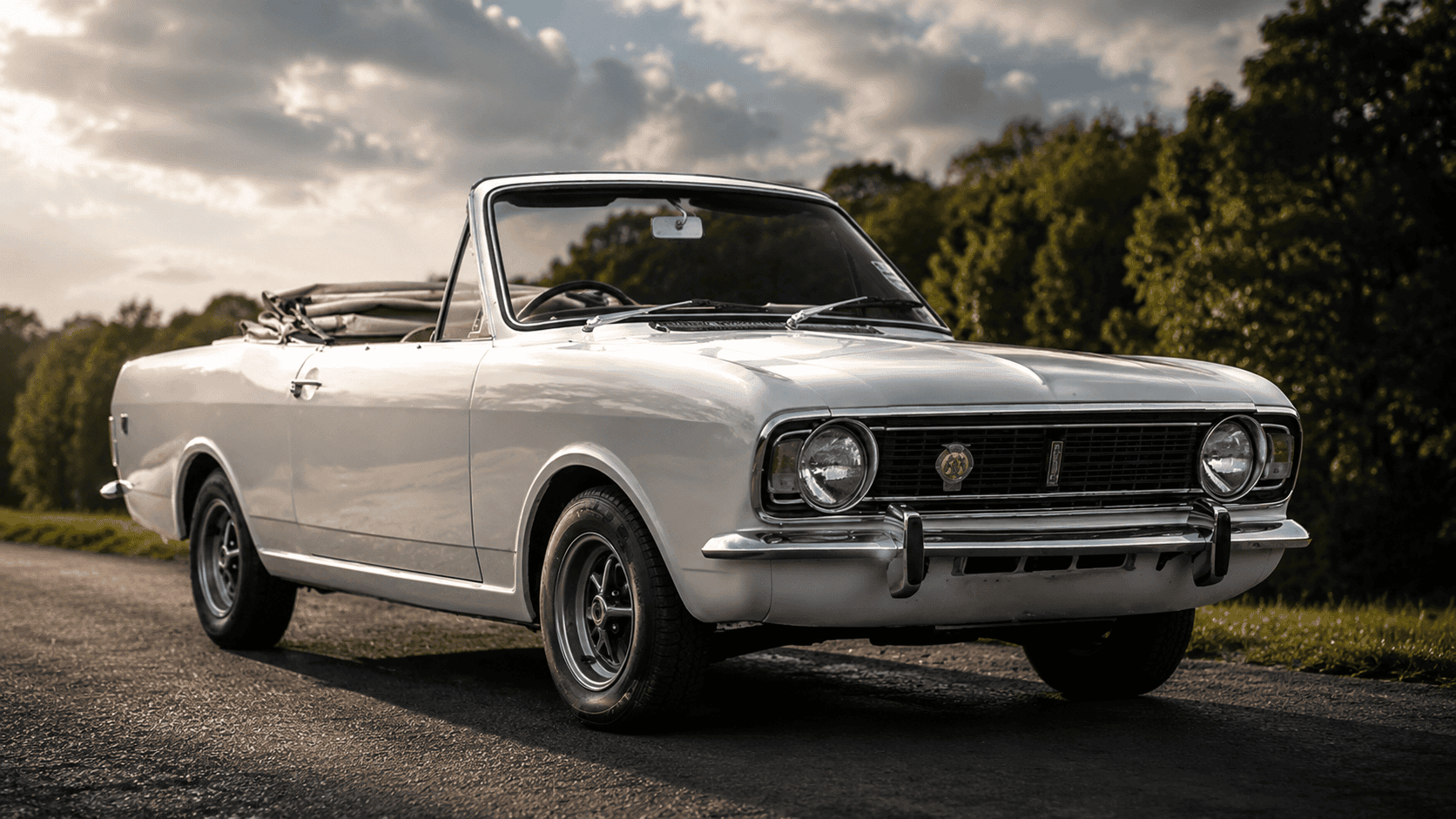
For most of the 1960s and 1970s, the Ford Cortina was simply the car. Not a car. The car. The one in the company car park, the one in the neighbour’s drive, the one that sales reps drove to meetings in and families drove to Cornwall in and that appeared, if you watched enough British television, in the background of almost every street scene shot anywhere in the country during the years when television was still capable of making a Cortina look glamorous. It was Britain’s best-selling car for most of its production life, built in Dagenham from 1962 to 1982, and it sold in such quantities that finding a pristine survivor is harder than finding rust in a neglected one. The Cortina was not built to last. It was built to sell, and in this particular objective it succeeded comprehensively, racking up over four million examples across five generations before the Sierra arrived with its aerodynamic body, its jelly-mould reputation, and the complete dismantling of everything the motoring press thought they knew about what Ford customers wanted. They wanted the Cortina. Ford gave them something better. It took years to forgive them.
This guide covers all five generations, from the clean-lined 1962 original through to the Cortina 80 Mk5 that closed out production in 1982. Five generations means five distinct cars in terms of bodywork, engines, and character, which is one more distinction than most buyers appreciate when they first start looking. The Cortina that appeals because of its association with Jim Clark and the British Touring Car Championship has almost nothing in common with the Cortina that appears in memories as the company car Dad drove in 1979. Both are Cortinas. Both are worth knowing about before money is committed to either.
Mk1 (1962–1966): the one that started it all
The original Cortina launched in September 1962 as the Consul Cortina, a name Ford sensibly abbreviated within months once it became clear that nobody was going to use it. Styled with the American influence that Ford’s British operation had not quite shaken off but was beginning to deploy with more restraint, it had tail fins that were already slightly behind the times on its launch date and headlamps that wore a mildly surprised expression. Both of these things became charming within a decade and are now among the Mk1’s most recognisable features. The construction was deliberately light, the engineering deliberately straightforward, and the pricing deliberately aggressive. One million were built in four years, which is as much a measure of the formula’s correctness as any amount of critical analysis.
The engine range ran from the 1,198cc Kent unit to the 1,498cc version, with the sporting GT using a Cosworth-tuned 78 bhp version of the latter that made it genuinely quick by 1960s British standards. The Lotus Cortina, jointly developed with Colin Chapman’s team and raced to legendary status by Jim Clark in the 1964 European Touring Car Championship, sits at the top of the Mk1 hierarchy and deserves a guide of its own; it will not be covered here in depth, partly for reasons of word count and partly because the Lotus Cortina market is sufficiently specialist and sufficiently expensive to be a different conversation from the one most buyers are having.
The GT is the most desirable non-Lotus Mk1 variant, and consequently the most faked. The registration document will not identify a genuine GT: check the Vehicle Identification Number. After the initial two-letter prefix, a genuine two-door GT carries the digits 77 in the VIN, and a four-door GT carries 78. A car presented as a GT without these digits in the correct position is wearing aspirational badging rather than factory specification. There is a lot of it about.
Mk2 (1966–1970): wider, heavier, and more civilised
The Mk2 arrived in October 1966 on the same basic floorpan as the Mk1 with a wider, longer body that Ford described as more spacious and the motoring press described as more American, the two being broadly the same observation from different perspectives. The tail fins were gone. The glasshouse was larger. The character was recognisably the same but noticeably more polished, and from September 1967 the Kent engine was replaced by Ford’s new 1.3 and 1.6-litre Crossflow units, which were livelier, more reliable, and considerably more pleasant to use than their predecessors.
The jewel of the Mk2 range is the 1600E, introduced in 1967 and standing for Executive: a Rostyle-wheeled, wood-veneered, vinyl-roofed executive express that Ford positioned as the thinking person’s alternative to a Rover. It had no right to be as convincing as it was at this task. The combination of the 1.6 Crossflow, a reasonably well-appointed interior, and the visual signature of the Rostyle wheels produced a car that looked considerably more expensive than it cost and drove rather better than the specification suggested. The 1600E is the most desirable Mk2, commands the highest prices in the market, and is therefore the most likely to be incorrectly described in a listing. Verify the specification against the VIN before making any decisions based on trim level claims from a seller.
Over 1,024,869 Mk2 Cortinas were built before the Mk3 replaced them in 1970, which is the kind of production figure that creates a false sense of security about how many decent survivors remain. Most of those cars were driven, rusted, repaired, driven again, rusted more thoroughly, and eventually scrapped by owners who did not know that in forty years anyone would care what had happened to them.
Mk3 (1970–1976): the Coke bottle Cortina
The Mk3 was such a dramatic departure from its predecessors that people within Ford’s product planning department argued it should have a different name entirely. They lost the argument, the car got the Cortina badge, and the American-influenced “Coke bottle” styling with its kicked-up rear haunches and dramatically sculpted flanks became the most immediately recognisable Cortina shape in the model’s history. Inside, the sloping dashboard looked as though it had been lifted from a contemporary Mustang, which was not entirely accidental. Ford knew their audience.
The Mk3 was also the first Cortina to share a platform with its German Taunus equivalent, introducing the 2.0-litre Pinto single-overhead-camshaft engine that would remain in Ford’s European range for nearly three decades. The Pinto is a generally excellent engine with one specific and non-negotiable maintenance requirement: the cambelt must be changed every 30,000 miles. A snapped cambelt on a Pinto is a catastrophic engine failure rather than a minor inconvenience, and the number of surviving Mk3, Mk4, and Mk5 Cortinas with no documented cambelt service history is a number that makes specialists reach for their quotation pads before the viewing is even concluded. Any car presented without cambelt history represents a known, immediate liability that should be budgeted at the outset rather than discovered afterward.
A major facelift in 1973 cleaned up the styling and introduced the 2000E as the range-topper, replacing the GXL that had been doing the executive express work since launch. The 1600E returned to acknowledge that the Mk2’s popular trick of dressing a sensible car in executive clothes had lost nothing in appeal. The GT, GXL, and post-facelift Ghia trim all command premiums over base cars, and the 2000E is the smart buyer’s pick in the current market: a GXL-beater that is currently selling for noticeably less than a 1600E in equivalent condition despite being, by most rational measures, the better car.
The Mk3’s notorious rear void bushes deserve specific mention because they are legendary and because the legend is entirely accurate. Fitted to the rear trailing arms and differential housing, there are eight of them, and they wear with a speed and thoroughness that suggests Ford may have been optimistic about the expected service life. The first sign is handling that steadily deteriorates; the confirmation is being able to rock the rear of the car from side to side by hand with the enthusiasm of someone who knows what they are looking for. Polyurethane replacement bushes are available and transform the handling; most owners find them too firm and live with regularly replacing the rubber originals instead. This is a Mk3 Cortina ownership experience rather than a fault finding exercise.
Mk4 and Mk5 (1976–1982): the pragmatic finale
The Mk4, launched in September 1976, was styled by Uwe Bahnsen and shared its design language with the contemporary German Taunus TC2, which had been on sale for seven months before the Cortina appeared and had therefore already told anyone paying attention exactly what the new Cortina was going to look like. The squared-off, glass-rich body was rational rather than emotional, which suited the fleet market that was by this point the Cortina’s most reliable customer and which bought cars on spreadsheets rather than feelings. It went back to the top of the sales charts anyway, because Ford understood their market and their market was buying Cortinas.
The Mk5, officially the Cortina 80, arrived in August 1979 with a higher roofline, restyled lighting, and, notably, improved rustproofing measures. The fact that Ford publicly acknowledged improved rust protection on the Mk5 is an implicit admission about the rust protection on the Mk3 and Mk4, and anyone buying either of those earlier cars should read that corporate honesty as the invitation to scrutiny that it represents. The Mk5 ran until July 1982 when the last example, a silver Crusader, rolled off the Dagenham line and into the Ford Heritage Centre, where it remains. The Crusader run-out edition, with two-tone paint and Ghia trim, sold 30,000 examples to buyers who wanted a Cortina and were not yet ready to confront the Sierra. It remains one of the more practical entry points into Cortina ownership: recent enough to benefit from the improved rust protection, available in well-specified trim, and currently priced at a level that reflects its position as the last and least glamorous generation rather than its considerable utility as an honest British classic.
What to look for: rust, in five generations of detail
The Cortina was built light and priced keen, which meant thin steel, many seams, and trapped moisture in locations that a more expensive car would not have had. The result is a car that rusts enthusiastically and in consistent patterns across all five generations, with the specific anatomy of the rot varying by model but the general principle remaining constant: the Cortina puts rust where it is most difficult and most expensive to address.
Mk1 and Mk2: check inner wings and strut tops, bulkhead, scuttle panel, A-pillars, sills and jacking points, floor pans, rear chassis rails, spring hangers, spare wheel well, and boot floor. All can be tricky to repair and all are guaranteed to be present in some degree on any car that has not had significant restoration work. The bonded strut top mounts on later Mk2s are obsolete from the factory and expensive to address: most restorers fit aftermarket roller-type replacements, which is worth confirming before purchase.
Mk3: add the Coke-bottle body’s specific problem to the general checklist. The inner sills on a Mk3 rot from the inside out, hidden behind the outer skin, and by the time the outer sill shows visible corrosion the inner structural section is often gone entirely. The scuttle panel beneath the wipers traps water and rots downward from the top. Front strut tops are structural, double-skinned, and an MOT failure when rotten. Check all three with specific care rather than assuming that what you can see represents the extent of what is there.
Mk4 and Mk5: the underbody metalwork is shared with the Mk3, which means the rust patterns are broadly consistent and the repair panel availability is better than it would otherwise be, with suppliers including Magnum Panels and Ex-Pressed Steel Panels covering the most common items. Sunroof cars are additionally susceptible to rust at the roof seal edges, and the factory steel sunroof panel is increasingly difficult to source. Check the battery tray, inner wing and bonnet hinge area, and top suspension mountings under the bonnet on all Mk4 and Mk5 cars: this area is a known weak point and one that is easily missed in a general inspection.
On screen
The Cortina’s most sustained television presence is in The Sweeney, the 1975 to 1978 ITV series in which Detective Inspector Regan and Sergeant Carter of the Flying Squad chased criminals around a version of London that seemed to consist almost entirely of industrial estates and car parks. The Squad cars were Fords throughout the run, progressing from the Consul through to the Granada, but the Cortina’s role was frequently that of the criminal getaway car: the Mk3 in particular, with its low waistline and American styling, looked appropriately menacing being driven badly in the service of fictional villainy. The association between the Cortina and the British crime drama of the 1970s is as much a part of the car’s cultural identity as its sales figures, and considerably more entertaining.
In motorsport, Jim Clark winning the 1964 European Touring Car Championship in the Lotus Cortina at Brands Hatch provided the car’s most glamorous moment: the world’s greatest driver of the era, in a recognisable production saloon, demonstrating that the gap between showroom and circuit was smaller than anyone had previously imagined. The footage of Clark throwing the Lotus Cortina sideways at Brands Hatch with the casual authority of someone who is doing something straightforward remains among the most watchable motorsport film of the decade.
The community
The Cortina is well served by a dedicated ownership community and a parts supply network that reflects the car’s volume production. The Cortina Owners Club covers all five generations with technical registers, spares schemes, and the kind of institutional knowledge that comes from a community that has been running for decades. The Ford Cortina 1600E Register maintains specific documentation for the most desirable Mk2 variant, including build records that can help verify originality claims. For Mk3 and later cars, the broader classic Ford community around Classic Ford magazine provides a wider net of technical expertise and marque knowledge. Parts availability across all five generations is generally good for mechanical items through Ford specialists; some body panels are becoming expensive or difficult to source on the earlier cars, which is the primary argument for prioritising body condition over mechanical condition when choosing a project.
Values overview
The Cortina market follows a clear hierarchy. Mk1 and Mk2 cars in genuine GT specification command the highest prices: a clean Mk1 GT can reach £7,000 to £8,000 at the top of the market, while honest runners in standard specification are available from £2,500 to £5,000. The Mk2 1600E attracts premiums of its own, with good examples reaching £8,000 to £15,000 depending on condition and documentation. The Mk3 market has been rising steadily, with 1600E and 2000E cars in good condition reaching £5,000 to £12,000 and base cars from £1,500 upward; the GXL represents the smart-money pick for anyone who wants the executive Mk3 without paying the 1600E premium. The Mk4 and Mk5 remain the most accessible entry points: usable drivers from £1,500 to £3,000, with Ghia specification and the rare 2.3-litre V6 Ghia commanding premiums at the upper end. For current values, our classic car valuation page tracks live pricing data across all Cortina marks and condition grades.
For related reading: our Ford Capri buyers guide covers the contemporary Ford sports car that shared much of its engineering with the Mk3 Cortina, our rust prevention guide is essential reading for any Cortina owner, and our seized nuts and bolts guide covers the tool that will be needed before the cambelt on any Pinto-engined car is inspected for the first time.
This page contains affiliate links. If you click a link and make a purchase, Classic Car Hub may earn a small commission at no extra cost to you.