
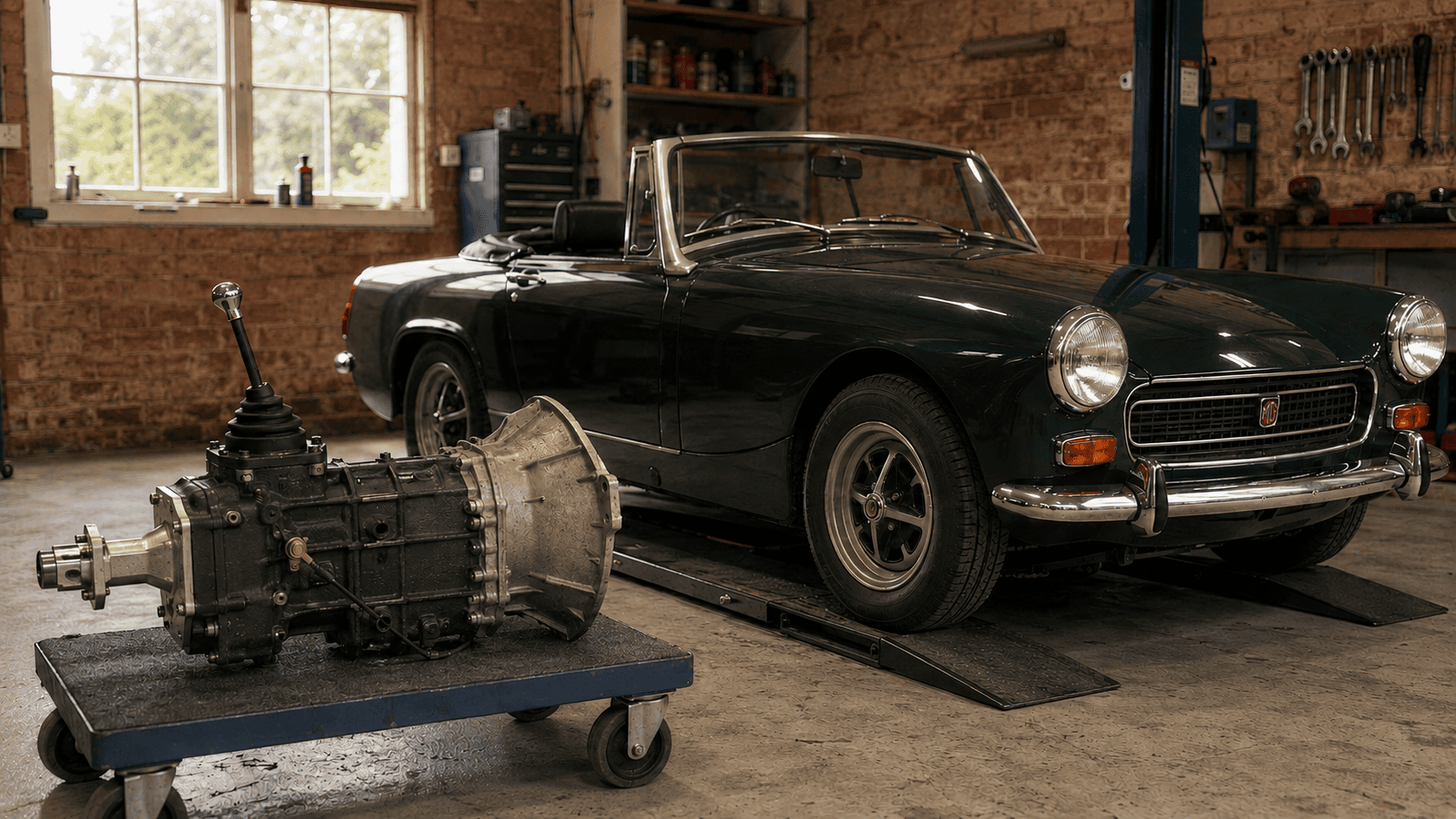
There is a particular moment, somewhere around junction four of a motorway you did not really want to be on, when the appeal of a five-speed conversion becomes overwhelming.
The engine is busy. Not unhappy, exactly, but busy. Conversation has moved from talking to shouting. Your passenger has given up and is looking out of the window with the expression of somebody reconsidering several life decisions. And you find yourself reaching for a gear that is not there, because the car was designed in an era when a long journey meant the A1 and a flask.
Fitting a five-speed gearbox to a classic is one of the most transformative changes you can make to how a car feels to live with. It is also one of the most commonly misunderstood, most frequently oversold, and, as of 2026, one with genuine paperwork implications that a great many owners have not yet caught up with.
We are going to use the MG Midget as the running example throughout, because it is the car the question gets asked about most, it covers both A-series and Triumph-engined variants, and every major conversion route has been tried on one. Most of what follows applies with minor changes to the MGB, the Morris Minor, the Spitfire and a long list of others.
What a Fifth Gear Actually Buys You
Let us deal with the arithmetic first, because it is simpler than the marketing suggests and it explains most of the disagreements you will read on forums.
Fourth gear in almost every classic four-speed is direct drive: 1.00:1. The input shaft and output shaft turn at the same speed. A five-speed conversion adds an overdrive ratio above that, and the benefit is simply the difference between that ratio and 1.00.
| Gearbox | Fifth ratio | Revs if fourth showed 4,000rpm | Reduction |
|---|---|---|---|
| Mazda MX-5 | 0.814 | 3,256 | 18.6% |
| Ford Type 9 | 0.82 | 3,280 | 18% |
| Datsun 210 | 0.85 | 3,400 | 15% |
| Suzuki Jimny | 0.86 | 3,440 | 14% |
| Toyota T50 | 0.86 | 3,440 | 14% |
So the honest headline is this: a good five-speed conversion drops your motorway revs by somewhere between a seventh and a fifth. It is a meaningful change. It is not the difference between a Midget and a Jaguar.
What it genuinely delivers is a calmer car. Less noise, less vibration, less mechanical anxiety on a long run, and usually a modest fuel saving. What it does not deliver is a fundamentally different vehicle, and anybody who tells you a fifth gear will make a Midget into a comfortable long-distance tourer has not spent long enough in one.
There is a second benefit that gets less attention and probably deserves more. Most of these conversions replace a tired 1960s gearbox with something rather newer, with synchromesh on every gear including first. On an A-series car with a worn ribcase box, the improvement in the actual quality of the gearchange can matter more day to day than the extra ratio.
Before Anything Else: Which Midget Have You Got?
This is where a surprising number of conversions go wrong, and it goes wrong at the ordering stage rather than in the garage.
“MG Midget” covers two entirely different engine families and four capacities, and the conversion parts are not interchangeable between them.
| Engine | Family | What changes for the conversion |
|---|---|---|
| 948cc | BMC A-series | Early cars may have a thin pressed-steel engine backplate rather than the later 10mm item. The kit must match the plate actually fitted. |
| 1098cc | BMC A-series | 10CC and 10CG engines take different spigot bush sizes. Kits supply both; you fit one and bin the other. |
| 1275cc | BMC A-series | The best-supported application. A smaller car retrofitted with a 1275 also needs the 1275 clutch fork and slave cylinder. |
| 1493cc (1500) | Triumph engine, BL single-rail box | Completely different approach. The original bellhousing is kept and adapted via a plate, rather than replaced. |
Ordering by capacity alone is not safe, particularly on a car that has lived sixty years and may well have had an engine transplant somewhere along the way. Get under it, identify the engine, identify the backplate, and count what is actually there before anybody takes your money.
The Ford Type 9: Still the Default Answer
The Ford Type 9, sometimes called the Type N in workshop manuals, was Ford’s first rear-wheel-drive five-speed. It arrived with the Sierra for the 1983 model year, was developed from the four-speed Type E, and essentially bolted an overdrive fifth into the tail housing.
It became the standard classic conversion gearbox for entirely practical reasons. Ford made enormous numbers of them, they are strong, the internals are still supported, and a whole industry of bellhousings and adaptor plates grew up around them. If you have ever seen a five-speed MGB, Morris Minor, MGA or Spitfire, the odds are good that there was a cast-iron Ford gearbox hiding under the tunnel.
Choosing a donor gearbox
The box you want is a two-wheel-drive, four-cylinder Type 9 with the short input shaft, from a 1.6, 1.8 or 2.0 Sierra, or a 1.6 or 2.0 Capri.
Burton Power identify the Type 9 by its cast-iron main case, alloy tail housing, usually removable bellhousing, and a one-inch, 23-spline input shaft. Ford fitted it to the Capri 1.6 and 2.0 from 1984, the Capri 2.8 from 1983, Sierra 1.6, 1.8 and 2.0 models, the XR4i, some XR4x4 applications, and the Mk3 Transit.
What matters is what is in front of you, not what the seller says the donor car was. These gearboxes have been swapped between vehicles for four decades. Identify the physical box.
Things to avoid unless your kit supplier specifically says otherwise:
- The 2.8 V6 box. It has genuinely nicer ratios, with a 3.36:1 first, but a longer input shaft. It is not a straight substitute for the short-input four-cylinder box.
- Four-wheel-drive versions. Wrong output arrangement entirely.
- The MT75. This is Ford’s later five-speed and has nothing to do with the Type 9. None of the conversion parts fit.
- Integral-bellhousing versions. The mainstream Spridget kits expect the separable arrangement.
There is also a point that catches people out badly. A standard Sierra gear lever comes out of the tunnel a long way further back than a Midget gear lever does. The established kits therefore supply a modified short remote, and even then the fitting instructions warn that the aperture may need enlarging for clearance. Buying a bare gearbox off eBay is the beginning of the project, not most of it.
The ratios, and the first gear problem
| Gear | Standard four-cylinder Type 9 | 1275 Midget ribcase |
|---|---|---|
| First | 3.65 | 3.20 |
| Second | 1.97 | 1.92 |
| Third | 1.37 | 1.36 |
| Fourth | 1.00 | 1.00 |
| Fifth | 0.82 | none |
Second, third and fourth are close enough to the ribcase to feel familiar. Fifth is the whole point of the exercise. First, however, is the fly in the ointment.
At 3.65:1 against the ribcase 3.20:1, the Type 9’s first gear is noticeably lower. At the same engine speed you are travelling roughly 12% slower. In practice it becomes a gear you use to get the car rolling and then abandon, and the gap up to second feels a little larger than it should.
Here is the part the sales literature tends not to mention: this is a problem that has already been solved. Burton Power sell a partial gearset that raises first from 3.65:1 to 2.98:1, using a new mainshaft first gear and a modified layshaft cluster, leaving the other ratios alone. They also sell complete reconditioned boxes built with it. A full close-ratio set goes further still and costs accordingly, and a V6 gearset improves things too provided somebody competent deals with the input shaft length.
If you are commissioning a conversion and you care about how the car drives rather than just what the rev counter reads at 70mph, the first gear conversation is worth having before the box is built, not afterwards.
This is part one of a UK owner’s series documenting a ribcase-to-Type 9 swap on his own Midget, and it starts exactly where you should: working out what parts the job actually needs.
What a complete kit contains
The reason a complete kit costs what it does is that the gearbox is perhaps a third of the problem. A current Frontline kit includes the reconditioned Type 9 with modified short remote, the engine-specific bellhousing or the 1500 adaptor plate, spigot bush, a special clutch driven plate and cover, release bearing and revised pivot, a new propshaft, the gearbox mount, crossmember and reinforcements, a Midget-to-Ford speedometer cable, a quickshift lever and gaiter, reverse light provision, and the fasteners and instructions.
Comparing the price of a bare secondhand gearbox with the price of a kit is therefore not a comparison at all.
How the four engines differ
On 948cc cars the kit uses a replacement bellhousing with matched clutch and spigot parts, and separate variants exist for the early pressed-steel backplate and the later 10mm plate.
On 1098cc cars two spigot bushes are supplied because 10CC and 10CG engines differ. Reverse light equipment also varies and should be confirmed when ordering.
On 1275cc cars a new bellhousing joins the A-series engine to the Ford box, hydraulic clutch operation is retained with matched components, and a stainless spacer ring is used at the flywheel and clutch cover. A 948 or 1098 car already fitted with a 1275 engine needs the 1275 clutch fork and slave cylinder as well, and Frontline list these as essential rather than optional.
The 1500 is the odd one out and involves the most machining. The original Triumph-family bellhousing is retained and mated to the Ford box through an adaptor plate. Material has to be removed locally from the bellhousing casting so the plate sits flat, two extra holes are drilled using the adaptor as a template, the bearing guide tube is opened out to at least 27mm, and the Ford centre guide tube is removed and shortened while preserving its oil seal. The original slave cylinder passes through the adaptor and is retained by a grub screw, its position adjusted to give correct release travel.
One warning specific to the 1500. The supplied clutch plate is thicker than standard, so worn clevis pins, tired pivots or badly bled hydraulics that you were getting away with before will now show up as clutch drag and a car that fights going into first. If your clutch hydraulics are marginal, sort them while the engine is out.
The Job Itself
What follows is an overview so you know what you are committing to. It is not a substitute for the kit instructions, which you should read in full before ordering rather than after.
Preparation. Confirm engine, backplate, clutch, differential ratio and speedometer connection. Photograph the car, the VIN and the underside thoroughly before you alter anything, for reasons that will become clear shortly. Disconnect the battery, then remove the engine and gearbox together. Seats, carpets and tunnel insulation come out too, because you are going to be working inside the cabin.
Engine and bellhousing. Out with the old spigot bush, in with the new one. Fit the matched clutch plate, cover and any specified spacer. Fit the replacement bellhousing to the Ford box, or carry out the 1500 adaptor work. Assemble the fork, pivot and release bearing, check the bearing slides freely, and trial-assemble engine to gearbox without dragging them together on the bolts. Frontline specify roughly 4 to 5mm clearance between the release bearing and the clutch pressure face before operation.
Body and mounting. And here is the bit that the brochures skate over. Approximately 250mm of the front floor of the transmission tunnel is cut away, following the tunnel profile. The central box member that the original gearbox sat on is removed. Supplied reinforcing sections go into the remaining crossmember stubs, the openings are sealed, and a new mounting plate is drilled and bolted to the floor. The instructions describe welding at this stage as optional, which is a sentence worth reading twice and which we will return to.
Driveline and instruments. Fit the new propshaft and check sliding yoke engagement and joint angles. Bleed the clutch. Connect the reverse light switch. Drill a fresh hole in the tunnel for the speedometer cable, protect it from the cut edge, and seal it. Route the cable without tight bends and arrange to have the speedometer recalibrated, since your indicated speed will otherwise be fiction. Our guide to instrument and gauge fitting covers the practicalities.
Filling and commissioning. There is a genuine discrepancy here that is worth knowing about. Frontline’s Midget instructions specify approximately 1.5 litres of semi-synthetic 75W-90. Burton Power list 1.9 litres for a standard two-wheel-drive Type 9, and specify GL4 oil. Do not split the difference and hope. Follow the specification given by whoever built or supplied your actual gearbox, and check the level at the plug rather than trusting a quoted volume. Our gearbox and differential oil guide explains why GL4 versus GL5 matters in a box with yellow metal synchros.
Part eight of the same series covers getting the engine and gearbox back into the car, which is the stage where any measuring you skipped earlier comes back to introduce itself.
“Reversible” Is Doing a Great Deal of Heavy Lifting
You will see the Type 9 conversion described in sales copy as reversible, with minimal modification to the frame or transmission tunnel. The MGOC overview has described it as designed to fit without bodywork modification.
Now read the fitting instructions again. Cut out 250mm of tunnel floor. Remove the central box member. Add reinforcement. Drill new holes in the floor for a mounting plate.
Those two descriptions cannot both be right, and it is the fitting instructions that tell you what actually happens to your car. The conversion is reversible in the sense that a competent fabricator could put the shell back to standard. It is not reversible in the sense that you unbolt some things and post them to the next owner.
This distinction has always mattered to originality-minded owners. Since 2026 it matters to the DVLA as well.
The DVLA Position, and Why It Changed Things
This is the section most likely to be new to you, so it is worth being precise. What follows is drawn directly from DVLA leaflet INF318, in the version numbered 7/26 that was current when this article was written.
INF318 divides work into repairs and restorations on one hand, and structural modifications on the other. Reassuringly, its list of ordinary repairs includes “replacing the gearbox or axles”. A gearbox swap, in itself, is not notifiable.
But the guidance addresses our exact situation by name, and it draws the line by construction type. Under repairs and restorations it lists alterations to the firewall or transmission tunnel to accommodate a different bellhousing or transmission, for vehicles with a separate chassis only, and adds a bracketed note that for a monocoque vehicle this needs to be notified as a modification. The structural modification list then repeats the same item, marked for monocoque vehicles only.
The MG Midget is a monocoque. So is an MGB, a Morris Minor, a Spitfire and most of the rest of the usual suspects.
The structural modification list also includes modifying or removing load-bearing sub-frames or support members, which is a reasonable description of removing the central box member the gearbox sits on, and making additional holes within 30cm of any suspension, steering, braking or seatbelt mounting point. On a small car with the seatbelt mountings not far from the tunnel, that last one is worth measuring rather than assuming.
What that means in practice
- You notify DVLA using form V627/3, the Modified Vehicle Statement, together with the V5C, photographic evidence of the changes, and an MOT where required.
- You notify only once the vehicle is fully built, complete and ready for road use. Early submissions may be returned.
- For vehicles over 40 years old, an MOT must be provided with the notification. This applies even to a car that is otherwise MOT exempt as a historic vehicle. Almost every Midget is now over 40.
- Provided there is no doubt about the car’s identity, it keeps its original VIN and registration number. This is the reassuring part and it is worth stating plainly.
- A new V5C is issued with an explanation in the Special Notes section. INF318 sets out a planned “Modified” marker, but is explicit that these new markers are not available yet and that in the meantime the existing “Rebuilt” marker will be used.
- DVLA may ask to inspect the vehicle.
- Tell your insurer before the work starts, not afterwards. Our classic car insurance guide covers agreed value and declared modifications.
That “Rebuilt” marker deserves a moment of your attention. It is a fair description of nothing much, it is the same marker applied to cars assembled from a heap of parts, and a future buyer reading a V5C will not necessarily know the difference between your carefully executed gearbox conversion and something rather less wholesome. Keep your photographs, your invoices and your correspondence. On a car where originality carries value, this is the real cost of the conversion, and it does not appear on any invoice.
None of this makes the Type 9 conversion a bad idea, and it is emphatically not a reason to panic about work already done. It does mean the word “reversible” should no longer be allowed to do the job of a proper conversation about what you are altering. INF318 is guidance rather than the whole of the law, it is not always a model of clarity, and it has been revised more than once recently, so check the current version and ask DVLA directly if your particular job sits near the line.
The flip side is genuinely useful. A five-speed conversion that does not cut the monocoque is a gearbox replacement, and gearbox replacement is listed as a repair. Which brings us neatly to the alternatives.
The Alternatives
Suzuki Jimny: the serious A-series contender
Barratt Engineering’s Spridget kit is the most interesting development in this field for years, and on an A-series car it now deserves to be the first thing you look at rather than an afterthought.
The donor is a five-speed from a manual Suzuki Jimny built between 1995 and 2005, either the G13B box from single-cam cars or the R7ME from the twin-cam M13A cars. The two have different bellhousing bolt counts and input shaft spigots, and Barratt now make adaptors for both. Earlier SJ410 and Samurai boxes are not compatible, which is a common and expensive misunderstanding.
The kit at £2,400 supplies an aluminium engine backplate, rear mounting bracket and anti-vibration mounts, a revised gearchange mechanism, a 5kg billet flywheel, high-torque starter, a 190mm clutch rated at 150Nm, a new propshaft, a clutch cable conversion, and the fasteners and gaskets. You add the gearbox and a speedometer solution, both of which Barratt can supply.
Its advantages are substantial. Barratt state that the gearbox fits a Spridget chassis without modification and that the gear lever exits in the standard location with a throw close to the original. It weighs only a few kilos more than the ribcase box, against a cast-iron Ford unit that is meaningfully heavier. It is a far newer gearbox. And critically, if you are not cutting the shell, you are not in V627/3 territory.
The compromises are real too. Fifth is 0.86, so you get a 14% reduction rather than 18%. It is A-series only and does nothing for 1500 owners. It converts your hydraulic clutch to cable operation, using Ford Escort Mk1 or Mk2 cables depending on which pedal box you have. The Suzuki box has no usable mechanical speedometer drive, so you need an electronic solution. And a 50mm access hole is drilled in the tunnel for the oil filler, closed with a bung, which is worth checking against the current guidance rather than assuming it is trivially fine.
Barratt’s own footage of a Midget running their Jimny gearbox, here paired with one of their engine conversions. Useful mainly for hearing and seeing the installation in a car rather than on a bench.
Datsun 210: excellent engineering, wrong country
The Rivergate conversion is the one that originality-conscious owners tend to want once they understand it, because Rivergate state it requires no engine, flywheel, chassis or body modification at all. It uses a billet adaptor and backplate incorporating a rear crank seal, with a special clutch disc used against the original pressure plate.
The correct donor is specific: an FS5W60A from an August 1979 to 1982 Datsun 210, model code B310, with “60” cast into the right-hand side of the case, a serial number beginning with F on top of the bellhousing, and 20mm, 18-spline shafts. Not, note, the earlier car often called a B210 in North America.
Fifth is 0.85 for a 15% reduction. The problem is entirely geographical. Suitable donor gearboxes in Britain are, as one forum contributor put it, as rare as hen’s teeth, and you are looking at transatlantic freight and import costs on top of the kit price. Rivergate’s calibrated speedometer adaptor has also been listed as unavailable. Fine engineering; awkward logistics.
Toyota T50: the one that got away
The T50 was once the premium Spridget conversion, with an alloy split case and good ratios of roughly 3.59, 2.02, 1.38, 1.00 and 0.86. Frontline used to supply a purpose-cast A-series bellhousing for it.
They no longer do, and the correct early gearboxes have become scarce as the donor cars disappeared and the drift community discovered the later ones. Different T50 versions have different input and output splines, bearing sizes and shifter positions. Treat it as a legacy conversion: buy a complete matched package, or confirm the exact casting, shafts and shifter version with a bellhousing supplier before you buy any gearbox at all.
Mazda MX-5 and BMW Getrag: fabrication projects
The appeal of an MX-5 box is obvious. Alloy case, delightful change, 0.814 fifth for the best overdrive figure of the lot. The obstacle is that the bellhousing is integral to the gearbox, so instead of buying a bellhousing you are commissioning a custom engine backplate.
A documented Sprite installation required a bespoke 10mm aluminium backplate made using the original A-series plate as a template, accurate starter and oil pump openings, removal of the large power-plant-frame projections from the Mazda casing for tunnel clearance, a bespoke clutch and spigot arrangement, fabricated mount and propshaft, an answer to a gearbox over seven inches longer with its lever correspondingly further back, and an electronic speedometer.
It is a fine piece of work and an interesting read. It is not an alternative to buying a kit, and the same applies to the BMW Getrag conversions, which additionally suffer a 3.764:1 first gear that makes the Ford’s 3.65 look positively tall.
| Conversion | Midget fits | Fifth | Cuts the shell? | Verdict |
|---|---|---|---|---|
| Ford Type 9 | 948, 1098, 1275, 1500 | 0.82 | Yes, tunnel and box member | Most established, only option for the 1500, most invasive |
| Suzuki Jimny | A-series only | 0.86 | Filler access hole only | Strongest current A-series choice |
| Datsun 210 | A-series only | 0.85 | No | Great engineering, poor UK donor supply |
| Toyota T50 | A-series only | 0.86 | Varies | Legacy; parts and bellhousings scarce |
| Mazda MX-5 | Fabrication only | 0.814 | Almost certainly | A project, not a purchase |
The Option Everybody Forgets: Overdrive
Before you commit to cutting anything, it is worth remembering that British manufacturers solved this problem in period, and solved it rather elegantly.
An overdrive is not a five-speed gearbox. It is a four-speed with an electrically selected epicyclic unit on the back, typically giving an overdrive ratio on third and top. On a Midget 1500 a Spitfire-derived J-type installation remains a period-correct alternative, though it still needs clearance and mounting work because the shell was not designed around the overdrive casing.
The advantages are that it looks right, it was a factory option on many contemporaries, and it gives you an extra ratio on third as well as top, which a five-speed does not. The disadvantages are that a tired overdrive is its own kind of misery and the units are not cheap. We cover the subject properly in our classic car overdrive guide, and if yours is playing up, the overdrive fault finding guide will save you some guesswork.
Beyond the Midget
Almost everything above transfers to other classics, with the details changing and the principles staying put.
The MGB is arguably the best-served car in Britain for five-speed conversions, with Type 9 kits from several suppliers and a large body of accumulated experience. The Morris Minor takes both Type 9 and Jimny conversions, the latter appealing for the same reasons it does on a Spridget. Triumph owners with a Spitfire or GT6 have Type 9 options and the factory overdrive route. The MGA has a long-established Type 9 kit, with the same choice between the standard 3.65 first and a 2.98 alternative.
Three questions carry across to every one of them. Does the conversion require you to cut a monocoque, and have you thought about INF318? What happens to your speedometer? And has anybody actually told you what first gear will be, as opposed to what fifth will be?
What It Costs
| Package | Listed price | What that does not include |
|---|---|---|
| Frontline Type 9 kit, 1275 Midget | £4,402.70 | Fitting, speedometer recalibration, MOT, VAT status to confirm |
| Frontline Type 9 kit, 948 or 1098 with 1275 engine | £4,411.90 | As above, plus the 1275 clutch fork and slave cylinder |
| Frontline Type 9 kit, 1275 with lightened flywheel | £4,825.70 | As above |
| Frontline Type 9 kit, Midget 1500 | Around £4,200 | As above; specify speedometer cable type |
| Barratt Jimny conversion kit | £2,400 | Gearbox and speedometer |
| Barratt rebuilt Jimny gearbox | Around £800 exchange | Confirm current price and core eligibility |
| Barratt electronic Smiths speedometer | Around £275 |
One point deserves emphasis before you budget. Frontline’s older product pages carried the line “All prices are exclusive of VAT”. If that applies to the figure you are quoted, a £4,400 kit is nearer £5,280 by the time it reaches you, and the difference is not small change. Ask explicitly whether the price includes VAT before you get excited or disappointed.
Then add professional fitting if you are not doing it yourself, speedometer recalibration, an MOT for the DVLA notification, oil, and the inevitable “while it is apart” items. A clutch you were going to do anyway. A rear crank seal that has been weeping for years. New engine mounts. It adds up quickly, and it always adds up in one direction.
Against that, be realistic about what the car is worth. Our valuations section will tell you where Midget values currently sit, and on a modest car a conversion can represent a startling fraction of the total.
Checklist Before You Order Anything
- Identify the engine capacity and engine code, not what the logbook says.
- Establish whether an early car has been converted to a later engine.
- Identify the engine backplate and clutch actually fitted.
- Record the differential ratio and tyre size, since these determine your actual cruising revs.
- Decide whether keeping the original mechanical speedometer matters to you.
- Ask whether the gearbox supplied is new, reconditioned or an unchecked donor, and get its serial and casting details.
- Ask what first gear ratio you are getting.
- Read the fitting instructions before ordering, not the product page.
- Confirm whether the quoted price includes VAT.
- Speak to your insurer.
- Read the current INF318 and plan your photographic evidence before anybody picks up a cutting disc.
While the drivetrain is out, inspect the clutch master and slave cylinders, clevis pins and hoses; the flywheel and ring gear; the rear engine oil leakage and backplate area; the donor gearbox bearings and synchros; the engine and gearbox mounts; and the propshaft joints, balance and sliding yoke. If any welding is involved in the crossmember work, our beginner’s welding guide is worth a read, though structural work near seatbelt mountings is a reasonable place to hand over to somebody who does it for a living.
Before road use, check every gear selects and the clutch fully clears, confirm nothing touches the shell, verify brake and fuel pipe clearance, torque everything, fill with the specified oil, check speedometer accuracy, and road test progressively. Then check it all again after a hundred miles, because something will have moved.
So, Is the Type 9 Still Worth It?
Yes, in specific circumstances, and those circumstances are narrower than they were five years ago.
Fit one if you have a Midget 1500 and want a genuine five-speed, since it is realistically your only supported option. Fit one if you want the largest available drop in cruising revs. Fit one if a complete, warranted package from an established supplier matters more to you than saving money, or if keeping a mechanical speedometer drive is important. Fit one if you have read the DVLA section above, understood what goes on your V5C, and decided you are content.
Think harder if you have an A-series car, because the Jimny conversion is newer, lighter, cheaper and does not require you to cut the shell. Think harder if your car is highly original or you have any thought of concours. Think harder if you mostly potter along B-roads and rarely see sustained 60mph, because you will be paying handsomely for a benefit you rarely collect. Think harder if the existing gearbox is healthy. And think very much harder if anybody has told you it is a simple bolt-in job that leaves no trace.
The Type 9 conversion has not got worse. It works, it works well, and thousands of happy owners will tell you so. What has changed is the competition beside it and the paperwork behind it, and the honest summary in 2026 is that the Ford box is no longer the automatic answer for an A-series Spridget. For a 1500, it remains very nearly the only one.
Whichever route you take, do the identification work before you spend the money. The gearbox is the easy part. It is everything bolted to either end of it that decides whether the job is a pleasure or a winter you would rather forget.
References and Further Reading
- DVLA form V627/3, the Modified Vehicle Statement
- DVLA INF318: making changes to a vehicle, including the structural modification definitions
- Burton Power: Ford Type 9 gearbox identification and specification guide
- Burton Power: Type 9 gearbox with the 2.98:1 long first gear conversion
- Frontline: Sprite and Midget 1275cc five-speed kit contents and fitting instructions
- Barratt Engineering: Suzuki Jimny gearbox conversion kits for A-series Spridgets
- Barratt Engineering on the G13B and R7ME Jimny gearbox differences
- Wheels-Alive: fitting a Mazda MX-5 gearbox to a Sprite or Midget
- MGA Guru: Ford Type 9 conversion ratios and options for the MGA
- Ford Type 9 transmission: applications and production history
This page contains affiliate links. If you click a link and make a purchase, Classic Car Hub may earn a small commission at no extra cost to you.