
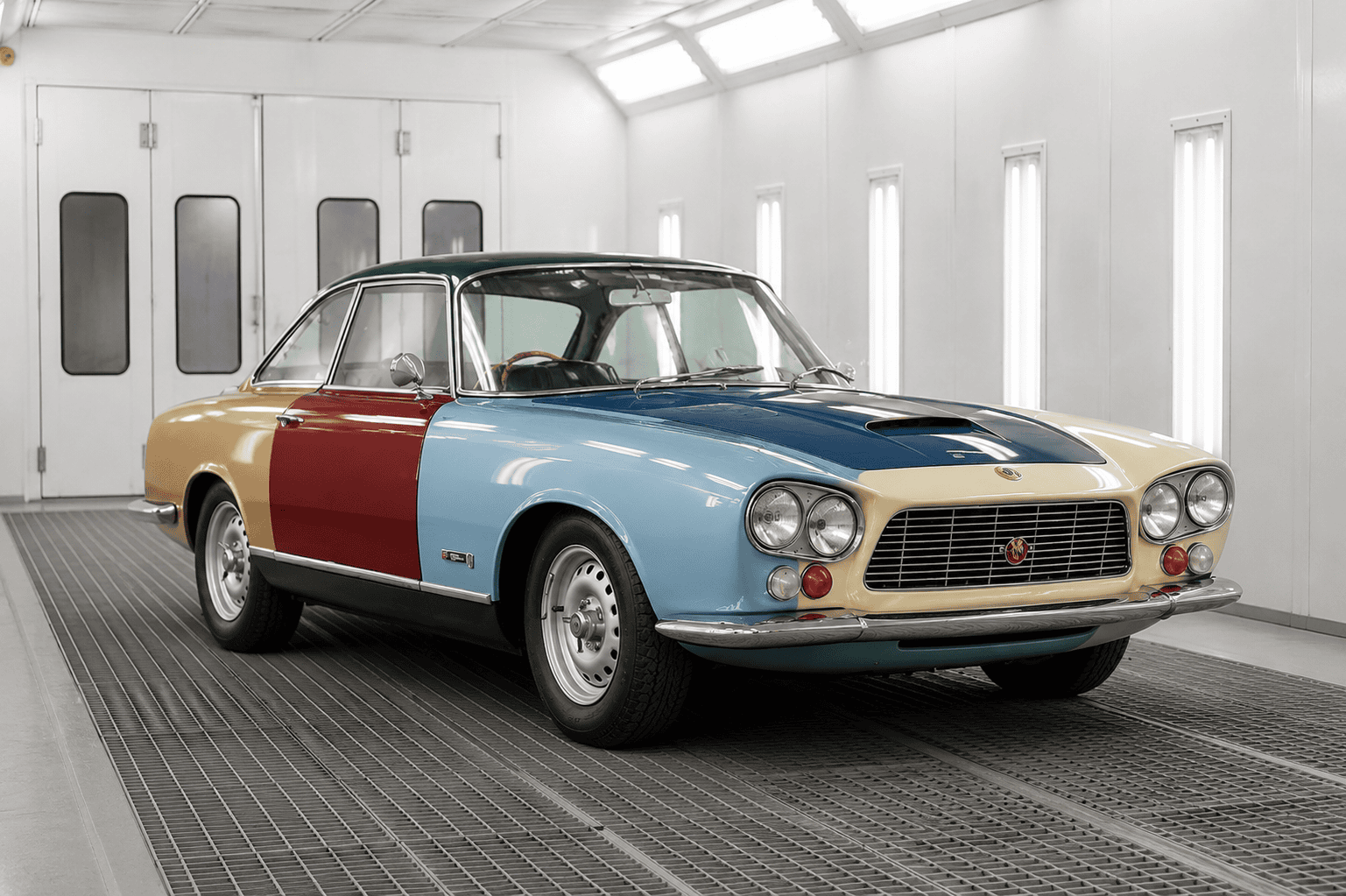
Ask for the paint code for an MGB and, before long, somebody will produce a chart.
Ask for the paint code for a Gordon-Keeble GK1 and you may accidentally find yourself conducting an archaeological investigation.
That is partly the joy of the Gordon-Keeble. It was never a mass-produced machine being sprayed down a production line by the thousand. It was an extraordinarily low-volume British grand tourer, clothed in Italian styling, powered by a Chevrolet V8 and built with the sort of hand-finished individuality that makes modern restorers alternately smile and reach for the whisky.
When it comes to paint colours, that individuality matters.
So, What Are the Gordon-Keeble GK1 Paint Codes?
The slightly inconvenient answer is that there does not appear to be a single, publicly documented Gordon-Keeble factory paint-code chart comparable with those available for larger manufacturers.
That does not mean the cars were painted with mysterious substances mixed by moonlight in a shed somewhere in Hampshire.
The paints themselves would naturally have been supplied to identifiable formulations. Gordon-Keeble, however, seems to have approached colour on a much more individual, customer-led basis than manufacturers working from a tightly controlled standard palette.
There is an unusually useful piece of contemporary evidence for this.
In an advertisement published in The Motor in the week ending 2 July 1966, Gordon-Keeble described its product as a “virtually hand-made car available in any variation of colours and internal tones.” View the original Gordon-Keeble advertisement.
That one sentence tells us a great deal.
A prospective buyer was apparently not being told, “Here are six colours. Pick one.”
Instead, the nature of the car meant colour and trim combinations could be selected with considerable freedom.
Which makes perfect sense. Gordon-Keeble was selling an expensive, exclusive GT to customers accustomed to having things their own way. Telling such a chap that he couldn’t have the particular shade of dark blue he fancied because “it’s not in the brochure” would rather have spoiled the effect.
The Owners’ Club Holds an Important Part of the Puzzle
Fortunately, Gordon-Keeble history has been unusually well preserved by the marque’s enthusiasts.
The Gordon-Keeble Owners’ Club records that Ernie Knott established an Owners’ Index containing each car’s chassis number, registration, ownership details and, crucially for our purposes, its interior and exterior colours. That index continues to be maintained. Read the Gordon-Keeble Owners’ Club history.
This is important because, with Gordon-Keebles, the sensible question is not necessarily:
“What colours were Gordon-Keebles available in?”
It is:
“What colour was this particular chassis when it left the factory?”
The distinction is small on paper and enormous in a paint shop.
Several surviving cars illustrate the point.
| Chassis | Evidence for Original Colour | What Happened Later |
|---|---|---|
| GK30 | An owner records that the car began life in light green. | It subsequently became yellow and later light blue. |
| GK55 | Research associated with the car points towards an original green finish. | It was later painted Siena Brown. |
| GK63 | Christie’s records the car as originally green. | It was resprayed Regency Red in the mid-1980s. |
| GK71 | Its history records dark green as the original colour, supported by surviving build information. | Around 1971 it became Electric Blue metallic and, much later, Ferrari Pearl Brown. |
| GK75 | Specialist research indicates it was probably delivered in dark blue in 1965. | It has since been restored in Silver Grey with Oxblood trim. |
| GK76 | Its owner reports that it was originally metallic burgundy, with surviving original paint under the bonnet. | Later finishes have obscured much of the original colour. |
| GK88 | The Owners’ Club records it as originally Golden Sand with red vinyl trim, supplied on 1 May 1965. | It was blue by 1982 and Aston Martin Royal Cherry from 1996. |
Sources: GK30, GK55, GK63, GK71, GK75, GK76 and GK88.
That table also demonstrates why trying to compile Gordon-Keeble colours from photographs on the internet is a particularly entertaining way of getting the wrong answer.
These cars are now roughly six decades old. Many have been restored once, some twice, and a few have gone through more colours than a 1970s kitchen.
A present-day red Gordon-Keeble was not necessarily born red. A silver one was not necessarily born silver. Auction catalogue photography tells you what was on the car when the camera shutter clicked, not what was sprayed onto it in Hampshire in 1965.
GK63 is a splendid example. A later observer could quite reasonably identify the car as Regency Red. Christie’s documentation, however, specifically records that it had originally been green and was repainted red in the mid-1980s.
Likewise, GK71’s journey from dark green to Electric Blue metallic and eventually Ferrari Pearl Brown shows just how dramatically the identity of one car can change during its life.
The Golden Sand Problem
GK88 gives us one of the most interesting paint-code traps.
The Owners’ Club records that the car was supplied by Central Motors of Sheffield on 1 May 1965, originally finished in Golden Sand with red vinyl upholstery.
So far, so good.
Now open the records for classic Jaguar paint colours and codes and things become tantalising.
Jaguar also offered a colour called Golden Sand during the period. A Jaguar service bulletin identifies Opalescent Golden Sand from G.I.P. with the manufacturer’s reference GL.24337/M.
It is therefore extremely tempting to write:
Gordon-Keeble Golden Sand: GL.24337/M.
But we shouldn’t.
At least, not yet.
I have found no surviving public document linking GK88’s Golden Sand specifically with Jaguar’s GL.24337/M formula. The names match and the dates overlap, but neither of those facts proves that Gordon-Keeble ordered precisely the same paint.
Perhaps it did. Small British manufacturers quite sensibly used colours and materials already available through established suppliers.
But “quite possibly” is not the same thing as “documented fact”.
For anyone restoring GK88, or another car discovered to have been Golden Sand, GL.24337/M is therefore a valuable period comparison, not a Gordon-Keeble paint code proven beyond doubt.
That distinction may sound pedantic until the freshly painted body emerges from the booth in the wrong shade. At that point it becomes remarkably interesting.
Why a Gordon-Keeble Paint Code May Not Work Like a Modern Paint Code
Today we are used to a manufacturer assigning a short code to a colour and attaching it to the vehicle.
Punch the code into a paint system and, allowing for age, fading and formulation changes, you have your starting point.
For a tiny 1960s manufacturer producing essentially bespoke cars, the trail can be rather different.
Gordon-Keeble may have ordered a customer’s chosen colour from an established paint manufacturer under that supplier’s formulation number, rather than creating a comprehensive family of Gordon-Keeble-specific codes.
That would fit perfectly comfortably with the company’s contemporary claim that cars could be supplied in virtually any variation of exterior and interior colour.
It would also explain why surviving historical records tend to tell us that a car was “Dark Green”, “Golden Sand” or “metallic burgundy”, while a definitive Gordon-Keeble code number remains elusive.
There is another complication too. A paint code identifies the colour formulation, but the type of paint system used on a classic car can have a considerable effect on how that colour actually looks once applied. Cellulose, synthetic enamel and modern two-pack systems can produce noticeably different depth, gloss and character, even when aiming at the same nominal shade.
In other words, finding the correct colour code is only part of the job.
And there may never have been a magical plate somewhere saying GK GREEN 004.
If anybody finds one, by all means cancel the archaeological dig and put the kettle on.
How to Find the Correct Original Colour for a Particular GK1
For a proper restoration, the car itself should be treated as a primary historical source.
- Start with the chassis number and the Gordon-Keeble Owners’ Club. The club’s Owners’ Index records historic exterior and interior colours and is the strongest first stop for establishing how a particular car was originally specified.
- Find the car’s surviving paperwork. A build sheet, supplying-dealer invoice, early registration record, period photograph or restoration file can confirm, or occasionally contradict, received wisdom.
- Inspect protected areas of the body. Under trim, behind fittings, inside apertures and beneath later finishes, an untouched fragment of original paint can survive. GK76 is a good example. Its owner reports a surviving patch of the original metallic burgundy beneath the bonnet.
- Have genuine original paint professionally analysed. Modern spectrophotometry and an experienced automotive paint specialist can often produce a much safer restoration match than blindly ordering paint from a six-decade-old cross-reference.
- Use contemporary manufacturer colours only as supporting evidence. A Jaguar, Rolls-Royce, Aston Martin or other period formula with the same colour name may be exactly right, but prove the connection before declaring it a Gordon-Keeble factory code.
If the existing finish is original, or even merely very old, it is also worth asking whether repainting is actually necessary. Our guide to restoring and caring for classic car paintwork covers oxidation, fading, polishing, local repairs and the point at which preservation ceases to be sensible and a respray becomes the better option.
On a car as rare as a Gordon-Keeble, surviving factory paint has historical value of its own.
That final point is particularly important because numerous Gordon-Keebles have subsequently been painted in colours belonging to other prestigious manufacturers.
A later Aston Martin, Ferrari or Rolls-Royce shade may look utterly magnificent on the shape, and very often does, without having the slightest claim to factory originality.
Were There Standard Gordon-Keeble Colours at All?
Probably there were colours which were suggested, commonly ordered or convenient for the factory to obtain.
What the available evidence does not support is the idea of a rigid, comprehensive Gordon-Keeble palette from which every production car had to be selected.
Indeed, the 1966 factory advertising says almost precisely the opposite.
The pattern among known cars reinforces the picture. Various greens, dark blue, metallic burgundy and Golden Sand are all associated with original cars, while individual histories show extensive later repainting.
It is therefore safer to talk about documented original Gordon-Keeble colours than to publish a supposed definitive list of Gordon-Keeble paint codes.
That wording isn’t merely cautious. It reflects how these cars appear actually to have been built.
It also puts the Gordon-Keeble in marked contrast with mass-produced British cars of the same period. An MG, Triumph or Austin can usually be approached through a reasonably well documented factory colour system. Gordon-Keeble requires considerably more detective work.
The Colours Lost to Time
There is something wonderfully Gordon-Keeble-ish about all this.
The car itself was an improbable cocktail: elegant Bertone styling, British construction, a fibreglass body and a large American Chevrolet V8, assembled in numbers small enough for practically every individual chassis to have its own biography.
A rigid corporate paint chart would almost feel out of character.
The evidence instead points towards cars being specified individually, with colour forming part of the bespoke nature of the purchase. The surviving Owners’ Index, build histories and scraps of untouched paint therefore matter far more than a generic online colour table.
Some of those original colours are now known only by a name in an old record. Others survive beneath bonnets, behind trim panels or under several generations of repainting. Their precise formulations may quite literally have been lost to time.
So if you are searching for the paint code for a Gordon-Keeble GK1, don’t begin by asking:
“What is the Gordon-Keeble paint code?”
Begin with:
“Which chassis have I got, and what do we know about how it was built?”
That is where the reliable answer starts.
And if your investigation eventually involves lying upside down with a torch, trying to find a square inch of untouched 1965 paint, congratulations, you are now doing Gordon-Keeble paint research properly.
References and Further Reading
The Gordon-Keeble is a very low-volume car and surviving factory documentation is far less comprehensive than it is for larger manufacturers. The following sources were used to cross-check the colours, individual chassis histories and period paint information discussed in this article.
- Gordon-Keeble Owners’ Club, History of the GKOC and Owners’ Index. The club’s historical records include chassis numbers, registrations, ownership details and recorded interior and exterior colours. Gordon-Keeble Owners’ Club history.
- Gordon-Keeble period advertisement, The Motor, week ending 2 July 1966. The advertisement describes the Gordon-Keeble as a “virtually hand-made car available in any variation of colours and internal tones”, an important clue to the way exterior and interior colours were specified. View the period advertisement.
- Gordon-Keeble Owners’ Club, Keebling Cuttings. Includes historical information relating to individual cars, including GK88, recorded as originally Golden Sand with red vinyl trim. Keebling Cuttings.
- Christie’s, Gordon-Keeble GK1 chassis history. Auction documentation recording the history of GK63, including its original green finish and later Regency Red repaint. Christie’s Gordon-Keeble listing.
- Car & Classic, Gordon-Keeble GK1 chassis GK71. Provides details of the car’s original dark green finish and subsequent colour changes. GK71 history.
- Wrightson Automotive, Gordon-Keeble histories. Specialist descriptions and research concerning surviving Gordon-Keebles, including GK55 and GK75. GK55 and GK75.
- PistonHeads, Gordon-Keeble owner discussions. First-hand enthusiast material concerning individual cars, including evidence relating to GK30 and the surviving metallic burgundy paint on GK76. Gordon-Keeble discussion.
- Jaguar period body and paint documentation. Used as a comparison source for the period colour Opalescent Golden Sand and its G.I.P. reference GL.24337/M. No evidence has been found proving that Gordon-Keeble used this exact formulation, so it is treated in the article as a period comparison rather than a confirmed Gordon-Keeble paint code. Jaguar body service information.
Further Reading on Classic Car Hub
- Jaguar Classic Car Paint Codes
- MG Paint Colour Codes
- Classic Car Paint Types Guide
- Classic Car Paintwork Restoration and Repair
- Gordon-Keeble-GK1 history
If you own a Gordon-Keeble with surviving factory paint, original build paperwork or a documented period colour specification, that information may help fill in another small piece of the marque’s history.
This page contains affiliate links. If you click a link and make a purchase, Classic Car Hub may earn a small commission at no extra cost to you.