
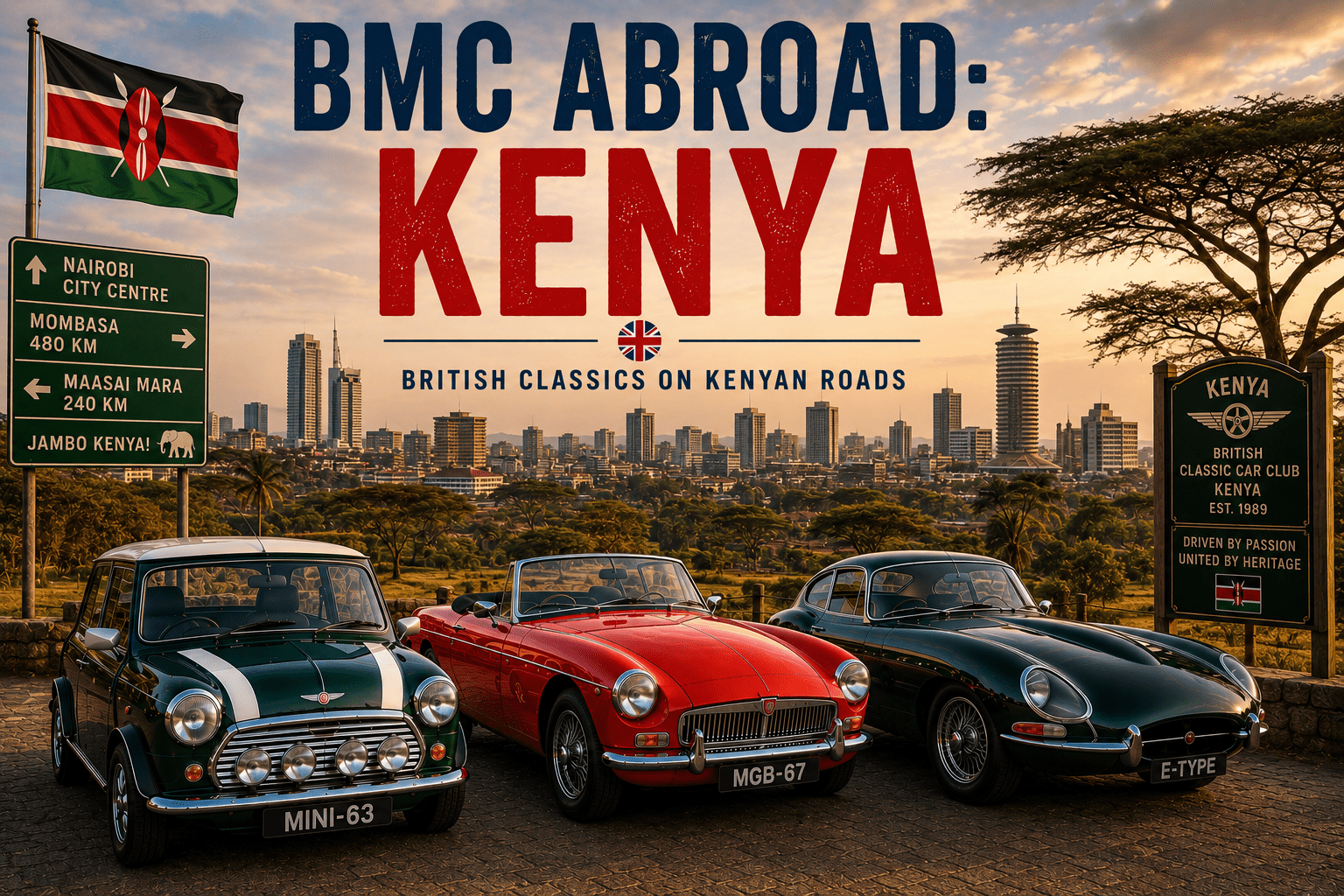
In 1960, Motor Sport magazine described the East African Safari as “the greatest test of a motor car in the world.” Of the thirty-four British cars that started that year’s event, only the Ford Zephyr and Anglia teams made it to the finish alongside one very battered Hillman Minx, which had been inverted at some point during the route and driven without a windscreen for two thousand miles. The four Mini-Minors were, in the magazine’s dry assessment, “completely out of their element.” None of the Sunbeam Rapiers started the second half. A TR3, a Herald, a Jaguar and a Morris Oxford all failed to finish.
That is the reality behind Kenya’s relationship with British cars: they arrived, they were tested more brutally than anything their designers had imagined, and the ones that survived earned a kind of respect that showroom condition never could. This is the latest in our BMC Abroad series, and Kenya’s chapter is built on motorsport, red dust, and a community that has been keeping these cars alive, and judging them to a remarkably high standard, for more than half a century.
The rally that changed everything
The East African Safari began life as the Coronation Safari in 1953, organised to mark the coronation of Queen Elizabeth II. The original event was conceived by Eric Cecil, Neil Vincent and Eric Tromp over drinks in Limuru, and covered 5,160 kilometres across Kenya, Uganda and Tanganyika (now Tanzania). Fifty-seven local drivers took part in what was a deliberately amateur affair: no official winner was declared, no service crews were permitted, and participants were responsible for their own repairs. Finishing was the achievement.
British cars were there from the start, and for the first decade they did well. Vic Preston Sr. won in 1955 driving a Ford Zephyr, a car that was not a factory rally special but a mildly modified road car with changes focused on durability rather than outright speed. The Zephyr took two outright wins in the 1950s, establishing a pattern that would define the event for years: the car that finished was the car that won, because most of the field did not finish at all. Attrition rates regularly exceeded 70%, and in the notorious 1968 running, only seven crews out of seventy-four made it back to Nairobi. One imagines a certain grim satisfaction in the Longbridge design office upon hearing this, though whether anyone there would have volunteered to drive one of their own cars through the Rift Valley is another question entirely.
The event gained international FIA status in 1957 and was renamed the East African Safari Rally in 1960. It became a round of the World Rally Championship in 1973. Through the 1960s, as rallying professionalised, Ford’s Boreham-based Competition Department sent factory teams to Kenya with Cortina GTs. In 1964, Kenyan residents Peter Hughes and Billy Young won outright in a works Ford Cortina GT, one of six white cars sent out from Essex in what amounted to a very long commute for a works team based in Chelmsford. Four of the six finished, which was considered remarkable in an event where barely a quarter of the entire entry survived. Our own Ford Cortina buyers guide covers the road car; here, the Cortina was proving something else entirely.
The Flying Sikh
No account of the Safari Rally is complete without Joginder Singh, and his story deserves telling properly rather than in passing. Born in Kericho, Kenya in 1932, the eldest of ten children of Punjabi immigrant parents, Singh’s first work experience was as a spanner boy in his father’s garage. He became the Royal East African Automobile Association’s first patrolman in 1958 and started rallying at the age of 26.
His 1965 win is one of the great underdog stories in motorsport. Singh and his brother Jaswant entered a second-hand Volvo PV544 that had already been raced for 42,000 competitive miles by factory driver Tom Trana. The crashed car had been abandoned in Kenya by the Volvo works team, and the Singh brothers rebuilt it themselves. They drew the number one starting position, considered unlucky in the Safari. Nobody gave them a chance against the factory teams from Citroen, Mercedes and Saab.
The brothers won by the largest margin in the rally’s history: one hour and forty minutes clear of second place. Amazon Motors, the Volvo dealer who had sold them the car on hire purchase, cancelled the contract after the race and gave them the car outright. It is now restored and on display at the Volvo Museum in Gothenburg. Singh went on to win two more Safaris, in 1974 and 1976, both times in a Mitsubishi Lancer 1600 GSR, and completed 19 out of 22 Safari starts in an event where the dropout rate regularly exceeded 90%. President Jomo Kenyatta gave him the title “Simba wa Kenya” (Lion of Kenya), and to this day, children across East Africa still shout “Jogida” when they see a car going fast. He passed away in London in October 2013, aged 81.
The official film of the 2025 East African Safari Classic Rally, a nine-day event covering over 3,200 competitive kilometres of Kenyan terrain in pre-1985 cars. Ford Escorts, Datsun 240Zs and Porsche 911s still race the same roads that broke the Sunbeam Rapiers sixty-five years ago.
The Concours d’Elegance: fifty years of polish on the racecourse
If the Safari Rally is Kenya’s test of what these cars can survive, the Africa Concours d’Elegance is the test of what they can become afterwards. Organised by the Alfa Romeo Owners Club (Kenya) since 1971, the Concours is held annually at the Nairobi Racecourse and attracts over 10,000 spectators, a field of 70 cars and 40 motorcycles, and competitors from as far afield as South Africa, Uganda, Tanzania and occasionally the UK. It has full continental status recognised by FIM-Africa since 2006, and its judging standards, regulated by the Kenya Motor Sport Federation, are genuinely rigorous: underside cleanliness, oil leaks, engine compartment, interior, external finish and roadworthiness, scored across a detailed points system.
Among its most successful competitors is Sati Gata-Aura, a 79-year-old retired rally driver who has been entering since 1985 and who took the 2025 overall car winner’s trophy with his 1947 MG TC, his fourth overall win. Gata-Aura’s MG, a striking green post-war British sports car, is the kind of car that would be a museum piece anywhere else; in Nairobi, it is polished, driven to the Racecourse, and submitted to judges who check its underside with a torch. “Once you put so much work into something, you do not want to leave it,” he told The East African after the 2024 event, when asked if he would ever sell.
The Concours began modestly: 12 Alfa Romeos at the Spread Eagle Hotel (now the Safari Park Hotel) in 1971, judged by Safari Rally winner Peter Hughes. By its tenth anniversary it was open to all makes. Today it is the second-largest Concours in Africa after South Africa’s, and its class list spans everything from pre-1940 veterans to post-war sports cars, utility vehicles, and motorcycles dating back to a 1925 Triumph 500SD.
What survives in Kenya, and what it takes to keep it going
Kenya’s classic car population is a mix of cars that arrived as colonial-era imports, rally cars that were retired locally rather than shipped home, and a smaller number brought in since by collectors and enthusiasts. The challenges of keeping them running are a version of the problems any classic owner faces, intensified by climate, geography, and the kind of dust that treats a Lucas distributor cap as a personal challenge.
- Red laterite dust gets into everything. It is abrasive, it clings, and it finds its way past seals and into bearings, carburettors and distributors with a persistence that British design never anticipated. Regular cleaning and sealing of air intake systems goes from a recommendation to a necessity.
- UV exposure is severe and year-round. Paint, rubber seals, interior trim and hood materials degrade faster than in a temperate UK climate, and the damage is often more advanced than a visual inspection suggests. Our paintwork restoration guide and soft top care guide cover the principles, though Kenyan owners operate at the sharp end of both.
- Parts supply is the perennial challenge. Kenya has no equivalent of Moss Europe or Rimmer Bros on its doorstep, and importing parts from the UK or Australia means navigating customs, paying duty, and accepting lead times measured in weeks rather than days. The club network, particularly through the Concours community and the broader classic car Facebook groups, fills the gap with a combination of shared knowledge, bulk import arrangements, and a strong local culture of fabrication and improvisation rather than catalogue ordering.
- Fuel quality varies. Octane ratings and ethanol content differ from the consistent UK supply, which means carburettor set-up and fuel system maintenance are a more active concern than they would be at home. Our E10 fuel system guide covers the chemistry; in Kenya, the practice is more varied.
The classic rally lives on
The Safari Rally itself returned to the World Rally Championship calendar in 2021 after a nineteen-year absence, and is now a permanent fixture again. But for classic car owners, the event that matters most is the East African Safari Classic Rally, a separate, biennial endurance event for pre-1985 cars that covers over 3,000 competitive kilometres across nine days. The 2025 edition ran from Mombasa through Kenya’s interior, with 57 entries and 45 finishers. Ford Escorts, Datsun 240Zs and Porsche 911s make up much of the field, prepared by specialists like Tuthill Porsche who treat the event as one of the most demanding tests in historic motorsport. The next edition is scheduled for December 2027.
It is worth pausing on what this means in the context of this series. Kenya is the only country we have covered where the original motorsport event that put British cars on the map is still running, in both its modern WRC form and as a dedicated classic rally, on substantially the same roads, against substantially the same terrain, that broke those Sunbeam Rapiers in 1960. The cars have changed, the professionalism has changed, but the dust, the wildlife crossings and the Rift Valley river crossings have not.
The 2024 Africa Concours d’Elegance at the Nairobi Racecourse: a good sense of the scale of the event, the quality of the cars, and how deeply embedded the classic car culture is in Kenyan life.
A scene that owes nothing to nostalgia for the old country
What makes Kenya different from several other countries in this series is that the classic car scene here is not a postcolonial echo. It is not driven by nostalgia for a British past that modern Kenya has moved on from. It is driven by motorsport, by competition, by a culture of mechanical self-reliance that goes back to Joginder Singh rebuilding a crashed Volvo in his garage, and by a community that has been meeting, competing and judging at the Nairobi Racecourse since 1971. The British cars are part of that story, but they are part of it on Kenyan terms rather than British ones, which is what makes the scene so much more interesting than a simple “they inherited our cars” narrative would suggest.
For more on the cars that Kenya tested and the marques that built them, our history of MG and history of Triumph pieces cover the manufacturing side, and the other instalments in the BMC Abroad series cover how these cars fared in climates from the Malaysian monsoon to the Japanese Shaken inspection regime. Kenya’s chapter, built on the Safari and kept alive by the Concours, is the one where the cars had to earn their survival rather than simply receive it.
Next: the series finale, pulling together what twelve countries tell us about the cars that Britain built and the world decided to keep.
References and further reading
- Africa Concours d’Elegance: history of the event, the official account of the Concours from its founding in 1971 to the present day.
- Alfa Romeo Owners Club (Kenya): about us, the club that has organised the Concours for over fifty years.
- East African Safari Classic Rally: events, the biennial classic endurance event for pre-1985 cars.
- Motor Sport Magazine: the eighth East African Safari (June 1960), the contemporary race report that described the event as “the greatest test of a motor car in the world.”
- Volvo Cars: 50 years since the Singh brothers’ fantastic Volvo victory, Volvo’s own account of the 1965 Safari win.
- British Motor Museum, Gaydon, the official archive for BMC and British Leyland motorsport history.
This page contains affiliate links. If you click a link and make a purchase, Classic Car Hub may earn a small commission at no extra cost to you.