
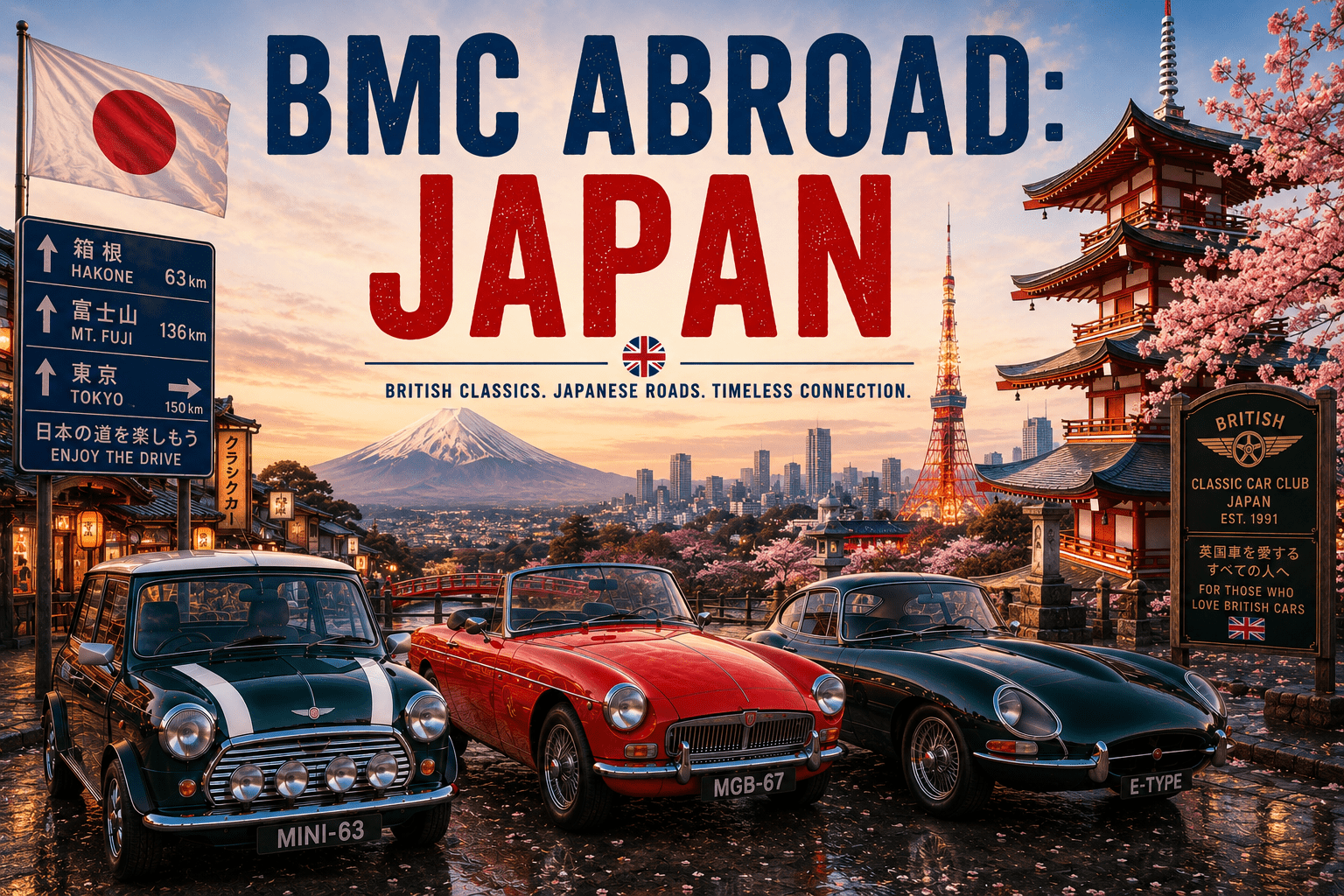
Mini’s own official history of the brand makes a claim that often raises eyebrows in the UK: the British Isles were not the biggest market for the classic Mini in the 1990s. Somewhere else was, and it was not Germany, not America, not anywhere in the old empire. It was Japan, an island on the other side of the world with no colonial connection to Britain whatsoever, that kept the Mini alive through a decade in which Rover’s home market gave the car every reason to fade away quietly.
That is the real “loved British cars more than Britain did” story, and it is a better one than the version people usually reach for, because it is not about nostalgia for a shared past. Japan has none of that with Britain. What it has instead is a genuine, structurally-backed, individually-championed enthusiasm for these cars that outlasted Britain’s own confidence in them, which is a different and rather more interesting thing entirely.
This entry in our BMC Abroad series looks at how that happened: the accident of geography that made Japan a natural home for right-hand drive British cars, the American servicemen who introduced Triumphs and MGs to the Japanese car scene decades before most Japanese buyers had heard of them, one Tokyo collector who is personally credited with saving the Mini’s reputation in the country, and why Japan has quietly become one of the best places in the world to find a British classic in exceptional condition.
The advantage nobody planned for
Start with the boring but decisive fact underneath all of this: Japan drives on the left, same as Britain, which means every British classic that ever found its way there slotted straight in as a right hand drive car in a right hand drive market. No conversion, no relocated pedal box, no compromise. Compare that to the United States or most of continental Europe, where a British sports car arrives as a slightly awkward oddity, and Japan starts from a position most other export markets in this series never had.
That accident of infrastructure does not explain the enthusiasm on its own, but it explains why the enthusiasm, once it existed, had somewhere practical to go.
Triumphs and MGs, courtesy of the US Air Force
One of the more unexpected chapters in Japan’s British car story does not actually start with a Japanese owner. The Tokyo Sports Car Club, founded by American servicemen stationed around Tachikawa and Yokota air bases, ran for nearly five decades and became a genuine, foundational part of Japan’s postwar car culture. Its early members, mechanics, pilots and officers filling their off-duty hours, spent much of that time tuning Triumphs and MGs alongside the American iron you would expect on a US base. It is not a Japanese club in origin, but it put British sports cars in front of a wider Japanese audience years before the domestic market had any real access to them, and it is as good an example as any of how these cars arrived in Japan by a route nobody in Britain could have predicted.
The Mini’s Lost Decade that was not
Individual dealers had been bringing Minis into Japan since the 1970s, drawn by a domestic appetite that existed well before any official channel did. Rover itself did not start exporting Minis to Japan formally until 1985, catching the tail end of Japan’s economic boom and a “Retro Boom” in consumer taste that made a small, old-fashioned, unmistakably British car feel fresh rather than dated. Rover leaned into it, building Japan-spec Minis with more chrome, more leather and safety features that UK buyers were never offered, while keeping the basic design untouched. The car’s Britishness was the entire point, not something to be engineered away.
Then Japan’s economy did what economies sometimes do. The bubble burst at the start of the 1990s and the country entered what became known as the Lost Decade, a prolonged stagnation that hit consumer spending across every category, cars very much included. By 1998, new car sales were falling month on month, down 14% for domestic models and a brutal 26% for imports overall. The Mini, in the same period, increased its sales by 17%. While the rest of the imported car market was in genuine crisis, more people in Japan were buying a small, expensive-to-run, thoroughly impractical British car than the year before. According to Mini’s own account, this Japanese demand is a significant part of why the Mini Cooper name was revived at all in 1990, and by extension why the car stayed in production into the new millennium rather than quietly disappearing in the mid-1990s as Rover’s fortunes worsened.
The man who would not let the Mini die
If Japan’s love for the Mini has a face, it belongs to Kazuo Maruyama. He first fell for the car not in Britain but in France, spotting rows of them parked on the street during a visit in the late 1960s, and by 1973 he had turned that fascination into a business, founding Mini Maruyama in Tokyo. Through the 1980s, when the classic Mini was struggling commercially even in some of its strongest markets, Maruyama kept championing the car in Japan against the prevailing wisdom of the time, and Mini’s own heritage pages now credit him as a central figure in the car’s Japanese revival.
His garage in central Tokyo has become something closer to a private museum than a workshop, holding cars that exist nowhere else in the world. Among them is one of the oldest surviving Minis anywhere, a prototype given to Maruyama personally by Sir Alec Issigonis, the car’s designer and, by all accounts, a genuine friend. It is a remarkable object to find tucked away in a Tokyo side street rather than in a British museum, and it says a great deal about where the deepest wells of Mini history now actually sit.
A visit to the Mini Maruyama workshop from a pair of British owners who had just bought their own Rover Minis in Japan, filmed on the ground rather than from a press release, and a good sense of what makes the place worth the trip.
Why Japanese-market cars are often the best surviving examples
There is a practical reason the classic car world pays close attention to anything with Japanese registration history, and it has nothing to do with sentiment. Shaken, Japan’s mandatory vehicle inspection, is one of the strictest and most expensive roadworthiness regimes in the world, applied every two years after a car’s first few years on the road. It goes well beyond a UK MoT in scope, checking everything from suspension geometry to chassis numbers against official records, and the cost of a full pass is significant enough that many Japanese owners simply sell a car rather than pay to keep it through another cycle.
The knock-on effect is a used car market, classics very much included, where cars tend to be either meticulously maintained to a genuinely high standard or sold on before they slip below it. Auction houses grade every car that passes through them on a documented scale, from heavily worn examples up to exceptional, and that grading is available to any buyer looking at the paperwork rather than just trusting a seller’s word. For a British classic that spent its whole life in Japan, this typically means a level of documented, verifiable condition history that is much harder to come by on a car that has spent forty years quietly rusting in a British lock-up.
The cars are starting to come home
All of which has created a small but genuine reverse flow: British classics, having spent decades in Japan, are increasingly being reimported back into the UK and other right hand drive markets. Specialist importers work from the original Japanese Export Certificate, which records mileage at the car’s last official Shaken inspections, alongside chassis-number background checks through UK-recognised verification services, to give a buyer far more confidence in a car’s history than most domestic UK sales can offer. It is a slightly strange loop for a British classic to complete: built in the Midlands, sold new in Tokyo, cherished and inspected twice a year for four decades, and finally shipped home to a country that had largely forgotten it existed.
Where to see them today
The classic Mini has its own fixture on the Japanese car calendar in the form of the annual Yokohama Historic Car Day, where rows of them still gather in numbers that would surprise most UK owners. British classics also turn up, less predictably but more often than you might expect, at general classic meets like the Nostalgic 2 Days show in Yokohama, alongside home-grown machinery like the Toyota 2000GT and early Datsun Fairladys. They are a minority presence at these events, outnumbered comfortably by Japan’s own automotive history, but a well kept MGB or an early Mini among a field of Hakosuka Skylines tends to draw its own small, appreciative crowd.
None of this is empire nostalgia, and it was never going to be; Japan owes Britain nothing of that kind. What it is instead is a country that looked at a small, characterful British car, decided independently that it liked it, and then went on liking it long after Britain itself had started to lose interest. Kazuo Maruyama put it about as plainly as anyone could: he kept vouching for the Mini against the consensus, and that stubbornness built the foundation for its popularity in Japan today. Britain built the car. Japan, in its own quiet way, is the reason a great many of them are still here to enjoy.
For more on the car at the centre of this story, our story of the Mini and classic Mini buyers guide cover its British side in full; if Japan’s chrome-and-leather export specification has piqued your interest, our Mini paint and colour codes guide is a useful starting point for identifying what you are looking at.
Next Friday: another stop on the old export map for the next instalment in the series.
This page contains affiliate links. If you click a link and make a purchase, Classic Car Hub may earn a small commission at no extra cost to you.