
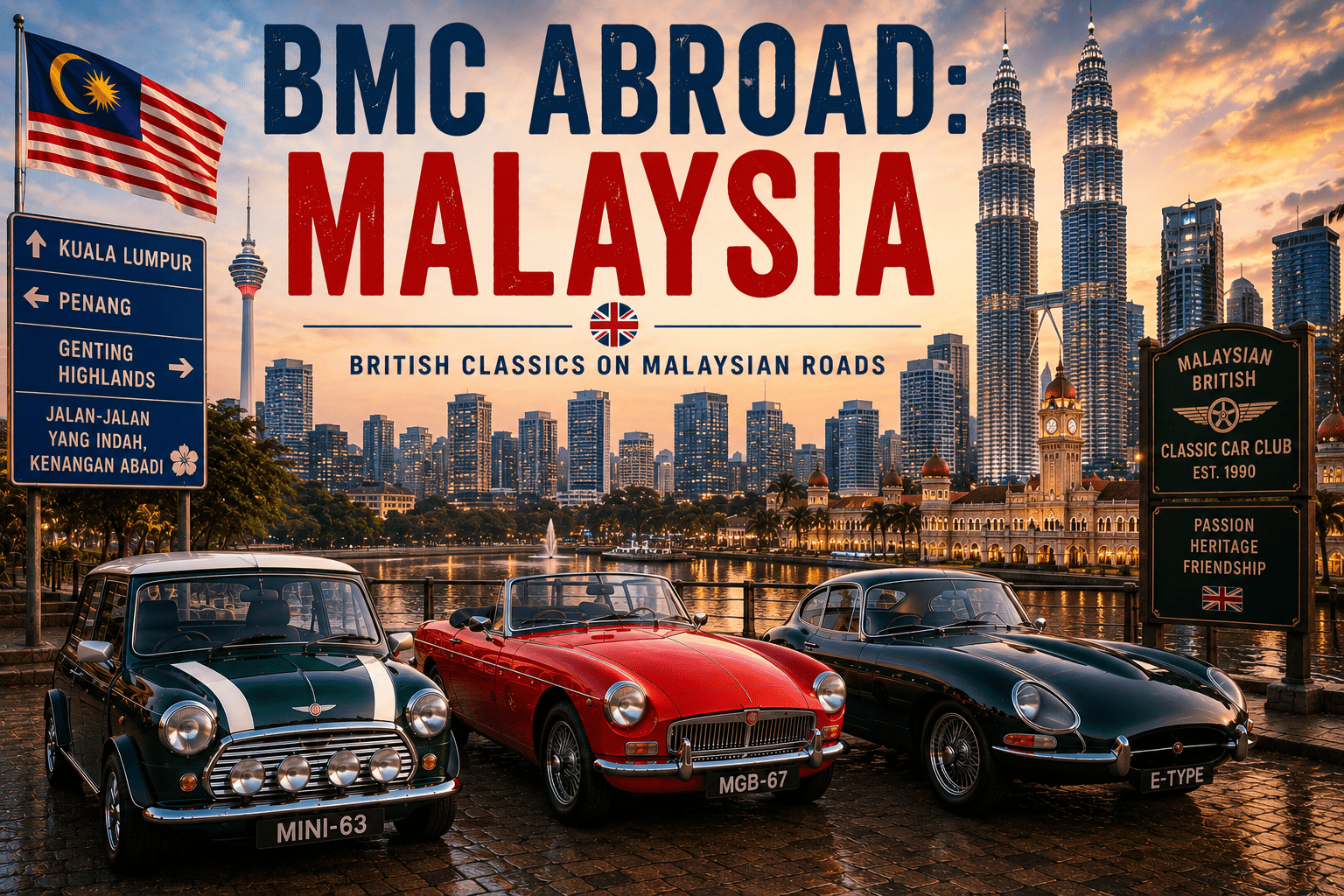
Ask a British classic car owner to name the most hostile climate for a Morris Minor and they will talk you through a Scottish winter: road salt, black ice, a heater that never quite wins the argument with the windscreen. Ask an owner in Malaysia the same question and they will laugh, then point at the humidity gauge. Monsoon rain, near-constant 85% humidity and a sun fierce enough to bleach a bonnet in a decade do a different kind of damage, but it is no less thorough. And yet the scene survives, and in places thrives, propped up by clubs founded before Malaysia itself existed in its current form and by a generation of enthusiasts keeping cars running that were, in some cases, built a few miles down the road rather than shipped in from Longbridge.
This is the latest in our BMC Abroad series, and Malaysia turns out to be one of the more layered entries: a market where British cars were once the default choice, where some of them were assembled locally rather than imported, and where the modern hobby is shaped as much by import bureaucracy and tropical weather as by any shortage of enthusiasm.
A market British cars used to own
Before independence, British cars were not a niche interest in Malaya; they were most of the market. By the 1920s around sixty different makes were on sale across the peninsula, and of the roughly twenty European marques represented, the majority were British: Sunbeam, Vauxhall, Wolseley and Daimler among them, competing against a smaller number of American and continental European rivals. Ford was significant too, though not in the way British buyers might assume: Ford Canada took direct control of the region’s distribution in 1926, using Ford Malaya as one of several empire subsidiaries designed to sidestep tariffs on cars entering from outside the empire.
That British dominance held for decades. As late as 1956, British-built cars still accounted for around 65% of new vehicle sales in Malaya, a figure that would be unthinkable in almost any market today. It is worth remembering when you see an MGB or a Triumph Herald at a Kuala Lumpur meet: these were not exotic imports in period, they were the default choice.
The cars that were built here, not just sold here
What sets Malaysia apart from several other entries in this series is local assembly. Independence in 1957, followed by the formation of Malaysia in 1963, brought a deliberate government push toward industrialisation, and one strand of that was persuading overseas motor manufacturers to assemble cars locally rather than simply ship in completed vehicles. Several agency groups set up assembly plants through the 1960s, and BMC’s local arrangement, run through Malayan Motors of the Wearne Brothers Group together with Borneo Motors and BMC-Far East, put Austin, Morris and other BMC models into local production.
The most enduring evidence of this is the Associated Motor Industries (AMI) plant at Shah Alam in Selangor, which at various points assembled the Morris Minor, the classic Mini and the Morris Marina for the Malaysian market. If you come across a Malaysian-registered Minor or Marina with slightly different trim to the UK original, or panel gaps that make a British restorer wince, CKD assembly rather than a shortcut restoration is often the explanation. These cars were built to a price for a domestic market, not hand-finished for export, and it shows in ways that are genuinely interesting rather than simply disappointing.
The clubs holding it together
The oldest and most significant body is the Malaysia and Singapore Vintage Car Register (MSVCR), which traces its roots back to 1955, when a group of enthusiasts in Malacca formed the Malayan Vintage Car Register. The club marked its 70th anniversary in 2025, has more than 350 members worldwide, and is a founding member of FIVA, the international federation for historic vehicles. It covers the whole of Peninsular Malaysia plus Singapore, split into four regions: North (based around Penang), Central (Kuala Lumpur), Southern (Johor) and Singapore itself. Membership does not require owning a car, and the club runs regular gatherings including a long-standing round-island rally in Penang, a tradition that has run since the 1960s.
Alongside MSVCR sits the North Malaysia Vintage & Classic Car Register, formed in 1984 to serve the northern states specifically, and the Royal Malaysia Vintage and Classic Car Club (RMVCCC), registered in Kuala Lumpur in 1995. There is also a more commercially minded strand to the scene: outfits like the Kuala Lumpur Collectors Guild treat classic and collectible cars as much as an investment class as a hobby, offering storage, restoration and even film and event hire alongside sales, which says something about how far classic car values have travelled locally in the past decade.
The community is also more culturally varied than a British visitor might expect. Rallies organised by groups like the Punjabi Automotive Association of Malaysia and Singapore, drawing on the country’s Sikh community, run alongside MSVCR and RMVCCC events, and motorsport crosses into the scene too: the Sepang Circuit has hosted rounds of the Classic Mini Championship Asia, putting these cars on a proper racetrack rather than just a car park on a Sunday morning.
Footage from an MSVCR AGM road rally, cars gathering for a run out with members of the Perak Classic Car club alongside them. It is a useful corrective for anyone picturing a handful of cars trailered out once a year; this is a genuinely active, driving hobby.
Getting a car in: the Approved Permit system
Anyone used to the UK’s fairly relaxed approach to importing an old car will find Malaysia’s system considerably more bureaucratic. Vehicle imports generally require an Approved Permit (AP) issued by the Ministry of International Trade and Industry (MITI), and classic and vintage vehicles have their own specific route. Since July 2018, the minimum age to qualify for a classic vehicle AP was raised from 25 years to 35 years, meaning the practical cut-off for import purposes sits at cars built in the late 1980s or earlier; the separate vintage vehicle category, requiring the car to be 50 years old or more, was left unchanged.
The paperwork is not trivial. Applications need certification as a genuine classic or vintage vehicle from a recognised body in the country of manufacture or export, replicas and rebuilt vehicles are explicitly prohibited, and imported cars must be registered with JPJ (the Road Transport Department) and cannot be transferred to a new owner for five years. Combine that with historically steep duties on non-locally produced vehicles, and it becomes clear why so much of the surviving British classic population in Malaysia consists of cars that were already here decades ago, whether as period imports or as CKD-assembled Minors and Marinas, rather than fresh arrivals from the UK.
No MOT, but no easy ride either
British owners grumbling about the MoT test might envy Malaysia’s approach, on paper at least. There is no compulsory periodic roadworthiness test for privately owned cars. Puspakom, the national vehicle inspection body, only requires an inspection at specific trigger points: an ownership transfer, a hire purchase application, or when a vehicle is imported. A Voluntary Vehicle Inspection scheme exists and covers many of the same items as a UK MoT (brakes, suspension, lights, emissions, general condition), but as the name suggests, take-up outside of the odd free inspection campaign is low.
This is not a settled arrangement, though. Proposals to introduce mandatory annual inspections for cars over a certain age, most recently pitched at 15 years old in early 2025 by a Member of Parliament, surface periodically and tend to provoke a strong public backlash before quietly being dropped. For now, a valid road tax and insurance policy is technically all that is required to keep an older car legal, which suits the classic scene, but does mean the condition of the wider older car parc varies enormously from meticulously kept to genuinely alarming.
The real enemy: heat, humidity and the monsoon
Every entry in this series has its own version of the climate problem, and Malaysia’s is unusually punishing precisely because there is no cold season to offer any relief. Rather than a few harsh winter months of salt and grit, owners face year-round humidity typically sitting well above 80%, seasonal monsoon downpours, and intense UV exposure, all twelve months of the year.
- Persistent humidity accelerates corrosion in exactly the places our own rust prevention guide flags as vulnerable on any British classic: box sections, sills and anywhere moisture can sit without airflow to dry it out.
- Monsoon rain finds its way into cars that were never sealed with a tropical climate in mind, since most were designed and built for a temperate British market (or, in the case of CKD Minors and Marinas, assembled to the same specification regardless of local conditions).
- Old-school wiring and bullet connectors, already a common source of trouble as covered in our electrical fault finding guide, corrode and cause intermittent faults faster in sustained humidity than they typically would in the UK.
- Constant strong sunlight fades paint and perishes rubber seals, trim and headlining at a rate British owners rarely have to plan for.
The upside, if there is one, is that Malaysian owners rarely have to think about the seasonal lay-up that fills our own winter storage guide: there is no frost, no road salt and no reason not to drive a classic in December just as readily as in June. The trade-off is that the car needs looking after every single week of the year rather than being tucked away and forgotten over a cold snap.
Keeping them running: the parts problem
With direct imports of complete cars restricted by the AP system, the local scene leans heavily on keeping existing cars alive rather than bringing in replacements, which puts real pressure on parts supply. Mainstream mechanical parts for the Morris Minor, Mini and MGB, the volume BMC models that were once assembled or sold locally in numbers, are generally reachable through the same international suppliers UK owners already use, with shipping from the UK, Australia or via Singapore forwarders adding cost and lead time rather than making sourcing impossible.
Trim, interior and body panels are the harder end of the job. With a comparatively thin local reproduction industry, owners rely more heavily on club networks, members bringing parts back personally from trips abroad, and a strong small-scale trade in panel beating and upholstery that can improvise a repair rather than simply bolt on a new part. It is a different skill set to the UK hobby, less “order it from Moss Europe” and more “find someone who can make it,” and it is arguably why the local scene has such a hands-on, workshop-driven culture.
What this means if you are buying or bringing a car in
A few practical points fall out of all this for anyone weighing up a Malaysian-market British classic, whether buying locally or considering shipping a car in.
- Check underneath thoroughly, and check it again. Humidity-driven corrosion does not always announce itself the way UK salt damage does, and a car that looks tidy in a lock-up can still be hiding serious sill and floor issues.
- If the car is a locally assembled Minor, Mini or Marina rather than a UK-built import, expect some detail differences in trim and finish; this is normal for CKD production and not evidence of poor restoration work.
- Budget for the AP paperwork and the five-year non-transfer rule if you are importing rather than buying locally; this is a genuinely different process to a UK import and needs planning well in advance.
- Join the local club scene before you buy if you can. MSVCR, RMVCCC and the northern register between them hold most of the collective knowledge on parts sourcing, trusted trimmers and panel beaters, and realistic valuations for the local market.
Anyone restoring one of these cars will find plenty crosses over from our core workshop content regardless of location: SU carburettor set-up, paintwork restoration and a solid grasp of how classic car insurance works before agreeing a value are all as relevant in Selangor as they are in Surrey. What changes is the environment the car then has to survive in, and the network of people needed to keep it going once it does.
For more on how these cars ended up scattered across the old empire in the first place, our history of MG and story of the Mini pieces cover the manufacturing side; this series is really about what happened next, and Malaysia’s chapter, built on colonial-era dominance, a genuine local assembly industry and a community that has kept going through seventy years of monsoons, is one of the more substantial ones we have covered so far.
Next Friday: we head to a different corner of the old BMC export map for the next instalment in the series.
This page contains affiliate links. If you click a link and make a purchase, Classic Car Hub may earn a small commission at no extra cost to you.