
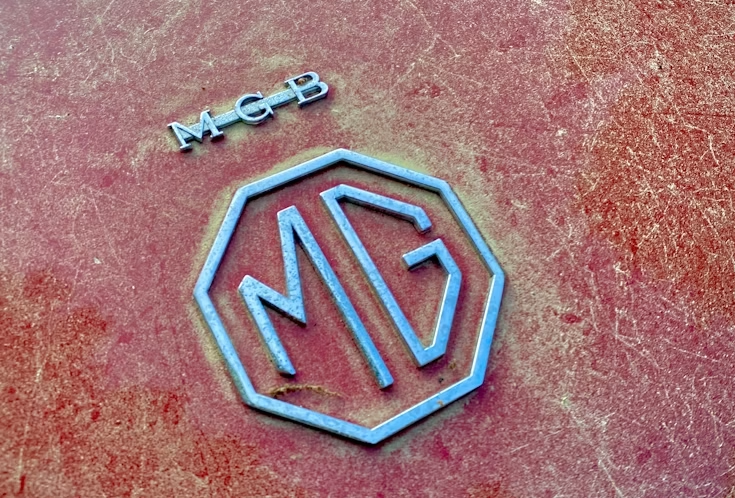
Few automotive marques have packed as much drama, triumph, heartbreak, corporate mismanagement, unlikely resurrection and sheer bloody-minded persistence into a century of existence as MG. The story begins in a Morris Garages showroom in Oxford in the early 1920s, passes through land speed records, a Le Mans class win, the most famous British sports car ever made, a factory closure that provoked demonstrations in the streets, and ends, for the moment at least, with a Chinese electric SUV wearing an octagonal badge that Cecil Kimber would probably regard with some bewilderment. It is, by any measure, quite a story.
It begins with a salesman who wanted to go faster
William Morris had built his automotive empire from nothing. Starting from a bicycle repair shop in Oxford in the early 1900s, he had worked his way up to becoming one of Britain’s most successful industrialists, producing affordable family cars that ordinary people could actually buy. Morris was a practical man with a talent for manufacturing and a firm grasp of what the mass market wanted. What he was not, particularly, was interested in making cars exciting.
Enter Cecil Kimber. Kimber joined Morris Garages, William Morris’s private retail and service company, as sales manager in 1921 and was promoted to general manager by 1923. He was an engineer by instinct, a racer by inclination, and a man who looked at a standard Morris Oxford and saw not a perfectly adequate family car but a starting point for something considerably more interesting. He began producing his own special-bodied versions of Morris models, fitting them with sportier coachwork and presenting them to customers who wanted something distinguishable from the standard product. These early specials became known as the Morris Garage Chummies, which is a name that does not quite convey the ambition behind them but has a certain period charm.
In 1923 one of Kimber’s creations won a gold medal in the Land’s End Trial. By 1924 the MG octagon had been registered as a trademark, on 1 May of that year, and the first car properly designated an MG, the 14/28 Super Sports, went on sale in September 1924. The initials stood for Morris Garages. Kimber chose them, it was said, as a mark of respect for his employer. Whether Morris felt equally respectful when Kimber started building increasingly elaborate sports cars on his watch is not entirely clear from the historical record.
Old Number One and the road to Abingdon
In March 1925, Kimber drove a car known as Old Number One to a gold medal in the 300 mile London to Land’s End Reliability Trial, the manufacturer’s first significant motorsport success. Old Number One still exists and is preserved as the earliest identifiable MG, though its precise claim to being “the first MG” has been debated by enthusiasts with the thoroughness that only the most dedicated marque historians can bring to a question.
By 1929 demand had outgrown the Oxford premises and MG moved to the former Pavlova Leather Company works in Abingdon-on-Thames, ten miles south of Oxford. The MG Car Company was formally incorporated as a limited company in July 1930. Abingdon would remain MG’s home for the next fifty years and the two became so closely associated that when the factory closed the town genuinely mourned. But that comes later.
The 1930s: going very fast indeed
The early 1930s were, by general consensus, the most exciting period in MG’s history. Kimber understood instinctively that motorsport success was the most powerful form of advertising available, and he pursued it with considerable enthusiasm and some very small cars.
In 1931 the MG EX120, nicknamed the Magic Midget, became the first 750cc car in the world to exceed 100mph, recording 103.13mph. This achievement was followed by the EX135 setting a new class record, and by 1932 MG held more international class records than any other manufacturer in the world. For a small factory in a market town in Oxfordshire to be holding more speed records than any other car maker on the planet requires a moment of appreciation.
In 1933 the K3 Magnette, driven by the great Tazio Nuvolari, won the RAC Tourist Trophy in Ulster at an average speed of 78.65mph, a record that stood for eighteen years. The same year MG won its class at the Mille Miglia, the first non-Italian team to win the Gran Premio Brescia team prize. The factory also adopted the slogan “Safety Fast” in 1930, which captured both the aspiration and the slight optimism of the era with admirable economy.
Then, in 1935, William Morris reorganised his business interests and sold MG to Morris Motors Limited. Factory racing activities were shut down on grounds of cost. Kimber continued as managing director but with considerably less autonomy than before. He was, by most accounts, not entirely reconciled to the change.
America discovers MG
In 1930 a yellow M-Type Midget was imported to the United States by Edsel Ford, son of Henry Ford, founder of the Ford Motor Company. Ford reportedly drove the car 27,000 miles around Grosse Pointe, Michigan, before placing it in the company museum, where it was later joined by the last MGB ever built. This detail about the founder of one of the world’s largest car companies falling for a small British sports car is one of the more enjoyable footnotes in automotive history.
American enthusiasm for MG would grow enormously after the Second World War, when returning GIs who had encountered British sports cars during their time in Britain began importing them in significant numbers. By the mid-1950s MG had effectively created the American market for European sports cars, a contribution to transatlantic automotive culture that is difficult to overstate and rarely properly credited.
The war and the loss of Kimber
When war broke out in 1939 the Abingdon factory was turned over to war production, assembling tank components, repairing military vehicles, and producing nose sections for the Albemarle bomber. In 1941 Kimber, frustrated with the pace at which government contracts were being distributed through Cowley, went out and secured his own contracts directly. His superiors in the Morris organisation were not pleased. After nearly two decades of building MG from a Morris Garages sideline into an internationally recognised sporting marque, Cecil Kimber was summarily dismissed.
He died in February 1945 in a railway accident at King’s Cross station, never having returned to the company he had created. His daughter said of his death that it was a merciful release, that MG had been his be-all and end-all, and that he had never quite got over being fired. Kimber House, the headquarters of the MG Car Club in Abingdon, is named in his memory.
The post-war years: going to America
The first post-war MG, the TC Midget, was launched in 1945 using a largely pre-war design because there was neither time nor money for anything more ambitious. By modern standards it was extremely basic. By the standards of an American market starved of interesting cars it was revelatory. More than a third of TC production went to the United States, where it introduced thousands of buyers to the concept of an affordable, responsive sports car that you could actually feel through the steering wheel. American MG enthusiasm became an institution.
The TF of 1953 was the last of the traditional upright-bodied T-Series cars, and it was at the time of its launch rather controversially received as old-fashioned. History has been kinder to it. In 1952 BMC was formed through the merger of Morris Motors and the Austin Motor Company, placing MG within a large and not entirely sympathetic corporate structure alongside its old rival Austin. John Thornley, who had first arrived at Abingdon in 1931 to run the MG Car Club from a desk in the corner and had worked his way up to general manager, now had to fight for investment in a new car against a management that had other priorities.
The MGA: modern at last
The MGA launched at the Frankfurt Motor Show in September 1955 was a revelation. Clean, low, modern in a way that the T-Series had conspicuously not been, it was designed by Syd Enever on a chassis developed by Roy Brocklehurst and it transformed MG’s standing in the sports car market overnight. In 1957 the EX181, a dedicated land speed record car, was taken to the Bonneville Salt Flats in Utah by Stirling Moss and recorded 245.65mph. Two years later Phil Hill raised this to 254.91mph, a record that remains the fastest any MG car has ever gone. Both drivers were wearing the MG octagon on a car that bore very little resemblance to anything available in a showroom, but the connection to the production cars was real and the publicity was enormous.
Over 101,000 MGAs were built before it was replaced in 1962, making it by far the most successful MG model to that point. The MGA had done what Thornley needed it to do. It had proved the marque could compete with European rivals and had built a level of demand that justified the next step.
The MGB: the people’s sports car
The MGB was announced at the Earls Court Motor Show in October 1962 and was an immediate success. Where the MGA had been a pretty car that made a strong argument for itself, the B was a convincing car that argued for almost nothing because it did not need to. Practical, robust, affordable, and genuinely enjoyable to drive, it captured everything MG had stood for since Kimber first fitted a sportier body to a Morris Oxford in the early 1920s and made it accessible to more people than ever before.
The MGB GT fastback coupe followed in 1965, partially styled with input from Pininfarina. The MGC with its 2912cc six cylinder engine ran from 1967 to 1969, a car that divided contemporary opinion and has since acquired a devoted following of people who were right about it all along. The MGB GT V8, using the lightweight Rover V8 engine, was available from 1973 to 1976. In 1969 HRH Prince Charles took delivery of an MGC GT, registration SGY 766F, which was later passed to Prince William. It remains probably the best-connected MG ever built.
The 250,000th MGB was built in 1971. The one millionth MG of any model was produced in 1975. In total, across all variants, more than 523,000 MGBs were built over eighteen years. It remains the most successful British sports car ever made by a distance that no other model has come close to reducing.
our MG paint codes guide covers every colour offered across the production run
British Leyland and the difficult years
The formation of British Leyland in 1968 placed MG in an organisational structure that was, to put it diplomatically, not ideally suited to producing the kind of cars MG was known for. Triumph, MG’s long-standing rival, was grouped with Rover and Jaguar in the Specialist Division. MG was placed with the mass market cars in the Austin-Morris Division. No new MG sports car was developed throughout the 1970s. The MGB and Midget soldiered on with incremental updates and the large black rubber bumpers mandated by American safety legislation from 1974, which did not improve them aesthetically.
Through all of this the Abingdon workforce maintained an industrial relations record that stood in remarkable contrast to the chaos elsewhere in British Leyland. The factory continued producing cars with minimal disruption while larger facilities were regularly convulsed by strikes. This good record did not save it.
In September 1979 British Leyland held a two-day celebration at Abingdon for the factory’s fiftieth anniversary. What most of those present did not know was that it was essentially a farewell party. The following Monday, BL chairman Sir Michael Edwardes announced that Abingdon would close at the end of the 1980 model year. The last MGB came off the production line on 23 October 1980 and was presented to Henry Ford II, to sit alongside his father Edsel’s 1930 M-Type Midget in the Ford museum. The symmetry was either very appropriate or deeply ironic depending on your point of view. Edwardes would later describe the closure as his only regret during his chairmanship.
The badge engineering years
With Abingdon gone, MG did not die. It was demoted. The octagonal badge reappeared in 1982 on the MG Metro, a warmed-up version of the Austin Metro that was not without merit as a hot hatchback but represented a significant reduction in ambition for a marque with MG’s history. The MG Maestro and MG Montego followed. They were competent cars. They were not what MG was for.
There was one exception to the general mediocrity of the period. The MG Metro 6R4 was a Group B rally car developed for the 1986 World Rally Championship, using a mid-mounted 3.0 litre V6 engine producing around 250bhp in road trim and considerably more in full competition specification. It was spectacular, extremely fast, and arrived just as Group B was being banned following a series of fatal accidents. The 6R4 never got to demonstrate its full potential in the championship it was built for, which is one of the more frustrating what-ifs in British motorsport history.
The return: MGF and MG Rover
The MGF launched in 1995 was the first proper MG sports car since the MGB and was greeted with considerable relief by everyone who had been watching the badge engineering era with declining enthusiasm. A mid-engined two-seater with Hydragas suspension, it was genuinely good fun to drive and sold well enough to confirm that the appetite for an MG sports car had not gone away during the fifteen years of its absence.
BMW had acquired the Rover Group in 1994 and sold it in 2000, retaining the Mini brand and the Rolls-Royce name and selling everything else, including MG and Rover, to a management buyout team that formed MG Rover Group. The TF, a significantly revised and improved version of the MGF, arrived in 2002. The 1,500,000th MG, a Golden Jubilee special TF 160, was built on 16 April 2002.
MG Rover went into administration on 8 April 2005. The company had been struggling for years with limited investment, an ageing product range and a market that was moving against it. Over 6,000 jobs were lost. The failure was widely mourned and equally widely regarded as having been avoidable with different decisions made earlier.
Under Chinese ownership
On 22 July 2005, Chinese manufacturer Nanjing Automobile Group purchased the MG marque and other assets from the administrator. In December 2007 Nanjing merged with SAIC Motor, China’s largest car maker, and the MG marque passed into SAIC’s ownership. The first all-new MG for sixteen years, the MG6, was launched in the UK in 2011, assembled at Longbridge. It was followed by a range of SUVs and eventually electric vehicles that have sold in remarkable numbers and positioned MG as one of the UK’s fastest growing automotive brands.
Whether the current MG range has any genuine connection to the cars Cecil Kimber was building in Oxford a century ago is a question that depends entirely on how you define a connection. The octagonal badge is the same. The commitment to affordable performance, in its own contemporary way, has some continuity with Kimber’s original proposition. The cars themselves are a world apart from anything Abingdon ever produced. This is probably not something that should surprise anyone.
One hundred years of the MG Car Club
One measure of what MG means to people is the MG Car Club, which was founded in 1930 when thirty MG owners gathered at the Roebuck Hotel near Stevenage and decided to form a club. By 1933 membership had exceeded 500. Today the MG Owners Club is the largest single-marque car club in the world, with members on every inhabited continent. The club’s headquarters are at Kimber House on Cemetery Road in Abingdon, on the edge of what was the factory site. The building is named after the man who started it all, which seems the least the marque could do for him.
The MG story is, at its heart, a story about what one person with enough passion and enough determination can build from a very unlikely starting point. Kimber had no factory, no independent funding, and no permission from his employer to do what he was doing. He had a conviction that people wanted sports cars they could afford, and the practical ability to build them. A century later, the octagon he designed is recognised on every continent, the cars he built are cherished by owners around the world, and the club his customers started in a Hertfordshire pub is the largest of its kind anywhere on earth. Not a bad result for someone who started out modifying family saloons in a garage in Oxford.
This page contains affiliate links. If you click a link and make a purchase, Classic Car Hub may earn a small commission at no extra cost to you.