
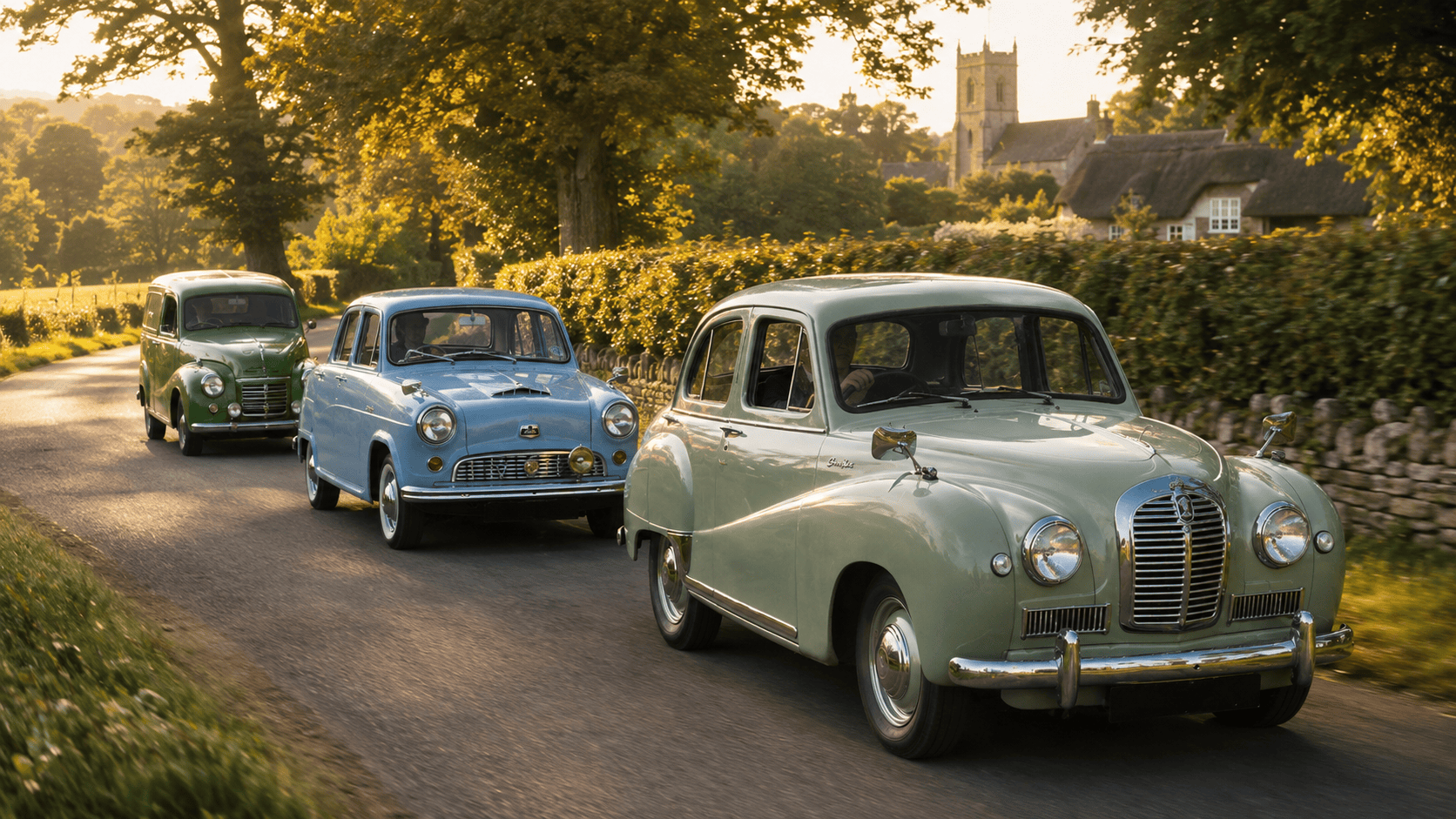
Here is the thing nobody tells you about the Austin A40 before you start looking: it is not one car, it is two, with a gap in the middle where a third one lived. Say “A40” to most people and they picture the crisp little Pininfarina box from the 1960s. Say it to your granddad and he pictures a tall, upright, separate-chassis saloon that helped drag Austin out of the post-war rubble. Both are right. Austin simply hung the same modest badge on two completely different cars a decade apart, because in those days the number pretty much told you the horsepower and not much else.
This guide covers the four variants worth knowing about as a buyer: the Devon and Dorset that started it all in 1947, the rounded Somerset that replaced them in 1952, and then, after a few years’ pause, the Farina Mk I of 1958 and the improved Farina Mk II that ran to 1967. If you want the honest version of what each one is like to own, what tends to rot, and which is the sensible buy, read on. None of them will ruin you financially, which is a large part of the appeal.
Two cars, one badge, and a gap in between
A quick pause, because the A40 name gets confusing fast. Austin named its cars after the approximate power output, so “A40” meant roughly forty horsepower, and to tell the various models apart they borrowed the names of English counties. That gives us the Devon, the Dorset and the Somerset. When the Somerset bowed out in 1954 the A40 name actually passed to the unitary-construction A40 Cambridge, which is a different car yet again and not covered here. The badge then went quiet for a few years before reappearing in 1958 on the Pininfarina-styled Farina, the first A40 not named after a county and also the last of the line.
So the four cars in this guide fall neatly into two camps. The Devon, Dorset and Somerset are the old-school ones: separate chassis, tall bodies, a tough 1200cc overhead-valve engine, and the manners of a well-mannered pre-war car without the pre-war complication. The two Farinas are the modern ones with a monocoque shell wearing Italian tailoring, powered by the familiar BMC A-series that also lived under the bonnet of the Sprite, the Midget and the Morris Minor. Keep that split in your head and everything else should fall into place.
The early cars: A40 Devon and Dorset (1947 to 1952)
The Devon was Austin’s first genuinely new post-war car, launched at the 1947 Paris Motor Show to a slightly sniffy reception about its conservative looks. Underneath the sensible clothes, though, it was a proper step forward. Gone were the running boards and separate wings of the 1930s, the headlamps were faired into the bodywork, and the front suspension was independent, with coil springs and wishbones, which was a first for an Austin saloon. At the back you still got a live axle on leaf springs, and the whole thing sat on a separate chassis, but for 1947 this was a modern, well-sorted family car.
The engine really matters here, because it started a dynasty. The 1200cc overhead-valve four was Austin’s first all-new post-war unit, good for around 40 bhp, and it is the direct ancestor of the BMC B-series that would go on to power everything from Cambridges to MGBs. It is a tough, torquey, unstressed thing that will happily sit at a steady fifty all day and grumble very little. Nought to sixty took the best part of 37 seconds, which tells you everything about the intended pace, but the car cruises far more willingly than its size suggests.
The Devon was the four-door; the Dorset was its two-door sister, and a rare beast. The Dorset never sold well and was effectively gone from the UK market by around 1948, so do not go looking for one as your first classic unless you enjoy a challenge. The far more useful news is that the same running gear also underpinned the A40 Countryman estate, van and pick-up, which soldiered on until 1956, and the pretty Jensen-bodied A40 Sports convertible of 1950 to 1953. The Sports is the family’s collector car and priced accordingly, so we will leave it to one side.
The A40 Somerset (1952 to 1954)
The Somerset is the Devon in a party frock. Mechanically it is much the same car, on the same wheelbase, with the 1200cc engine now nudged up to 42 bhp, but the body was completely restyled in the rounded “Transatlantic” idiom of the bigger Austin A70 Hereford. All soft shoulders and chrome, it was aimed squarely at the export drive, and plenty went to America, Australia and South Africa. Inside you get the full period American theme: column gearchange, a front bench seat and an umbrella-handle handbrake under the dash.
The one to seek out, if open-air motoring appeals, is the Somerset Coupé, which despite the name is a full drophead convertible with a clever three-position roof that can be shut, half-opened over the front seats, or dropped altogether. The bodies were built by Carbodies of Coventry, and only 7,243 were made against 166,063 saloons, with most exported. Genuine survivors are scarce and cherished. The Austin Counties Car Club, which looks after all the separate-chassis cars, rather nicely calls the Somerset the last “real” Austin, since it was the final new model the company launched with a separate chassis before the unibody era arrived.
The A40 Farina Mk I (1958 to 1961)
Now for the car most people mean when they say A40. By the mid-1950s BMC’s own designs were looking dowdy next to the Continentals, so the company turned to Battista “Pinin” Farina’s studio in Turin, and the result was genuinely radical for a small British family car. The Farina wore a crisp, upright two-box shape with a truncated tail, years ahead of the curvy stuff around it, and it looked expensive enough that Austin could charge a premium and keep the old A35 in production alongside it.
Under the smart suit, mind you, it was pure A35. The 948cc A-series gave 34 bhp, the running gear was conventional, and the brakes used a slightly Heath Robinson hydro-mechanical set-up, hydraulic at the front and cable-operated at the rear, that needs keeping on top of. It is no sports car. But it is light, willing and returns around 45 mpg, and there is something very likeable about a cheap little family saloon dressed by the same house that clothed Ferraris.
The clever bit arrived in October 1959 with the Countryman estate. Its rear window lifted up and its lower tailgate dropped down, opening the whole back of the car, and it is regularly cited as one of the first hatchbacks. The truth is a shade more complicated, the British car had a two-piece split tailgate rather than a single lifting hatch, and it was actually Innocenti’s Italian-built version that first fitted a proper one-piece door, but the basic idea of a two-box body you load through the back genuinely did turn up here a decade before the rest of the industry caught on. Not bad for a humble Austin.
The A40 Farina Mk II (1961 to 1967)
The Mk II is the one to have, for my money, and the reasons are practical rather than romantic. In 1961 the wheelbase was stretched by about three and a half inches to free up rear legroom, the grille went full-width, the dashboard was redesigned, an SU carburettor replaced the old Zenith, a front anti-roll bar was added, and power crept up to 37 bhp. All useful, all sensible.
The bigger change came in the autumn of 1962, when the 948cc engine gave way to the 1098cc A-series with 48 bhp, shared with the Morris Minor and the Morris 1100 of the day. It brought a better gearbox and, at last, fully hydraulic brakes to replace that part-cable rear system. A 1098 Mk II will see 75 mph and does the nought to sixty dash in around 24 seconds, which sounds glacial now but makes it perfectly usable on a modern B-road. A veneer-look fascia followed in 1964. If you want an A40 you can drive without excuses, this is it.
It is worth knowing that the Farina outstayed its welcome slightly. By the mid-1960s BMC’s own front-wheel-drive 1100 made the little rear-drive Austin feel cramped and old-fashioned, Mk II sales actually trailed the Mk I, and production finally stopped in November 1967. Total Farina production came to around 342,000 cars across both marks, so while nice ones are not thick on the ground, this was never a rare car when new.
The Farina’s unlikely second career
One thing that keeps the Farina’s name alive far more than its modest showroom career ever did: historic saloon racing. That light, boxy, beautifully balanced little shell turns out to be a natural on a circuit, and a well-sorted A40 will embarrass cars it has no business keeping up with. If you have ever been to a historic meeting and watched a grid of upright little Austins being hustled around with the inside front wheel in the air, that is the A40 living its best life. It is a big part of why the shape is still fondly remembered, and why a good competition car occupies its own corner of the market.
What to check before you buy
The good news across the whole range is the mechanical side. Both engine families are simple, tough and thoroughly understood, and a problem will announce itself long before it strands you. The bad news, as ever with a British car of this era, is rust, and how you approach it depends on which camp your car is in.
Bodywork and structure
On the separate-chassis cars (Devon, Dorset, Somerset) the chassis itself is your first job. Get underneath and check the frame, the outriggers and the body mounting points, because a rotten chassis is a far bigger undertaking than tatty panels. Floors are the usual weak spot, and the Somerset drophead is especially prone to rotting through its floor, partly because open cars let the weather in and partly because so many led hard lives abroad before coming home. A solid but scruffy separate-chassis car is a much better bet than a shiny one hiding frame rot.
On the Farina, which is a monocoque, the shell is the structure, so rust is more serious and can hide anywhere along the bottom few inches of the car. Check the sills, floors, front valance and apron, the bulkhead, the lower wings and wheelarches, the area below the light clusters and the boot floor. Poke, do not just look, and be very suspicious of fresh underseal and thick filler. The hard truth is that values are low enough that a genuinely rotten Farina is not economic to restore if you are paying someone else to do the welding, so buy on condition and walk away from the worst. Whatever you end up with, our guide to classic car rust prevention is worth reading, since keeping the tin-worm at bay is far cheaper than curing it.
Engine, gearbox and brakes
- On the early cars, the 1200 OHV engine is durable but check for the usual tired-engine signs: low oil pressure, smoke on the overrun and a rattly timing chain. Parts are more specialised than the A-series, so factor that in.
- On the Farina, the 948cc and 1098cc A-series units are a known quantity with enormous parts support, shared with the Sprite, Midget and Minor. Problems will be obvious and cheap to put right.
- Mind the brakes on the Mk I Farina and the early Devon: both use a part-mechanical rear system that needs regular attention to work properly. The Mk II Farina from 1962 gained fully hydraulic brakes, which is one more reason to favour the later car.
- Check the gearbox synchromesh and, on a 1098 Mk II, enjoy the fact that it is the sweetest of the lot to change. Rear leaf springs sag and crack with age on all of them, but the clubs have had replacements remade.
Panels, parts and the clubs
This is where the owners’ clubs earn their keep, and it genuinely affects which car you should buy. New body panels for the Farina are limited, but the A40 Farina Club has used its spares fund to commission repair sections for the major trouble spots, including outer sills, front valances, lower wing and wheelarch repair pieces, the fiddly bits below the light clusters and grille surrounds, plus remanufactured rubber seals. Much of this is members-only, which is a very good reason to join before you buy rather than after. For the Devon, Dorset and Somerset, the Austin Counties Car Club is the equivalent hub of knowledge and spares. On both sides of the range, the club is worth its subscription several times over.
What to pay
Values are refreshingly sane, which is much of the charm. As a rough guide at the time of writing, a usable, honest A40 of any flavour starts around £3,000, with good, sorted cars generally sitting between roughly £4,500 and £8,000. Countryman estates tend to ask a little more than the equivalent saloon, dropheads are scarce and priced accordingly, and the Jensen-bodied A40 Sports sits well above the rest as the family’s collector car. Competition Farinas trade in their own world entirely. The very top of the market is the exception rather than the rule: the headline figure is a Farina that made £45,000 at auction in 2021, but that is a long way from what a nice road car costs. Buy the best you can afford, spend the difference on club membership and a proper inspection, and you will not go far wrong.
So which A40 should you buy?
It comes down to what you want from it. If you love the upright, chrome-and-leather, post-war character and do not mind period pace and part-mechanical brakes, an honest Devon or Somerset is a charming, gentle thing with a lovely club scene, and the Somerset drophead is a genuinely pretty open car if you can find a sound one. If you want something you can actually use, that parks in a modern space, sips fuel and can be kept going on the same shelf of A-series parts as half the classic world, buy a 1098cc Farina Mk II. And if the two-box Pininfarina shape and that pioneering hatchback story are what draw you, the Farina is the one that carries the history anyway. For most people coming to the A40 for the first time, the later Farina is the sensible answer. For the romantics, the Counties cars are waiting.
Technical specifications by variant
| Devon / Dorset | Somerset | Farina Mk I | Farina Mk II | |
|---|---|---|---|---|
| Years | 1947–1952 (Dorset to c.1948) | 1952–1954 | 1958–1961 | 1961–1967 |
| Construction | Separate chassis | Separate chassis | Monocoque | Monocoque |
| Body styles | 4dr saloon (Devon), 2dr (Dorset); Countryman, van, pick-up | 4dr saloon; 2dr drophead coupe | 2dr saloon; Countryman (from 1959) | 2dr saloon; Countryman |
| Engine | 1200cc OHV four | 1200cc OHV four | 948cc BMC A-series | 948cc, then 1098cc A-series (autumn 1962) |
| Power | c.40 bhp | 42 bhp | 34 bhp | 37 bhp (948) / 48 bhp (1098) |
| Carburettor | Zenith | Zenith | Zenith | SU |
| Gearbox | 4-speed, synchro on top three | 4-speed, column change | 4-speed | 4-speed (improved from 1962) |
| Brakes | Drums; hyd front / mech rear (full hyd from late 1951) | Girling hydraulic drums | Hydro-mechanical (hyd front, cable rear) | Fully hydraulic drums (from 1962) |
| Top speed | c.70 mph | c.70 mph | c.73 mph | c.75 mph (1098) |
| 0–60 mph | c.37 sec | not quoted | c.36 sec | c.24 sec (1098) |
| Production | c.289,900 Devon saloons; family total c.456,500 to 1956 | 166,063 saloons + 7,243 dropheads | 141,899 saloons + 27,713 Countryman | 172,568 (all Mk II); Farina total c.342,000 |
For related reading on Classic Car Hub, our Austin paint colour codes guide covers where to find the original factory colour on an A40 when a repaint beckons, and our classic car paintwork restoration guide covers bringing tired but honest paint back to life.
References and further reading
- Austin Counties Car Club, the owners’ club for the Devon, Dorset and Somerset
- The A40 Farina Club, owners’ club and repair-panel spares scheme for the Farina
- The British Motor Museum at Gaydon, home of the BMC archive and Heritage Certificates
- Classics World Austin A40 Farina buyer’s guide, with detailed panel and club information
- Honest John’s Austin A40 Farina model review and ownership notes
- National Motor Museum, Beaulieu, on the A40 Farina Countryman and the hatchback claim
This page contains affiliate links. If you click a link and make a purchase, Classic Car Hub may earn a small commission at no extra cost to you.