
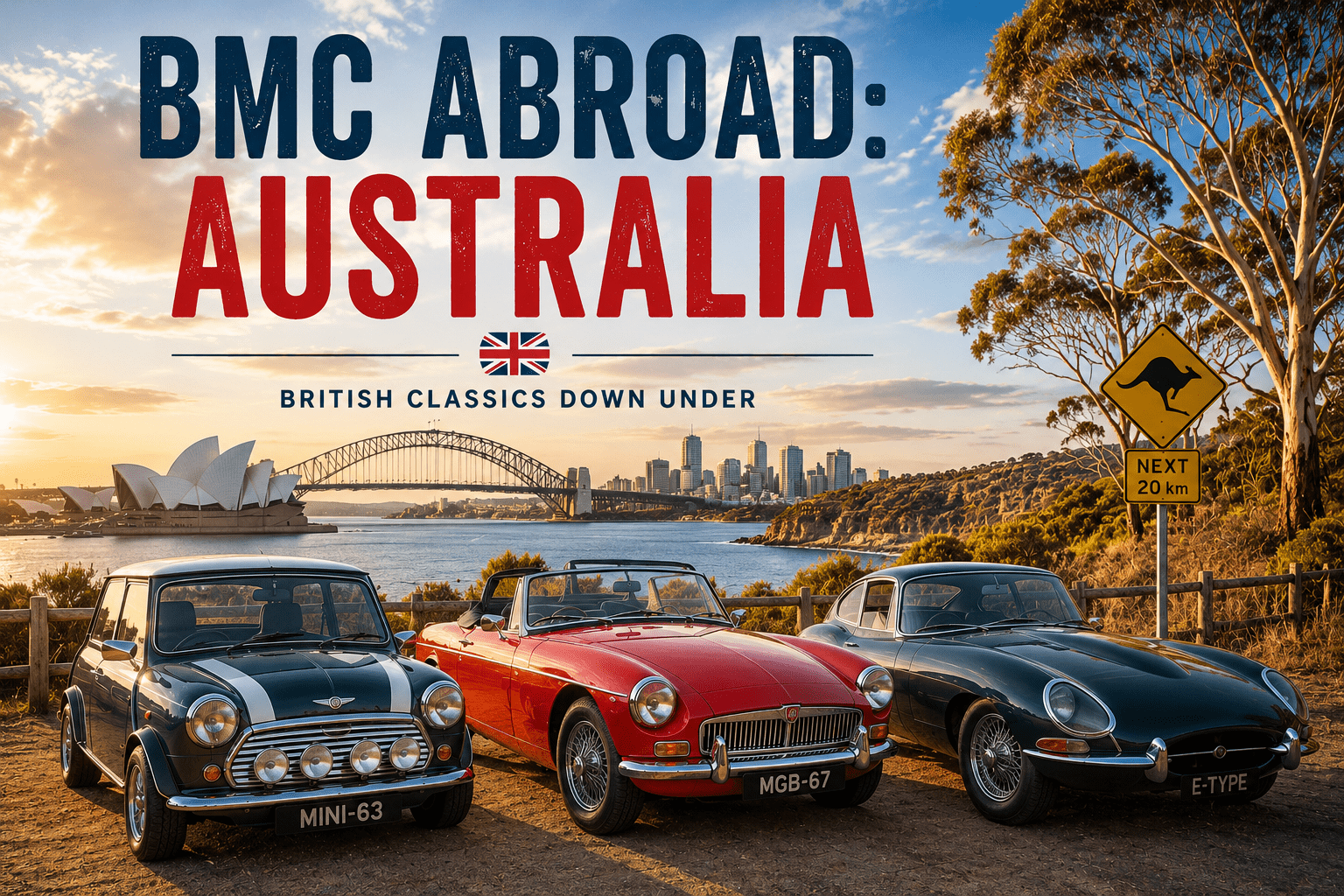
Australia’s relationship with the classic British car is not one of import and nostalgia at a distance. It is something more direct, more physical, and considerably more complicated. For twenty-five years, from the opening of the Zetland factory in Sydney in 1950 to its closure in 1975, British Motor Corporation and then British Leyland built cars on Australian soil, employed thousands of Australians in their factories, and developed local variants of their models specifically for Australian conditions. This was not a distant manufacturer shipping product to a colonial market. This was, for a generation of Australians, an industry that employed their neighbours and built the car in the driveway. The emotional connection between Australia and the classic British car runs deeper than simple nostalgia, and the survival rate of those cars on Australian roads today reflects it.
Built here: the manufacturing story
The story begins with Lord Nuffield, who instructed his Australian representative in 1946 to find a site for a car factory in Sydney. The site they found was the former Victoria Park Racecourse at Zetland, five kilometres from the city centre. Nuffield Australia opened the first stage of the factory there in March 1950, initially assembling Morris Minor and Morris Oxford models from imported component packs. When the Austin Motor Company of Australia merged with Nuffield Australia in 1954 to form British Motor Corporation Australia, the Zetland site became the group headquarters and the only BMC plant in the world capable of manufacturing a complete vehicle from raw materials. At its peak the factory employed 7,000 people from 35 nations, a figure that reflects the postwar migration wave that was reshaping Australian society at the same time it was building its cars.
BMC Australia was not merely an assembly operation. The engineers at Zetland developed vehicles specifically for Australian roads and conditions. The Austin Lancer and Morris Major were Australian variants of the Wolseley 1500, modified for local requirements. The Austin Freeway and Wolseley 24/80 of 1962 were Australian-built variants of the A60 Cambridge powered by a six-cylinder version of the BMC B-Series engine. The Austin Tasman and Kimberley of 1970 were developments of the 1800 platform with a six-cylinder OHC engine and extended wheelbase, designed entirely for the Australian market. These were not badge-engineered imports. They were Australian cars wearing British names.
The Morris Mini Moke deserves a paragraph of its own. Built at Zetland from 1966 with larger 13-inch wheels and modified rear suspension compared to the UK original, it was an adaptation made specifically because Australian roads had made clear that the original’s ground clearance was the wishful thinking of engineers who had never left Oxfordshire. After the Zetland factory closed, Mini and Moke production continued under the Pressed Metal Corporation at Enfield in western Sydney. The last Australian-built Mini left Enfield in 1978. The last Moke followed in 1982, by which point the vehicle had outlasted the company that designed it by nearly a decade. In Britain, the Moke is a curiosity. In Australia, it is something closer to a national symbol. The distinction matters to anyone who has seen one parked on a beach north of Byron Bay with a surfboard strapped to it and understood immediately that it had arrived somewhere it was always supposed to be.
Across the country in Melbourne, Standard-Triumph had been assembling cars at Fishermans Bend since 1952, producing the Standard Vanguard, the Triumph Mayflower, and subsequently TR series sports cars, Heralds, and Vitesses for the Australian market. The Fishermans Bend plant closed in 1974. British Leyland’s final act on the continent was the Leyland P76, launched in 1973 as a genuine attempt to build an Australian car that would compete with Holden and Ford on their own terms. It was a six-cylinder and V8 saloon with a boot large enough, it was prominently advertised, to hold a 44-gallon drum. Whether there was significant consumer demand for a car specifically marketed on the size of its boot is a question history has settled. The P76 was discontinued after less than two years of production, taking the Zetland factory with it. Leyland Motor Corporation of Australia formally ceased to exist in March 1983, ending thirty years of British car manufacturing on the continent in circumstances that were, to put it diplomatically, not its finest hour.
The cars that stayed
The scale of BMC and Leyland’s Australian operation means that the classic British car population in Australia is not primarily an imported collection. Most of the British classics on Australian roads today were built there, or were imported new during the postwar decades when British cars dominated the Australian market before Japanese manufacturers arrived in force in the late 1960s and early 1970s. The Morris Minor, the Mini, the MGB, the Triumph Spitfire, the Land Rover, the Austin-Healey: these were the ordinary transport of suburban Australia from the 1950s onwards, not exotic imports. They survived in numbers that reflect that ubiquity.
The Moke occupies a particular position in Australian automotive culture that has no equivalent anywhere else in the world. Built in Australia for longer than it was built in Britain, adapted for Australian use from the outset, and associated in the Australian national memory with the beach, the outback, and a particular strand of 1970s optimism, the Moke is in many respects more genuinely Australian than British in character. A Moke on a beach north of Byron Bay has found its natural habitat. The same vehicle on a wet street in Longbridge would have had considerably less to recommend it.
The regulatory framework: club rego and what it means in practice
Australia’s approach to historic vehicle registration is the inverse of Singapore’s in almost every practical respect. Where Singapore rations classic car use to 45 days per year through a system of day licences and imposes substantial costs at every turn, Australia has arrived at something that looks, by comparison, almost welcoming. Rather than a single national scheme there are eight different state and territory systems, each administered locally and each with slightly different rules, which is the kind of thing that sounds complicated until you discover that the practical outcome in almost every case is cheap registration, a logbook to fill in, and the freedom to actually use the car.
The common thread across all states is the requirement to be a paid-up member of an accredited club. This is not merely a bureaucratic formality: club membership in Australia unlocks concessional registration, which means the annual cost of keeping a classic British car legally on the road is a fraction of what a modern car would cost to register. It also means that the clubs themselves are well-funded, well-attended, and genuinely useful, because every member has a practical financial reason to be there as well as a sentimental one.
Victoria, where the club scene is particularly well developed, operates what is widely regarded as the most straightforward system. Vehicles 25 years and older qualify for a club permit, allowing either 45 or 90 days of use per year. The 90-day permit costs approximately AUD 154, which includes compulsory third-party insurance and the permit fee. The full registration cost for a standard vehicle in Victoria runs to over AUD 800 per year, making the saving substantial. New South Wales allows 60 days of personal use per year for vehicles 30 years and older, in addition to unlimited club events. Queensland, South Australia, and Western Australia operate their own variations on the same principle, all significantly cheaper than standard registration.
The practical consequence for a classic British car owner in Victoria or New South Wales is that the car can be used on weekend runs, club gatherings, and the occasional longer trip with minimal bureaucratic friction and at a cost that is genuinely affordable. This is not a scheme that rations the car to a handful of days per year. It is a scheme that enables regular use while acknowledging that a 1967 MGB is not a daily commuter.
The community
Australia’s classic British car club scene is one of the most active in the world outside the United Kingdom itself, and the club permit system is a direct reason why. Because club membership carries a tangible financial benefit, membership rates are high and clubs are well-funded, well-organised, and genuinely active. The Easter national meetings that rotate between state centres are significant events, drawing hundreds of cars from across the country for a long weekend of concours judging, social runs, and technical sessions.
The MG Car Club of Australia coordinates MG clubs across all states and the ACT, with the MG Car Club of Victoria being among the largest, running twelve regional chapters across the state. The Triumph Sports Owners Association Australia covers all Triumph cars through state chapters, and the TR Register Australia, dedicated specifically to the sidescreen TR2 to TR4A models, has been active since 1976. The Victorian Mini Club traces its origins back fifty years to the original Morris 850 Club and operates an active motorsport programme under the Motorsport Australia framework. The Morris Minor Car Club of Victoria is one of several Morris Minor clubs around the country dedicated to the most numerous surviving British classic in Australia. Most states have equivalent clubs for each marque, and the Association of Motoring Clubs Victoria provides the umbrella registration body that accredits clubs for the permit scheme.
The BMC Leyland Car Club, which covers the full range of BMC and Leyland models including the distinctly Australian variants, is one of the more unusual clubs in the world, combining the generic British marque enthusiasm found elsewhere with a specific focus on cars that never left the continent. Members with Austin Freeway or Morris Major saloons are not an oddity. They are the point of the club.
What Australia actually does to a British classic
Australia is a large country with a varied climate, and the challenges a classic British car faces in coastal Queensland are different from those it faces in the Barossa Valley or on the road between Alice Springs and Darwin. What unifies the Australian experience across all regions is ultraviolet radiation at levels that have no equivalent in the Northern European environment these cars were designed for.
Ultraviolet radiation: the primary enemy
Australia’s UV index regularly exceeds 11 in summer, a level classified as extreme and substantially above anything experienced in the United Kingdom even on its most optimistic summer day. The practical consequences for a classic car are significant and arrive faster than any British owner would expect. Paint oxidises, fades, and begins to chalk within a single Australian summer without appropriate protection. Chrome develops surface pitting. The rubber of door seals, window channels, hood fabric, and suspension bushes dries and cracks at rates that would genuinely astonish an owner accustomed to the slow, damp deterioration of a northern English garage. Tyre sidewalls develop UV cracking on cars that are barely driven, purely from sitting in ambient radiation while parked. Australia does not rust your classic car the way Britain does. It simply dismantles it from the outside inward, methodically, in full sunshine.
The practical response among experienced Australian classic car owners involves several layers: quality paint protection (ceramic coating has become the standard recommendation among the more committed owners for its durability relative to conventional wax), covered storage wherever possible, UV-protective sprays applied regularly to all rubber components, and replacement of original rubber with modern UV-resistant materials where originality permits. Our tyre safety guide covers sidewall inspection, which takes on a specific relevance in the Australian context given the accelerated UV degradation and the consequences of a tyre failure on a remote road far from the nearest help.
Heat: cooling, oils, and electrics
Australian summer temperatures present cooling challenges across the entire country. In Adelaide and inland South Australia, 40-plus degree days are a normal feature of summer rather than an occasional exception. In the Northern Territory, 45 degrees is not remarkable. Even in Melbourne, which has a climate closer to southern England than the rest of Australia, extremes above 40 degrees occur regularly in January and February.
The cooling systems of classic British cars were engineered for Northern European conditions, and a standard-specification cooling system on an MGB or a TR6 will work harder in an Adelaide summer than it was ever designed to. The standard preparation is familiar: uprated radiator core, quality thermostat, silicone hoses throughout, and consideration of an electric cooling fan in addition to or in place of the mechanical original. The full procedure is covered in our cooling system guide. In very high ambient conditions, the coolant specification also matters: a correctly inhibited modern coolant provides better protection against the accelerated galvanic corrosion that elevated operating temperatures encourage in aluminium-component engines.
Heat accelerates oil oxidation and degrades oil’s lubricating properties faster than the service intervals designed for cooler climates would suggest. Owners in warmer Australian states typically reduce oil change intervals accordingly. Engine oil coolers, relatively uncommon on UK classics, are a sensible fitment for cars regularly used in extreme summer conditions. The battery is also affected: heat shortens battery life substantially compared to temperate climates, and a battery that would last five years in the English Midlands may be ready for replacement after two in central Queensland. Our battery guide covers maintenance and storage.
Distance and reliability
Australia is approximately the same size as the continental United States, a comparison that sounds abstract until you consider that Sydney to Melbourne is almost 900 kilometres by road, that Perth is roughly 4,000 kilometres from Sydney, and that crossing the Nullarbor Plain between South Australia and Western Australia involves over 1,200 kilometres of road with essentially nothing on either side of it and very little at either end. The Nullarbor, whose name is Latin for no trees, delivers on its name with a thoroughness that takes a while to process when you are actually on it. This is not a context in which a fuel leak or a cooling system failure is merely inconvenient. It is a context in which both are serious.
The Australian classic car owner who uses their car for interstate runs, as many do, needs a level of mechanical reliability that is not absolutely critical when the next garage is fifteen minutes away. This shapes maintenance habits: more frequent fluid changes, more thorough pre-trip inspections, and a more comprehensive breakdown kit than its UK equivalent. Our breakdown kit guide covers the essentials, though the Australian version of this list should add a water supply, a satellite communicator or EPIRB for remote areas, and careful thought about fuel range before heading inland.
Dust is a specific issue on the unsealed roads that make up a significant proportion of Australia’s road network outside the major highway corridors. Dust infiltrates air filters, clogs cooling systems, and works into every gap in bodywork and sealing. Air filter maintenance intervals on any classic driven on unsealed roads need to be much shorter than the manufacturer’s original specification, and the sealing of body gaps and door apertures deserves attention before any extended outback driving.
Which British classics suit Australia
The good news for Australian owners is that no British classic is fundamentally unsuited to Australian conditions, because these cars were sold and used here in large numbers during their production years without modification beyond what Zetland’s engineers had already incorporated. The question is less whether a given car can cope with Australia and more how much preparation and maintenance is required to keep it doing so.
The Morris Minor is probably the most numerous British classic surviving in Australia, and for good reason. The simple, understressed A-series engine runs cooler than almost any other British unit. The car’s mechanical simplicity makes it easy to maintain anywhere in the country. Parts are well-supported locally. The Morris Minor’s compact dimensions suit the narrower rural roads of inland Australia, and the car’s durability means examples with substantial mileage remain entirely usable. The Morris Minor buyers guide covers what to look for.
The Mini and Moke are uniquely positioned in Australia because significant numbers were built there and remain there. The Moke in particular has an Australian association that makes local ownership feel natural in a way it does not elsewhere. The Mini is well-supported by an active club scene with a motorsport focus, and the small engine produces manageable heat loads even in Australian summer temperatures provided the cooling system is maintained.
The MGB is among the most popular British classics in Australia across all states, supported by an active national club network, excellent parts availability both locally and from UK suppliers, and a mechanical specification that responds well to the cooling and electrical upgrades that Australian conditions demand. Our MGB buyers guide and TR6 buyers guide both contain relevant pre-purchase inspection detail for Australian buyers looking at imported or local examples.
The Land Rover has perhaps the strongest claim of any British vehicle to suit Australia across the widest range of conditions. In rural and outback use, the Series Land Rover’s mechanical simplicity, its ground clearance, its parts availability (particularly in rural areas with agricultural and station fleets), and its adaptability to local modification make it closer to essential transport than recreational vehicle in some parts of the country. The Land Rover community in Australia is large, well-supported, and particularly strong in Western Australia and Queensland. Our classic Land Rover buyers guide covers the key inspection points.
The Triumph sports cars are well-served by the TSOA’s national network and TR Register Australia. The Spitfire and TR6 in particular have a strong following. The same cooling considerations that apply to the MGB apply here, and the TR6 fuel injection requires particular attention in high ambient temperatures as covered in the TR6 buyers guide. The Herald and Vitesse, less common in Australia than the sports cars, represent characterful alternatives with separate chassis that respond better to the rougher surfaces encountered on unsealed roads than the monocoque sports cars.
Parts supply: better than you might expect
Australia has a better local parts supply for classic British cars than its geographical isolation might suggest, partly because the manufacturing history created a local industry to support those cars and partly because the surviving population is large enough to sustain specialist suppliers. Classic Motoring Australia stocks parts for the Mini, Moke, Morris Minor, MGB, MGA, and Austin-Healey Sprite and Midget. Classic Car Parts Australia covers MG, Triumph, Jaguar, Mini, and Austin-Healey. UK mail order to Australia involves international shipping at meaningful cost, but all the major UK suppliers including Rimmer Bros and Moss Europe ship internationally and are regularly used by Australian owners for less common items.
The wrecker and parts car market is also a relevant source for Australian owners, particularly given the large surviving population of British cars. Specialist classic car wreckers exist in most states, and the club networks are effective channels for locating specific parts that the mainstream trade does not stock. For owners of the Australian-specific BMC variants such as the Austin Freeway, Tasman, Kimberley, or Morris Major, local sourcing is often the only practical option given that these models were never sold outside the region.
Why they keep going
Australia’s classic British car community does not need to justify itself with nostalgia for something distant and foreign. The justification is local and immediate: these cars were built here, driven here, maintained here, and the people who kept them going when they were merely old and unfashionable are the reason so many survive now that they are properly appreciated. The Zetland factory is long gone, replaced by a suburb of apartments within sight of the Sydney CBD. The Fishermans Bend plant is now a university engineering campus. But the cars that those factories built are at shows in Adelaide and runs in the Yarra Valley and tracks outside Canberra, maintained by people who in many cases are the grandchildren of the workers who built them.
The enjoyment available to an Australian classic British car owner is considerable and, by the standards of classic car ownership in most of the world, remarkably unencumbered. The club registration system is affordable, the roads in country Victoria, South Australia, and the southern highlands of New South Wales are exactly what a classic British sports car was made for, and the distances available to anyone who wants to cover them are, frankly, extraordinary. A weekend run in Australia can cover more ground than a week’s touring in England. The challenges of Australian ownership, from UV protection to cooling and pre-trip preparation, are well understood within a community that has been solving them since before the cars were considered classic. They are not obstacles to enjoyment. They are simply the terms on which Australia offers it, and most owners consider it a fair deal.
For technical guidance relevant to Australian conditions: our cooling system guide, rust prevention guide, pre-season safety check, breakdown kit guide, and tyre safety guide all apply directly to Australian ownership. The classic car price checker shows current UK market values as a reference point for buyers considering importing a specific model.
This page contains affiliate links. If you click a link and make a purchase, Classic Car Hub may earn a small commission at no extra cost to you.