
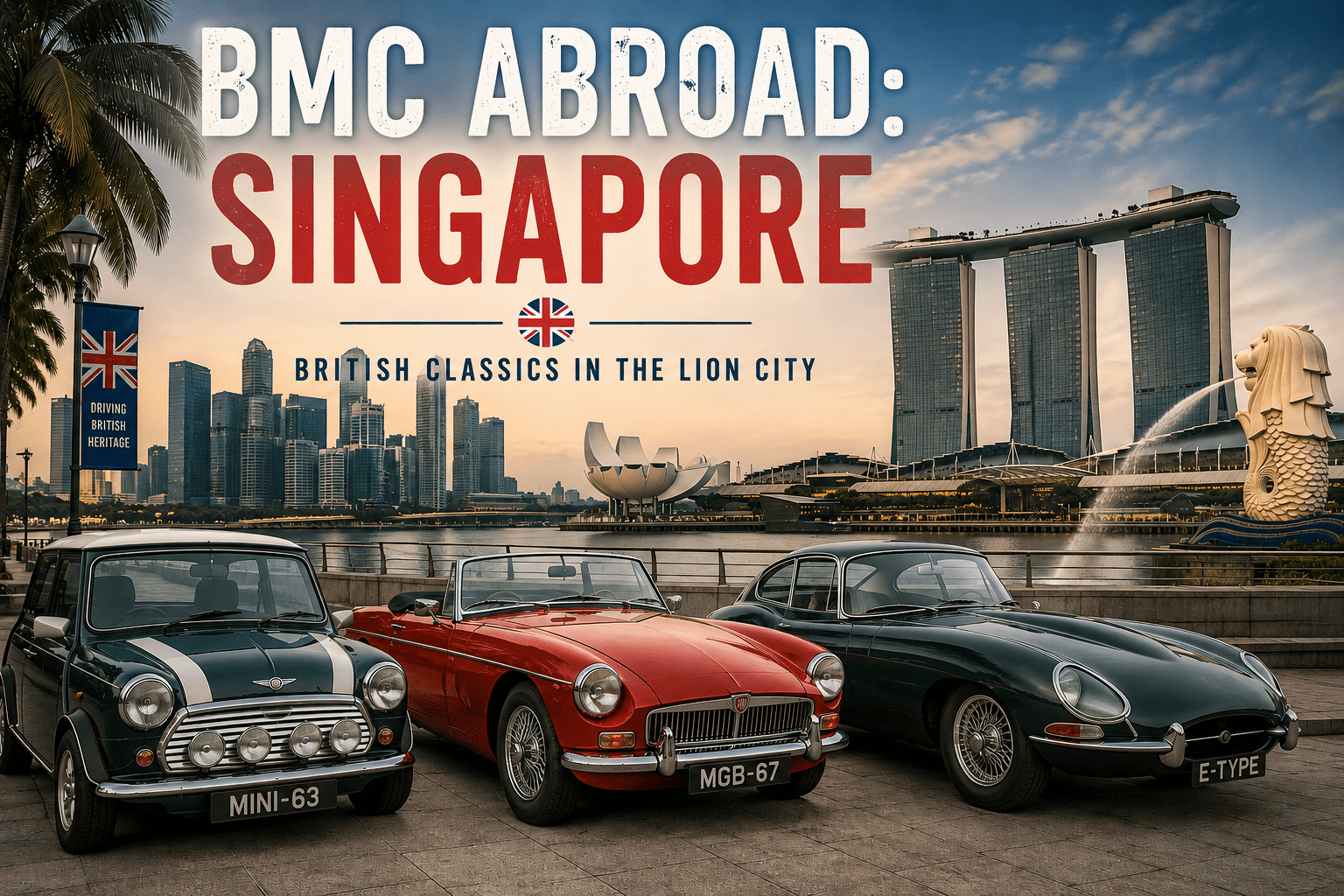
Singapore should not, by any rational analysis, be a good place to own a classic British car. The climate is hostile to old metal in almost every measurable way: the temperature rarely drops below 26 degrees Celsius, the humidity averages between 80 and 90 percent, the ultraviolet radiation is intense enough to destroy rubber and fade paint within a season, the rain arrives in quantities that would astonish a Yorkshireman, and the road network is so managed and metered that you are only legally permitted to drive a classic vehicle for 45 days each calendar year. The cars themselves are expensive to import, expensive to register, and expensive to maintain. Parts arrive from the other side of the world, often with customs paperwork attached.
And yet the classic British car community in Singapore is alive, dedicated, and considerably more sophisticated in its approach to the particular challenges of tropical ownership than most of its counterparts in the countries where these cars were originally built. This is the first entry in our BMC Abroad series, and we are starting here because Singapore already makes up a significant portion of Classic Car Hub’s readership. This article is for those of you on that side of the world: the people who already own a British classic in Singapore, the people considering buying one, and the people who simply want to understand why anyone would go to such considerable lengths to keep a 1960s sports car running on a tropical island city-state where most of the population sensibly uses the MRT.
Why British cars ended up in Singapore
The answer begins in 1819 when Stamford Raffles established a British trading post on the island. Over the following century and a half of British colonial administration, the infrastructure, legal system, and commercial habits of Singapore were shaped by British institutions. This included something as practical as which side of the road to drive on: Singapore drives on the left, a legacy of British rule that survived independence in 1965 and which has practical consequences for classic car ownership to this day. Right-hand drive is the natural configuration for left-hand traffic, which means the entire output of the British motor industry from the 1950s, 1960s, and 1970s fits without conversion, without a steering swap, without any of the complications that affect classic British car owners in continental Europe or North America.
British car brands were the dominant presence in Singapore’s pre-independence automotive market. Ford operated an assembly plant in Singapore at Alexandra from the early colonial era. BMC and British Leyland vehicles were sold through dealerships across the island throughout the 1950s and 1960s. The Mini, the Morris Minor, the MGB, the Triumph Herald and Spitfire, the Land Rover: these were not exotic imports in 1960s Singapore. They were the everyday cars of the middle class, the vehicles in which families learned to drive, the cars parked outside shophouses and in the driveways of bungalows in Bukit Timah and Serangoon. The emotional connection that drives classic car enthusiasm in Singapore today is, for many owners, as direct and personal as it gets. These are the cars their fathers and grandfathers drove.
The regulatory framework: what ownership actually means in Singapore
To understand classic car ownership in Singapore you must first understand the Certificate of Entitlement system, because it shapes everything. Introduced in 1990 as a response to Singapore’s constrained land area and rapidly growing car ownership, the COE is a separate bidding process required before purchasing any vehicle. A standard COE grants the right to own a car for ten years, after which it must be scrapped, exported, or the COE renewed for further five or ten year periods. COE prices are set by open auction and reflect demand. In recent years, Category B COE prices (covering engines above 1600cc) have regularly exceeded SGD 100,000 on their own, entirely separate from the price of the car itself. This makes car ownership in Singapore one of the most expensive in the world for standard vehicles.
Classic vehicles operate under a separate framework that changes the economics considerably. Under Singapore’s Classic Vehicle Scheme, any vehicle at least 35 years old qualifies for registration at substantially different terms. Road tax is a flat SGD 280 per year regardless of engine size. The COE is charged at only 10 percent of the Prevailing Quota Premium for the appropriate category, reducing what would otherwise be a six-figure cost to something more manageable. There are two important conditions. First, the vehicle may only be used for a maximum of 45 days per calendar year. Owners receive 28 free day licences annually; a further 17 days can be purchased at SGD 20 each. Second, the vehicle must be maintained in its original condition without modifications, alterations, or conversions before import. All classic vehicles registered under the scheme must be right-hand drive.
There are additional costs at the point of importation that catch first-time buyers unprepared. Excise duty of 20 percent of the car’s Open Market Value is payable on import. Additional Registration Fees apply at rates that increase steeply for higher-value vehicles. For a modest classic British sports car with a relatively low OMV, these costs are manageable. For a more valuable example, they can add substantially to the landed price. One further restriction worth understanding before purchase: once registered as a classic vehicle in Singapore, ownership cannot be transferred for five years. And if the car is subsequently deregistered, it cannot be re-registered as a classic vehicle in future. These are not casual decisions.
The community: who owns and why
The Classic Car Club Singapore, known as the CCCS, is the island’s principal organisation for classic vehicle enthusiasts and the natural first point of contact for anyone entering the scene. The club organises regular gatherings, annual shows, and social events, and provides a network of contacts and accumulated knowledge about the specific challenges of ownership in Singapore’s conditions. For British marque owners in particular, the institutional knowledge within the CCCS about local sourcing, sympathetic workshops, and tropical-specific maintenance is genuinely valuable.
The Singapore and Malaysia Vintage Car Register covers both sides of the causeway and reflects a practical reality of Singapore’s classic car scene: Malaysia plays a significant role in it. The Johor Bahru area just across the Causeway offers restoration workshops at costs that reflect Malaysian rather than Singaporean labour rates, and the Malaysian classic car market provides a regional hunting ground for project cars and parts that would cost considerably more if sourced from the UK. Many Singapore owners have had restoration or maintenance work carried out in Johor, combining the lower labour costs with the convenience of proximity.
The community itself skews toward enthusiasts who came to classic cars through family connection rather than pure mechanical curiosity. The sight of a Morris Minor or a Triumph Herald on Singaporean roads in the 1960s and 1970s was unremarkable. Today it is extraordinary, which gives the cars a visibility and a nostalgia that resonates well beyond the enthusiast community. It is not unusual for a Singapore classic car owner to attract sustained attention at a filling station or a car park from people who have not seen a particular model since childhood.
The environmental challenges: what Singapore actually does to a British classic
This is the section that matters most for anyone maintaining a classic British car in Singapore’s climate, and it is where the experience diverges most sharply from UK ownership.
Humidity
Singapore’s average relative humidity runs between 80 and 90 percent year-round. The UK, for comparison, rarely exceeds 70 to 75 percent even in its dampest months, and the British classic car was designed to cope with a rather different atmosphere. Humidity at Singaporean levels accelerates electrochemical corrosion dramatically. The original Lucas bullet connectors and Lucar terminals used throughout British cars of the 1960s and 1970s are already considered one of the weakest points of these cars in the UK climate. In Singapore’s atmosphere, without active protection, they corrode at a rate that makes regular electrical fault-finding not an occasional chore but an ongoing maintenance discipline.
The practical responses are well established among experienced Singapore owners. ACF-50, originally developed for aviation applications, applied to all electrical connections is considered essential rather than optional. Electronic ignition conversion eliminates the points and condenser that are most vulnerable to moisture-induced corrosion, replacing them with a system that is both more reliable in humidity and better suited to the stop-start driving conditions of the city. Our electronic ignition conversion guide covers the procedure in detail.
The interior of the car is equally at risk. Original leather and vinyl interiors absorb moisture at ambient humidity levels and will develop mould within weeks if the car is not actively protected in storage. Most Singapore classic car owners invest in dehumidified storage, either using a dedicated unit in their private garage or, for those without suitable storage space, using one of the specialist classic car storage facilities that maintain controlled conditions. The target is to hold relative humidity at between 40 and 55 percent in the storage environment, which is achievable with modern desiccant dehumidifiers but requires specific equipment and running costs that simply do not apply to ownership in Northern Europe.
Heat and cooling systems
Singapore’s ambient temperature of 26 to 33 degrees Celsius means a classic British engine starts its working day already considerably warmer than its designer intended. The cooling systems of 1960s British cars were typically engineered for northern European conditions and often considered marginal even in the UK during summer. In Singapore’s stop-start city traffic, with ambient temperatures making the baseline already elevated, cooling becomes the central mechanical concern.
The practical responses include uprated radiators with greater core capacity, electric fans supplementing or replacing the original mechanical fan, improved thermostats, and silicone hoses throughout the cooling circuit replacing the original rubber that both degrades in heat and becomes less efficient over time. Regular cooling system maintenance is not optional: our cooling system guide covers the full procedure including the correct coolant specification, which matters particularly in tropical conditions where the corrosion inhibitors in fresh coolant provide specific protection against the accelerated galvanic corrosion that higher operating temperatures encourage.
The Lucas fuel injection systems fitted to UK-market Triumph TR6s and some other British cars are particularly prone to vapour lock in high ambient temperatures, a problem that manifests as hot restart failure and erratic running in slow traffic. Most Singapore owners of injected TR6s have carried out the Bosch metering unit conversion described in our TR6 buyers guide, which addresses the primary source of heat-related injection unreliability. Carburettor-equipped cars require careful attention to heat shielding around the carburettor body and fuel lines.
Ultraviolet radiation and rubber degradation
Singapore’s equatorial position means ultraviolet radiation levels substantially higher than anywhere in the United Kingdom. The practical consequences for a classic car are significant and visible within a single season without appropriate protection. Paint oxidises and fades. Chrome develops pitting and loses its lustre. Rubber components, from door seals and window channels to hood fabric on open cars, degrade and crack at rates that UK owners would find startling. Original soft tops last considerably longer in a Yorkshire garage than under the Singaporean sun.
The mitigation is straightforward in principle if not always in practice: UV-protective coatings for paintwork, quality rubber treatments applied regularly to all exposed rubber surfaces, covered or garaged storage as standard rather than occasional, and replacement of hood fabric with UV-resistant modern materials where originality requirements permit it. Ceramic paint protection coatings, now widely available in Singapore’s well-developed automotive detailing industry, provide substantially better UV resistance than traditional wax and represent a sensible investment for a classic car that is driven in equatorial sunshine.
Rust: a different kind of problem
UK classic car owners think of rust primarily in terms of road salt: the enemy is the winter road network, and the season of risk is November to March. Singapore has no road salt and no winter, which might suggest that rust is less of a concern. It is not. What Singapore has instead is coastal salt air, sustained high humidity, and frequent heavy rain followed by intense heat that cycles metal through expansion and contraction repeatedly. The result is a different rust pattern from the UK: less concentrated on the underside in places where road spray accumulates, more diffuse on any surface that traps moisture, and particular in the areas around bodywork seams and joints where water pools and the high humidity sustains corrosion continuously.
The underbody of any classic British car in Singapore benefits substantially from wax injection into cavities and a quality underseal applied to all exposed surfaces. Regular washing after rain to remove any salt deposits from coastal exposure is more relevant in Singapore than a UK owner might expect. Our rust prevention guide covers the relevant treatments, though the seasonal advice within it translates to a year-round maintenance schedule in Singapore’s climate rather than a winter-focused one.
Which British classics suit Singapore best
The 45-day annual usage limit changes the calculus of classic car ownership in Singapore in ways that are worth thinking through before buying. In the UK, a classic car used year-round needs to be reliable over a wide range of conditions and distances. In Singapore, the car will be used for perhaps one day per week on average, predominantly for weekend runs, club gatherings, and social occasions. Reliability in stop-start city traffic matters more than long-distance capability. Parking in Singapore’s high-density environment matters more than open-road performance. Ease of maintenance in the local context matters considerably.
The Classic Mini is exceptionally well suited to Singapore’s conditions and is among the most popular British classics on the island for good reason. Its compact dimensions make it entirely at home in Singapore’s tight urban environment. The engine and mechanical specification are about as simple as a post-war car gets, keeping maintenance costs manageable and reducing the consequences of high ambient temperatures on a small, accessible powerplant. The Mini’s cultural significance is universal and generates immediate recognition. Parts supply from the UK is extensive. The only meaningful cooling concern is keeping the engine oil level correct and the cooling system properly maintained, as the A-series engine in a Singapore traffic jam is working harder thermally than Alec Issigonis designed it to.
The MGB handles Singapore’s conditions reasonably well with appropriate preparation. The B-series engine is robust and tolerant of high ambient temperatures provided the cooling system is maintained properly, the thermostat is in good condition, and the carburettors are correctly tuned for the heat. Parts availability from UK suppliers is exceptional. The MGB’s relatively low visual profile means it attracts genuine interest from Singaporean motorists old enough to remember them from the 1960s and 1970s. The chrome bumper cars are the most desirable, as they are everywhere. Our MGB buyers guide covers the full inspection procedure.
The Morris Minor earns its place in Singapore’s classic car scene not through sporting credentials but through an almost universal nostalgic recognition among older Singaporeans and a robust simplicity of construction that makes it one of the more forgiving classics to maintain in a hot climate. The side-valve engine of the earliest cars runs cool and reliably in almost any conditions. The later overhead-valve A-series-equipped cars share running gear with the Mini, which helps with parts supply. The Morris Minor was ubiquitous in 1960s Singapore and a surviving example in good condition stops traffic for the right reasons.
The Triumph Spitfire is manageable in Singapore with care. The 1296cc engine keeps it in the lower COE category, the parts supply from UK specialists is strong, and the open-top driving experience is genuinely enjoyable on a dry Singapore evening when the temperature drops to the lower end of its range. Cooling requires attention: the Spitfire’s engine was not over-engineered for tropical conditions and benefits from the standard uprated radiator and electric fan treatment. The separate chassis gives the car good structural longevity provided rust is addressed proactively.
The cars that present the greatest challenges in Singapore are those with larger, hotter-running engines and more complex fuel systems. The Jaguar E-Type, magnificent as it is in other contexts, requires significant cooling system attention in stop-start city traffic, particularly in six-cylinder form and substantially more so in V12 form. The E-Type’s thermostatically complex coolant system, which was marginal at times on cool English roads, requires meaningful upgrades to cope reliably with 33 degree ambient temperatures and the heat soak of slow urban traffic. The rewards for getting it right are considerable, but the investment should be understood before purchase.
Parts supply and restoration in Singapore
The principal source of parts for most Singapore classic British car owners is UK mail order. Rimmer Bros and Moss Europe, now trading together as Moss Rimmer, between them cover the majority of common British marques with comprehensive stocks and international shipping. SC Parts Group offers a complementary range with particular depth on Jaguar, Austin-Healey, and MG. The costs of shipping from the UK to Singapore are not trivial, and the choice between air freight (expensive but fast) and sea freight (cheaper but weeks in transit) becomes a consideration when the car needs a specific part to return to roadworthiness.
Malaysia provides a regional alternative that experienced Singapore owners use intelligently. The Malaysian classic car market has produced a larger surviving population of British cars than Singapore, partly because the ownership regulations are different and partly because many cars that left Singapore after deregistration ended up in Johor or Kuala Lumpur. These cars provide both completed examples for purchase and donor vehicles for parts. Johor Bahru’s proximity to Singapore makes cross-causeway collecting runs practical. Labour costs for restoration and mechanical work in Johor are substantially lower than in Singapore, and the quality available at reputable workshops is high.
Singapore itself has a well-developed precision engineering industry and machinists capable of fabricating components to specification. Owners who need something made rather than bought can usually find the capability locally, which is an advantage over some other regions where classic car owners must rely entirely on imported parts. Specialist workshops in Singapore with experience of British classics exist, though the community is small enough that finding one with genuine expertise in a specific marque may require some investigation through the CCCS community before committing.
Why Singapore’s enthusiasts keep going
The rational case for classic British car ownership in Singapore does not make itself easily. The regulatory framework is restrictive, the climate is hostile, the costs are significant, and the usage is limited to fewer days than many British owners take for granted in a summer. And yet the community exists, persists, and in the view of those within it, would not swap their position for anything.
Part of the answer is the scarcity premium that the COE system inadvertently creates. A classic vehicle registered in Singapore is genuinely rare. There are perhaps a few dozen examples of any given British classic model on the island at most. When a 1967 MGB appears at a Saturday morning gathering at East Coast Park, it is not competing for attention with fifty other MGBs. It is the MGB. The crowd that forms around it includes people who have not seen one since their childhood in the 1970s, people whose parents owned one, people who simply cannot believe it is still running. That kind of reception, repeated at every gathering, provides a level of social reward for the effort of ownership that is difficult to quantify but very easy to understand.
Part of the answer is also the engineering challenge itself. Keeping a classic British car in sound mechanical order under the conditions Singapore imposes requires genuine knowledge, regular attention, and the satisfaction that comes from solving problems that the original designers never anticipated. The owners who have been doing this for decades have accumulated expertise that is specifically Singaporean: they know which cooling upgrades work in local traffic, which electrical treatments last in 90 percent humidity, which parts they can source regionally and which require a UK order. This is a different kind of ownership from its UK equivalent, more demanding in some ways and more rewarding in others.
The British classics that arrived in Singapore aboard ships in the 1950s and 1960s came as practical transport. The ones that survive today have been transformed by circumstance into something rather more: preservations of a shared history between a small island nation and the country that shaped it, maintained against considerable odds by people for whom the cars mean something that no amount of inconvenience has managed to diminish. From a Classic Car Hub perspective, approximately 11,000 kilometres away in the country where these cars were built, that is a story that deserves to be told, understood, and appreciated.
For technical advice relevant to Singapore ownership: our rust prevention guide, cooling system maintenance guide, electronic ignition conversion guide, electrical fault finding guide, and battery guide all contain information particularly relevant to tropical conditions. The classic car price checker shows current UK market values, which provide a useful reference for anyone considering importing a specific model.
This page contains affiliate links. If you click a link and make a purchase, Classic Car Hub may earn a small commission at no extra cost to you.