
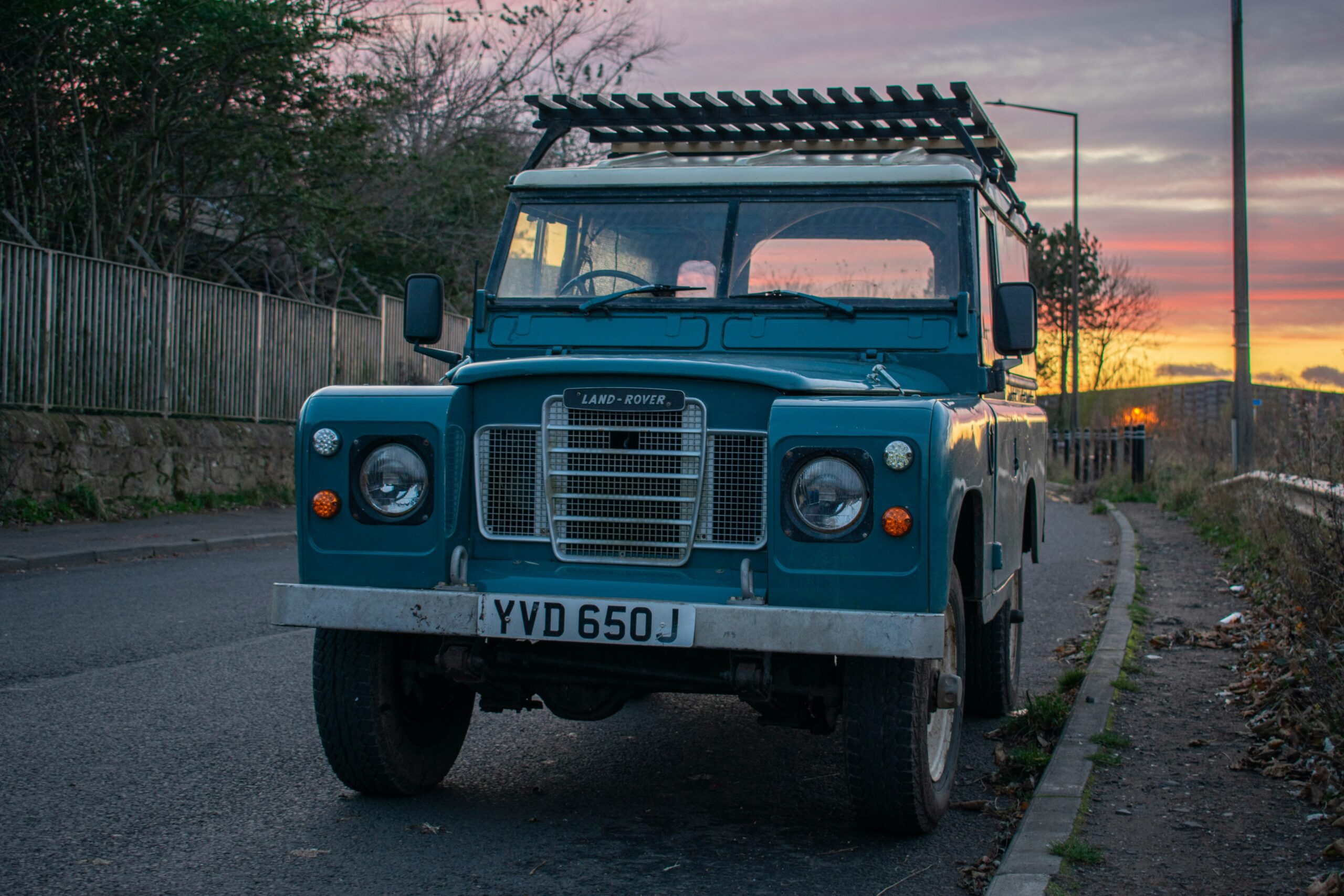
There is a particular type of person who buys a classic Land Rover. They are not necessarily experienced mechanics. They are not necessarily wealthy. They are not necessarily entirely rational. What they share is a conviction that getting somewhere slowly, noisily, and with a modest quantity of oil redistributing itself around the engine bay is preferable to getting there quickly and comfortably in something more sensible. These people are, broadly speaking, correct. The classic Land Rover is one of the most honest, most capable, most characterful and most thoroughly British vehicles ever made, and this guide will help you buy one without making the kind of expensive mistakes that experienced Land Rover owners have already made so you do not have to.
The story begins on a beach
In 1947, on the beach at Red Wharf Bay on the Isle of Anglesey, a man named Maurice Wilks picked up a stick and drew the outline of a vehicle in the wet sand. His brother Spencer, who was standing nearby, asked what it was. Maurice said he was going to build it. It is, depending on your perspective, either one of the most consequential doodles in automotive history or evidence that the Rover Company’s management style was refreshingly informal.
The context is important. The Rover Company had emerged from the Second World War with its original Coventry factory heavily bombed and its management installed in a shadow factory at Solihull that had previously built Bristol Hercules aircraft engines. They had a skilled workforce, a big building, and a government that would only supply them with enough steel to build 1,100 luxury cars per year. What they needed was a vehicle that could be built from aluminium, of which there was a considerable postwar surplus from aircraft production, and sold in enough numbers to keep the company alive.
The result was launched at the Amsterdam Motor Show on 30 April 1948. It had an 80-inch wheelbase, a 50bhp 1595cc petrol engine borrowed from the Rover P3, a body hammered from Birmabright aluminium alloy, no doors as standard, optional passenger seats, and a price of £450. Rover’s management had hoped they might sell around 5,000 in the first year. They sold 8,000. The British Army placed its first order within twelve months. By 1951, King George VI had granted Land Rover a Royal Warrant. By 1953, a specially built Land Rover was carrying the Royal Family on State occasions. The little utility vehicle designed to keep the lights on at Solihull had become something rather more than that.
The Series Land Rovers (1948 to 1985)
The original Land Rover, which was not called the Series I at the time because there was only one series, ran from 1948 to 1958. By the time it was replaced, over 200,000 had been built. The Series II arrived in 1958 with a new overhead-valve 2286cc engine and a slightly more refined body. The Series IIA followed in 1963 with further refinements including the option of a diesel engine, which proved enormously popular. The Series III arrived in 1971 and remained in production until 1985, by which time over a million Series Land Rovers had been built across all three variants.
What the Series Land Rovers share, regardless of which variant you are looking at, is a simple ladder-frame chassis, an aluminium body that does not rust, leaf spring suspension, and mechanicals of almost wilful simplicity. They were designed to be maintained by farmers in remote locations using tools that farmers in remote locations actually had, and that design philosophy produced vehicles of considerable longevity and robustness. Land Rover claimed in 1992 that seventy percent of all Land Rovers ever built were still in use. The figure is frequently cited and entirely plausible.
Which Series Land Rover?
Series I cars are the most characterful and the most expensive. The earliest 80-inch wheelbase cars are increasingly rare in genuinely good original condition and command prices that reflect this. Unless your heart is specifically set on an early car, the Series I is probably not the ideal starting point for a first time buyer.
The Series IIA in 88 or 109-inch wheelbase is generally considered the sweet spot of the Series Land Rover range. The diesel engine option makes it more practical for everyday use. Parts availability is good. The mechanical specification is well understood and extensively documented. For a buyer who wants a working, usable, genuinely capable classic that does not require a dedicated restoration budget to acquire, the IIA is where to look.
The Series III is the most common and the most affordable. It is also, in the view of many purists, the least interesting, having received a revised dashboard and various other updates that make it feel slightly more modern without being particularly better. This is an unreasonable criticism of what remains an excellent vehicle, and the Series III’s greater availability means better choice at the buying stage and lower prices than equivalent earlier cars.
The Defender (1983 to 2016)
The vehicle we now call the Defender did not arrive fully formed with that name. The Land Rover 110, with its coil spring suspension replacing the Series cars’ leaf springs, arrived in 1983. The 90 followed in 1984. The name Defender was not applied until September 1990, when Land Rover needed to distinguish the model from the newly launched Discovery. Whatever you call it, the coil-sprung era Land Rover represented a significant improvement in ride quality and off-road articulation over the Series cars, while retaining the basic separate chassis and aluminium body construction that had defined Land Rovers since 1948.
The last classic Defender rolled off the Solihull production line at 9:22 on the morning of 29 January 2016. It wore the registration H166 HUE, a deliberate nod to HUE 166, the very first pre-production Land Rover built in 1948. It was the 2,016,933rd vehicle in an unbroken line stretching back nearly seven decades. More than 700 current and former Solihull employees attended the ceremony. There were cheers. There were tears. There was, it is safe to assume, a certain amount of tea.
Which Defender engine?
The engine question is the most important decision in any Defender purchase and it is worth getting right. The Defender’s engine history spans everything from the 2.5-litre diesel that powered early 90s and 110s through to the 2.4-litre Ford-derived Puma diesel fitted to the final generation cars, and the choice of engine has a significant impact on reliability, running costs, and how much of your weekend you spend underneath the vehicle.
The 200Tdi, fitted from 1990 to 1994, was the first diesel engine specifically designed for the Defender rather than adapted from another Land Rover model. It produces 107bhp and is a robust, relatively simple unit. Known issues include timing belt neglect and oil leaks from the rocker cover, both of which are manageable with regular maintenance.
The 300Tdi, produced from 1994 to 1998 and producing 111bhp, is widely considered the most reliable engine ever fitted to a Defender. It is a direct injection turbodiesel with mechanical fuel injection, which means there is no electronic management system to fail and any competent mechanic can work on it without specialist diagnostic equipment. The timing belt requires regular replacement but otherwise the 300Tdi is robust, long-lived, and well understood. If you can only remember one engine number from this guide, remember 300Tdi.
The TD5, produced from 1998 to 2007 and producing 122bhp, introduced electronic engine management to the Defender for the first time. It is a more powerful and refined engine than the Tdi units but requires specialist diagnostic equipment to work on and is more sensitive to neglect. Injector seal failure is a known issue and the wiring harness deteriorates with age. A well-maintained TD5 is an excellent engine. A neglected one is an expensive problem.
The Puma, a 2.4-litre Ford Transit-derived diesel producing 122bhp, was fitted to the final generation Defenders from 2007 until 2016. It is arguably the most refined of all Defender engines and comes with a six-speed Getrag gearbox, but it represents a compromise between the mechanical simplicity of the Tdi cars and the sophistication of more modern vehicles. Parts availability from the Ford Transit crossover is a genuine advantage.
90, 110 or 130?
The 90 is the most popular and the most characterful. The short wheelbase and lightweight construction make it extraordinarily capable off-road. As a daily vehicle for two adults it is entirely practical. As a daily vehicle for a family of four it requires a certain philosophical adjustment to the concept of personal space.
The 110 is the sensible family choice. More rear seat space, a larger load area, a more comfortable ride on the longer wheelbase. Most Defender 110s were built as station wagons with seating for up to nine, which is either a considerable practical advantage or evidence that Land Rover had a creative approach to passenger comfort, depending on how long your journey is.
The 130, with its extended rear body on a 127-inch wheelbase, is primarily a working vehicle used for towing or carrying. Values are generally lower than equivalent 90s and 110s. For most buyers it is not the obvious choice but if you regularly need to carry a horsebox or several hundred kilograms of agricultural supplies, it is the correct tool for the job.
The Discovery Series 1 and 2 (1989 to 2004)
The Discovery was launched in 1989 as Land Rover’s answer to the growing market for premium off-road vehicles that could also be used for the school run without alarming the other parents. It used the Range Rover’s permanent four-wheel drive system and Rover V8 engine in a new body on a development of the existing ladder-frame chassis, but at a price that made it considerably more accessible than the Range Rover. It was enormously successful and saved Land Rover from a precarious financial position during the early 1990s.
The Discovery Series 1, produced from 1989 to 1998, is now entering classic status and prices for good examples are rising accordingly. The 3.5 and 3.9-litre Rover V8 petrol versions produce a wonderful sound and offer effortless performance, but fuel consumption is significant enough to make a grown adult weep. The 300Tdi diesel version, sharing the same engine as the contemporary Defender, is the more sensible choice for regular use. The Series 1 is identifiable by its stepped roofline with the raised rear section, which provides excellent headroom in the back seats and makes the car instantly recognisable from any angle.
The Discovery Series 2, produced from 1998 to 2004, used the Td5 diesel or the 4.0-litre V8 and offered a more refined driving experience with ACE active cornering enhancement on later models. The Td5 engine in the Discovery is the same unit as in the Defender and carries the same known issues around injector seals and wiring harness deterioration. Head gasket failure on the V8 engines is a well-known concern and any V8 Discovery should have its cooling system inspected carefully before purchase.
Common issues to watch for
The chassis: the most important thing
Every classic Land Rover sits on a steel ladder-frame chassis that was never galvanised from the factory. The body panels are aluminium and do not rust. The chassis rusts comprehensively and from the inside out, which means the surface can look acceptable while the structure inside has deteriorated significantly. This is the single most important thing to check on any classic Land Rover and it is not negotiable.
Get underneath the vehicle with a torch and a screwdriver. Probe the main chassis rails, the crossmembers, the outriggers, and the area where the gearbox crossmember meets the main rails. If the screwdriver meets solid resistance you are dealing with sound metal. If it goes through, you are looking at a chassis replacement rather than a repair, which is a significant expense on any model. The rear crossmember is typically the first area to fail. Fresh underseal applied in generous quantities to the underside of a vehicle you are considering is a warning sign rather than a reassurance. It may be hiding something rather than protecting it.
The bulkhead
The front bulkhead, the steel firewall separating the engine bay from the cabin, is the second most critical structural component to inspect and the most expensive to address correctly. It corrodes around the windscreen, around the fresh-air ventilation flaps, in the footwells, and at the corners near the upper door hinges. The double-skinned sections trap moisture against steel and the resulting rust can be well advanced before it is visible from the outside. A properly repaired or galvanised replacement bulkhead is a significant positive on any car that has had the work done. An unaddressed rotten bulkhead on a car being sold at full price is a reason to negotiate firmly or walk away.
Electrical gremlins
Lucas electrical components fitted to British vehicles of the 1960s through 1980s earned the nickname Prince of Darkness among mechanics, a tribute to their creative approach to reliability. The Series Land Rovers are entirely susceptible to this characterisation. Wiring harnesses deteriorate with age, earth connections corrode, and previous owners frequently add their own modifications with varying degrees of competence. On any Series Land Rover, test every electrical component before purchasing. Lights, wipers, indicators, heater — all of them. Budget for wiring work on any older car regardless of how optimistic the seller is about the current state of the electrics.
TD5 Defenders have a specific and well-documented wiring harness problem where the loom deteriorates and causes a range of electronic faults. A replacement wiring harness is a worthwhile investment on any TD5 and its presence should be viewed as a significant positive on a car being inspected for purchase.
Oil leaks and the philosophy of acceptance
A classic Land Rover that does not leak oil is either very new or very unusual. The experienced community wisdom holds that a Land Rover is not leaking oil, it is marking its territory, and while this is amusing it also contains a genuine practical point. Minor seepage from gaskets, the rocker cover, and various transmission components is entirely normal on older examples and should be assessed in context rather than treated as automatic grounds for rejection. What matters is the scale and origin of any leak. A thin film on the underside of an old engine is normal. A substantial drip from the gearbox output shaft seal or evidence of oil loss significant enough to require regular topping up is a different matter and deserves investigation.
Swivel housings
The front axle swivel housings on classic Land Rovers require regular greasing and oil changes that are frequently neglected. A neglected swivel housing becomes noisy and then fails, producing a clunking sensation under steering and eventually serious front axle problems. Check that the swivel housing oil level is correct and that there is no excessive play at the front wheels with the steering at full lock. Swivel housing replacement is not catastrophically expensive but it is the kind of job that should be reflected in the purchase price of any car where neglect is evident.
Check for a hard life
Classic Land Rovers were built to work and many of them did, extensively. A Land Rover that has spent its life as a farm vehicle or been used for regular serious off-roading will carry the evidence of that life in its drivetrain, its underbody, and the condition of its diff plates and radius arms. None of this is necessarily a reason to walk away — a genuinely hard-worked Land Rover that has been properly maintained can be in better mechanical condition than a lightly-used one that has been neglected. But a hard-worked example priced as if it were a pampered weekend vehicle is a reasonable cause for negotiation.
What to pay
Land Rover values have been climbing steadily since the classic Defender ended production in 2016, and the Series cars have benefited from the same wave of appreciation. Good examples across all classic Land Rover variants are now genuinely expensive, and the days of finding a running Series III for a few hundred pounds have largely passed.
Series II and IIA Land Rovers in solid, usable condition ask between £8,000 and £15,000 depending on specification and body style. Well-restored examples command £18,000 to £28,000. Series III cars are more accessible, with solid usable examples from £6,000 to £12,000 and restored cars at £15,000 to £22,000. Series I cars in good original condition command a significant premium and need individual valuation.
Defender 90 and 110 values depend heavily on engine and condition. A solid 300Tdi Defender 90 in usable condition typically asks £18,000 to £28,000. Good examples exceed £35,000. TD5 Defenders in good condition are £15,000 to £25,000. Final Puma Defenders start at around £20,000 and well-presented late cars ask considerably more. Any Defender described as recently restored at a price below these figures warrants careful questioning about what exactly the restoration involved.
Discovery Series 1 cars in good condition are £6,000 to £12,000. The 300Tdi versions command a premium over the V8 petrol cars for practical reasons. Discovery Series 2 prices are broadly similar with the TD5 versions preferred.
Before you buy
The Land Rover Series 1 Club, the Land Rover Series 2 Club, the Land Rover Discovery Owners Club, and the many regional Land Rover owners groups all offer technical advice, pre-purchase inspection assistance, and the kind of community knowledge that comes from decades of collective experience. The Dunsfold Collection at Dunsfold Park in Surrey houses one of the most significant collections of historic Land Rovers in the world and is worth visiting if you are serious about understanding the marque’s history before committing to a purchase.
Classic car insurance on an agreed value policy from a specialist insurer is strongly recommended and every classic Land Rover on the road today qualifies for historic vehicle road tax exemption. Parts availability across the Series and Defender range is excellent, with Britpart, John Craddock, and Dunsfold Land Rover among the major suppliers holding comprehensive stocks.
One final thought worth sharing. The classic Land Rover is not a comfortable vehicle by modern standards. It is not quiet, it is not refined, it is not particularly efficient, and there is a reasonable chance it will require your attention at some point when you would rather it did not. What it is, when properly maintained and sympathetically driven, is an experience entirely unlike anything else on four wheels. It goes where other vehicles will not go, it does what other vehicles cannot do, and it does both of these things with a directness and honesty that modern vehicles, for all their sophistication, cannot replicate. Maurice Wilks drew something rather remarkable in that sand.
Before you make an offer, check current market values with our free classic car price checker — estimated UK values by condition grade with live eBay listings alongside, so you can see what cars are actually selling for right now.
This page contains affiliate links. If you click a link and make a purchase, Classic Car Hub may earn a small commission at no extra cost to you.