
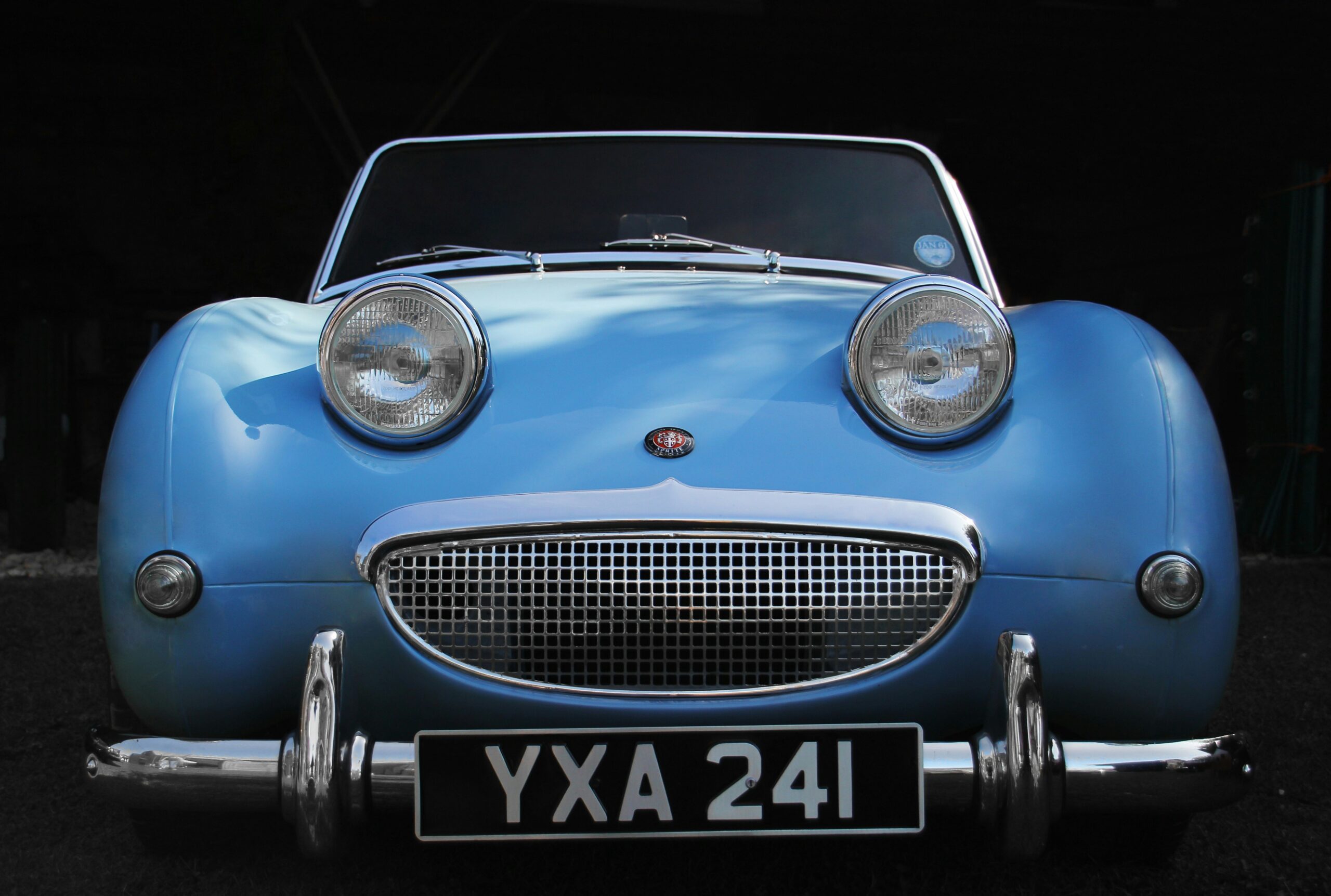
There are cars that are merely good-looking, and there are cars that make people smile at them from across the street. The Austin-Healey Frogeye Sprite is firmly in the second category. Its bulging headlights stare out at the world with an expression of such permanent cheerfulness that it is genuinely difficult to walk past one without smiling back. This was entirely accidental. The lights were supposed to retract. Budget constraints from BMC fixed them permanently upright, and in doing so created the most distinctive and best-loved face in the British sports car world. Sometimes cost-cutting produces masterpieces. The Frogeye is proof.
Beyond the looks, the Frogeye is a genuinely engaging small sports car with a fascinating engineering story, a competition record that belies its modest specification, and a driving character that rewards the attentive driver considerably more than its 43 horsepower might suggest. It is also, at sixty-something years old, a car that needs buying with knowledge and care. Values have risen substantially and are not going to fall. The days of finding a sound project for modest money are largely behind us. This guide covers what the Frogeye is, where it came from, what it is like to drive, and what to look for carefully when you are standing in someone’s driveway deciding whether to write a cheque.
How the Frogeye came to exist
By the mid-1950s, the British Motor Corporation had successfully merged most of the major British car brands into a single organisation, and Donald Healey’s company was producing the Austin-Healey 100 and 100-Six in the sporting upper-middle market. Leonard Lord of BMC and Donald Healey shared a concern: sports cars were becoming expensive, and there was a gap in the market for something genuinely affordable. Something, as the development team would later describe it, that a chap could keep in his bike shed.
The brief was radical in its economy. Where most sports cars of the era used purpose-built chassis and proprietary components at some cost, the new car would use whatever BMC had in its parts bins. The engine came from the Austin A35. The front suspension came from the Austin A35. The steering rack came from the Morris Minor. The gearbox and rear axle came from the A35. Into this pragmatic assembly, Healey’s engineers inserted twin SU carburettors and stronger valve springs, extracting 43 horsepower from the 948cc A-series engine where the A35 managed 34. The name during development was the Tiddler, a name that the marketing department wisely declined to use in anger.
The body was styled by Gerry Coker and finished by Les Ireland after Coker emigrated to the United States in 1957. It was mounted on a monocoque structure, the first volume-production British sports car to use unitary construction, with the floor pan, sills, and transmission tunnel providing the structural strength. Barry Bilbie, Healey’s chassis designer, adapted the structural approach from the Jaguar D-Type racing car, routing rear suspension loads through the bodyshell itself rather than through a separate frame. This is elegant engineering. It also means that structural rust is not merely cosmetic. More on this shortly.
Donald Healey, with characteristic flair, chose to launch the car on the 20th of May 1958 in Monaco, timed to coincide with the Monaco Grand Prix. Journalists were flown to Nice, accommodated appropriately, and given a small 43 horsepower sports car to drive on the Riviera. The resulting coverage included descriptions such as “the first ever people’s sports car” and “I have never driven a safer, faster car.” It cost £679 including purchase tax. It was an immediate hit.
The headlights: the story everyone knows and the version that almost happened
Gerry Coker’s original design had the headlamps mounted in pods on the bonnet that would retract flush with the surface when not in use, facing skyward. It was an elegant solution to the regulatory requirement that headlamp centres be at least 26 inches from the ground. BMC’s accountants examined the cost of the retraction mechanism and declined to fund it. The lights were fixed permanently upright and the Frogeye was born. The mechanism Coker envisaged would not appear on a production car until the Porsche 928 of 1978, twenty years later. Whether Porsche’s engineers were aware of the Healey prototype drawings is a matter of pleasing speculation.
The result of the cost-cutting was that the Frogeye acquired a face so distinctive and so consistently described as happy, cute, or cheerful that it has defined the car’s character ever since. There are not many instances in automotive history where the accountants improved the product, but this may be one of them.

The car in detail
The Frogeye’s body is a one-piece clamshell: bonnet and front wings form a single pressing hinged at the scuttle that lifts to reveal the entire engine bay with an accessibility that no modern car can match. The structural consequence of this arrangement is that the clamshell itself is entirely non-structural. All the strength is in the tub behind it, which means the clamshell can rust, dent, and generally deteriorate without compromising the car’s integrity in the way that structural rust elsewhere does. This is one of the few genuine advantages of buying a car with sixty years of patina.
There are no exterior door handles. The driver and passenger open the doors by reaching through the sliding side window aperture to the inside handle, a process that requires a certain amount of commitment when the car is parked close to another vehicle. There is also no boot lid. The spare wheel and any luggage live behind the seats, accessed by folding the seatbacks forward and reaching into what one period writer described as potholing into a small dark cave. The space itself, however, is considerably larger than it appears from outside. The Frogeye is a Tardis in miniature.
The rear suspension uses quarter-elliptic leaf springs with lever-arm dampers and an upper radius arm to control the axle. It sounds primitive and it is, but the addition of the upper radius arm eliminated the axle tramp that would otherwise have made the car near-undriveable under hard acceleration. Quarter-elliptic springs are shorter and stiffer than the semi-elliptic items found on most contemporaries, and the Frogeye’s rear end can feel lively when the springs are seized or the dampers are worn, generating oversteer on the exit of corners with an enthusiasm that rewards smooth driving and punishes the ham-fisted. This is not a fault. It is character, correctly understood.
On the road
The Frogeye weighs 664 kilograms. This is the single most important performance specification on the car. In a world where a modern hatchback tips the scales at well over a tonne, a car that weighs roughly the same as four adult passengers has a fundamental advantage that no amount of horsepower can replicate. The Frogeye does not feel like a 43 horsepower car. It feels alive, immediate, and directly connected to the road in a way that most modern cars cannot achieve regardless of how much technology is applied to the problem.
Steering is rack and pinion derived from the Morris Minor, light and accurate. The driving position is low and the driving experience is intimate: the road is very close, the wind is present regardless of the weather, and the engine sounds considerably more urgent than its specification suggests. Top speed is a genuine 83 miles per hour on a long enough road, and 60 miles per hour arrives in approximately 20 seconds from rest, which was competitive for its class in 1958 and is still perfectly adequate for the B-roads where the Frogeye is most at home. Fuel consumption is around 40 miles per gallon in typical use, which is an unexpected bonus from a car that was designed economically and has remained so throughout its life.
Motorsport: better than it had any right to be
The Frogeye’s competition record is considerably more impressive than a car with 43 horsepower and a Morris Minor steering rack has any right to deliver. The car won its class on the 1958 Alpine Rally in the hands of John Sprinzel and Willy Cave, its first full year of production. The following year it won its class at the 1959 Sebring 12 Hours, one of the most demanding endurance events in the calendar, driven by Americans Jim Parkinson and Hugh Sherwood. These performances were achieved on largely standard equipment and on the strength of the car’s exceptional handling, light weight, and mechanical reliability rather than outright power.
The competition success prompted the development of the Sebring Sprite, a factory-developed competition version with aluminium body panels, a tuned engine, and a hardtop. These are now among the most valuable and historically significant of all Sprites. A standard Frogeye in good health can still be entered in appropriate historic motorsport events and acquits itself well. This is a genuine competition heritage, honestly earned.
Interesting facts worth knowing
The Frogeye’s frontal styling was noted at launch to bear a passing resemblance to the 1951 Crosley Super Sport, an American microcar that had used a broadly similar headlamp arrangement. Whether this was inspiration or coincidence is unclear. The Crosley company had ceased production by 1952, which at least meant the comparison was not commercially inconvenient.
Kermit the Frog made his first television appearance in 1955, three years before the Frogeye reached the public. Both are green, both have bulging eyes on top of their heads, and both have inspired an unreasonable amount of affection in people who should perhaps have moved on by now. Jim Henson and Donald Healey never collaborated, but the thematic coincidence is too pleasing to ignore entirely.
Of the 48,987 Frogeyes built, approximately a quarter were right-hand drive. The majority went to the United States, where the car was known as the Bugeye rather than the Frogeye, and where it sold in large numbers to precisely the young, enthusiastic buyers that Donald Healey and Leonard Lord had identified as their market. Around 1,000 Mk1 Sprites are estimated to still be registered in the UK today, which makes finding a good one a matter of patience rather than desperation, but does not leave enormous room for the careless buyer to walk away from one that has problems and find another immediately around the corner.
What to look for: bodywork and structure
The Frogeye’s monocoque construction means that structural rust is not merely cosmetic inconvenience: it is a genuine safety and integrity issue. The floor pan, sills, bulkheads, and suspension mounting points carry real structural loads, and a body with significant corrosion in these areas is not merely a restoration project but potentially a car that should not be driven. Approach the body inspection with this in mind, and approach thick underseal with immediate suspicion. Underseal can indicate a conscientious previous owner who treated the underside proactively. It can also indicate someone who applied two inches of black paste over active corrosion to make it someone else’s problem. A magnet is your friend here.
The most critical rust areas, in rough order of structural importance:
- The sills: structural and essential. Check inside and outside, and particularly the joint between the sill and the floor. Any flexibility when you press on the sill is a very bad sign. Sound metal is rigid metal.
- The rear spring mounting boxes: the quarter-elliptic rear springs mount into box sections in the rear bulkhead. These boxes rust with particular determination and are both structurally important and genuinely difficult to repair properly. This is the single most important check on a Frogeye. If the spring boxes are rotten, budget accordingly or walk away.
- The floor: both the driver and passenger floors should be solid. Lift the carpets or rubber mats and look. A floor with holes is an obvious problem. A floor that sounds hollow when tapped may have rusted from underneath with the surface still appearing intact.
- The front bulkhead: the large void in the front bulkhead traps moisture. Check from the engine bay side, particularly around the heater box, battery shelf, and master cylinder location. Corrosion here affects the structural foundation of the front end.
- The rear bulkhead and radius arm mounts: where the upper radius arms for the rear axle attach is a known rust trap. Rust here compromises rear axle location and is structurally significant.
- Inner wings and engine supports: with the clamshell raised, the inner wing structure and the engine support brackets are visible. They are sometimes well-preserved by the protective coating of engine oil leaks, but inspect them carefully nonetheless. The crossmember beneath the radiator is also vulnerable.
- A-posts and door surrounds: uneven door gaps or doors that sag on their hinges suggest either worn hinges (manageable) or structural rust at the hinge mounting points (not manageable cheaply).
The clamshell bonnet and front wings, being non-structural, can be repaired or replaced more pragmatically than the tub. Replacement bonnets are available, and fibreglass alternatives exist for those not concerned with absolute originality. Our rust prevention guide covers the treatment and protection approaches worth considering once any restoration is complete.
What to look for: suspension and steering
The Frogeye has four grease nipples per side for the front suspension that require regular attention with a grease gun. A car whose previous owner did not know this exists will have worn kingpins and suspension upright bushes. With the front of the car safely raised, grip each front wheel at the top and bottom and attempt to rock it. Any play at all in the vertical plane indicates worn kingpins or wheel bearings and should be investigated. The lever-arm dampers front and rear should be checked for oil leaks: a damper weeping oil is both ineffective and messy, and rebuilding or replacing them is standard maintenance on a car of this age.
The quarter-elliptic rear springs can rust and fracture. Inspect them carefully. Seized springs, which are common after years of neglect, eliminate the small but important amount of movement the springs are designed to provide and make the rear end’s handling behaviour more dramatic than it should be. Some cars have been converted to telescopic dampers at the rear, which is a worthwhile improvement to handling consistency. Halfshaft breakage is a known issue, particularly on cars that have been fitted with more powerful engines than the standard 948cc unit. Check the differential for oil leaks, which are common, and listen for whine or clonk from the back end during the test drive.
The rack-and-pinion steering from the Morris Minor is one of the Frogeye’s better components, robust and accurate. Stiff steering suggests the rack has not been lubricated regularly. Split steering rack gaiters allow water into the rack and lead to corrosion of the rack itself: check both gaiters are intact and undamaged.
What to look for: engine and drivetrain
The 948cc A-series engine is one of BMC’s most straightforward and robust units. It is simple to work on, cheap to rebuild, and well supported by specialist knowledge. The vast majority of problems it develops are easy to diagnose and inexpensive to address. Start the engine from cold and listen: the A-series should idle smoothly and pull cleanly through the rev range once warm. Blue smoke from the exhaust on the overrun indicates worn valve guides or piston rings. A persistent tapping from the top of the engine may be worn valve gear or simply valve clearances that need adjustment: our valve clearance guide covers the procedure.
The most significant engine-related issue on the A-series is valve seat recession on unleaded fuel. The original cast iron cylinder head has soft valve seats that require the lubrication provided by leaded fuel. Without it, the seats erode progressively, closing up the valve clearances and eventually causing the valves to burn. The symptoms are narrowing valve clearances that require increasingly frequent adjustment and a gradual loss of compression and power on the affected cylinders. Budget around £500 or more for a replacement cylinder head with hardened valve seat inserts already fitted, which eliminates the problem permanently. This is standard maintenance on any A-series engine that has been used regularly on modern unleaded fuel without a lead replacement additive.
The twin 1⅛ inch SU carburettors are well-documented and straightforward to maintain and tune. Our SU carburettor guide covers the setup procedure. Many Frogeyes have been fitted with the larger 1¼ inch carburettors from the Mk2 Sprite, gaining three to four horsepower. Engine swaps to 1098cc or 1275cc A-series units are common and entirely practical: the 1275cc unit from the Midget or later Sprite produces around 65 horsepower in standard tune and transforms the car’s performance without altering its essential character. The fitting of a more powerful engine should be accompanied by attention to the driveline: a 1275cc engine in a car with an original Frogeye differential and halfshafts runs at the limit of the driveline’s tolerance, and halfshaft breakage on upgraded cars is a known issue.
What to look for: interior and hood
The Frogeye’s interior is spartan by design and the car was sold without bumpers, a heater, or a radio as standard equipment. There is genuinely not much to go wrong here. Seats, trim, and carpets can all be replaced at modest cost, and correct interior components are available from specialists. Early cars had sliding sidescreens rather than windows; later production cars have perspex sliding windows, which are more weatherproof. Check the hood condition carefully: a hood that fits poorly or has shrunk with age is a common problem, and a correctly-fitting replacement costs several hundred pounds. Also check that the windscreen frame and surround are rust-free, as corrosion here is both structural and expensive to address.
Values and what to pay
The Frogeye is no longer the accessible bargain classic it once was, and this needs to be understood before viewing cars. A rolling project needing significant work starts at around £5,000 to £7,000. Rough but complete running cars sit between £10,000 and £14,000. Good usable examples in honest condition with sound structure and a working engine trade between £14,000 and £18,000. Fully restored cars with documented history and correct specification can reach £20,000 to £25,000 or more. The average recorded sale price according to Classic.com data from spring 2026 was around £14,600, which provides a useful mid-market reference point.
Originality commands a meaningful premium at the top of the market. Matching-number cars with documented history from new are rare and valued accordingly. Engine swaps, while common and practically sensible, reduce the value of an otherwise excellent car for collectors who prioritise originality. At the usable driver end of the market, a well-sorted Frogeye with an uprated engine is arguably a more enjoyable ownership proposition than a numbers-matching original running the standard 43 horsepower, and the value difference is smaller than it would be for a rarer car.
Check current market values with our free classic car price checker, which shows estimated UK values by condition grade alongside live eBay listings so you can see what cars are actually changing hands for right now.
Ownership: clubs, parts, and support
The Frogeye is one of the best-supported classics available at any price. The Austin-Healey Club and the Midget and Sprite Club between them provide comprehensive technical resources, spares schemes, and a community of owners with accumulated knowledge about every conceivable problem the car can develop. Parts availability is excellent: the A-series engine is shared with dozens of BMC products produced over three decades, and mechanical components are available from multiple suppliers at competitive prices. Body panels, hoods, trim, and interior components are similarly well-covered.
The Frogeye is straightforward to maintain at home with basic mechanical knowledge and a standard toolkit. Its simplicity is genuine rather than illusory, and the accessibility provided by the clamshell bonnet is one of the most useful features on any classic car. Our springtime safety check guide provides a useful framework for the annual inspection, and our classic car insurance guide covers what to look for in a specialist policy for a car in this value bracket.
Verdict
You cannot dislike a Frogeye. This is not entirely a matter of the looks, though the looks are a significant factor. It is the combination: the looks, the lightness, the directness, the noise of the A-series at full chat through a pair of SU carburettors on a good stretch of road, the sense that the car is participating in the drive rather than merely executing your instructions. It was designed as an accessible sports car that almost anyone could afford. It has become something more valuable than that: a small, honest, communicative sports car that rewards involvement and delivers genuine driving pleasure without requiring either a significant budget to buy or a specialist to maintain.
Buy the best body you can find. Mechanicals on a car this simple and this well-supported are a secondary concern compared to the cost and complexity of structural rust repair on a monocoque fifty years old. Take your time, use the clubs, and do not let the headlights talk you into a car that needs more work than you are prepared to give it. They are very persuasive, those headlights. That is, of course, the entire point.
This page contains affiliate links. If you click a link and make a purchase, Classic Car Hub may earn a small commission at no extra cost to you.