
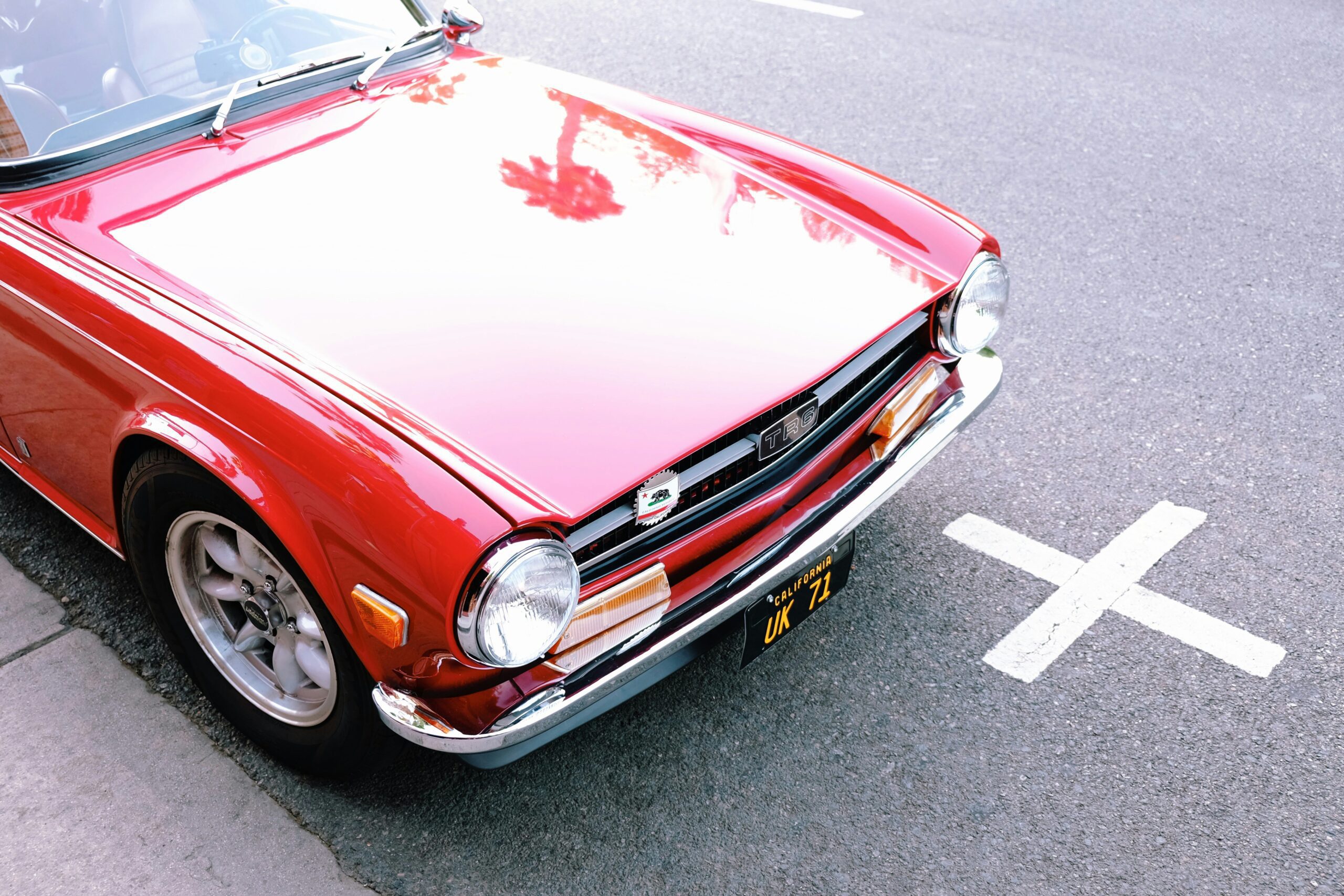
The Triumph TR6 holds a specific place in British sports car history as the last of the traditional TR line: a separate-chassis, rear-wheel drive two-seater with a straight-six engine, produced in Coventry between 1969 and 1976. It was styled by the German coachbuilder Karmann, who reworked the nose and tail of the existing TR5 on a modest budget and produced something that looked considerably more purposeful than its predecessor. Nearly 95,000 were built, the vast majority destined for American showrooms, making it the best-selling Triumph sports car of all time. Today it remains one of the most accessible six-cylinder classics available, with strong parts support, active clubs, and a driving character that rewards the investment.
The TR6 is a car of two distinct specifications. UK and most export market cars received Lucas mechanical fuel injection and are the versions most buyers are seeking. American market cars received twin Zenith-Stromberg carburettors to meet emissions regulations and produced significantly less power. Many US cars have since been imported to the UK, and understanding the difference between the two specifications is essential before making a purchase.
For a detailed inspection guide covering what to look for when viewing any TR6, see our full Triumph TR6 buyers guide.
Quick Facts
| Detail | Information |
|---|---|
| Years produced | 1969 to 1976 (UK production ended February 1975) |
| Manufacturer | Triumph (British Leyland) |
| Body style | 2-door open roadster with optional removable hardtop |
| Engine | 2498cc straight-six OHV |
| Power (UK spec) | 150bhp to 1973; 125bhp from 1973 |
| Power (US spec) | 104bhp (twin Zenith-Stromberg carburettors) |
| Transmission | 4-speed manual; optional A-type or J-type overdrive |
| Drive layout | Rear-wheel drive, separate chassis |
| Total built | 94,619 |
| UK sales | 8,370 |
| Approx. UK value range | £3,000 to £25,000+ depending on specification and condition |
Specifications
| Specification | UK / Export (fuel injected) | US spec (carburettor) |
|---|---|---|
| Engine | 2498cc straight-six OHV, Lucas PI | 2498cc straight-six OHV, twin Zenith-Stromberg |
| Power (early) | 150bhp at 5,500rpm | 104bhp |
| Power (from 1973) | 125bhp at 5,500rpm | 104bhp |
| Torque | Approx. 143lb/ft | Approx. 143lb/ft |
| Gearbox | 4-speed manual, optional overdrive | 4-speed manual, optional overdrive |
| Final drive ratio | 3.45:1 | 3.71:1 |
| Suspension front | Wishbone with coil springs and anti-roll bar | As UK spec |
| Suspension rear | Semi-trailing arm independent, coil springs | As UK spec |
| Steering | Rack and pinion | Rack and pinion |
| Brakes | Disc front, drum rear | Disc front, drum rear |
| Kerb weight | Approx. 1,130kg | Approx. 1,130kg |
| Top speed | Approx. 118mph | Approx. 107mph |
| 0 to 60mph | Approx. 8.9 seconds | Approx. 10.7 seconds |
| Length | 3,950mm | 3,950mm |
| Width | 1,470mm | 1,470mm |
Model Variants and Production Changes
| Period | Commission Series | Key Changes | Notes |
|---|---|---|---|
| 1969 | CP | Launch specification. Chrome windscreen surround, chrome engine covers, body-colour windscreen pillars | Earliest and most original specification |
| 1970 to 1971 | CC and CR (early) | Black windscreen surround, painted engine covers. Revised disc wheels, optional 72-spoke wires. New inlet manifold on US cars | A-type overdrive engages on all ratios except first |
| 1971 to 1972 | CR (to CR641) | Triumph Stag gearbox components adopted. Steering lock fitted | Last of the A-type overdrive cars |
| 1972 to 1973 | CF and CR (from CR567) | J-type overdrive fitted. Front airdam added for 1973. Matt black wiper arms, revised air intake | J-type overdrive operates on 3rd and 4th only |
| 1973 to 1975 | CF (late) | UK power reduced to 125bhp. Headrests now standard. Revised switchgear and instruments | UK production ended February 1975 |
| 1974 to 1976 | CF (US) | Rubber bumper overriders. Raised front bumper. Air injection system added for US emissions | Last TR6 built July 1976 |
The most desirable cars for UK buyers are early fuel-injected examples with the A-type overdrive, which engages across more gears than the later J-type. The 1973-on detuning to 125bhp sounds significant on paper but means little in practice due to changes in power measurement methodology at the time. Cars with documented UK history and original right-hand drive command the strongest premiums. US imports can represent good value but need careful specification checks before purchase.
Common Problems
- Sill corrosion: The sills are the most critical rust location on the TR6 and must be checked inside and out. Any flexibility when pressure is applied to the outer sill indicates structural rot. Outer sills welded over corroded inner structure are a common and dangerous false repair.
- Rear axle mounting points: The T-shaped pressing over the rear axle top and the trailing arm attachment points rust from the inside outward. Swelling around the attachment bolts is the first visible sign. If these fail, body separation from the chassis becomes a possibility. Treat any swelling as a serious finding.
- Rear wing to deck junction: Three layers of metal meet at this point and trap dirt efficiently. A difficult area to repair correctly. Inspect carefully and look for previous bodywork at this location.
- Chassis crossmembers: Rear suspension mounting points on the chassis and the X-brace cover plate in the centre are vulnerable. View on a ramp wherever possible.
- Lucas fuel injection: The original metering unit is prone to heat soak and vapour lock on warm days. Most cars have had the Lucas unit replaced with a Bosch equivalent, which is significantly more reliable. If not done, budget for the conversion.
- Crankshaft thrust washers: When worn to the point of displacement, the crankshaft moves fore and aft in the block and destroys the engine in the process. Check: press the clutch firmly on a warm engine and watch for any fore-and-aft engine movement.
- Gearbox layshaft bearings: Rumbling in intermediate gears that disappears in top is the characteristic symptom. Serviceable but factor in the rebuild cost.
- Imported cars: Check specification carefully. US-spec carburettor cars, lower final drive ratio (3.71:1 vs 3.45:1), and any right-hand drive conversions all need investigating before purchase.
Running and Maintenance
The TR6 engine is a long-stroke, torquey unit derived from Triumph’s 2.0-litre saloon car engine and is built for durability rather than ultimate performance. With regular oil changes it will cover 150,000 miles between rebuilds. All components are available for a full rebuild when required, including cylinder sleeves, pistons, and bearing sets. The overhead valve layout makes it accessible and straightforward to work on at home.
Club Triumph and the TR6 Drivers Club both provide excellent technical support and parts schemes. Our springtime safety check guide covers the annual inspection sequence, and our electrical fault finding guide is useful for the Lucas electrics. The ignition timing guide covers the correct procedure for the TR6 distributor. Heritage bodyshells are available for the most ambitious restorations.
All TR6s now qualify for historic vehicle road tax exemption. Classic specialist insurance is widely available and competitively priced for cars used on a limited mileage basis.
UK Values
| Condition | US import / carburettor | UK spec fuel injected | Early PI with overdrive |
|---|---|---|---|
| Project or rough | £2,000 to £6,000 | £3,000 to £9,000 | £4,000 to £10,000 |
| Usable driver | £7,000 to £12,000 | £12,000 to £16,000 | £13,000 to £18,500 |
| Good | £10,000 to £14,000 | £16,000 to £21,000 | £18,000 to £23,000 |
| Excellent or concours | £13,000 to £18,000 | £21,000 to £27,000 | £23,000+ |
TR6 values peaked in 2023 and have settled slightly since, but remain above pre-2020 levels. Fuel-injected UK-specification cars with overdrive and documented history hold value best. US imports represent the most affordable route into TR6 ownership but carry specification caveats that should be reflected in the price. Average recorded sale price across the market currently sits at approximately £15,600 across all specifications.
Buyer’s Tips
- Confirm whether the car is fuel injected or carburettor before viewing. Do not assume from the asking price or description.
- Check the sills by applying firm pressure to the outer panel. Any flex or softness indicates structural corrosion behind the outer skin.
- With the engine warm, press the clutch firmly and watch for engine movement. Any fore-and-aft rocking indicates worn crankshaft thrust washers.
- Feel both heater hoses at the bulkhead with the engine warm. Both should be hot. One cold hose points to a heater valve or matrix issue.
- Check door gaps at the B-post. Gaps that widen toward the rear of the door aperture indicate a sagging chassis, the opposite of most other open cars.
- Test overdrive operation if fitted. A-type engages on all gears except first. J-type on third and fourth only. Problems are usually electrical rather than mechanical.
- For imported cars: establish the final drive ratio (3.45:1 UK, 3.71:1 US), confirm the specification, and inspect any right-hand drive conversion carefully.
- Join Club Triumph before buying. Pre-purchase inspection assistance is available through the club and is worth using for any significant purchase.
Looking for buyers guides, workshop advice, paint codes or restoration tips for your favourite classic? Search the Classic Car Hub below.
Frequently Asked Questions
Is the Triumph TR6 a good classic car to buy?
Yes, particularly as a first six-cylinder classic. Parts availability is excellent, club support is strong, and the mechanical specification is straightforward enough for home maintenance. The main caveats are rust in the chassis and sills, which need careful inspection, and the importance of confirming UK fuel-injected specification rather than a US-spec carburettor import.
What is the difference between early and late TR6s?
The most significant differences are the overdrive type (A-type on earlier cars engages on more gears than the later J-type) and the UK power output (150bhp to 1973, then 125bhp, though the real-world difference is smaller than the figures suggest due to changes in measurement). Early cars also have chrome windscreen surrounds and engine covers. From 1973, a front airdam was added. US-specification cars used carburettors throughout and had rubber bumper overriders from late 1974.
How many Triumph TR6s were built?
A total of 94,619 TR6s were built between January 1969 and July 1976. Of these, only 8,370 were sold in the UK. The remainder went to export markets, predominantly the United States, which accounts for the large number of left-hand drive and carburettor-specification cars now finding their way back into the UK.
Is the TR6 fuel injection reliable?
The original Lucas mechanical fuel injection had a reputation for unreliability in period, particularly vapour lock on hot days. Most of these issues are now well understood and fixable. The most significant improvement is replacing the Lucas metering unit with a Bosch equivalent, which eliminates the majority of problems. A TR6 with a Bosch-converted fuel injection system is generally reliable in everyday use.
What should I look for when buying a TR6?
The structural condition of the chassis and sills is the priority. Check for swelling around the rear axle mounting bolts, flexibility in the sills, and door gaps widening at the B-post. Confirm whether the car is fuel injected or carburettor specification. Test the crankshaft thrust washer condition by pressing the clutch firmly on a warm engine and watching for fore-and-aft movement. Our full TR6 buyers guide covers every aspect of the pre-purchase inspection in detail.
This page contains affiliate links. If you click a link and make a purchase, Classic Car Hub may earn a small commission at no extra cost to you.