
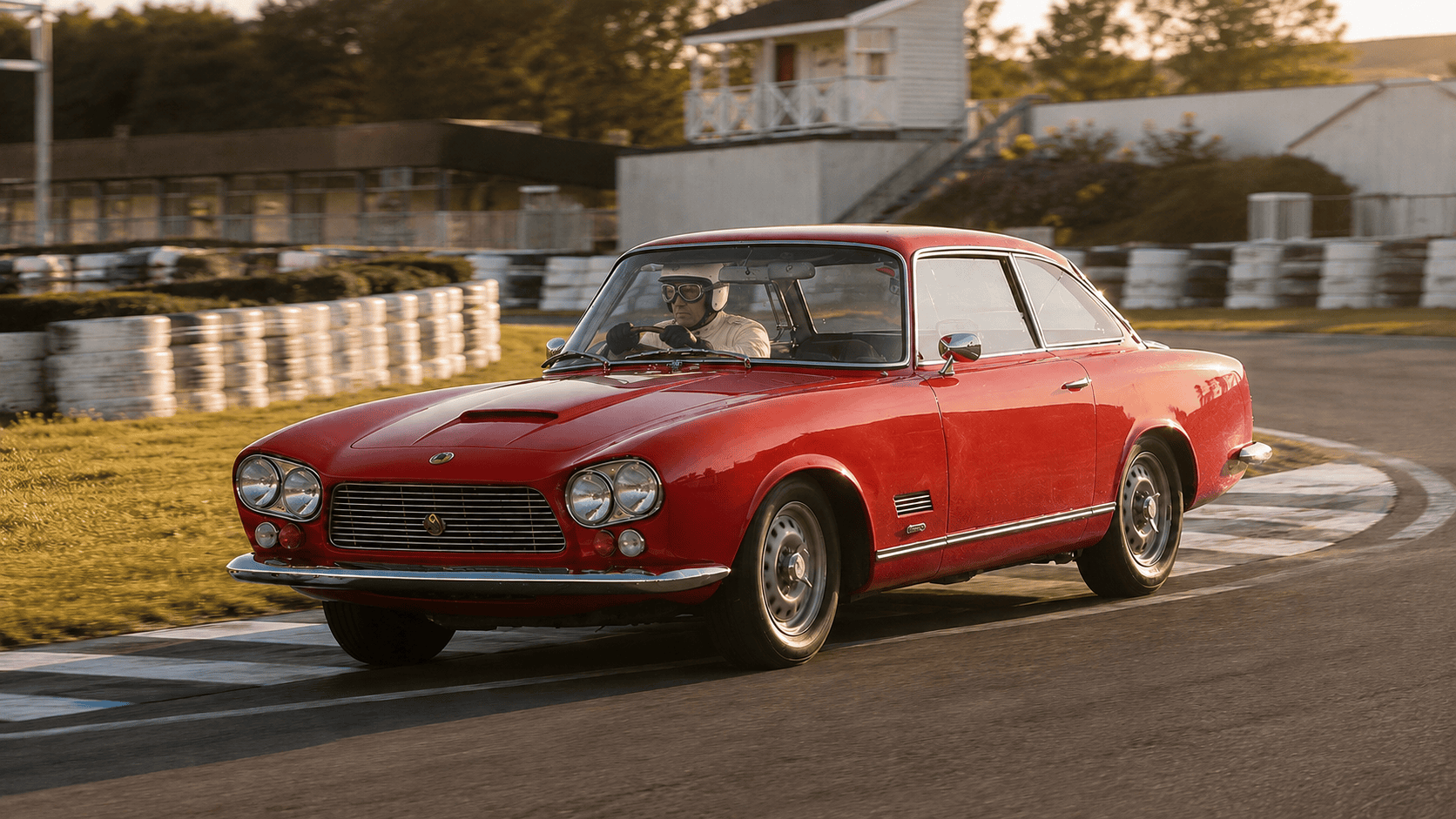
Somewhere in the grounds of a photographic studio in the early 1960s, a tortoise went for a walk. It was, by all accounts, an unhurried sort of walk, this being the only kind available to tortoises. What that animal did not know was that it was about to become the emblem of the fastest four-seater car in Britain.
The Gordon-Keeble GK1 should have been a triumph. It had a Chevrolet V8, a chassis designed by a proper engineer, a body drawn by Giorgetto Giugiaro before most people had heard of him, and a price that undercut everything it competed against. Ninety-nine of them were built. The company went under twice in about eighteen months.
This is the story of how a genuinely brilliant car managed to fail, and why roughly nine out of ten of them are still with us.
An American Pilot Walks Into a Suffolk Garage
The chain of events starts in 1959, and it starts with an American.
Rick Nielsen was a USAF Voodoo pilot stationed at Bentwaters in Suffolk. He owned a Peerless GT, a British four-seat coupé with a glassfibre body, a de Dion rear axle and a Triumph TR3 engine producing around 100bhp. Adequate, but Nielsen was a fighter pilot, and fighter pilots have opinions about adequate. He asked a local engineer named Jim Keeble, who ran a garage on Grove Lane in Ipswich and spent much of his time preparing racing cars for customers, whether a 4.6 litre small-block Chevrolet V8 might be persuaded to fit.
Keeble said yes, and decided to do the job at the Peerless factory in Slough. Which is where he met John Gordon.
Gordon was Peerless’s managing director and a man in need of a new idea. He had returned to England from Italy in 1951 and set up rebodying Rolls-Royces as shooting brakes, then teamed up with racing car designer Bernie Rodger in 1957 to build the Peerless: a four-seat GT with Aston Martin performance at nothing like Aston Martin money. It very nearly worked. Around 250 Phase 1 cars were built between 1958 and 1959, followed by 46 Phase 2 cars, before boardroom trouble and slow sales closed the business. Rodger restarted it as Warwick and managed about another 40. A Peerless ran at Le Mans in 1958, incidentally. Two cars were entered and only one started, but Peter Jopp and Percy Crabb brought the 1,991cc car home sixteenth overall and first in class, in a field that was effectively a three-litre contest against Aston Martin, Jaguar and Ferrari. Not bad for a Triumph-engined family coupé.
What Gordon saw in Nielsen’s V8 Peerless was the future. What he needed was Keeble.
Twenty-Seven Days in Turin
Over the winter of 1959, Keeble designed and built an entirely new chassis: a square-section tubular steel spaceframe with coil and wishbone independent front suspension, a de Dion rear axle located by a Watt linkage, and disc brakes on all four corners. This was serious racing-derived thinking, not a modified saloon floorpan with ambitions.
While Keeble welded, Gordon went to the Turin Show and found Nuccio Bertone. Bertone had recently taken on a young designer fresh out of college, and handed him the job. Giorgetto Giugiaro was 21. The Gordon GT was his second car design, after the Alfa Romeo 2600, and the first of his to be seen in public.
Gordon’s brief was refreshingly short: it had to seat four properly, it had to fit Keeble’s chassis, and it had to have four headlights, because Nielsen’s Corvette had four headlights. Giugiaro delivered a long, low, restrained shape with slightly canted quad lamps and a great deal of glass, the sort of thing that makes owners of far more expensive Italian machinery turn their heads and then pretend they were looking at something else.
The completed chassis went to Italy in January 1960. Bertone built the steel body onto it, and according to German magazine Auto, Motor und Sport, did the whole job in precisely 27 days. The car appeared on the Bertone stand at the Geneva Salon in March 1960, badged simply as a Gordon. It missed press day, held up by paperwork at the Swiss border, but it made the first public day and it was the sensation of the show, helped considerably by being the only genuinely new car there.
Detroit Says Yes
Buoyed by Geneva, Gordon shipped the prototype to America. There it was driven by Zora Arkus-Duntov, the man behind the Corvette and an old friend of Gordon’s, who reportedly pronounced it quicker than his own car.
More usefully, it impressed Ed Cole, executive vice-president of General Motors. Cole sanctioned the supply of the brand new 327 cubic inch small-block, the engine destined for the Corvette Sting Ray. As the Gordon-Keeble Owners’ Club notes, this made the GK1 the first non-GM production car to use one of the company’s engines. There was even loose talk of selling the coupé through GM dealers, which came to precisely nothing, as loose talk usually does.
So: a superb chassis, an Italian body, an American V8 on tap, and rave reviews. Production began four years later.
Four Years in the Wilderness
The gap between the 1960 prototype and the 1964 production car is where the whole thing quietly went wrong, and it went wrong for the most British of reasons: nobody would fund it.
Armstrong-Siddeley looked at taking on the entire project and passed. Renzo Rivolta was keen to build it under licence in Italy, and also passed, then introduced the strikingly similar Iso Rivolta shortly afterwards. Make of that what you will.
In the end the money came from George Wansbrough, an ex-Jowett man and Mercantile Credit board member, who eventually put in his own funds. Wansbrough and Gordon then fell out, and Gordon walked away from the company that carried his name. He took the original badge with him: a rampant stag’s head drawn from the emblem of the Clan Gordon and the Gordon Highlanders. It was 1963 before Wansbrough brought Keeble back in to get the car into production, and by then Gordon had no involvement at all. The car kept both names anyway.
Eastleigh: Spitfires, Fibreglass and Transit Van Ball Joints
Production went to Eastleigh aerodrome in Hampshire, now Southampton Airport. The building had form: it was where the very first Supermarine Spitfire was prepared for its maiden flight in 1936. A plaque marking this was unveiled at the airport as part of the marque’s 40th anniversary celebrations in 2004.
Press tooling for a steel body was out of the question on the available money, so the production cars switched to glassfibre. The first bodies came from Williams & Pritchard, one of the finest coachbuilding firms in the country, and later the work was done in-house by craftsmen who had come from Supermarine and Vosper Thornycroft. Eastleigh had been building glassfibre railway carriages since 1945. The skills were sitting there waiting.
And in one of those details that makes British motoring history so consistently entertaining, the ball joints and suspension bushes came off the Ford Thames 400E van, which was being built a couple of miles down the road at Swaythling. A 140mph Anglo-Italian grand tourer, riding on Transit ancestry.
What Jim Keeble Actually Built
The engineering deserves a proper look, because the GK1 was not a parts-bin special dressed up for the Motor Show.
The spaceframe was fabricated from one-inch square steel tube, hand built, with foam rubber injected between the tubes for insulation. The de Dion rear axle kept the wheels upright under cornering and load in a way no live axle could manage, while keeping unsprung weight down. Discs on all four wheels were still notable in 1964, and the braking system ran twin master cylinders, one front and one rear, which was ahead of most of the industry. Two fuel tanks were fitted rather than one.
The cabin leaned hard into the aviation theme, which was appropriate given who was building it and where. Seven dials, toggle switches, quilted PVC trim and eyeball vents of the sort you would find on an airliner. Electric windows were standard, which almost nothing else at the price offered. So were seatbelts, a push-button radio and a fire extinguisher.
The one genuine weak point was the steering, a Marles worm and roller box that period road testers and later owners have both found wanting. The Owners’ Club has since endorsed a rack and pinion conversion, often power assisted, which tells you most of what you need to know.
| Specification | Gordon-Keeble GK1 |
|---|---|
| Built | 1964 to 1966, Eastleigh and Sholing |
| Number built | 99, plus a 100th assembled later from spares |
| Construction | Steel spaceframe chassis, glassfibre body |
| Engine | 5,354cc Chevrolet V8, Carter four-barrel carburettor |
| Power | 300bhp at 5,000rpm |
| Torque | 360lb ft at 3,000rpm |
| Transmission | Four-speed manual (Warner T-10), rear-wheel drive |
| Front suspension | Wishbones, coil springs |
| Rear suspension | De Dion axle, trailing arms, coil springs, Watt linkage |
| Steering | Marles worm and roller |
| Brakes | Discs all round, twin master cylinders |
| Wheelbase | 2,591mm (8ft 6in) |
| Length | 4,813mm (15ft 9.5in) |
| Weight | 1,435kg (3,164lb) |
| Original tyres | 640-15 crossply, later 670-15 |
| Drive configuration | Right-hand drive only |
Performance figures vary depending on who was holding the stopwatch and how much they wanted the car to succeed. The Owners’ Club and the Bonhams catalogues quote 140mph and 0-60mph in under six seconds. Classic & Sports Car’s factfile is more conservative at 137mph and 7.5 seconds. Either way, in 1964 this was extraordinary, and it came with four seats and a boot. First gear was reportedly good for at least 50mph, and the thing would pull from walking pace in top, which is the sort of party trick that a 5.4 litre V8 performs without breaking sweat.
The press were duly impressed. Autocar, testing it in 1965, called it “a car which is way ahead of anything else in its class”. Motor settled for describing it as an electrifying four-seater.
Influx, the magazine run by Adrian Flux, put together this short piece on how the car came about and what it feels like from behind the wheel. It is a useful antidote to reading specification tables.
£2,798, and Why That Number Killed It
The Gordon-Keeble was launched to the press at the Savoy Hotel in March 1964 at £2,798.
To understand what that meant, look at what else was on the table.
| Car | Approximate UK list price, mid-1960s |
|---|---|
| Jaguar E-type | Around £2,050 |
| Gordon-Keeble GK1 | £2,798 |
| Jensen C-V8 | Around £3,500 to £3,900 |
| Iso Rivolta | Around £4,000 |
| Aston Martin DB5 | Around £4,250 |
| Bristol 407 | Around £5,100 |
Only the E-type undercut it, and Jaguar was almost certainly not making money on those either. Against an Aston, the Gordon-Keeble saved you roughly £1,400 while being faster and carrying two more people.
Which sounds like a recipe for success, and was in fact a recipe for insolvency. Wansbrough had not built enough margin into the number. Each car was effectively financing the next one, so there was no reserve when anything went wrong, and something always goes wrong. Martin Buckley, writing in Classic & Sports Car, put it neatly: the car was “too timidly priced to make money”.
There was a second problem, and it was one of perception. A four-seat 140mph GT at that money invited suspicion. Some buyers concluded that anything this cheap could not possibly be as good as it looked, which was exactly wrong, and exactly the sort of thing British buyers have always concluded.
Prices did rise, through the £3,600 mark and eventually to £4,058 for the last cars. By then it was far too late.
A Strike at Adwest, and the End of the Beginning
By autumn 1964 as many as four cars a week were leaving Eastleigh and the order book looked healthy. The trouble was that Gordon-Keeble bought in almost everything, which made it entirely hostage to its suppliers.
The killer blow came in the spring of 1965 when Adwest, which supplied the steering boxes, went on strike. Without steering there was no car, and cars sat around the works in various states of nearly-finished while the wage bill carried on regardless. The company called in the receiver in May 1965, with around 82 cars completed.
It is a very 1960s British ending. Not bad engineering, not bad design, not even bad demand. A parts supplier had an industrial dispute and a company died.
Keeble Cars, the IT, and Car Number 100
The wreckage was bought by Harold Smith and Geoffrey West, north London garage owners who had been selling the cars. They reconstituted the business as Keeble Cars Ltd (some accounts record the name as Gordon Cars Ltd) and moved production to an old lightbulb factory at Sholing, near Southampton. Jim Keeble came back.
The car was rebadged as the IT, the initials generally taken to stand for International Touring, and the price went up to around £3,850. According to the Owners’ Club, the new operation finished 11 part-built cars and built six more from scratch before running out of both backing and buyers, which brings the total to exactly 99. Other sources put the post-rescue figure at anywhere between nine and twenty, so treat any precise claim with a degree of scepticism. The 99 total, however, is agreed on almost everywhere.
Then there is car number 100, assembled from leftover parts by a garage in north London after the company had gone. The Owners’ Club places this four years after the collapse, which puts it around 1970. Others say 1967, and Hagerty says 1971. Nobody seems entirely certain, which is rather in keeping with everything else about the marque.
The de Bruyne Footnote
In 1968 the rights were bought by John de Bruyne, a Newmarket car dealer who believed he could shift two a week through his Ford dealership. He showed a revised car at the New York Auto Show that year, with a blander nose and Ford Executive rear lamps, alongside a new mid-engined coupé.
Sources disagree on whether one car or two wore de Bruyne badges, and on how much was genuinely new versus rebadged. What is not in dispute is that nothing came of it. The Gordon-Keeble was finished.
The Prototype Went To The Pictures
Here is the one screen appearance worth reporting, and it is genuine.
The original Gordon GT prototype appears in The Green Helmet, a 1961 MGM British motor racing drama directed by Michael Forlong and starring Bill Travers, Ed Begley and Sid James, with a guest appearance from Jack Brabham. The Internet Movie Cars Database logs the car, and the Owners’ Club confirmed the identification directly when asked: it is the one and only Gordon GT, steel bodied, 4.6 litre, and for filming it wore the registration HLW 493 rather than its real plate, 472 LKX.
The prototype then had a difficult few decades. It disappeared into obscurity, resurfaced in the 1990s under a new owner, went to a restorer, and was then removed mid-job following a dispute and locked away unfinished for close to thirty years. A new custodian bought it in 2020 and put roughly 400 man-hours into a full mechanical recommissioning. It appeared at Syon Park in 2021 and later that year at the NEC, where it was shortlisted as one of three cars for Car of the Show out of around 3,000 entries. It lost to a 1934 Mercedes, which is no disgrace.
Beyond that, the GK1 has no meaningful film or television career. Anyone telling you otherwise is likely to be confusing it with something else, which given how few people can identify one on sight is not entirely surprising.
Where Did They All Go?
Here is the genuinely remarkable part.
The Gordon-Keeble Owners’ Club states that all but ten cars still exist, that at least 70 are still in use, and that 27 of those live overseas. For a car built by a company that failed twice inside two years, that is an astonishing survival rate.
Three things explain it. The first is the glassfibre body, which simply does not do what steel does when you leave it outside in a British winter. Anyone who has spent a weekend on rust prevention on a 1960s steel monocoque will grasp the advantage immediately. The second is that the running gear is a Chevrolet small-block, an engine for which parts have never been difficult and never will be. The third is the club itself.
The GKOC was founded in July 1970 by Ernie Knott, who bought chassis 32 and then wrote to Autocar and Motor asking other owners to get in touch. Sixteen cars turned up at Silverstone on 29 July 1970 near Woodcote Corner. Knott went on to run a Gordon-Keeble centre at Brackley in Northamptonshire, source and remanufacture spares, and develop a series of endorsed upgrades. He died in 2002. The Owners’ Index he started, listing every car by chassis number, registration, colours and modifications, is still maintained.
That is what a properly run single-marque club does for a car’s survival, and it is worth remembering when your own club subscription comes up for renewal.
For anyone who wants the story in considerably more depth, Derek Baker gave a full talk on the Gordon-Keeble to the Eastleigh and District Local History Society in June 2025. It is a long watch and worth every minute, particularly on the local industrial context.
Owning One Now
The first owners were, as one dealer put it, a list that read rather like Debrett’s. Chassis 14 went to William David Ormsby-Gore, the 5th Baron Harlech, who was British Ambassador in Washington at the time; Bonhams catalogue notes for that car record a press cutting showing Jackie Kennedy behind the wheel. Chassis 93 went to Simon Mackay, Baron Tanlaw, and subsequently passed through the racing driver Willie Green, the Patrick Collection, and Aston Martin’s Victor Gauntlett.
Values today are difficult to pin down for the obvious reason that with fewer than 100 cars in existence, almost nothing comes to market. The Classic Valuer records just nine public sales in its entire database, with a median around £62,600, a top result of £105,100 and a low of £18,000. Classic & Sports Car’s factfile put a good car at £50,000 to £90,000 at the time of publication. In practice, a lot of Gordon-Keebles change hands privately through the club and never reach an auction catalogue at all.
For current figures and how the wider market is behaving, see our classic car valuations section.
If you are seriously considering one, three practical points. Body panels and trim are the hard part, not the mechanicals, since the Chevrolet V8 and the Warner gearbox are effectively off-the-shelf items while a damaged glassfibre wing is not. Steering is the known weakness, and a club-endorsed rack conversion is common and generally regarded as an improvement rather than a sin. And the brakes, while good for 1964, are 1964 brakes, so read our guide to classic car braking systems before you form any opinions about stopping distances.
Insurance is usually written on an agreed value basis given the rarity, though you will want a proper valuation on file. Our classic car insurance guide covers what agreed value actually means and why it matters more on cars like this than on a well-populated model.
The Tortoise Had The Last Laugh
Back to that badge, because the real story is better than the one usually told.
When John Gordon left the company he took the stag’s head emblem with him, which left the production car with a bare patch of bonnet at exactly the moment it needed to be photographed for publicity. Someone from the media company picked up a passing tortoise and put it where the badge should have been. The joke was obvious and enormous: the world’s slowest animal sitting on what was then the world’s fastest four-seater. It was funny enough that they kept it, surrounded it with laurel leaves, and put it into production.
Sixty years on it looks less like a joke and more like a prophecy. The hare companies of 1960s Britain sprinted and expired. The Gordon-Keeble ran for two years, failed twice, and yet ninety of the hundred cars are still here, still going, still looked after by people who care rather a lot.
Aesop would have understood perfectly.
References and Further Reading
- Gordon-Keeble Owners’ Club: the Gordon GT prototype and its origins
- Gordon-Keeble Owners’ Club: the production GK1, the tortoise badge and survival figures
- Gordon-Keeble Owners’ Club: the Peerless and Warwick cars
- Gordon-Keeble Owners’ Club: Eastleigh’s industrial legacy and the Spitfire connection
- Gordon-Keeble Owners’ Club: full technical specification and chassis photographs
- Classic & Sports Car: Gordon-Keeble GK1 driven against the Bristol 407 and Jensen C-V8
- Below The Radar: the full Gordon-Keeble GT company history by Richard Dredge
- IMCDb: the Gordon GT prototype in The Green Helmet (1961)
- Longstone Tyres: original and recommended tyre sizes for the Gordon-Keeble GT
- The Classic Valuer: recorded Gordon-Keeble public sale results and median values
- Peerless and Warwick Owners Register: marque history and the 1958 Le Mans class win
This page contains affiliate links. If you click a link and make a purchase, Classic Car Hub may earn a small commission at no extra cost to you.