
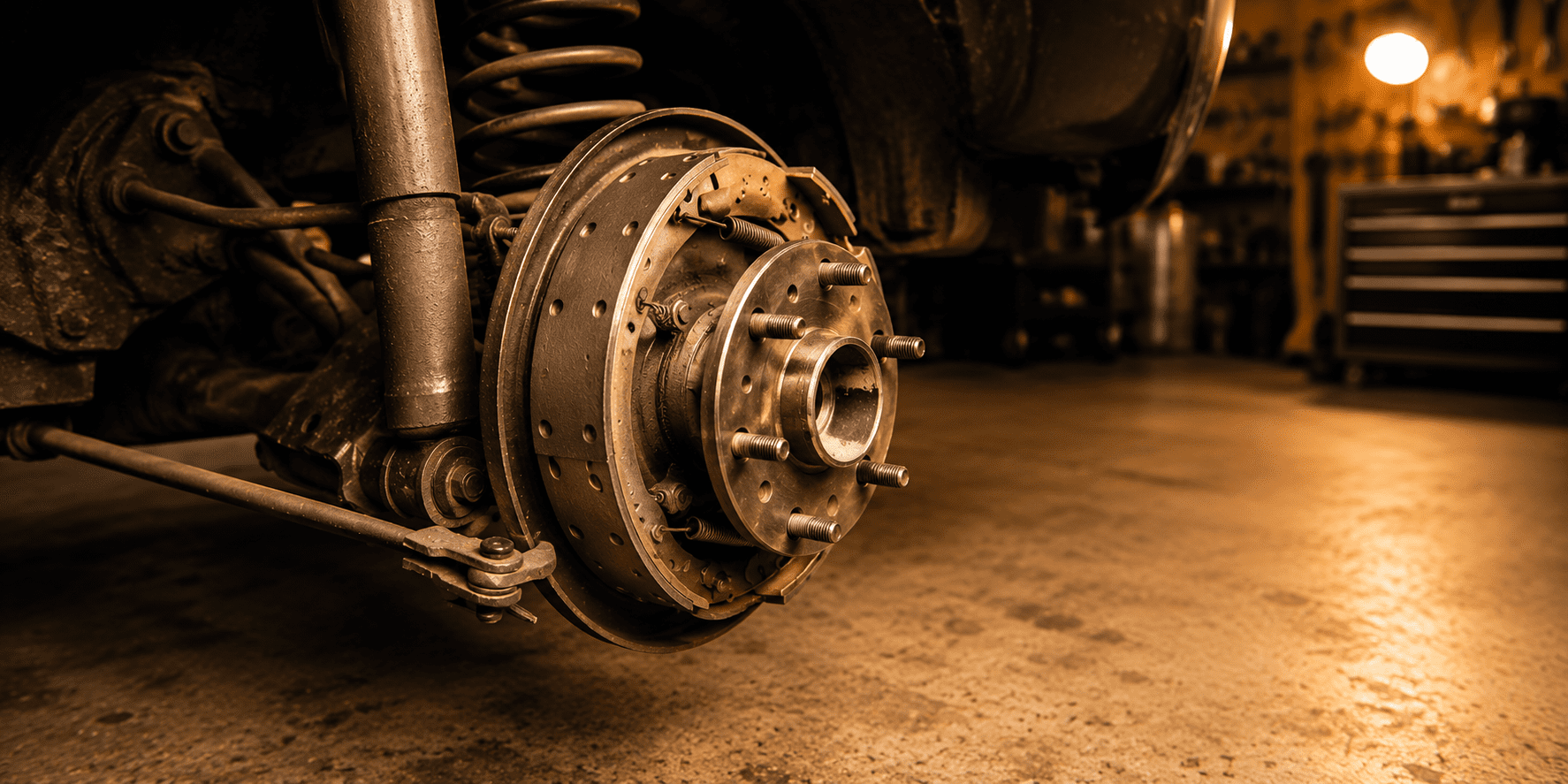
Brakes are the one system on a classic car where the consequences of getting things wrong are immediate, dramatic, and non-negotiable. Everything else on the car can be slightly suboptimal: a mildly rich carburettor, a slightly worn bush, a small oil weep. The brakes cannot. They need to work correctly every time, which means they need to be properly maintained, correctly bled, and fitted with components that are in serviceable condition. The good news is that classic car braking systems are mechanically straightforward by any modern standard, and most of the work described in this guide is well within the reach of any competent home mechanic. The better news is that understanding the system properly also reveals several worthwhile upgrades that transform the braking character of many classics at modest cost.
Understanding your classic car’s braking system
Before touching anything on the braking system, there is one important distinction to understand, because it directly affects how you interpret any failure and how seriously you take any degradation in performance.
Most classic British cars built before approximately 1967 use a single-circuit hydraulic braking system. This means all four wheels are operated by a single hydraulic circuit from one master cylinder. A failure anywhere in that circuit, a burst pipe, a failed union, a perished hose, removes all four-wheel braking simultaneously. There is no backup. This is simply how brakes were engineered in that era. The legislation requiring dual-circuit systems for new cars in the UK came into force in 1967, so cars like the early Mini, the Triumph Herald, early TR models, and most cars of that generation are single-circuit. Understanding this is not cause for alarm but it is cause for rigorous maintenance, because the tolerance for worn, leaking, or poorly maintained components in a single-circuit system is considerably lower than in a dual-circuit one.
Brake fluid: types, intervals, and the paint problem
Brake fluid is the element of the braking system most frequently neglected and most misunderstood. There are four types in common use and the differences between them matter considerably for classic car owners.
DOT ratings explained
DOT 3 and DOT 4 are both glycol-based fluids. DOT 4 has a higher minimum boiling point (230°C dry, 155°C wet) than DOT 3 (205°C dry, 140°C wet) and is the correct specification for the vast majority of classic British cars. They are compatible with each other and can be mixed, though the boiling point of the mixture will be closer to the lower-rated fluid. Both are hygroscopic: they absorb moisture from the atmosphere over time through the reservoir vent and through the walls of rubber hoses. This absorbed moisture lowers the fluid’s boiling point progressively, which is why regular replacement is necessary regardless of mileage.
DOT 5 is silicone-based and fundamentally different from DOT 3 and 4. It has an excellent dry boiling point of 260°C, it does not absorb moisture, and it does not strip paint if spilled. These are attractive properties for a classic car used occasionally and stored for periods. The disadvantages are equally real: DOT 5 is compressible under very high pressure which can produce a slightly spongy pedal, it should never be mixed with glycol-based fluids (the result is a gelatinous mess that blocks the system), and it requires the entire system to be flushed completely clean before use. It is not a drop-in improvement.
DOT 5.1 sounds like it should be silicone-based given its number, but it is not. It is a glycol-based fluid with the same high boiling point as DOT 5, compatible with DOT 3 and DOT 4, and it is hygroscopic like all other glycol fluids. The naming convention is genuinely confusing and has caught out more than one careful owner who researched their options thoroughly and still got it wrong. DOT 5.1 is compatible with glycol systems. DOT 5 is not.
When to change brake fluid
For DOT 4, every two years regardless of mileage is the standard recommendation for a car in regular use. The reasoning is straightforward: glycol fluid absorbs moisture whether the car is driven or not, and the wet boiling point of two-year-old DOT 4 is significantly lower than fresh fluid. For a classic used occasionally, this is actually more reason to change it regularly, not less. A car that has sat through a winter and been started a handful of times has still had two years’ worth of moisture absorption. Brake fluid discolouration in the reservoir is a rough indicator, but a properly dark or contaminated appearance should be treated as overdue rather than as the trigger point. Change it on a schedule, not on appearance alone.
The paint problem
DOT 3 and DOT 4 brake fluid will strip paint from bodywork with a speed and efficiency that is genuinely remarkable. A spill on a painted surface that is not addressed immediately will blister and lift the paint within minutes. The correct response to a brake fluid spill on paintwork is to flush the area immediately and generously with clean water. Do not wipe it: wiping spreads the fluid over a larger area and extends the damage. Flood it with water, repeatedly, until the fluid is completely diluted and removed. Keep a bottle of water near the brake fluid reservoir whenever bleeding or filling the system. This is not excessive caution. It is the voice of experience.
When bleeding brakes on a car with a painted engine bay or adjacent panels, lay absorbent rags around the master cylinder reservoir before removing the cap. A single overfill or a splash during reservoir top-up is enough to begin the damage. DOT 5 silicone fluid does not share this property, which is one of its genuine practical advantages for show cars or freshly restored vehicles where a spill would be especially costly.
Bleeding the brakes
Air in the hydraulic system compresses under pedal pressure where brake fluid does not, producing a pedal that travels further than it should, feels spongy, or in extreme cases reaches the floor before generating any meaningful braking force. Bleeding removes the air and restores a firm, progressive pedal. It is also required any time any part of the hydraulic system has been opened: a replaced caliper, a new master cylinder, a brake pipe repair, or a pad change where the caliper piston has been pushed back hard enough to displace fluid.
The order of bleeding
Always bleed from the wheel furthest from the master cylinder first, working progressively towards the closest. On a right-hand-drive British classic, this is typically: rear right, rear left, front right, front left. The master cylinder is on the left of the engine bay in most British cars, making the front right the closest wheel hydraulically. Check the workshop manual for the specific sequence recommended for your car, as some models specify a different order. Getting it wrong does not cause harm but it is less efficient and may require more passes to achieve a clean, air-free result.
The two-person method
The traditional method requires one person in the car operating the pedal and one person at each wheel managing the bleed nipple. It works well and requires no equipment beyond a ring spanner of the correct size, a short length of clear tubing, and a jar. The sequence at each wheel is: attach the tube to the bleed nipple and submerge the other end in a small amount of clean brake fluid in the jar (this prevents air being drawn back in on the return stroke), open the nipple approximately half a turn, have the assistant pump the pedal slowly three times and hold it down on the third, close the nipple before the pedal is released, and repeat until the fluid emerging from the tube runs clear and bubble-free. Keep the master cylinder reservoir topped up throughout. Allowing it to run dry introduces a large air bubble into the system that will require considerably more work to remove.
Workshop tip: Bleed nipples on classic cars seize with age and can shear if forced. Before attempting to open any nipple that has not been disturbed recently, apply penetrating oil and allow it to work for at least thirty minutes. A seized nipple that shears off in the caliper or wheel cylinder is considerably more expensive than the brake service you were trying to perform. If a nipple is particularly stubborn, our guide to removing seized nuts and bolts covers the options available before resorting to drilling.
One-person bleeding methods
For the solitary mechanic, several effective alternatives exist. Pressure bleeders such as the Eezibleed use a sealed reservoir pressurised from the spare tyre to push fluid through the system without pedal operation. They work well, are inexpensive, and allow one person to work methodically around the car without requiring an assistant who pumps the pedal with the enthusiasm of someone who has been asked to do it for the fifteenth time. Vacuum bleeders attach to the nipple and draw fluid through with a hand pump. They are effective but require care to ensure the seal around the nipple is airtight, as even a minor leak draws air through the nipple threads and gives a false impression of bubbles in the fluid.
Disc brakes: changing pads
Disc brake pads on a classic car should be replaced when the friction material is worn to approximately three millimetres or less, when the pad is contaminated with oil or brake fluid (replace immediately regardless of thickness), or when the braking has become uneven, noisy, or requires significantly more pedal effort than previously. Do both sides of an axle simultaneously. Replacing one side only and leaving the other worn is false economy that produces uneven braking and a car that pulls to one side under hard application.
The procedure
- Before starting: Open the master cylinder reservoir and remove a small amount of fluid. Pushing the caliper piston back displaces fluid upward into the reservoir, and if the reservoir is already at maximum level it will overflow. Given what brake fluid does to paint, this is worth attending to before rather than after.
- Remove the wheel and support the car securely on axle stands. Never work under a car supported only by a jack.
- Inspect the disc before removing the caliper. Look for deep scoring, cracking, or uneven wear. A disc with deep grooves will rapidly destroy new pads and should be replaced alongside them. Light surface rust is normal on a car that has been standing and will clear within a few brake applications.
- Remove the caliper by undoing the two caliper bolts. On most classic British cars these are straightforward bolts accessible from behind the caliper. Hang the caliper from the suspension or support it with wire rather than allowing it to hang on the brake hose, as the hose is not designed to support the caliper’s weight and will be damaged by it.
- Remove the old pads and note how they are located and any retaining clips or springs. Photograph the assembly if in doubt about reassembly sequence.
- Push the caliper piston back into the caliper body using a large flat-bladed screwdriver, a dedicated piston tool, or a piece of wood and a G-clamp. The piston needs to retract fully to accommodate the thickness of the new pads. On rear calipers with an integrated handbrake mechanism, the piston must be rotated clockwise while being pushed back rather than pushed straight in. Attempting to push a rear piston straight back will damage it.
- Fit the new pads, reinstate any retaining clips or anti-squeal shims, refit the caliper, and torque the bolts to the specified figure.
- Before moving the car: pump the brake pedal repeatedly until it feels firm. New pads are not in contact with the disc when first fitted and the first pedal application will go to the floor. Pump until resistance builds and confirm pedal firmness before driving.
Drum brakes: inspection, shoes, and adjustment
Drum brakes have a reputation for being less effective than disc brakes, which is true under repeated hard use where heat is generated faster than it can be dissipated. For normal road use on a classic car, a well-maintained drum brake system is entirely adequate, and the drum brakes fitted to many British classics were well-engineered for their era. The key word is maintained.
An important safety note on older brake dust
Brake linings on cars manufactured before the mid-1970s may contain asbestos. Never use compressed air to clean drum brakes on older vehicles. The correct approach is to use a damp cloth or purpose-made brake cleaner aerosol applied to a damp pad, which captures the dust rather than dispersing it. This is not overcaution. Asbestos fibres released from old brake linings are a genuine health hazard and the correct precaution costs nothing beyond a moment’s awareness.
Removing and inspecting
Remove the wheel and support the car on axle stands. The drum itself usually pulls or slides off the hub once the wheel is removed, though on a car that has not been disturbed for some time it may need encouragement. Light taps with a rubber mallet around the circumference usually persuade it. If the drum is truly stuck, the adjuster can often be backed off through the access hole in the drum or backplate to relieve the shoes’ grip on the drum surface. Do not use a steel hammer directly on the drum.
With the drum removed, inspect the lining thickness (replace when worn to approximately three millimetres), check for oil or brake fluid contamination on the linings (any contamination means replacement regardless of thickness and investigation of the source), and look for scoring or heavy wear marks on the drum surface. A slightly scored drum can be skimmed by a machine shop to restore the surface. A drum that has worn beyond its minimum thickness specification or cracked in any way must be replaced.
Replacing shoes
Drum brake shoe replacement requires care because the springs holding the shoes in place are under tension and have a facility for launching themselves across the workshop at precisely the moment you are least expecting it. Study the layout carefully before disturbing anything, and photograph or sketch the spring arrangement as it is before removal. Work on one side at a time so the opposite wheel provides a reference if you lose track of the spring configuration. Replace shoes as a complete axle set: if one side needs them, both sides get them.
Adjusting drum brakes
Self-adjusting drum brakes on later classic cars handle this automatically during normal use. Manual adjuster drums, found on many older British classics, require periodic adjustment to maintain the correct shoe-to-drum clearance as the linings wear. The adjuster is typically a square-headed peg or a slotted wheel visible through an access hole in the backplate or drum. Adjust until the drum just drags when rotated by hand, then back off one or two clicks until it rotates freely with minimal drag. Adjust both shoes independently where separate adjusters are fitted. After any new shoe fitting, a gentle bedding-in period of progressive stops from moderate speed allows the new lining to conform to the drum surface before full braking loads are applied.
Upgrades worth considering
Braided stainless steel brake hoses
The standard rubber flexible brake hoses on a classic car serve two purposes: they allow suspension and steering movement while maintaining the hydraulic connection, and they expand slightly under the pressure of a brake application. That second property is entirely undesirable. A rubber hose that expands under pressure absorbs some of the pedal effort that should be going to the brakes, producing a softer, less immediate pedal feel. It also allows the hose to swell, which can restrict return flow when pressure is released.
Braided stainless steel hoses with a PTFE inner liner are dimensionally stable under pressure. They do not expand. The result is a firmer, more direct pedal feel, more immediate braking response, and a more consistent feel that many drivers find significantly more confidence-inspiring, particularly under harder use. They are also considerably more durable than rubber hoses, resistant to perishing and cracking, and available for virtually every classic British car from specialist suppliers including Goodridge and HEL Performance. Cost for a complete set is typically between £60 and £120 depending on the car.
Fitting braided hoses requires opening the hydraulic system, so the brakes will need bleeding afterwards. On the subject of the old rubber hoses: if your classic still has its original rubber hoses, inspect them carefully. A rubber brake hose that is cracked, swollen, or has any visible deterioration is a safety issue. The hose can fail partially, swelling internally to create a one-way valve effect that applies the brake but does not release it, dragging that wheel and heating the disc or drum progressively. This is not a theoretical scenario. Replace rubber hoses on any interval exceeding ten years regardless of external appearance.
High-performance brake pads and shoes
Uprated brake pads and shoes are available for most classic cars and represent a worthwhile upgrade for any car used on track days. Standard pads are optimised for road use: quiet, effective from cold, and long-lasting. Performance pads trade some cold performance and longevity for improved friction at higher temperatures and better fade resistance. EBC Greenstuff and Yellowstuff ranges, along with Mintex performance compounds, cover most classic British applications. For a road car used occasionally on track, the EBC Greenstuff provides a good compromise between everyday driveability and improved performance under harder use.
Disc conversions for drum-braked classics
Conversion kits to replace front drum brakes with discs are available for many popular classics including the early Mini, various Triumph models, and certain Ford applications. The improvement in front braking performance is significant and the modification is reversible on most cars, preserving originality if desired. For a car used regularly, particularly in mixed traffic conditions where repeated moderate stops are more common than single emergency stops, the improvement in feel, fade resistance, and maintenance accessibility makes a front disc conversion a worthwhile investment. Rear drum conversions are less commonly available and the benefit is less pronounced, as the rear brakes on most classic cars contribute a smaller proportion of total braking effort by design.
Brake maintenance as a routine
The braking system on a classic car should be inspected annually as a minimum, with particular attention to fluid condition, hose integrity, and pad or shoe thickness. This is straightforward to incorporate into the pre-season inspection covered in our springtime safety check guide. After any winter storage period, checking that the brakes are releasing cleanly and that no wheel is dragging should be among the first checks before the car is used on the road.
A brake system that has been properly maintained requires little reactive attention. One that has been neglected becomes expensive to restore and potentially dangerous in the interval. Given that the brakes are the single system on the car that everything else depends on, this is the maintenance category where the standard advice to address issues promptly rather than noting them for later applies most forcefully. Check them, service them, and change the fluid on schedule. The alternative is not worth the saving.
This page contains affiliate links. If you click a link and make a purchase, Classic Car Hub may earn a small commission at no extra cost to you.