
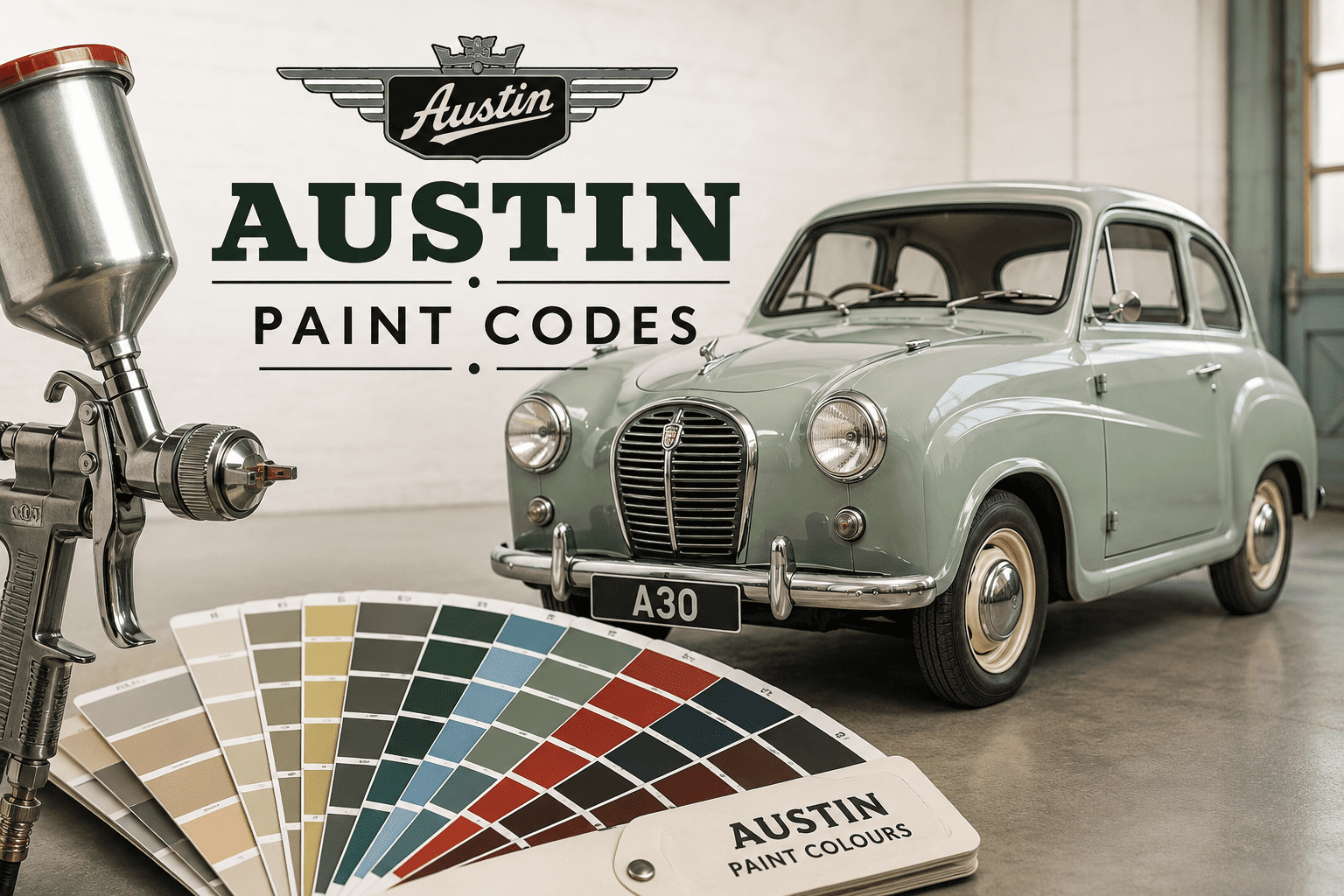
Austin built more cars for the British market than almost anyone else for much of the postwar period, which is impressive, and then proceeded to give them so many different colour coding systems that looking up a paint code requires knowing something about corporate history. The range here runs from the A30 of 1951 to the Metro of the 1980s: three decades, four entirely different coding systems, and enough shades of beige to keep the 1970s exactly as it was. Finding the right code means knowing which era your car belongs to, and this page sorts that out for you (hopefully).
The short version of Austin’s coding chaos: 1950s cars used colour names with no codes at all. The BMC era from around 1960 brought two-letter prefix codes (BU for blues, GN for greens, RD for reds, WT for whites, and so on) shared across MG, Morris, and everyone else under the BMC umbrella. British Leyland arrived in 1968 and introduced BLVC numeric codes, because change for its own sake was something British Leyland did with real commitment. Then from the mid-1970s, three-letter codes replaced or supplemented the numbers. All four systems are covered below.
How to find your paint code
The identification plate is somewhere under the bonnet, though Austin was not entirely consistent about where. On A30, A35, and A40 Farina models, try the scuttle panel or inner wing. On the A55 and A60 Cambridge, the bulkhead or inner wing. On the 1100 and 1300, the bulkhead. On the Maxi, the bulkhead again. On the Allegro, the scuttle. On the Metro, the bulkhead, where someone at Austin Rover presumably decided it belonged and decided to stop experimenting. The plate lists the paint code alongside the trim code, engine details, and build date, which is useful if you have ever wondered exactly when your Allegro was released into the world.
A word on the very early cars: 1950s Austins, including the original A30, were built before the BMC coding system existed. They carry colour names only, with nothing stamped on the car to help you. For these, the Austin A30-A35 Owners Club holds historical records and is considerably more useful than staring at the bulkhead hoping something will appear.
Austin A30 (1951–1956)
Britain in 1951 was still rationing some foods, which perhaps explains why the A30\’s colour palette was so restrained. Most colours carry names only with no formal code on the car, and several of those names reflect the national mood: Court Grey, Sandringham Fawn, and Buckingham Green suggest a country thinking fondly about the Coronation rather than the open road. Codes shown are from surviving paint supplier records where available, since Austin was not yet in the habit of stamping them anywhere particularly convenient.
Austin A35 (1956–1968)
The A35 arrived at Earls Court in 1956 with a larger engine, a proper remote-control gearchange, and, crucially, a slightly wider range of colours. By the early 1960s the formal BMC prefix system was in place, and the A35 gained access to the full BMC palette. Vans and pick-ups soldiered on until 1968, which tells you something about the A35’s durability and rather more about the van market’s indifference to style.
Austin A40 Farina (1958–1967)
Austin asked Battista Pininfarina to design a small British family saloon, which is the kind of decision that sounds optimistic in the boardroom and looks genuinely elegant in the metal. The A40 Farina was the result: tidy Italian styling wrapped around the A35’s mechanical bits, wearing the full BMC colour palette throughout its production life. Available as Mk I (1958-1961) and Mk II (1961-1967), both marks shared the same colours, so the chart below covers either.
Austin A55 and A60 Cambridge (1957–1969)
The Cambridge range provided reliable transport for Middle England throughout the 1960s without drawing attention to itself in any way whatsoever, which was presumably the point. It used the full BMC prefix palette from the start and stayed in production until 1969, by which point it had been reliable for so long that nobody particularly wanted to replace it. For owners seeking the original colour of a car that was specifically chosen not to stand out, this is your reference.
Austin 1100 and 1300 (1963–1974)
Britain’s best-selling car for much of the late 1960s, the ADO16 was a genuine engineering achievement: Hydrolastic suspension, transverse engine, front-wheel drive, and a colour range that spanned the transition from BMC prefix codes to British Leyland’s BLVC system. If your car was built before 1968 it uses prefix codes; from 1970 it uses BLVC numbers. Cars from the messy changeover period in between may use either, because British Leyland’s transition management was about as orderly as you would expect from a company that had just merged seventeen manufacturers and not entirely worked out what to do next.
Austin Maxi (1969–1981)
Launched in 1969 as one of the world’s first five-door hatchbacks, the Maxi had several good ideas in it that the buying public took some years to appreciate. It used BLVC codes from the start, arrived in a range of colours that leaned toward the earthy end of the spectrum in its middle years, and spent twelve years in production being quietly useful while everyone waited for the Allegro to replace it. Early cars carry BLVC numbers only; later examples show both the BLVC number and the three-letter code on the plate.
Austin Allegro (1973–1982)
The Allegro arrived in 1973 and has spent the decades since being treated with the affectionate sympathy reserved for cars that tried hard under genuinely difficult circumstances. It replaced the beloved 1100/1300, had a quartic steering wheel, and was described by contemporary road testers in terms that its designers found hurtful. What it also had was a genuinely varied and in places quite bold colour range, including Aconite (purple, and correctly so) and Flamenco Red. BLVC codes in early production, three-letter codes from the mid-1970s. Some colours are shared only with a small number of other BL models, which gives Allegro owners a certain exclusivity they may not have been aware they were purchasing.
Austin Metro (1980–1990)
British Leyland launched the Metro in October 1980 as the car that was going to save the company, which is a considerable amount of pressure to place on something with a 998cc engine. It largely delivered: the Metro was genuinely competitive against the Fiesta and Polo, sold well, and came in a broader range of colours than its predecessors including several metallics that gave it a more contemporary feel. BLVC codes on early cars, Austin Rover three-letter codes from 1982, and Rover Group codes on the late production cars that outlasted several corporate reorganisations to make it to 1990.
Colour codes and year ranges sourced from Paintref.com, the Austin A30/A35 Owners Club, Metro Owners Club, Allegro Club International, and the Morris Minor Forum BMC/BL paint code archive. Year ranges are approximate factory catalogue dates. Colour swatches are approximate digital representations only and will not match original factory paint exactly. Always obtain a proper paint match from a supplier using the factory code.
A note on Austin Mini colours
Austin Mini colours are not included here because the Mini ran for forty-one years and accumulated enough colour variants to fill an article of its own. The Classic Mini was sold as both Austin and Morris badged versions for most of its life, wearing the same colours regardless of which badge was on the front, so a separate Mini colours page covers both. Our Classic Mini guide is the place to start. Austin-Healey colours are also not here, on the basis that they belong to the Austin-Healey and not to any of the estimable but considerably less glamorous machines in this particular guide.
Finding and buying touch-up paint
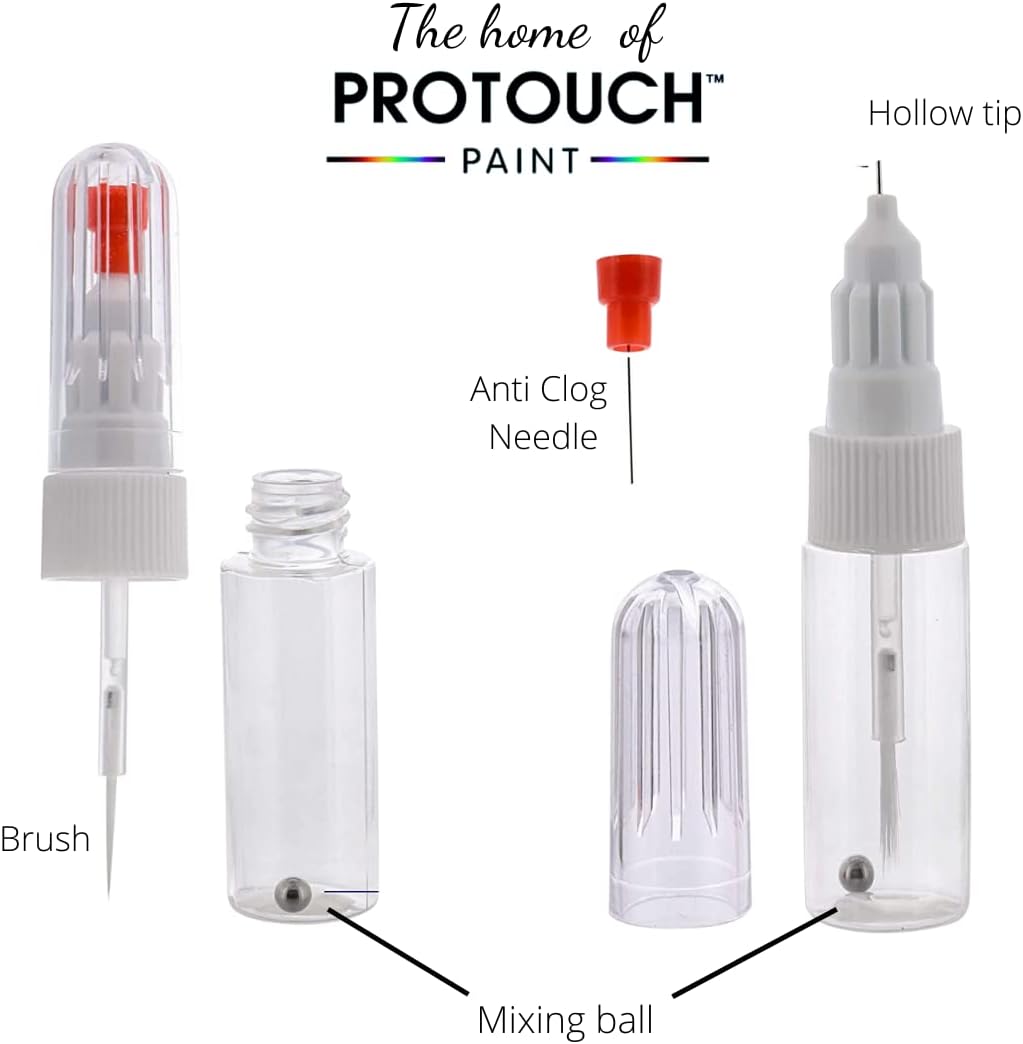
The good news is that Austin paint, for all its coding complexity, is generally well supported by the major classic car suppliers. Moss Europe and SC Parts Group list codes and stock aerosols and tins for most BMC-era Austins. For BLVC-coded cars the Moss range is comprehensive. For Austin Rover-era Metros and later, Halfords and most motor factors can mix from the plate code, and the three-letter system is well represented in trade mixing databases.
For a full respray or a colour that has gone out of standard production, always give the supplier the code rather than the name. Austin colour names were not always unique across different years, and telling a paint supplier you want Tartan Red will get you a question about which Tartan Red rather than a tin of the correct one. The Austin A30-A35 Owners Club, Allegro Club International, and Metro Owners Club all hold historical records for their respective cars and are generally more helpful than the internet at large when the code on the plate refuses to match anything in the catalogues.
For related reading: our Classic Mini buyers guide, Morris Minor buyers guide, and paintwork restoration guide cover related ownership subjects in the depth they deserve.
This page contains affiliate links. If you click a link and make a purchase, Classic Car Hub may earn a small commission at no extra cost to you.