
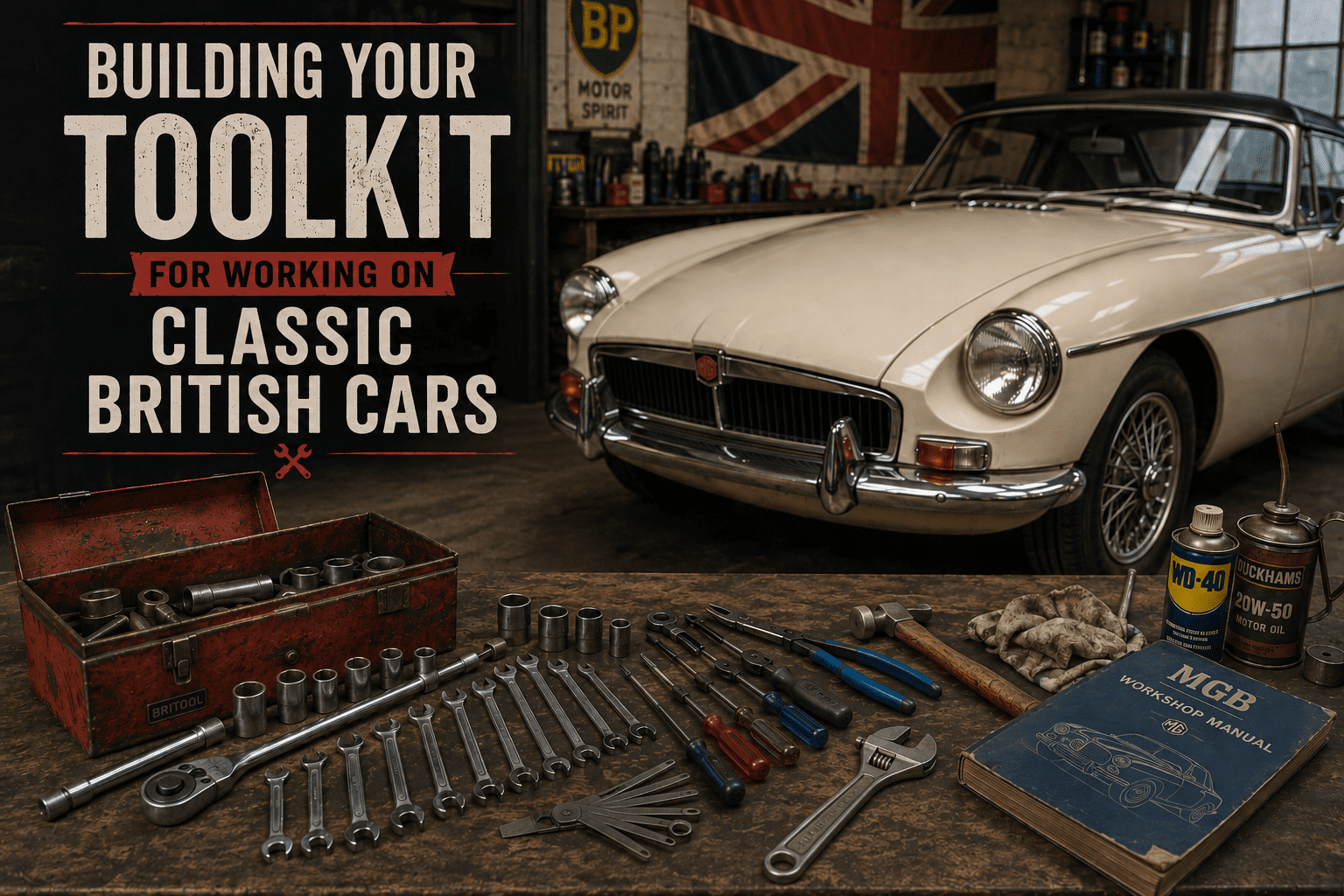
Somewhere in almost every classic car owner’s garage there is a socket set. It came in a red plastic case. It has 99 pieces. It was either a Christmas present, a spur of the moment sale purchase, or it arrived when a previous owner left something behind. Exactly three of its sockets get used regularly. The rest exist to rattle around in the tray and produce a sense of false security about your workshop’s readiness for any eventuality. This guide is about building a toolkit that actually works: tools chosen because they are useful, sized correctly for classic British cars, and bought at a price that reflects the fact that you are servicing a Triumph you own, not earning a living from doing so.
The approach here is straightforward. Start with what you genuinely need and add to it as specific jobs require specific tools, rather than buying a large set and hoping everything will be covered. A well-chosen selection of twenty tools will serve a classic car owner better than a comprehensive set of ninety-nine. Quality matters more than quantity, though the relationship between price and quality is more nuanced than the tool brands’ marketing suggests. And there are a handful of things specific to classic British cars that no general tool guide covers at all, because general tool guides are not written for people who periodically encounter a fastener from 1959 that exists in a thread form no longer manufactured in large quantities.
The thread situation: a uniquely British problem
Before any tools are discussed, the fasteners they are used on need a brief explanation, because classic British cars contain at least three different thread and size systems and understanding which one you are dealing with prevents the specific frustration of using the wrong tool and being surprised by the result.
Whitworth and BSF (British Standard Fine) are the thread systems used on British cars and machinery from the Victorian era through to the early 1970s. The wrench sizes are measured across the flats of the hexagonal bolt head, but the sizing convention is different from metric or AF (Across Flats, used on American fasteners). A 1/2 inch Whitworth spanner fits a bolt head that is noticeably different in size from a 1/2 inch AF spanner. The two are close enough that the wrong one will almost go on, which is arguably worse than not fitting at all. Classic British cars from roughly pre-1971 will have Whitworth and BSF fasteners in various locations: on the engine, in the suspension, on brake components, and on anything else that predates the adoption of metric or UNF/UNC fasteners.
AF spanners (Across Flats, sometimes called SAE or imperial) are the American sizing system, used extensively on British cars built from the late 1950s onward alongside the Whitworth legacy fasteners. The MGB, for example, uses predominantly AF-sized fasteners throughout, with some Whitworth fasteners in specific locations that cause brief confusion and then require the correct spanner.
Metric became the standard from the early 1970s on British cars, and anything built after roughly 1973 is predominantly or entirely metric. Many cars of the mid-1970s are mixed: a combination of metric and AF fasteners that reflects a transitional period in British manufacturing that was not entirely systematic in its approach to standardisation.
The practical consequence: if your classic is pre-1971, you need Whitworth/BSF spanners as well as AF. If it is from the 1960s to early 1970s, you need AF spanners and should have a small Whitworth set for specific applications. If it is post-1973, metric will cover most things. If you are not sure, identify the car’s fasteners before buying tools rather than buying three sets speculatively. The internet forum community for any specific British classic will tell you exactly which thread systems are involved, usually with a vigour that suggests the topic has caused them some previous annoyance.
The foundations: spanners and sockets
A combination spanner (open jaw at one end, ring at the other) in each size relevant to your car is the most-used tool in most workshops. The ring end provides more contact with the fastener and is less likely to slip; the open end provides access in positions where the ring cannot fit. Both ends earn their existence. A set of combination spanners in the correct sizes for your car is more useful than a comprehensive set that consist mostly of sizes you will never use.
For socket sets, the two most important decisions are drive size and quality. Drive size determines the torque you can apply: 1/4 inch drive for small fasteners and fiddly locations, 3/8 inch drive for general work, and 1/2 inch drive for the larger fasteners on wheel nuts, suspension components, and anything that requires significant torque. A 3/8 inch drive set covers approximately eighty percent of everything on a classic car. A 1/2 inch set covers the rest. The 1/4 inch drive set is extremely useful for the places where a larger socket and ratchet physically will not fit, and this describes several important locations on most British classics.
Deep sockets are worth having alongside standard ones. A deep socket reaches over a long stud or a bolt with an extended thread, which comes up regularly on classic cars where the original fasteners were not replaced with shorter modern equivalents. A spark plug socket is a deep socket with a rubber insert to protect the ceramic insulator, and it earns its place in every classic car toolkit from the first service onward.
Screwdrivers: not all the same
Classic British cars use flat-blade (slotted) screws in locations that modern cars have mostly moved away from, and they use Pozidriv rather than Phillips in many applications from the 1960s onward. These are not interchangeable. A Phillips driver used on a Pozidriv screw will “cam out” and round the head, particularly on any screw that has been in the car for several decades. Pozidriv has an additional cross embossed between the main cross; Phillips does not. Look at the head of the screw before selecting the driver.
Impact screwdrivers are genuinely useful for the stubborn screws on classic British cars that have never been out since manufacture. An impact driver accepts standard screwdriver bits and, when struck with a hammer, turns the bit a fraction while simultaneously driving it into the head. The combination of rotational and axial forces loosens screws that would otherwise strip the head before moving. They cost around £15 to £25. Every classic car owner encounters the screw that would otherwise require a drill and an extractor, and the impact driver is considerably less stressful (provided the area you need it for has ample room).
A stubby screwdriver, with a handle wider than its shaft is long, reaches into recessed spaces where a full-length driver cannot be held at the right angle. These spaces exist on every classic car and have been responsible for a disproportionate share of stripped screw heads over the decades. Own at least one stubby flat and one stubby Pozidriv.
Measuring tools: the ones most people skip
A feeler gauge set costs around £5 and is irreplaceable for setting valve clearances and spark plug gaps on a classic car. Feeler gauges are thin blades of known thickness that are slipped between two surfaces to measure the gap between them. The gap between valve stem and rocker arm on a classic British engine needs to be set to a specific measurement, and guessing has a poor track record. Our valve clearance guide covers the procedure, but none of it is possible without the gauge. This is not a tool to be optional about.
A torque wrench allows fasteners to be tightened to a specific measured value rather than by feel or optimism. Cylinder head bolts, sump plugs, wheel nuts, and various other fasteners have specified torque values that exist because overtightening causes damage and undertightening causes leaks or losses. The click-type torque wrench, which clicks audibly when the set value is reached, is the most practical type for workshop use. A 3/8 inch drive torque wrench covering roughly 5 to 100 Newton metres handles most classic car work. A 1/2 inch drive version is needed for wheel nuts and suspension components. Do not use a torque wrench as a breaker bar in the loosening direction: they are calibrated mechanisms and mechanical abuse affects their calibration.
A vernier calliper or digital calliper allows accurate measurement of small dimensions: brake disc thickness, piston ring gap, component clearances. Not an everyday tool but invaluable when a job requires it. Digital callipers from Toolstation or Amazon cost around £10 to £20 and are accurate enough for classic car work. The expensive high precision Mitutoyo versions used by professional engineers are not necessary for someone measuring the thickness of a brake disc.
Electrical tools: Lucas, bafflement, and the multimeter
A digital multimeter is the most important diagnostic tool in a classic car owner’s kit. It measures voltage, resistance, and continuity, which covers the vast majority of electrical diagnosis on any car. A decent multimeter costs between £15 and £40 from Toolstation, Screwfix, or Amazon. The specific brand matters less than the habit of using it: a multimeter that is in the drawer solves no problems, but a multimeter that comes out every time there is an electrical symptom solves most of them. Our electrical fault finding guide covers the specific tests relevant to classic British cars.
A test light (a simple lamp with a probe on one end and a crocodile clip earth on the other) is a useful addition to the multimeter for quickly confirming the presence or absence of voltage at a point in a circuit. It provides less information than a multimeter but takes less time to set up for a quick check. On a positive earth car (pre-1965 on most British vehicles), the earth clip connects to the positive terminal rather than the negative, which is the kind of reversed convention that makes electrical work on early British classics a specific and character-building experience.
A crimping tool and a selection of bullet connectors, spade connectors, and bullet crimp terminals are essential for anyone who does any electrical work at all. Lucas electrical connectors on British classics are the bullet type: a cylindrical brass pin that pushes into a brass socket. They corrode at the contact face, pull apart under vibration, and cause intermittent faults that are difficult to trace unless the connections themselves are in the habit of being inspected. A crimping tool that makes a proper swaged connection costs around £8 from Toolstation and is worth considerably more than its price.
Classic British car specific tools: the ones the general guides miss
A timing light is essential for checking and setting ignition timing on a classic car with a distributor. It is a stroboscopic lamp triggered by the ignition system that effectively freezes the timing marks on the crankshaft pulley so they can be read against the reference mark on the engine. Without it, ignition timing is either set by ear (unreliable) or not checked at all (worse). Inductive timing lights that clip onto the HT lead are available from around £15 upward. The more expensive units also provide advance measurement, which is useful but not essential for basic timing checks.
A compression tester screws into the spark plug hole and measures the compression produced by each cylinder. Healthy compression is healthy engine. Low compression in one cylinder indicates a problem: worn rings, a burnt valve, a failed head gasket, or a worn bore. This is the first diagnostic step before any engine-related symptom is investigated further. It is also one of the most useful checks when buying a classic car. A basic compression tester costs around £10 to £20. It is used infrequently but provides specific and valuable information each time. Our spark plug diagnosis guide covers what to look for alongside the compression test.
A tyre pressure gauge of the pen or dial type, rather than a digital one that requires a battery to have given up at the wrong moment. Classic car tyres are on rims that were not designed with modern tyre widths or pressures in mind, and the correct pressure is worth verifying rather than assuming. Our tyre safety guide covers the specifics.
A hub puller for Triumph owners specifically. The wire wheel splined hub on a Triumph TR or Spitfire can, over time, develop a relationship with the stub axle that goes beyond what was intended. A hub puller makes the separation manageable. Attempting the same task with a hammer and creative language is less effective and considerably louder.
An oil filter removal tool that fits your car’s filter housing. The canister-type oil filter on many British classics requires a specific wrench size, and the aftermarket spin-on filter replacements can be done by hand going on but often require a tool to remove. A strap wrench or chain wrench costs around £5 and is the difference between an oil change that takes twenty minutes and one that takes an hour.
Cheap tools, expensive tools, and the honest middle ground
The tool quality question produces strong opinions in any workshop and the answer is, frustratingly, more nuanced than either “always buy cheap” or “always buy the best.” The truth is that the relationship between price and quality varies significantly by tool type, and some tools are worth paying for while others are not.
Worth paying more for: ratchets (cheap ratchets skip under load and wear quickly), combination spanners (cheap ones have poor tolerances that round fasteners), screwdrivers (cheap ones have handles that twist before the blade does and tips that cam out immediately), and torque wrenches (calibration matters and cheap torque wrenches often are not). The Halfords Advanced range (with its lifetime guarantee) represents a significant step up from the base range at a modest price premium and has been widely used by home mechanics for over two decades. Draper Expert, Teng, and Sealey are all well-regarded at the middle price point. Snap-on and Facom produce genuinely exceptional tools and cost what you would expect for genuinely exceptional tools, which is more than is sensible for someone who services one car at the weekends rather than twelve cars a day.
Not worth paying much for: extension bars, universal joints, and socket accessories are largely commodity items where the price differential does not translate into meaningful performance difference. A £3 extension bar from Toolstation performs identically to a £30 extension bar from a premium supplier in the environment of a home workshop. A hammer is a hammer above a certain minimum quality threshold. Scraper blades, wire brushes, and consumable items are obviously not worth premium pricing.
The adjustable spanner deserves its own paragraph because it is simultaneously the most useful tool for the owner who does not have every spanner size and the most dangerous tool for fasteners that deserve better. An adjustable spanner in good condition, used carefully, will turn a nut. An adjustable spanner that is worn, or used sloppily, will round the flats of a fastener that has been on the car since 1968 and does not have obvious replacements available. The correct spanner for the correct fastener is always the better choice. The adjustable spanner is the choice when the correct spanner is not to hand, and it should be used with the awareness that it is always a compromise rather than a solution.
The tools that never get used
Every toolkit accumulates items that were bought for a specific purpose and then never used again, or were included in a set and have never been used at all. This is not necessarily a problem: a tool that has been owned for ten years without use is still a tool that is available if the need arises. But it is worth knowing which items fall into this category before buying them.
Torx bits, the star-shaped fastener drive used extensively on modern cars, appear on very few classic British cars. A set of Torx drivers included in a general tool kit is largely irrelevant for British classic work. Allen keys are similarly uncommon on older British cars as original fasteners (though used extensively on aftermarket components like caliper bleed nipples and modern replacement parts). Spline bits, triple-square drivers, and a number of the more exotic drive formats in comprehensive bit sets will never be used on anything made in Coventry, Abingdon, or Canley.
The thirty-seven-piece hex bit set. The pipe threading die that came in a big metal box. The bearing separator that looked necessary at the time and has lived under the workbench since then. Everyone has at least three of these. They are not failures of judgement so much as the natural accumulation of an enthusiasm for tools that slightly exceeds the immediate requirement. The important thing is not to let them create a false impression of preparedness that substitutes for actually having the right tools for the specific tasks at hand.
Lifting gear: the tools that keep you alive
A workshop trolley jack and a pair of axle stands are not optional equipment for anyone who works under a classic car, regardless of how briefly they intend to be underneath it. The car jack from the boot is for roadside tyre changes only. This is covered in detail in our workshop safety guide and is worth reading before the first time the car is raised for any work beneath it.
Wheel chocks cost around £5 for a pair and prevent the car from rolling while it is being worked on. They are the category of tool whose value is most obvious in hindsight, which is an excellent reason to own them before the hindsight becomes relevant.
Tool maintenance: a brief word about not being a hypocrite
An owner who keeps their classic car in good condition while allowing the tools that maintain it to rust is making a specific philosophical statement about priorities that most people would not consciously endorse. Rusty tools are less effective, harder to use, and in some cases dangerous.
The basics are simple. Store tools in a dry location, either a proper tool chest or a decent tool bag rather than a plastic crate that traps moisture. Wipe tools down after use if they have been exposed to grease, oil, or water. Apply a light film of oil or a product like WD-40 to metal tools before extended storage: WD-40 is not, it should be noted clearly, a lubricant in any meaningful long-term sense, but it is an effective moisture displacer and provides adequate short-term protection on stored hand tools. Proper lubrication for moving parts (ratchet mechanisms, adjustable spanner screws) requires an actual lubricant: a light machine oil or a dedicated tool lubricant.
Rusty tools can usually be recovered. Soaking in a penetrating oil for twenty-four hours, followed by wire brushing with a steel wire brush on a drill, addresses surface rust on most hand tools without significant metal loss. Tools with active pitting or visible structural compromises should be replaced rather than trusted with fasteners that matter. A snapped socket extension inside an engine bay is the kind of incident that significantly changes the nature of a routine oil change.
Look after the tools that look after the car.
Building the toolkit over time: the sensible approach
The best toolkit is not the most comprehensive one. It is the one built up over time by someone who added tools as specific jobs required them, bought decent quality at a sensible price, and understands what each tool is actually for. Start with the genuine essentials: a combination spanner set in the correct sizes for your car, a 3/8 inch drive socket set, a set of screwdrivers (flat and Pozidriv), a multimeter, a feeler gauge set, a timing light, and the lifting equipment. Add to this as specific jobs require it, and buy quality on the items that reward it.
The toolkit built up this way over three or four years of regular workshop sessions will serve a classic car owner better than anything bought all at once, because each tool in it was acquired in the context of needing it for a specific purpose. It will fit in a proper tool chest rather than a series of miscellaneous boxes. And most of it will not be rusty.
For related reading: our workshop safety guide covers using the tools correctly once you have them, our electrical fault finding guide covers getting the most from the multimeter, our valve clearance guide covers the specific use of the feeler gauge, and our seized nuts and bolts guide covers what to do when the tool that should work does not and more persuasive measures are required.
This page contains affiliate links. If you click a link and make a purchase, Classic Car Hub may earn a small commission at no extra cost to you.