
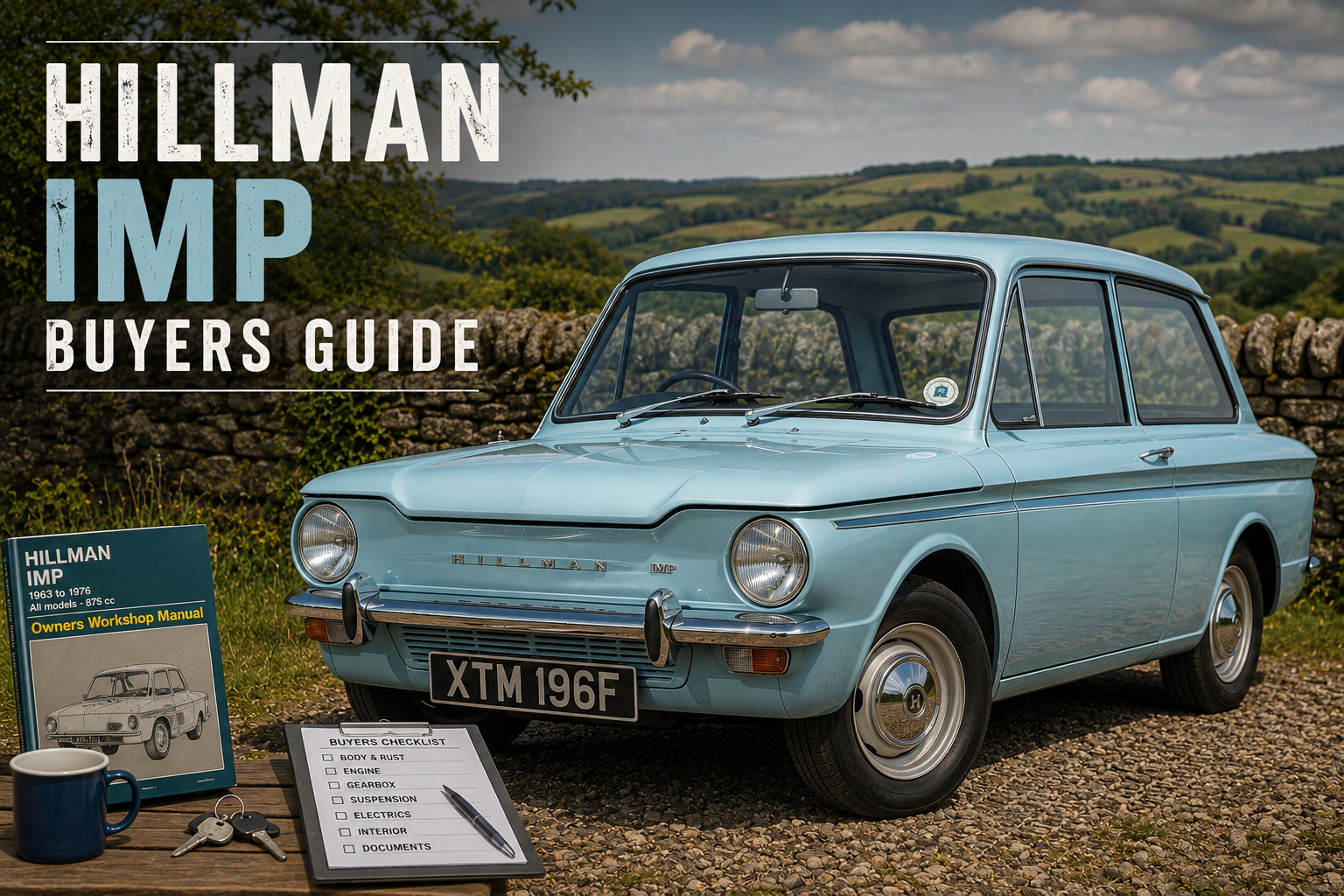
The Hillman Imp occupies a curious position in British classic car culture. It is a car that most people vaguely remember, a handful actively dismiss, and a dedicated community of enthusiasts would argue with you about if you said anything sufficiently unkind. It is small, rear-engined, and cheap. It arrived in 1963 and it came second in a race it was never quite going to win: the Mini had got there four years earlier, sold in vast numbers, and achieved the kind of cultural permanence that is essentially impossible to unseat. The Imp was generally viewed as “the other one”.
Which is, quite frankly, a shame. The Imp is a more technically interesting car than its reputation suggests, faster in Sport form than most people expect, and is genuinely rewarding to drive when set up correctly. It won international rallies, and appeared in The Sweeney. The story of how it came to exist is, in itself, one of the more entertaining chapters in the history of British motoring. That story is where this guide begins.
A brief and gloriously chaotic history
The Rootes Group had not built a small car since the 1930s and had no particular desire to do so. Then the Suez Crisis of 1956 sent petrol prices through the roof, the Mini arrived in 1959 and sold in vast numbers, and Rootes found themselves building large, thirsty cars for a market that was increasingly interested in small, economical ones. Something had to be done. The result was Project Apex, led by engineer Tim Fry and technical designer Mike Parkes, who later in his career would be racing on the Ferrari F1 team. Their brief was to build a small car that could carry four people and their luggage, rival the Mini, and still make money at competitive prices. No small ask.
The prototype was called the Slug. This was not encouraging. But it evolved into something genuinely interesting: a rear-engined, rear-wheel-drive small car with fully independent suspension, rack-and-pinion steering, and an all-aluminium overhead camshaft engine derived from the Coventry Climax FWMA unit that had originally been designed to power portable fire pumps. Detuned and enlarged slightly to 875cc for road use, it produced 39bhp in standard form, which was respectable for such a small, light car. The whole package weighed remarkably little, and it handled well as a result.
Then came Linwood. The government of the day, anxious to provide industrial employment near the Clyde following the decline of shipbuilding, offered Rootes substantial financial incentives to build their new factory in Scotland rather than in the Midlands where the company’s expertise lay. Rootes took the deal. The Linwood plant was purpose-built, modern, and staffed by workers with no previous experience of car manufacturing. The engines were built in Coventry, sent to Scotland by rail, and the finished cars were assembled by people who were learning as they went. The quality problems that resulted were severe enough to damage the Imp’s reputation within its first two years, and that reputation proved stubbornly difficult to shift even after the car was substantially improved in 1965.
The models: more than you might expect
The Imp family is considerably larger than most people realise. The core Hillman-badged cars were sold in Standard, De-Luxe, and Super trim levels throughout the production run. The De-Luxe accounted for the lion’s share of sales at 93,266 examples for the Mk1 alone. The Super added equipment and revised trim. None of these are particularly rare. All of them are a great starting point for anyone new to Imp ownership.
Beyond the standard cars, however, the range diversified considerably:
- Singer Chamois (1964-1970): The luxury variant, with a distinctive grille, better interior trim and standard equipment. Around 39,000 were built across saloon and coupe versions. The Chamois attracted buyers who wanted something a little more refined than the standard Hillman. Richer pensioners, according to one rather wonderful period description.
- Sunbeam Imp Sport (1966-1976): The performance variant, featuring a twin-carburettor version of the 875cc engine producing around 51bhp and a higher-specification interior. The one to have if you plan to use the car with any degree of enthusiasm. Around 43,000 were built in total across various Sunbeam-badged Sport variants.
- Imp Californian and Singer Chamois Coupe (1967-1970): A coupe body style with a more steeply raked roofline. Approximately 7,673 Californians and 2,742 Chamois coupes were built. The coupe looks rakish but the aerodynamics are actually slightly inferior to the saloon, which is a pleasing detail.
- Sunbeam Stiletto (1967-1973): The coupe body with the Sport twin-carburettor engine and luxury interior. The closest thing the Imp range had to a genuine gran turismo. Only 8,213 were built in two series, making it the rarest and most desirable variant.
- Hillman Husky (1967-1970): An estate based on the van’s body pressings, which gave it somewhat unconventional styling. Around 2,882 Mk2 examples were built. Now highly sought after precisely because of that unconventional styling and their relative scarcity.
- Commer and Rootes Van (1965-1970+): The van was more successful than it might appear on paper, with around 15,700 built across its various guises. Extremely useful, extremely characterful, and now rather collectable.
The total across all variants was 440,032 cars, which sounds impressive until you note that the planned production rate was 150,000 per year. It never came close. Rootes had committed to building the Linwood plant on that assumption, borrowed heavily to do so, and when the Imp sold in significantly lower numbers than projected the financial strain contributed directly to the Chrysler takeover of Rootes Group in 1967.
Interesting facts and lesser known details
The Imp has a particularly rich collection of footnotes, Here’s a few worth knowing:
The Coventry Climax engine at the heart of the Imp was derived from the same family of units used in Lotus racing cars, though a different variant with a different cylinder head. The Imp used the FWMA unit, while Lotus used the FWMC. This means the Imp’s engine has genuine motorsport DNA, even if the standard road car’s 39bhp does not immediately suggest it.
Early Imps used a pneumatically operated throttle system rather than a conventional cable. This was genuinely innovative and genuinely unreliable. It was replaced with a conventional cable arrangement on later cars, and any Mk1 still running the original pneumatic setup deserves considerable sympathy. The 1965 Mk2 revision addressed this and a long list of other early teething problems, and the Mk2 cars are substantially more dependable than the originals.
The Imp was the first British production car with an opening rear window. This top-hinged rear glass opened upwards to provide access to the luggage area behind the rear seats, making the Imp effectively a hatchback before the term existed. The rear seat also folded to extend the luggage area considerably, which gave the Imp a genuine practical edge over its rivals for a car of its size.
Rosemary Smith, the Irish rally driver, won the Tulip Rally outright in 1965 driving a works Imp. The following year she won the Coupe des Dames, then was disqualified on a controversial headlamp technicality. The Imp also won the British Saloon Car Championship three years running in 1970, 1971, and 1972 in the hands of Bill McGovern. Not bad for a car with a reputation for unreliability.
The Imp’s platform was used as the basis for a number of specialist sports cars, including the Ginetta G15, the Clan Crusader, the Bond 875, and the Davrian. The Ginetta alone accounted for around 800 examples, the Bond 875 for around 3,400. The Imp’s lightweight aluminium engine and compact dimensions made it an attractive donor vehicle for small manufacturers throughout the late 1960s and into the 1970s.
On screen
The Imp has had a surprisingly active television career for a car that never quite achieved the cultural status it deserved. It appeared in The Sweeney on multiple occasions, both as a saloon and in van form, which is about as period-correct a small car as you could wish for in the background of a 1970s police drama filmed on location in west London. It appears in Man in a Suitcase, Life on Mars, The Professionals, Heartbeat, The Saint, The New Avengers, and Keeping Up Appearances, among others. On the big screen it appears in François Truffaut’s 1966 film Fahrenheit 451 and Ken Russell’s Tommy from 1975, which between them represent a more culturally ambitious filmography than most small cars ever manage.
What to look for
The Imp was a relatively complex small car, and the things that go wrong on them are specific enough that a little knowledge goes a long way when viewing one.
Bodywork and rust
The Imp’s bodyshell rusts in the predictable places, and there are enough of them to make a thorough inspection worthwhile. The leading edge of the double-skinned bonnet is a primary concern: water gets in and has nowhere to go, and the resulting rust is often invisible until the bonnet is removed. Check the bottom edges of the doors, the front and rear wheelarches, and particularly the base of the inner wheelarch where it meets the sill. Window sills rust from the outside and from condensation on the inside simultaneously, which is efficient if nothing else. The floor structure should also be inspected carefully, particularly around the rear subframe mounting points. A Imp that has lived its life in a damp terraced street somewhere in Sheffield is likely to have suffered considerably more than one garaged carefully in a dry climate, but few cars of this age and value have been garaged carefully.
Sills and structural rust on a small car are expensive to repair relative to the car’s value, so this is worth getting right before purchase rather than discovering afterwards. Our rust prevention guide covers what to look for and how to assess severity.
Engine
The aluminium engine is fundamentally sound but has specific weaknesses. The combination of an aluminium block and iron cylinder head creates differential expansion rates, and head gasket failure is common, particularly on cars that have overheated or been run without proper antifreeze inhibitor in the coolant. An aluminium block that has been run with plain water rather than a proper antifreeze mixture for an extended period will have corroded internally, which is not always obvious until the head is removed. Ask about the cooling system maintenance history. If the seller looks uncertain, factor in a head gasket and cooling system service.
The engine should start readily, idle smoothly, and pull cleanly through the rev range. Blue smoke on the overrun indicates worn valve guides or seals. White smoke or a sweet smell from the exhaust suggests a head gasket already failing. Overheating during the test drive is a significant warning. The Imp runs an engine-driven cooling fan; fitting an electric fan as a modification is a sensible upgrade that reduces the engine load and improves cooling efficiency.
Gearbox and drivetrain
The gearbox is a beautifully engineered unit that changes with a precision disproportionate to the car’s overall demeanour, but the nylon bushes on the gear linkage, positioned directly below the gearlever, wear with age and create an imprecision in the change that can feel worse than it actually is. A rebuild of the linkage bushes is a relatively inexpensive fix. The synchromesh on first and second gear is usually the first to wear, so pay particular attention to changes into those ratios when cold.
The driveshafts use rubber Rotoflex doughnut couplings rather than conventional universal joints. These perish with age, and perished couplings can fail without much warning. Visually inspect both driveshaft couplings carefully. Any cracking, splitting, or distortion means replacement before the car is used. Fit heavy-duty versions rather than the cheapest available, because the budget alternatives wear out quickly. This is not the place to save money.
Steering and suspension
The Imp’s steering should feel light and precise. Any stiffness or vagueness points to worn kingpins and bushes, which are a known wear item and not cheap to replace. Check for play in the steering by gripping the wheel and attempting small movements while a second person watches the front wheels. Any lag between input and response indicates kingpin wear. The independent rear suspension is generally more durable but check the condition of all rubber bushes throughout.
Driving behaviour: a note on the rear engine
The rear-engined layout means the Imp handles quite differently from a front-engined car and differently from the Mini it was designed to compete with. Under normal driving it is pleasant, with a comfortable ride and light controls. Push it into a tight corner and then lift off the throttle and the weight distribution will allow the rear to step out more readily than an inexperienced driver might expect. This is not dangerous on a road with sensible speeds, but it requires an adjustment of technique. Anyone who has driven a Volkswagen Beetle or early Porsche 911 will be familiar with the general character. On the Yorkshire Moors on a dry day it is an engaging and rewarding drive. On a wet roundabout somewhere off the M62, approached with the same confidence you would bring to a front-engined car, it is rather more educational.
Which one to buy
The answer depends largely on what you want to do with it. A standard Hillman Imp De-Luxe is the most practical starting point for anyone new to the model: parts are most readily available, the community knowledge base is largest, and the cars are numerous enough that you can afford to be selective. Avoid very early Mk1 cars unless you have specific reasons to want one and the patience to deal with the pneumatic throttle system. Post-1965 Mk2 cars are considerably more sorted and represent better value for money as a usable classic.
The Sunbeam Imp Sport is the driver’s choice. The twin-carburettor 51bhp engine transforms the car’s character, the braking is improved over the standard model, and the cars are rare enough to be interesting without being so scarce that running one becomes difficult. The Stiletto is more desirable still, but the coupe body means slightly less practicality and rather more attention from people who want to discuss it at length at every fuel stop. Whether this is an advantage is a matter of personal preference.
Vans and Huskys are the most collectable variants. They are also the rarest in good condition, and the value premium for excellent examples is real. Singer Chamois saloons in good original condition represent exceptional value: the additional equipment and interior quality make them a more complete car than the base Hillman without the complexity of the Sport engine.
Values and what to pay
The Imp remains genuinely affordable at the lower end. A running project needing work can still be found for under a thousand pounds, and a solid, usable standard car in reasonable condition typically sits between fifteen hundred and two thousand five hundred pounds. Excellent examples in original specification fetch up to three thousand five hundred pounds. Rarer variants in good condition command more: a good Stiletto or Sport in honest, original condition will exceed these figures comfortably, and the best known restored examples have attracted prices above five thousand pounds. Vans and Huskys in good order are similarly priced above the standard saloon.
Values have been rising steadily as the cars become rarer and the enthusiast community grows. Now is not a bad time to buy. Check current market values with our free classic car price checker, with estimated UK values by condition grade and live eBay listings alongside, so you can see what cars are actually selling for right now.
Running an Imp
The Imp Club is excellent and well-organised, with a comprehensive technical library and a spares supply operation that keeps otherwise unobtainable parts available. Membership is strongly recommended before purchase, let alone afterwards. The Club’s technical expertise is the single most useful resource available to an Imp owner and has kept many cars on the road that would otherwise have been abandoned.
Servicing is accessible for any competent home mechanic, though the rear-engined layout means some tasks require a slightly different approach than a conventional front-engined car. Setting valve clearances, for example, requires access to the rear-mounted engine rather than the front, which changes the working position considerably but not the principle. Our valve clearance guide covers the general procedure. Annual maintenance should follow the schedule in our springtime safety check guide, paying particular attention to the coolant system and the Rotoflex driveshaft couplings.
Insurance is straightforward through a classic car specialist. The Imp falls into a very low insurance group given its engine size, age, and the profile of its typical owner. Adrian Flux, Footman James, and Hagerty are among the specialist insurers who understand the classic small car market and price accordingly. Our classic car insurance guide covers what to look for in a policy.
Verdict
The Hillman Imp is a car that rewards curiosity. Its history is interesting, its engineering is genuinely clever in several respects, its motorsport record is better than anyone gives it credit for, and driving one well requires enough involvement to make it a genuinely engaging experience rather than mere transportation. It was launched when the Beatles were at number one and it went out of production to the sound of Barry White. In between, 440,032 were built, and almost none of them were boring. Relatively few survive in good condition, which makes finding a good one a slightly more patient exercise than with more common classics, but the effort is worth it.
It is not, and never was, the Mini. Nothing is. But as a small car with character, mechanical interest, a fascinating backstory, and a price that still makes it one of the most accessible classics on the market, the Imp makes a compelling case for itself. The Slug, as it might have been called, turned out rather well.
This page contains affiliate links. If you click a link and make a purchase, Classic Car Hub may earn a small commission at no extra cost to you.