
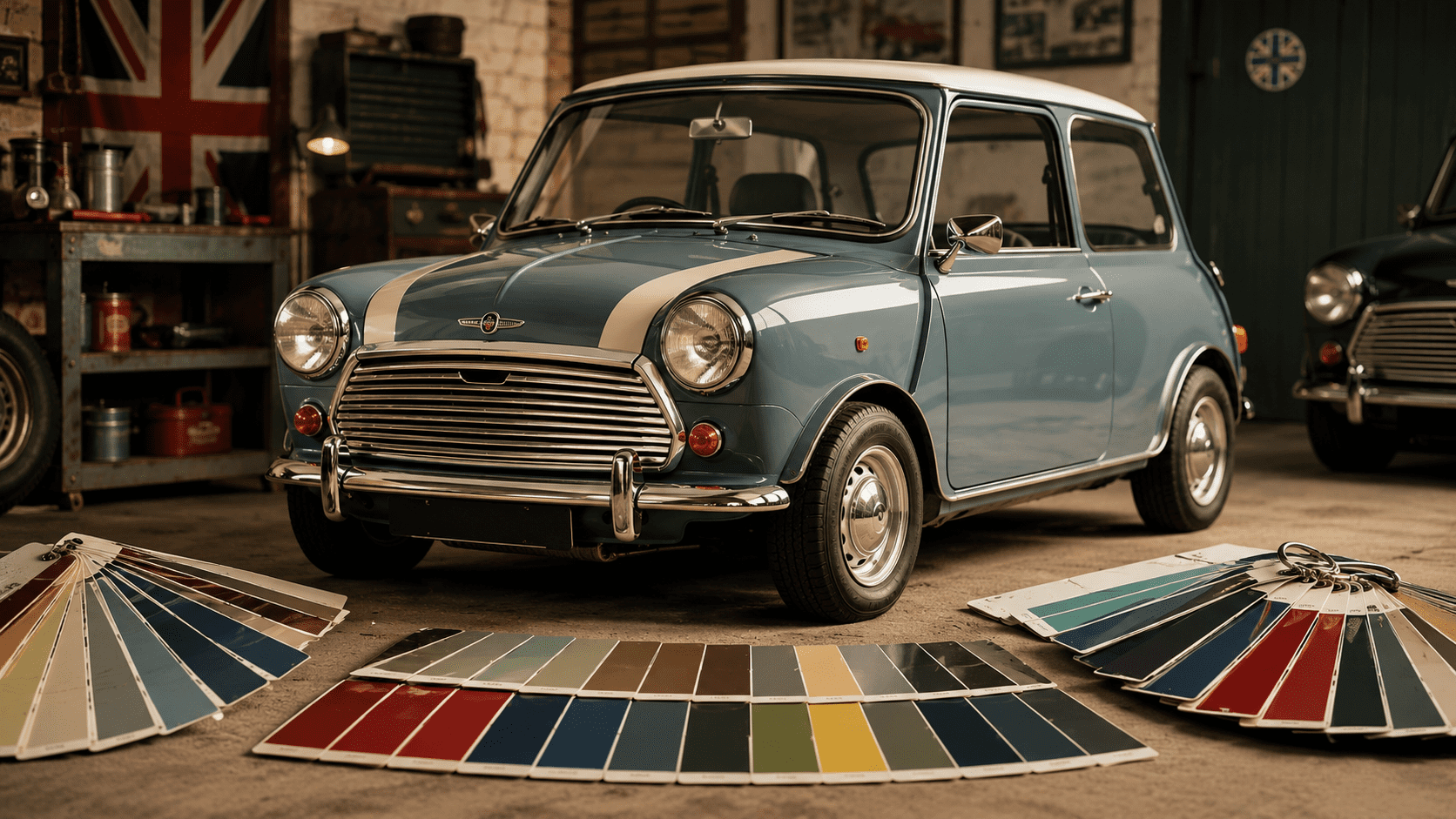
The Mini went through more colours in its forty-one years of production than almost any other car this site covers, for the simple reason that it was in production for forty-one years. From the Austin Seven and Morris Mini-Minor of August 1959 through to the final Cooper Sport and Classic Seven that rolled out of Longbridge in October 2000, the Mini was badge-engineered, facelifted, relaunched, and reinvented as a fashion statement more times than any small car has any right to be, and its colour chart tracks every one of those changes faithfully. A 1962 Mini in Speedwell Blue, a 1976 Clubman in Limeflower, and a 1998 Cooper Sport in Volcano Orange Metallic are recognisably the same basic shape underneath, but they could not have come from more different decades if you had asked the BMC, British Leyland, Austin Rover, and Rover Group colour departments to plan it that way.
This page covers factory paint colour codes across the full Mini range. Like the rest of the BMC and British Leyland family, the Mini used the two and three-letter prefix codes (BU for blues, GN for greens, RD for reds and so on) through the 1960s, before the BLVC three-letter coding system took over from around 1969 onward. The Mini’s particular wrinkle is that, because it ran for so long under so many different corporate umbrellas, a surprising number of colours were revived, renamed, or very slightly adjusted and reissued decades after their first appearance: Old English White alone appears under at least three different codes across the car’s lifespan, separated by twenty years and two changes of parent company.
A few things worth knowing before you reach for a tin
The two-tone roof on the Cooper and Cooper S was not merely a styling flourish: it was originally intended to help police spotters and rally officials identify the sportier models from a distance, and it has remained one of the most instantly recognisable details in British motoring ever since. Almost any colour combination is technically possible if you are mixing your own, but the period-correct combinations (white roof on a coloured body, or occasionally the reverse) are documented by the owners clubs and worth checking before assuming any two colours will look right together. They will not all look right together. Some genuinely clash in a way that no amount of confidence will resolve.
One detail that catches out a surprising number of restorers: a colour named on an identification plate does not always match the same name used in a modern paint database. “Malmo Green” turns up on at least one genuine 1968 Mini ID plate and corresponds to nothing in any standard BMC colour list, which suggests either an export-market or limited-run colour that was never properly catalogued, or simply a transcription quirk from a factory worker having an off day. When a colour name on your car’s plate does not match anything in the references below, the marque-specific forums (The Mini Forum chief among them) are usually able to identify it from a photograph faster than any database search will.
Mini Mk1 (1959–1967)
The original Austin Seven and Morris Mini-Minor, badge-engineered twins from launch, sharing identical mechanicals and an almost identical colour palette beneath the different grille treatments. Early cars used named colours with BMC two and three-letter prefix codes; the Cooper and Cooper S from 1961 and 1963 introduced the two-tone roof treatment that became as much a part of the car’s identity as its shape.
Mini Mk2 and Mk3 (1967–1969)
The Mk2 brought a larger rear window and a redesigned grille; the Mk3, from 1969, introduced wind-up windows and concealed door hinges, marking the point where the bare-bones original began to feel like a more grown-up small car. The colour range largely continued from the Mk1 with the addition of several new shades as the decade turned.
BLVC era: Clubman, 1275GT and the British Leyland range (1969–1980)
The Clubman and the 1275GT arrived in 1969 with their longer, squared-off nose, and the BLVC three-letter coding system replaced the old BMC prefix codes around the same time. This is the period that gave the Mini some of its most recognisably 1970s colours: Limeflower, Bronze Yellow, Glacier White, and the deep, almost lacquered Flamenco Red that suited the Clubman’s slightly more angular looks rather well.
Austin Rover and Rover Group: Mayfair, special editions, and the final cars (1980–2000)
The Mini soldiered on through the Austin Rover years and into the Rover Group era with a steady stream of special editions, each with its own dedicated colour or two: the Mayfair, the Park Lane, the Ritz, the Designer editions (Cooper RSP, the Italian Job edition, the various John Cooper specials), and finally the Cooper Sport and Classic Seven that closed out production in October 2000. By this point the three-letter Austin Rover code was the only system in use, and the colour names had become considerably more marketing-led than the sober BMC nomenclature of the 1960s.
Colour codes and year ranges sourced from the BMC/BL Paint Codes and Colors archive (Mini Shrine and affiliated marque forums), The Mini Forum colour guide, and the Austin Mini paint code reference at MiniMania. Year ranges are approximate factory catalogue dates and overlap at model transitions; BMC two and three-letter prefix codes and the later BLVC three-letter Austin Rover codes sometimes refer to very similar but not always identical shades, so cross-check against a second source before committing to a full respray. Swatch colours are approximate digital representations only and will not accurately reproduce original paint. Always obtain a professional spectrophotometer match using the factory code for any respray or significant touch-up work.
Where to find your paint code
On most Minis the identification plate is found on the front bulkhead, under the bonnet, usually on the passenger side. Earlier cars sometimes have it riveted to the inner wing instead. The plate will show the body colour code (and, on later cars, the trim code) typically as a short alphanumeric string rather than the colour name itself, which means the name-to-code lookup tables above are doing the real work. On Mk1 and Mk2 cars from the 1960s, a colour name may be stamped directly onto the plate alongside or instead of a code; on later cars the three-letter BLVC code is the only thing you will find, and you will need a reference table (or the owners club) to translate it back into a name that means anything to a paint supplier.
If the plate is missing, corroded beyond legibility, or simply absent (not unheard of on a car that has had forty years and several owners to lose bits along the way), the chassis or commission number can sometimes be cross-referenced against surviving BMC, British Leyland or Austin Rover production records held by the relevant marque clubs, though this becomes progressively harder the further back the car’s production date sits. For cars built from the late 1970s onward, the VIN plate carries more standardised information and is generally the more reliable source.
Two famous Minis worth knowing about
The three Mini Coopers that performed the gold bullion heist getaway in The Italian Job (1969) were finished in red, white, and blue: as patriotic and as memorable a colour scheme as British cinema has ever put on four wheels, and one that did more for the Mini’s cultural standing than any factory advertising campaign managed in the same decade. The cars themselves were comprehensively destroyed during filming (a fact that pains Mini enthusiasts to this day, given how many of the originals did not survive the stunts), but the red, white, and blue trio remains the single most requested colour combination from anyone restoring a Mini with half an eye on cinema history, whether or not they ever say so out loud.
Mr Bean’s Mini, the lime-green-and-black 1969 example with the registration number SLW 287R that appeared throughout Rowan Atkinson’s television series, is technically Austin Citron Green with a matte black bonnet, though the precise shade has been the subject of more good-natured online argument than almost any other Mini colour question, including from people who insist it is apple green and others equally convinced it is something closer to yellow. The car’s actual colour code aside, it remains one of the most recognisable small cars in British comedy, largely thanks to a driving style that the original colour chart’s BMC paint chemists could not possibly have anticipated when they mixed the batch.
For related reading: our classic Mini buyers guide covers what to look for when purchasing across the full model range, our classic Mini specs and values guide covers the technical detail and current market values by variant, our Story of the Mini covers Issigonis’s original design and the car’s cultural impact in full, and our Austin paint codes guide and Morris paint codes guide cover the closely related ranges that shared much of the same BMC and BL colour palette throughout the same decades.
This page contains affiliate links. If you click a link and make a purchase, Classic Car Hub may earn a small commission at no extra cost to you.