
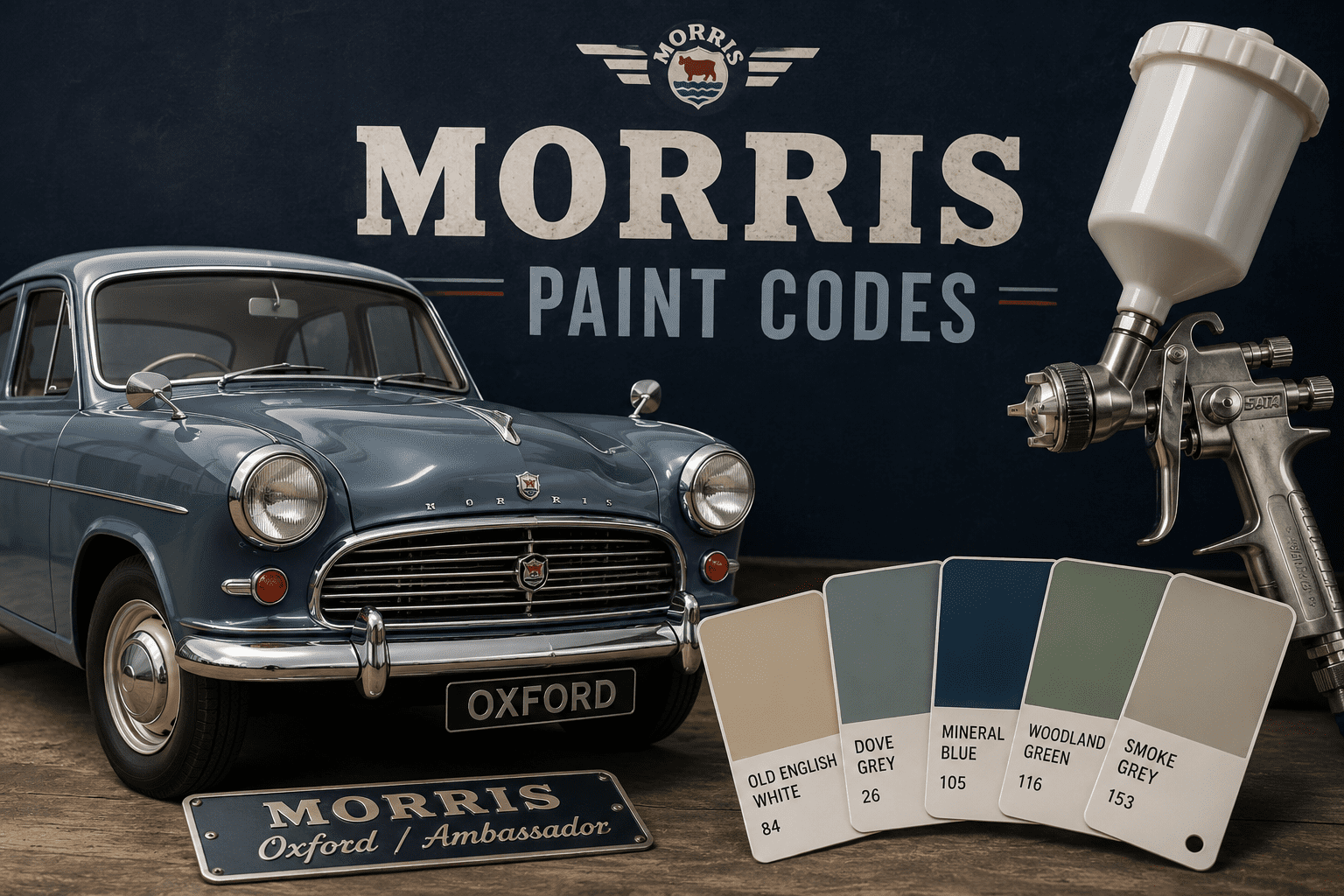
Morris built cars from 1913 to 1984, which is a span of seventy-one years, eight million vehicles, and more variation in quality and public affection than any single manufacturer probably deserves. At one end of that range sits the Morris Minor: the best-loved small British car ever made, designed by Alec Issigonis, built from 1948 to 1971, and still maintained and driven in numbers that would surprise anyone who did not already know the Minor’s particular hold on its owners. At the other end sits the Morris Ital, which was a Morris Marina with a new front end designed by Giorgetto Giugiaro and lasted four years before British Leyland retired the Morris name entirely in 1984. In between sit the Oxford, the 1100, the 1300, and the Marina, which between them covered almost every need a British family had for a car from the 1950s through to the early 1980s.
This page covers factory paint colour codes for all the main Morris models. Like Austin, Morris used four different coding systems across its production life: pre-BMC name-only colours on the earliest cars, the BMC prefix codes (GR for greys, BU for blues, GN for greens) from around 1960, British Leyland’s BLVC numeric codes from 1970, and Austin Rover three-letter codes from the early 1980s. The right system depends entirely on which car and which year you are looking at, and getting it wrong produces results that will confuse a paint supplier before they can mix you the wrong colour. This guide takes each model in turn and makes the whole thing considerably more straightforward than it sounds.
One connection worth flagging: if you have been reading our BMC Abroad India article, you will already know that the Morris Oxford Series III became the Hindustan Ambassador in 1957 and remained in production in India until 2014. The same car, the same basic bodyshell, running for fifty-seven years in conditions Cowley never imagined. Finding the correct touch-up paint for a British example is somewhat more straightforward than the Indian one, which has its own specific heritage, but the codes are the same.
How to find your paint code
The identification plate location varies by model, era, and the apparent enthusiasm of the Cowley assembly workers on the day your particular car was built. As a reliable guide:
Morris Minor (all series): on the firewall or bulkhead under the bonnet, typically on the driver’s side. On Series MM and early Series II cars, the plate may be riveted to the scuttle panel rather than the bulkhead proper. Look for a small aluminium or steel plate with a number beginning with the chassis number, followed by the body colour and trim codes. On later 1000 series cars the plate is usually more accessible and more clearly laid out, as though whoever designed it had received feedback about the earlier versions.
Morris Oxford: bulkhead or inner wing under the bonnet, right-hand side on earlier series, moving toward the inner wing on later series from around the Series V onward.
Morris 1100 and 1300: bulkhead under the bonnet. The plate includes body number, paint code, trim code, and build date. The paint code is a two-letter prefix code on pre-1968 cars and a BLVC number on post-1970 cars.
Morris Marina and Ital: bulkhead, typically driver’s side under the bonnet. On the Marina the plate also carries the commission number which is useful for confirming the original specification if the car has been resprayed at some point in its life. The Morris Minor Owners Club, the Morris Marina Owners Club, and the Morris Register all hold build records that can assist with colour confirmation if the plate is damaged, obscured, or missing.
Morris Minor Series MM (1948–1953)
The Series MM was Alec Issigonis’s original: torsion-bar front suspension, unitary construction, and an engine borrowed from a pre-war Morris Eight that Issigonis considered inadequate before the car had even reached the showrooms. The colour range was postwar modest. No codes existed yet in the modern sense; colours were specified by name and matched by paint suppliers from Cowley’s own formulas. One notable hazard: Maroon A (RD8) faded alarmingly over time, turning a sad pinkish beige. If your early Minor is a suspicious colour, this may explain it.
Morris Minor Series II (1952–1956)
The Series II brought the 803cc overhead-valve engine from the Austin A30, which was an improvement on the side-valve unit in most measurable respects. The colour range continued from the late Series MM with gradual additions. The formal BMC coding system was not yet in place but suppliers were beginning to assign numbers.
Morris Minor 1000: 948cc (1956–1962)
The 1000 arrived with the 948cc A-Series engine and became the definitive Minor: the one most people picture, most commonly survive, and most actively restored. The BMC prefix coding system was introduced during this period, which is why earlier cars in the range carry names only while later ones have proper codes. Smoke Grey is worth a specific mention: despite the name, it is a soft blue-grey and has been frequently misidentified as a blue or a true grey by owners who have not seen it next to its code. BU-15. Blue prefix. The clue was there all along.
Morris Minor 1000: 1098cc (1962–1971)
The final and longest-running configuration of the Minor, now with the 1098cc A-Series engine and the full BMC prefix coding range at its disposal. The last Minors left Cowley in 1971. Eight hundred of them, in Glacier White, were built as a special edition to mark the occasion. The waiting list for those 800 cars suggests the British public was not quite ready to let the Minor go, which is a sentiment that has not diminished in the fifty-plus years since.
Morris Oxford (Series I–VI, 1948–1971)
The Oxford was the Minor’s larger, more practical sibling: a proper family saloon for people who needed to carry four people and their luggage with some conviction. Series I through VI shared the same general colour palette as the rest of the BMC range for their respective eras. The Series III Oxford, produced from 1956, has a particular distinction: it became the Hindustan Ambassador in India, where it remained in production until 2014. If you are reading this having just read the India entry in our BMC Abroad series, this is the connection. The same car. Fifty-seven years. Which makes finding the right touch-up paint somewhat more urgent if you are restoring one for concours than if you are running an Ambassador taxi in Kolkata.
Morris 1100 and 1300 (1962–1974)
The ADO16, sold as Morris 1100 and later 1300, was at various points the best-selling car in Britain. Hydrolastic suspension, front-wheel drive, transverse engine: Issigonis again, doing what Issigonis did. The colour range spans the BMC prefix era and the BLVC transition, with the coding system changing mid-production as British Leyland took over from BMC in 1968. Pre-1968 cars use prefix codes; post-1970 cars use BLVC numbers. Cars built between those dates may use either.
Morris Marina (1971–1980)
The Marina replaced both the Minor and the Oxford in Morris’s lineup, which is a combination of shoes that proved difficult to fill in the estimation of contemporary road testers and much of the British public. History has been somewhat kinder: the Marina is now a genuine classic with an active owners club, a dedicated following, and the kind of retrospective affection that tends to follow any car once the industry moves on and survivors become rare. The BLVC coding system was used throughout its production run, with three-letter codes appearing alongside the numbers from the mid-1970s onward.
Morris Ital (1980–1984)
The Ital was the Marina with a facelift by Giorgetto Giugiaro’s Italdesign studio, which is either a hopeful touch of Italian flair applied to a workhorse or evidence that British Leyland had run out of other ideas, depending on your disposition. It used the Austin Rover coding system from its launch alongside continuing BLVC numbers, and was the last car to carry the Morris name before the badge was retired. In 1984, after 75 years and roughly eight million cars, Morris was done.
Colour codes and year ranges sourced from the Potteries branch of the Morris Minor Owners Club paint and trim guide, the Morris Minor Forum BMC/BL paint code archive, Paintref.com Morris colour cross-reference, and the Morris Marina Owners Club and Ital Register colour and trim database. Year ranges are approximate factory catalogue dates. Swatch colours are approximate digital representations only and will not accurately reproduce original paint. Always obtain a professional spectrophotometer match using the factory code for any respray or significant touch-up work.
Sourcing touch-up paint and reproduction colours
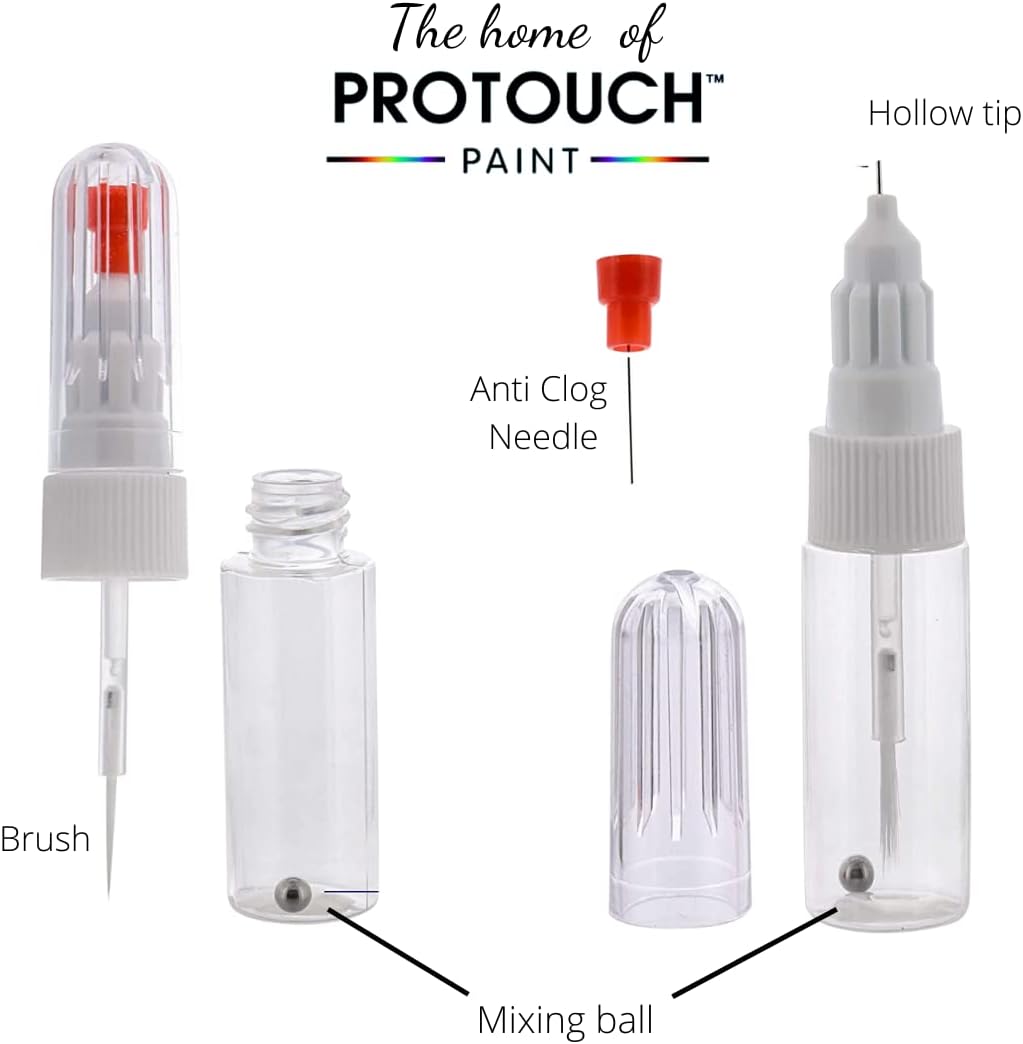
For Morris Minor colours specifically, the Morris Minor Owners Club and the Charles Ware Morris Minor Centre both hold comprehensive colour references and can advise on suppliers. For anything using the BMC prefix code system, Moss Europe, SC Parts, and Rimmer Bros all stock aerosol touch-up paints for the most common colours. For BLVC-coded cars (Marina, late 1100/1300), the major factors can mix from the code using trade mixing systems. For Austin Rover-coded Ital colours, Halfords and most motor factors carry the system.
A note on Smoke Grey specifically: this colour, code BU-15, is one of the most commonly misidentified on the Morris Minor because the name suggests a grey and the actual colour is a soft blue-grey. Owners who order grey touch-up paint and find it does not match are usually confronting this particular piece of BMC nomenclature. The BU prefix is the giveaway: all blue-family colours begin with BU. Smoke Grey is a blue. A gentle, understated, thoroughly characteristic 1960s British blue, but a blue nonetheless.
For related reading: our Morris Minor buyers guide covers what to look for when purchasing a Minor, our BMC Abroad: India covers the extraordinary story of the Morris Oxford that became the Ambassador, our paintwork restoration and repair guide covers paint correction, and our Austin paint codes page covers the closely related Austin range that shared much of the same BMC/BL palette.
This page contains affiliate links. If you click a link and make a purchase, Classic Car Hub may earn a small commission at no extra cost to you.