
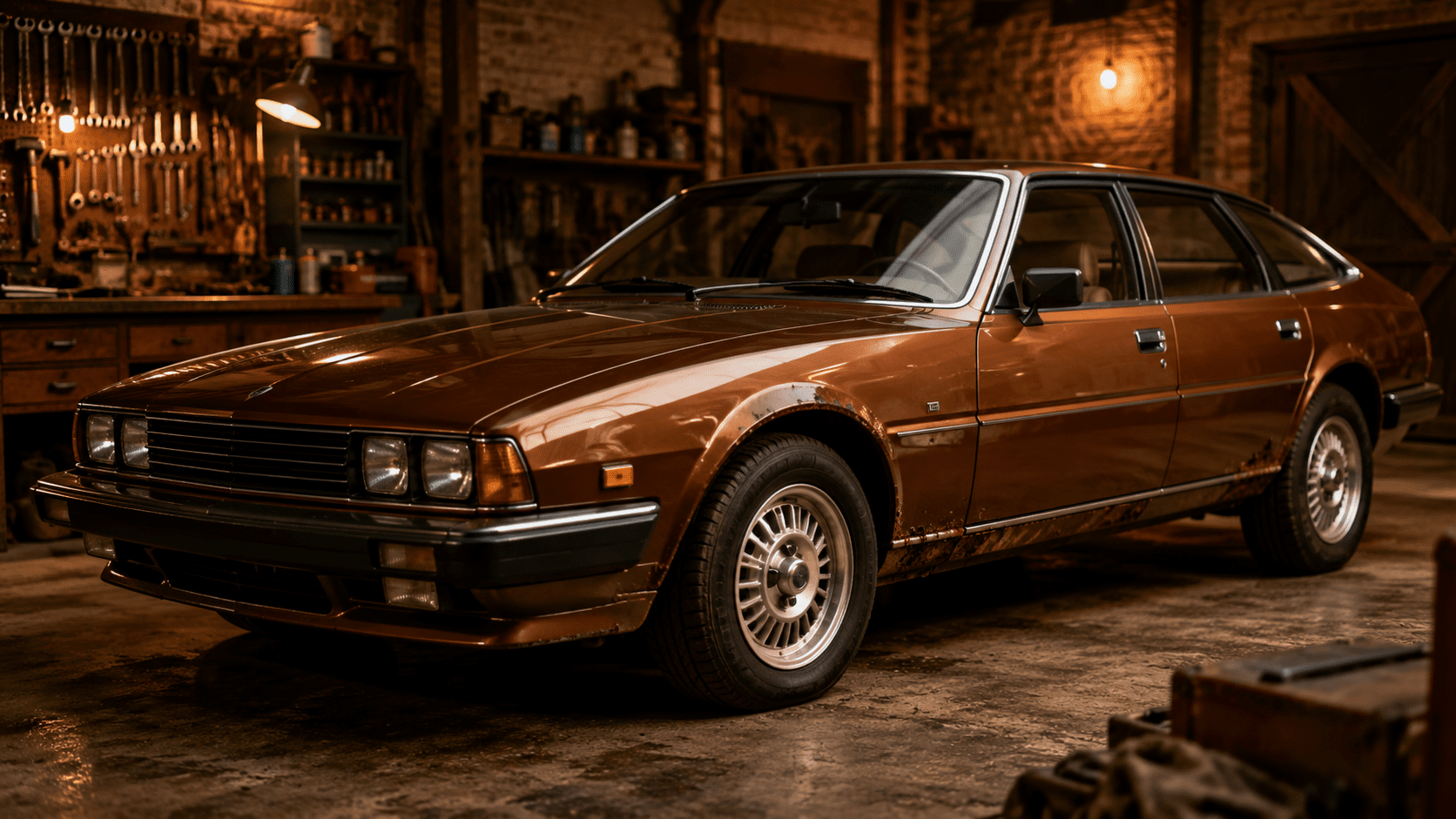
Car magazine, reviewing the newly launched Vitesse in 1982, called the Rover SD1 “a poor man’s Aston Martin,” which remains one of the most accurate single sentences ever written about a British car. It looked like nothing else on the road, sounded like a V8 should, went like one too, and cost a fraction of what an actual Aston Martin demanded. It also, in its earliest production years, rusted with an enthusiasm that bordered on the competitive, fitted electrical components with what can charitably be described as a flexible attitude toward reliability, and generally did everything in its power to undermine the brilliance of the engineering and styling underneath. This is the central tension of SD1 ownership, then and now: a genuinely excellent car, wrapped in a build quality reputation it spent a decade trying and largely failing to shake off, now widely regarded by people who actually own one as one of the great undervalued British classics of the late twentieth century.
The SD1 replaced both the Rover P6 and the Triumph 2000/2500 in one stroke when it launched in 1976, a David Bache design with a fastback hatchback silhouette that owed a visible debt to the Ferrari Daytona and looked considerably more expensive than its price tag suggested. It won the European Car of the Year award for 1977, which the car’s subsequent reputation for water ingress and electrical gremlins makes easy to forget but which was, at the time, a thoroughly deserved accolade for a genuinely innovative piece of design. Three hundred and three thousand were built before production ended in 1986, and the survivors split cleanly into a hierarchy of desirability that is worth understanding before you start looking.
The range: four cylinders, six cylinders, and the engine everyone actually wants
The SD1 launched in 1976 with only one engine: the 3.5 litre Rover V8, the same ex-Buick aluminium unit that had already done sterling service in the P5B and P6. This was, by any sensible measure, starting at the top and working downward, which is not how most manufacturers build a model range but is entirely consistent with how British Leyland tended to do things in this period. The six-cylinder 2300 and 2600 arrived in late 1977, using an engine descended from the Triumph 2000/2500 unit, followed eventually by a four-cylinder 2000 with the O-Series engine from 1982, and a VM-sourced Italian turbodiesel (shared with the Range Rover) from the same year. The diesel will comfortably exceed 100mph, which is the kind of fact that exists purely to be repeated at classic car shows by owners enjoying the look on people’s faces.
The V8 is the engine most buyers want and the reason most SD1s are bought in the first place. It is smooth, free-revving for a unit of its size and era, pulls cleanly from low revs, and sounds the way a V8 in a proper executive car is supposed to sound: confident rather than aggressive. It is also, in standard 3500 form, comfortably unstressed, which means a well-maintained example will cover very large mileages without complaint. The six-cylinder cars are not the poor relation their reputation sometimes suggests: the 2600 is only marginally slower than the 3500 in a straight line, returns noticeably better fuel economy, and is a genuinely pleasant car to drive, though the engine has one specific and well-documented weakness covered below. The four-cylinder 2000 is the car for someone who wants the SD1 shape and the SD1 driving position without the running costs, and it is more capable than its modest reputation suggests.
Mark One versus Mark Two: the line that actually matters
Far more important than which engine is fitted is which side of the 1982 facelift the car was built on. The Mark One SD1 (1976 to 1982) is visually identifiable by chrome bumpers (except on the V8-S and Vanden Plas models, which had black-painted or rubber-trimmed versions), round instruments, and a shallower rear window. It was also, by widespread agreement including from the people who built it, assembled during a period of industrial strife and patchy quality control at the Solihull plant, and the consequences of that show up today as electrical gremlins, trim that was never especially durable to begin with, and a level of rust resistance that ranged from inadequate to actively hostile.
The Mark Two (1982 onward) brought a deeper rear window to improve reversing visibility, a glass-fibre front spoiler on most models, considerably improved interior trim, and most importantly a noticeably better build standard. Most SD1s that have survived to the present day are Mark Twos, for the straightforward reason that more of them were built to last. A well-cared-for Mark One with sorted paintwork is not a problem car, but it requires a buyer who understands exactly what they are taking on and is handy with a screwdriver. A Mark Two is the easier and generally more sensible starting point for anyone new to the model.
The Vitesse: the one everyone is actually looking for
The Vitesse, launched at the 1982 British Motor Show, took the 3.5 litre V8, fitted Lucas fuel injection, a hotter camshaft, and freer-breathing manifolds, and lifted power from the standard 155 brake horsepower to 190. The suspension was lowered and stiffened, the wheels grew to 15-inch deep-dish alloys, and a substantial front chin spoiler and rear spoiler were added, giving the car a genuinely purposeful look that the standard SD1, elegant as it was, never quite achieved. The name itself was a deliberate revival of Triumph’s old performance badge, repurposed for Rover at a moment when British Leyland was rediscovering its enthusiasm for cars that went rather than merely arrived.
The Vitesse’s competition career gives the road car a pedigree that few other British executive saloons of the era can match. Tom Walkinshaw Racing took the Vitesse to wins across the European Touring Car Championship through 1985 and 1986, Andy Rouse won the 1984 British Saloon Car Championship in one, and by 1986 the touring car versions were producing in the region of 340 brake horsepower from the same basic V8 that idled so contentedly in road-going form. In 1985, Rover built a limited run of just 500 Twin Plenum Vitesses, fitted with a Lotus-engineered twin-plenum inlet manifold to homologate the change for touring car racing. Officially these still produced 190 brake horsepower; in practice most informed sources put the real figure closer to 210 to 220. The Twin Plenum cars also received a noticeably deeper front valance and are, without serious competition, the most desirable production SD1s in existence. Only 3,897 Vitesses were built in total, and confirming that a car genuinely is one, rather than a standard 3500 wearing a spoiler and some aspirational badging, means checking the chassis number rather than taking the seller’s word for it. Genuine Vitesse chassis numbers begin SARRRE, with the E specifically denoting the Vitesse variant.
The Vanden Plas EFi, introduced in 1984, took the Vitesse’s 190 brake horsepower fuel-injected V8 and wrapped it in the full wood-and-leather Vanden Plas luxury specification rather than the Vitesse’s sporting one. Only 1,113 were built, making it rarer than the Vitesse itself, and it occupies a slightly different niche in the market: buyers wanting the performance without the spoilers and the boy-racer aesthetic that the Vitesse, charmingly, does not attempt to disguise.
What to look for: rust, in considerable detail
Rust is, without serious competition, the thing that kills SD1s, and it is the issue that defines the entire buying process. Every single guide ever written about this car leads with rust for the simple reason that the car earned it. Check, in order of importance: the front and rear wheelarches, inner and outer; the sills (these tend to fare better than the rest of the car, since the SD1’s pressure ventilation system pushed air through this section and generally kept it dry, so rotten sills suggest a car that has had a genuinely difficult life rather than simply an old one); the door bottoms; the front and rear valance panels; the bonnet and tailgate, both top and underside; the boot floor; and the floor pans throughout, which means lifting the carpets rather than glancing at them. Lean in around the windscreen surround and, where fitted, the sunroof aperture and its drainage channels: leaking seals here are common and the resulting water ingress causes corrosion that is considerably more involved to repair than it is to prevent.
Specifically on the running gear, check the rear suspension trailing arms where they mount to the bodyshell: this is a recognised SD1 weak point, with corrosion capable of causing the arm to separate from the structure entirely in severe cases, which is the kind of failure that turns a viewing into an emergency. Cracking in the arms themselves is also reported and worth checking for independently of the corrosion at the mounting point.
Unless a car comes with documented, ideally photographed, evidence of a proper restoration, assume nothing about its history and check everywhere. Rimmer Bros and other specialists can supply a good range of panels and repair sections, but not everything is available, and a major restoration on a heavily corroded car can consume a budget considerably larger than the car’s eventual value. As with most British classics from this era, the honest advice is to find the soundest example the budget allows and avoid the temptation of a cheap, rusty Vitesse on the basis that the engine alone justifies the price. The engine is rarely the part that bankrupts an SD1 restoration.
The engines in detail
The Rover V8 is, by this point in its long career, about as well understood as any engine in British motoring, with parts and expertise available in abundance. It is tough and forgiving of reasonable use, but two specific habits will shorten its life: running with low coolant or a neglected cooling system, which leads to internal corrosion that blocks the waterways and eventually the radiator itself, and infrequent oil changes, which accelerate camshaft wear and can lead to sludged hydraulic tappets. Neither fault announces itself dramatically; both develop quietly over years of indifferent maintenance and then present as a noisy, overheating, or generally unhappy engine to whoever buys the car next. Check for any history of overheating, examine the coolant for the rusty appearance that indicates internal corrosion has already begun, and listen for top-end noise that suggests camshaft wear is already underway.
The six-cylinder engine, derived from the Triumph 2000/2500 unit, is hugely durable when its oil is changed regularly and surprisingly fragile when it is not, owing to a restrictor valve in the camshaft oil feed that blocks if the oil is neglected, leading to rapid and serious camshaft wear. Removing the restrictor entirely is a recognised and worthwhile modification among SD1 specialists, though it requires removing the cylinder head to do it properly. The engine is also belt-driven rather than chain-driven; confirm the timing belt has been changed within the last five years or so, since a snapped belt on a worn camshaft is not a survivable event for either component.
The manual gearbox fitted to most SD1s is generally tough, though it does eventually wear: a rumbling noise with the clutch engaged in neutral suggests a worn layshaft, which means either a full rebuild or sourcing a sound used replacement, neither of which is a five-minute job. The automatic, a Borg Warner unit, can be fragile and should shift smoothly through all ratios without hesitation or harshness; anything else is worth investigating before committing to the purchase rather than after.
Interior, trim, and the electrics that were never the strong point
Mark One interiors used cheaper materials than the Mark Two and durability suffered accordingly: threadbare carpets (frequently the result of years of leaking windscreen seals rather than simple wear), perished seat trim, and small fittings such as the choke lever that are now notoriously difficult to source for the earliest cars. Sourcing replacement seat material for some specific trims, the V8-S in particular, is close to impossible, which makes a car with a sound original interior considerably more valuable than the same car with a deteriorated one even before any mechanical comparison is made. The Series 2 brought proper wood and leather to the upper trim levels and the Vanden Plas models genuinely felt the part, but the costs of professional re-trimming on a tired example mount quickly and should be factored into any budget for a car that needs it.
Electrics were, by general and fairly unanimous consensus, never the SD1’s strongest department, and the wiring detail differs between model years in ways that make sourcing the precisely correct replacement part more fiddly than it should be. None of this amounts to a complex electrical system in absolute terms, simply an inconsistent one: systematically check every gauge, every switch, and every warning light, and be more thorough still on the higher specification cars with electric windows, central locking, and air conditioning, since there is simply more to go wrong. Be prepared, even on a well-sorted example, to learn to live with the occasional small electrical quirk. This is, to a meaningful extent, part of the SD1 ownership experience rather than evidence of a bad example, though there is a difference between charming occasional quirks and a car with a serious unresolved fault, and a buyer needs to be honest with themselves about which they are looking at.
The community
The Rover Sports Register is the dedicated club for the SD1 and the earlier P5B and P6 3500, with a strong technical knowledge base specific to the V8 and the model’s known weak points. The wider Rover P5 Club and Rover Car Club communities also maintain useful crossover knowledge given the shared V8 heritage. AROnline, the long-running and exhaustively researched reference site covering BMC, British Leyland and Rover Group history, remains one of the single best free resources for understanding exactly which specification any given SD1 left the factory with, which is considerably more useful than it sounds given how many subsequent modifications, badge swaps, and aspirational respecifications have accumulated across nearly fifty years of survivors.
What to pay
Values across the SD1 range remain genuinely accessible by classic car standards, though they have been rising steadily as good examples become scarcer. Project cars and the scruffiest survivors can still be found for under £1,000, though anything at that price is firmly project territory and should be approached with the usual caution about budgets escalating once the welding starts. A presentable six-cylinder car in nice condition is achievable from around £4,000 to £5,000, with a usable standard V8 available from a similar budget rising to roughly £8,000 to £10,000 for an excellent example. An early Vitesse in good condition typically commands £6,000 to £10,000, with the very best examples pushing past £15,000. The Twin Plenum Vitesse occupies its own tier entirely: solid examples start from around £7,000, with genuinely original, top-condition cars now changing hands for £20,000 and beyond. Modified cars with a larger V8 conversion can represent good value for a buyer unconcerned with originality, sometimes offering healthier mechanicals than a tired standard example at a comparable price, though this is a deliberate trade of originality for usability rather than a shortcut to the same thing.
For related reading: our Rover classic paint colour codes guide covers the full factory colour range across the P4, P5, P6 and SD1, our classic Land Rover buyers guide covers the related marque that shares the SD1’s V8 heritage, and our rust prevention guide is essential reading for any SD1 owner, given everything covered above.
This page contains affiliate links. If you click a link and make a purchase, Classic Car Hub may earn a small commission at no extra cost to you.