
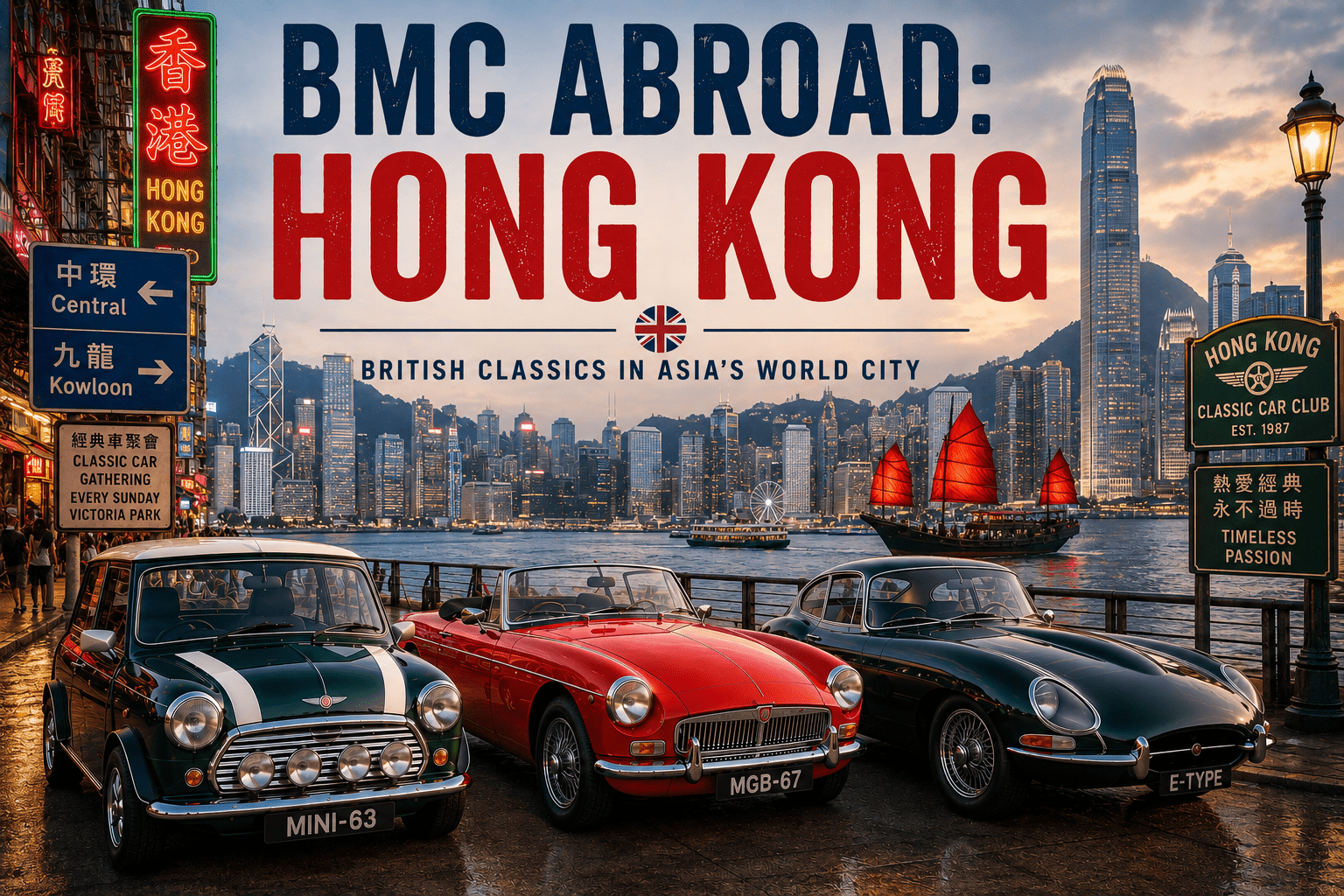
Hong Kong has roughly 7,500 people per square kilometre, an average relative humidity that sits above 75 percent for most of the year and regularly tips past 90 percent during the rainy season, and a private car parking space market so competitive that individual spaces in the right building have sold at auction for sums that would buy a very presentable house in most of the English countryside. Into this environment, for the best part of seventy years, a determined and quietly impressive community of enthusiasts has been importing, maintaining, and somehow finding room for classic British cars. It is, by any reasonable measure, one of the least hospitable places on earth to keep an MGB happy, and one of the most admirable places to find someone doing it anyway.
This entry in the BMC Abroad series is as much about ingenuity as it is about cars. Where most of the destinations covered so far have offered either too much heat, too much rain, or too much rust-inducing road salt, Hong Kong offers a uniquely concentrated combination of all the usual climatic problems plus a real estate market that treats a dry, secure parking space as a luxury good. The owners who keep classic British cars running here are not simply enthusiasts. They are logistics experts, amateur climatologists, and in some cases landlords to their own vehicles in a way that British owners, who can at least leave a Morris Minor under a tarpaulin in the garden without anyone calling it an investment decision, rarely have to contemplate.
How British cars got there in the first place
Hong Kong’s relationship with British cars dates back to the colonial administration, when Austin, Morris, and the rest of the BMC range were the natural choice for a territory still firmly within the British sphere of influence. The distributorship arrangements that grew up around this were, like much of Hong Kong’s commercial history, a story of determined local entrepreneurship rather than simple imperial default. Metro Cars, founded in 1953 by Bert Chan Young, secured the Austin distributorship from BMC and built a genuinely substantial operation: a Tai Po Road facility with four floors, the upper two dedicated to assembling new vehicles and refurbishing older ones, and a later showroom on Nathan Road large enough to anchor the brand’s presence in Kowloon for over a decade. This was not a token colonial outpost selling the occasional Cambridge to homesick expatriates. It was a proper assembly and distribution operation, competing hard for market share against the American and, before too long, the Japanese manufacturers who would eventually come to dominate Hong Kong’s roads.
The Austin A55 Cambridge has a particular claim to Hong Kong motoring history that goes beyond ordinary private ownership: it served as part of the territory’s taxi fleet through the late 1950s and into the early 1960s, which means a car that most British enthusiasts now encounter only at concours events spent a working life in Hong Kong hauling fares through some of the densest urban traffic on the planet. A surviving example of one of these taxis is now part of the Hong Kong Classic Car Club’s collection, a rare and genuinely significant artefact of the territory’s everyday transport history rather than simply another well-preserved old Austin.
The Mini arrived with all the cultural baggage that The Italian Job would later attach to it, and found a particularly enthusiastic audience among Hong Kong’s younger, more image-conscious drivers from the 1960s onward. One especially well-documented sale, in January 1969, saw Metro Cars hand over the keys to a new Mini Cooper to Cheung Chi-doy, a celebrated local footballer, at the opening of their new Tsuen Wan showroom: a piece of marketing that says something about how thoroughly the Mini had become a symbol of contemporary cool in the territory by the end of the decade, in exactly the way it had in Swinging London at the same moment.
The humidity problem, properly explained
British classic car owners spend a great deal of time worrying about road salt, and reasonably so. Hong Kong owners do not generally have a road salt problem. What they have instead is air that behaves, for roughly eight months of the year, like the inside of a kettle that has just boiled. Average relative humidity in Hong Kong sits above 75 percent year-round and climbs past 90 percent during the rainy season from May through September, which puts the territory’s ambient air comfortably above the 60 percent threshold at which unprotected steel begins corroding at a noticeably accelerated rate, and not far off the 70 percent mark at which mould becomes a genuine concern for upholstery and interior trim rather than a theoretical one.
Add to this the coastal salt mist that settles on anything parked near Hong Kong Island’s waterfront, Tsuen Wan, Tuen Mun, or Tseung Kwan O (which, given Hong Kong’s geography, covers a fairly generous proportion of the territory’s available parking), the heavy monsoon rain that finds its way into the smallest unsealed crevice and then sits there quietly working on the metal underneath, and the general urban pollution that mixes with rainfall to produce a mildly acidic finish to the whole arrangement, and the cumulative effect on an unprotected classic British car is roughly what would happen if you parked the same car in a British seaside town, removed the winter, and ran the summer on a continuous loop for fifty weeks of the year. UK owners worry about October to April. Hong Kong owners worry about January to December, with a brief and very welcome dry spell somewhere in the autumn that everyone treats with the gratitude usually reserved for a bank holiday.
The practical response among serious Hong Kong collectors has been to treat dehumidified, climate-controlled storage not as an indulgence but as a basic precondition of ownership. Secretive, purpose-built storage facilities in the New Territories, running at controlled humidity levels well below the ambient outdoor figure, have become the default home for any classic worth keeping in genuinely original condition, and the management of relative humidity inside these facilities is discussed by Hong Kong collectors with the kind of precision that British owners usually reserve for ignition timing or carburettor jet sizes. One well-documented private collection occupies a 5,000 square foot dehumidified and sealed facility specifically built for the purpose, with cars that the owner has described, without any apparent irony, as being like family. Given what it costs to keep them dry in that climate, the description is entirely earned.
The density problem, properly explained
Hong Kong’s housing density is famous for good reason, and the same pressures that produce the territory’s celebrated micro-apartments apply with equal force to the question of where, precisely, an owner is supposed to put a classic car when it is not being driven. Private car parking spaces in Hong Kong are not treated by banks or by the market as a minor convenience attached to a flat. They are classified and valued more like commercial or industrial property, traded independently of any residential unit, and in the most desirable buildings on Hong Kong Island they have, at various points, changed hands at prices that would make a UK estate agent need to sit down. A single parking space, with no car included, has sold for sums in the tens of millions of Hong Kong dollars in the territory’s most sought-after developments. The classic car owner who has secured a dry, secure, and reasonably accessible space for their MGB has not simply solved a storage problem. They have made a real estate decision, and a fairly serious one.
This scarcity shapes Hong Kong classic car ownership in ways that have no real equivalent in Britain. A UK owner with a inconvenient garage can usually solve the problem by building a slightly bigger shed. A Hong Kong owner facing the same dilemma is negotiating in a property market where the parking space alone may be worth more than the car parked in it, several times over. The specialist storage and import companies that have grown up to serve Hong Kong’s classic car community, offering everything from climate-controlled storage to detailing, sourcing, and shipping services, exist precisely because the alternative, doing all of this yourself in a territory with essentially no spare space anywhere, is simply not realistic for most owners.
The community
The Classic Car Club of Hong Kong (1989) Ltd, despite its incorporation date suggesting comparative youth next to some of Britain’s century-old marque clubs, has built a genuinely substantial collection and community presence in the territory, including the surviving Austin A55 Cambridge taxi mentioned above and a wider fleet that the club has assembled with an evident sense of the territory’s own motoring history rather than simply importing generic European classics. The club’s Facebook group is the most active day-to-day point of contact for anyone wanting to connect with members. Alongside it, the Collectors Car Club of Hong Kong has been running regular Sunday morning drives and breakfast meets since at least 2005, welcoming a deliberately eclectic mix of vehicles from vintage Volkswagens through to pre-war classics, and maintaining an active programme of public welfare activities alongside the purely social side of the hobby.
For owners of the marque this site is named after, there is good news: several MG car clubs operate in Hong Kong, with members maintaining everything from MGAs to MGBs in a climate that, as covered above, does absolutely nothing to make that maintenance easier. The annual Chater Road Show in Central, and the more recent Hong Kong Classic Car and Vintage Festival held along the harbourfront, have both grown into significant fixtures on the territory’s social calendar, drawing well over a hundred classic vehicles from across the full range of marques and eras represented in Hong Kong’s surviving collector community, which independent estimates put at somewhere in the region of 3,000 classic cars in total across the territory: a genuinely substantial number given the constraints already described.
The cars today
Surviving British classics in Hong Kong tend to fall into two distinct categories, and the difference between them is usually visible from several feet away. The first category has spent its life in proper dehumidified storage, driven occasionally and deliberately, and emerges from its climate-controlled garage looking better than most equivalent cars that have spent forty years in the comparatively gentle British climate. The second category has been parked outdoors, or in inadequately ventilated underground car parks, and shows every single month of Hong Kong’s humidity in its sills, its door bottoms, and the chrome that the climate has been quietly working on since the day it arrived. There is very little middle ground. The climate does not allow for casual neglect in the way a temperate climate does; it either gets addressed properly or it wins, and it tends to win quickly.
For the owners who have got it right, the reward is a genuinely vibrant and sociable classic car scene, operating in one of the most visually striking urban backdrops anywhere in the world: a well-presented Jaguar E-Type or MGB threading through Central’s high-rise canyon, or lined up along the harbourfront for the autumn festival, against a skyline that no British car show could ever hope to match. It is not an easy place to keep a classic British car. It may, on the evidence of the people doing it, be one of the more rewarding ones.
For technical guidance relevant to any classic surviving in a high-humidity environment: our rust prevention guide covers treatment options that matter considerably more in Hong Kong’s climate than in Britain’s, our winter storage guide covers many of the same principles that Hong Kong owners apply year-round rather than seasonally, and our chrome and brightwork guide is essential reading for anyone keeping bright trim presentable in a coastal, salt-laden atmosphere. For the wider series: the BMC Abroad landing page covers all entries to date.
This page contains affiliate links. If you click a link and make a purchase, Classic Car Hub may earn a small commission at no extra cost to you.