
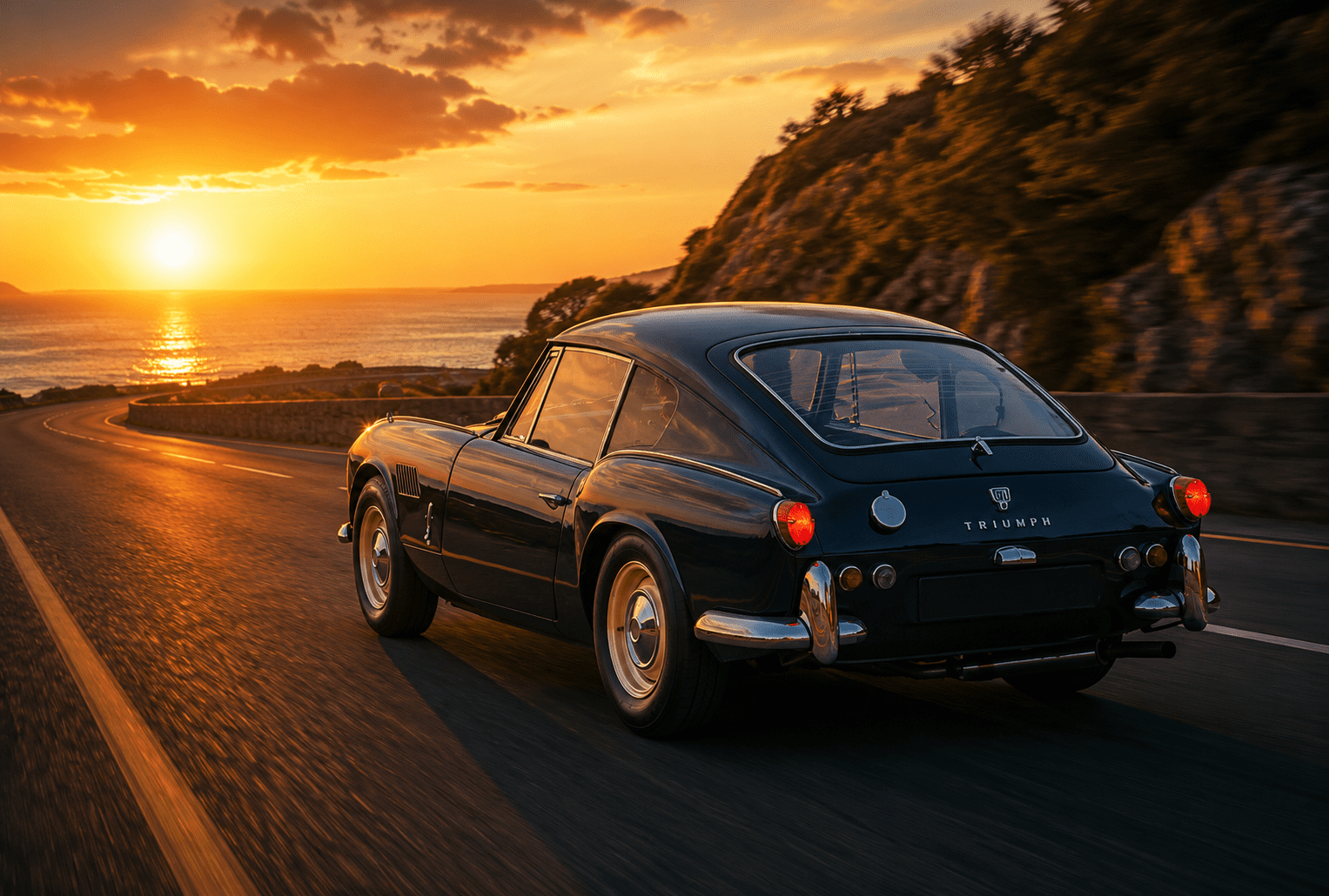
In 1966 Triumph took a Spitfire, fitted a 2.0-litre six-cylinder engine, added a fastback roof, and created a car that promptly earned the nickname the Poor Man’s E-Type. This is both a compliment and an understatement. The E-Type reference acknowledges the GT6’s genuine visual appeal: it is a handsome car with a smooth, long bonnet and a flowing fastback roofline that stands up well alongside more expensive company. The GT6 was faster than the MGB GT when it launched, considerably more refined than its four-cylinder Spitfire sibling, and priced to sell to buyers who wanted something with real performance but could not stretch to Jaguar territory. Around 40,900 were built across three marks between 1966 and 1973, which is a modest total by mass-market standards and one that helps explain why good examples are becoming less easy to find.
The three marks: what changed and why it matters
The GT6’s development across three marks tracks a specific problem and its progressive solution. The original car had a rear suspension geometry that, at the limit, could produce an abrupt handling characteristic. Triumph’s engineers knew about it, addressed it incrementally, and by the Mk3 had largely resolved it. Understanding which mark you are looking at therefore tells you something meaningful about what driving it will be like.
The Mk1 (1966 to 1968) had swing-axle independent rear suspension carried over from the Spitfire, producing significant camber change under compression and a tendency at the limit that contemporary road testers described with diplomatic understatement. Motor magazine recorded a 0-60 time of 12 seconds and a top speed of 106 mph, which made it genuinely quick for its price. The interior was notably better appointed than the Spitfire, with a wood-veneer dashboard and improved seating. Around 15,818 were built, predominantly for export to the United States.
The Mk2 (1968 to 1970), sold in North America as the GT6+, was the solution. Triumph’s engineers substantially revised the rear suspension using reversed lower wishbones and Rotoflex driveshaft couplings, transforming the handling and producing what many specialists regard as the best-driving GT6 of the three. Power increased to 104 bhp with a revised cylinder head, camshaft, and manifolds. The front bumper was raised to meet new crash regulations and side vents appeared on the front wings and rear pillars, distinguishing the Mk2 visually from the original. Around 12,066 were built.
The Mk3 (1970 to 1973) received the Michelotti restyle that also transformed the Spitfire into the Mk4: a cut-off tail, recessed door handles, and a revised front end. The all-synchromesh gearbox from the Mk3 onward was a meaningful improvement over the earlier unit, which lacked synchromesh on first gear. Power was reduced slightly to 95 bhp to meet tightening emissions requirements but the all-synchro gearbox improved real-world performance. A brake servo was added in 1973. Around 13,042 were built.
How to identify each mark at a glance
Mk1: round front lamps flush in the front wings, chrome bumper at original low height, no side vents, clean unadorned body sides, removable windscreen surround frame. The overall appearance is the cleanest and most original of the three.
Mk2: raised front bumper, side vents on the front wings and rear C-pillars, otherwise similar front treatment to the Mk1. The easiest identification is the combination of original nose style with the vented detail and higher bumper position.
Mk3: completely revised Michelotti body treatment with a higher, more steeply raked windscreen now integral to the body structure (no longer removable), the characteristic cut-off Stag-style tail, recessed door handles, and a wider front track. The Mk3 looks noticeably different from the earlier cars and shares its general body treatment with the Spitfire Mk4.
Specifications by mark
| Specification | Mk1 (1966–68) | Mk2 (1968–70) | Mk3 (1970–73) |
|---|---|---|---|
| Engine | 1,998cc I6 OHV | 1,998cc I6 OHV | 1,998cc I6 OHV |
| Power | 95 bhp @ 5,000 rpm | 104 bhp @ 5,300 rpm | 95 bhp @ 5,000 rpm |
| Torque | 117 lb ft @ 3,000 rpm | 117 lb ft @ 3,000 rpm | 117 lb ft @ 3,000 rpm |
| Transmission | 4-speed, no synchro 1st | 4-speed, no synchro 1st | 4-speed, all synchro |
| 0–60 mph | ~12.0 sec | ~10.1 sec | ~10.1 sec |
| Top speed | 106 mph | 107 mph | 112 mph |
| Kerb weight | 864 kg | 855 kg | 863 kg |
| Rear suspension | Swing axle IRS | Rotoflex wishbone IRS | Swing-spring IRS |
| Built | ~15,818 | ~12,066 | ~13,042 |
Dimensions
| Measurement | Mk1 and Mk2 | Mk3 |
|---|---|---|
| Wheelbase | 2,128 mm (83.8 in) | 2,128 mm (83.8 in) |
| Length | 3,717–3,734 mm | 3,785 mm |
| Width | 1,450 mm (57.1 in) | 1,486 mm (58.5 in) |
| Height | 1,193 mm (47.0 in) | 1,193 mm (47.0 in) |
What the performance figures feel like
The GT6’s six-cylinder engine transforms the car’s character relative to the four-cylinder Spitfire. It is smooth, quiet at a cruise, and pulls strongly from low revs in a way that the revvy four-cylinder cannot replicate. Motor magazine’s 1967 road test described the engine as “remarkably subdued from within the cabin” and noted that “plenty of torque means it is content to idle along in top gear in traffic.” That quality remains one of the GT6’s most appealing attributes today: it is a car that does not demand to be driven hard to be enjoyed. The performance figures that matter are 60 to 80 mph in top gear, which is where the six-cylinder’s torque advantage over the four-cylinder competition makes itself felt on a real road rather than a test strip.
Values overview
The Mk2 commands the highest values of the three, reflecting its combination of the most powerful engine and the most sorted handling in a body that still carries the cleaner original front-end treatment. The Mk1 attracts collectors seeking originality, and the Mk3 offers the most usable driving experience for a daily or regular driver. Total production of just over 40,000 across all marks, combined with decades of attrition, means genuinely good examples are rarer than the numbers suggest and values reflect this scarcity in the upper condition grades.
Current market pricing for all GT6 marks is tracked on our classic car valuation page, which gives a live picture of what cars are selling for across condition grades.
Owners club and community
The Triumph Sports Six Club (TSSC) covers the GT6 alongside the Spitfire, Vitesse, and Herald. The GT6 Register within the TSSC maintains records of surviving cars and provides specific technical guidance for all three marks. The Rotoflex rear suspension on the Mk2 requires specialist knowledge and access to the correct rubber doughnut couplings, and the TSSC is the most reliable source of both. Parts availability for the GT6 is good through Rimmer Bros, Moss Europe, and the TSSC spares operation, though some body panels are harder to find than Spitfire equivalents due to the lower production volume.
For related reading: our Triumph GT6 buyers guide covers what to look for in detail, our Triumph Spitfire specs and values guide covers the four-cylinder sibling, and our Triumph paint colour codes guide covers the full factory colour range for all GT6 variants.
This page contains affiliate links. If you click a link and make a purchase, Classic Car Hub may earn a small commission at no extra cost to you.