
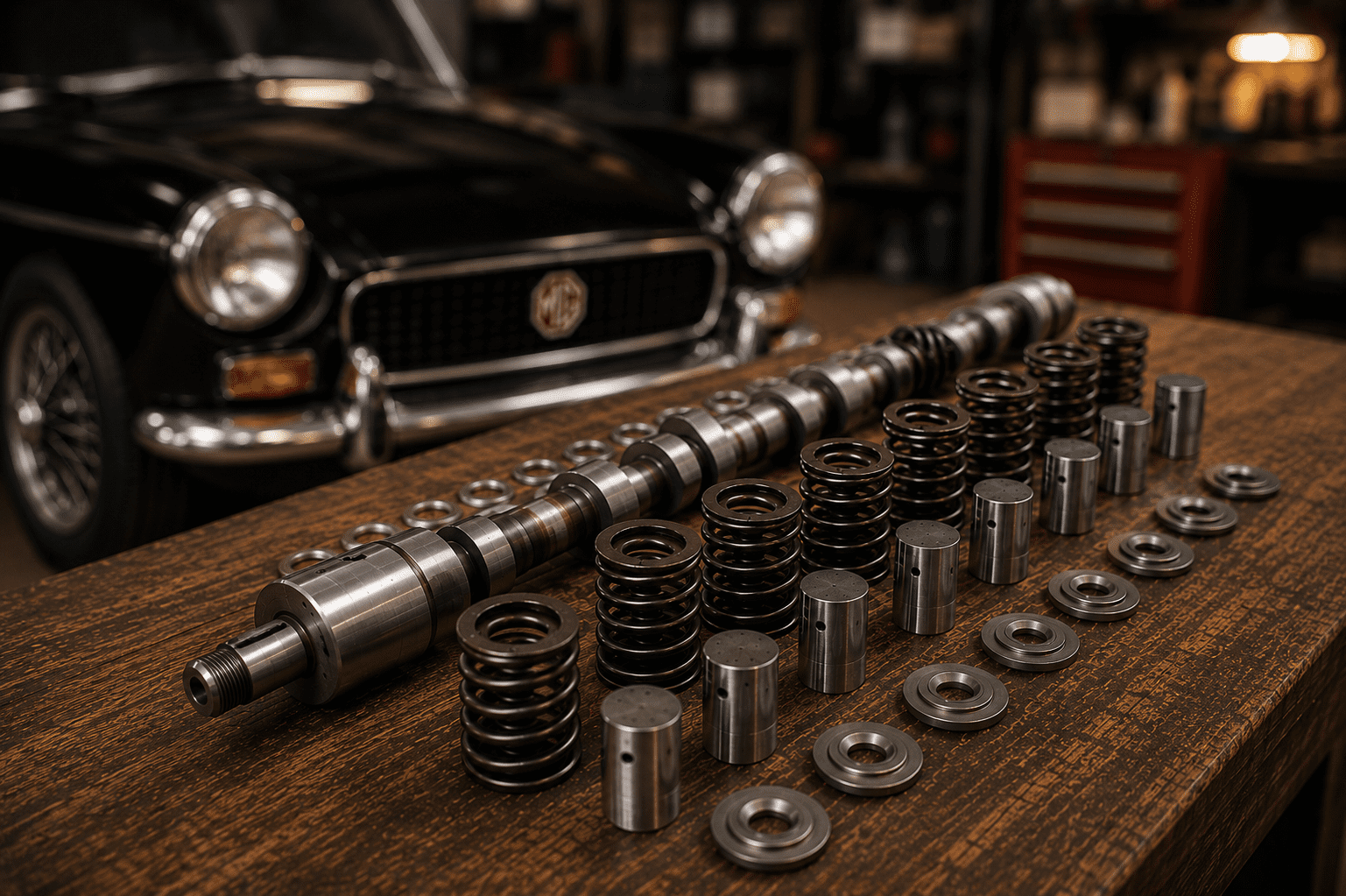
At some point in the ownership of almost any classic car, the thought occurs. The engine is running well, the car is sorted, everything works, and yet. There is a suspicion, half-formed and persistent, that a bit more response, a bit more mid-range, a bit more enthusiasm from the engine when you use the full throttle on a clear road, would make the whole thing considerably more rewarding. Changing the camshaft is usually where this line of thinking eventually leads. A performance camshaft is one of the oldest and most effective engine modifications available, and one of the most frequently misunderstood. This article explains what it actually does, what it costs you in the process, and whether it is the right modification for your particular car and your particular usage style.
What a camshaft actually does
The camshaft is the component responsible for opening and closing the engine’s valves. It rotates at half the speed of the crankshaft, and its lobes, one per valve, push against the valve train to open each valve at the correct moment and allow it to close under spring pressure when the lobe has passed. The shape of those lobes determines three critical things: lift, duration, and overlap.
Lift is how far the valve opens. A valve that opens further allows more air and fuel mixture to enter the cylinder in a given time, which is beneficial at high engine speeds where the engine is trying to breathe as much as possible in a very short window.
Duration is how long the valve stays open, measured in degrees of crankshaft rotation. A valve that stays open longer gives the engine more time to fill the cylinder, again most beneficial at high rpm where the speed of events means a shorter duration would leave the cylinder incompletely filled.
Overlap is the period during which both the inlet and exhaust valves are open simultaneously, at the end of the exhaust stroke and the beginning of the inlet stroke. At high rpm, this overlap helps the exiting exhaust gases draw fresh mixture into the cylinder behind them, a scavenging effect that improves cylinder filling. At low rpm, the same overlap causes fresh mixture to escape out of the exhaust before combustion, producing a rough idle, poor throttle response, and reduced low-speed torque.
These three characteristics are deeply interconnected, and changing any one of them affects the others and affects the engine’s behaviour across the entire rev range. A camshaft is not a straightforward power switch. It is a trade-off, and understanding what you are trading is the purpose of the rest of this article.
Why your standard camshaft is already a compromise
The camshaft fitted to your classic car at the factory was not chosen because it was the most powerful option available. It was chosen because it delivered acceptable performance across the full range of conditions the car would encounter in normal use, while also meeting emissions standards, providing a smooth idle, giving reasonable fuel economy, and not requiring the engine to be rebuilt every twenty thousand miles. Factory engineers knew exactly what a more aggressive camshaft profile would do to the engine. They chose not to use one on a road car because a road car needs to start on a cold morning, idle smoothly in traffic in Bradford, pull cleanly from low revs when loaded with passengers, and not fail an emissions test.
This is not laziness. It is genuine engineering compromise, and it produces an engine that works well for almost everything a road car is asked to do. The question you need to answer before changing the camshaft is whether your use of the car genuinely falls outside what that standard compromise was designed for, or whether you are simply attracted to the idea of more performance without being honest about whether you will actually use it.
The camshaft spectrum: from mild to wild
Performance camshafts for classic cars exist on a spectrum, and the most important thing to understand is that you do not simply buy more performance. You buy a different balance. The gains at one end of the rev range come directly at the cost of behaviour at the other end. Understanding where on the spectrum you need to be is the entire decision.
Fast road camshafts
A fast road cam offers slightly more lift and duration than the standard profile, with modest increased overlap. The gains are real but measured: improved mid-range response, a slightly broader power band, and a more willing character when the revs rise above the middle of the range. The losses are equally modest: a very slight roughening of the idle that most people barely notice, fractionally less torque at very low engine speeds, and a possible need to rejet the carburettor and advance the ignition timing slightly to suit the new profile.
A fast road cam is the choice for a classic used for everyday driving that also sees spirited use at weekends and the occasional club run or track day. It is the modification that genuinely improves the car without making it difficult to live with. The idle remains acceptable, the car pulls cleanly from low revs in traffic, it passes an MOT without drama, and on the open road it rewards a willing right foot. This is the cam that most classic car owners actually need, and it is the one most commonly recommended by the major UK suppliers.
Sports and hot road camshafts
The next step up introduces noticeably more duration and overlap. Power increases more substantially in the upper rev range, the engine develops a more characterful idle with a lumpiness that some find appealing and others find irritating, and low-speed tractability begins to suffer meaningfully. A car fitted with a sports cam will be noticeably less pleasant in slow traffic, will require more use of the gearbox to stay in the power band, and may require stronger valve springs, a carburettor upgrade, and a timing adjustment to extract the full benefit.
This specification suits a car that sees regular track days alongside road use, where the driver is experienced enough to manage the narrower power band, and where the car’s other systems, braking, tyres, and suspension, are developed to a level that makes the additional top-end power usable. Fitting a sports cam to an otherwise standard classic with average tyres simply produces a car that is less enjoyable to drive in most situations while being faster in a narrow band of conditions you rarely encounter on the road.
Competition camshafts
A full race or competition cam operates on the extreme end of the duration and overlap spectrum. The power band narrows dramatically. The engine may barely idle at all at low revs, producing the characteristic loping, erratic tick-over that announces a seriously modified engine from three streets away. Below the power band the car is effectively undriveable. Above it, the performance is genuinely dramatic. This specification belongs in a car built specifically for circuit racing, with a full rebuild to match, including high-compression pistons, a big-valve head, ported and polished combustion chambers, uprated valve springs, and supporting fuelling and ignition systems. It does not belong on the road unless you enjoy explaining to people why your car will not pull away from traffic lights without stalling.
Which cam for which car: a practical guide by use
The everyday classic
If your classic is your weekend car and occasional summer transport, used for touring, shows, and the kind of driving that involves real roads with real traffic and real corners rather than a circuit, the honest answer is probably that a standard camshaft already serves you well. The performance gains from even a fast road cam will only be felt in the upper rev range that a genuinely relaxed road drive rarely visits. If you want the car to feel more responsive, checking that the existing cam timing is correctly set, the ignition timing is optimised, and the carburettor is properly adjusted will typically deliver more real-world improvement for less cost and no compromise to driveability. Our SU carburettor guide and performance optimisation guide are the place to start.
The enthusiastically driven road car
A fast road cam is the right answer here. The gains are real and noticeable, the losses are minimal, and the car remains usable in all conditions. For the most common classic British engines, the established UK suppliers offer specific fast road profiles developed and refined over decades. Kent Camshafts, Piper Cams, and Newman Cams all produce profiles for the BMC A-series, BMC B-series, Triumph four and six-cylinder engines, and Ford Kent units. A phone call to any of them, with the engine specification and intended use clearly explained, will produce a specific recommendation rather than a catalogue number chosen blind.
For a BMC A-series engine (Mini, MG Midget, Sprite) a fast road profile adds meaningful mid-range response without disturbing the car’s manners. For the B-series (MGB, Marina), the same principle applies. For the Triumph four-cylinder (Spitfire, Vitesse 1300, Herald) and the Triumph six (TR5, TR6, Vitesse 6-cylinder), fast road profiles are well established and the improvement in character is significant given how under-cammed some of these engines were from the factory. The Ford Kent unit responds particularly well to camshaft work given its fundamentally strong bottom end.
The track day car that also drives to the circuit
This is where the decision becomes genuinely interesting. A sports or hot road cam profile will transform the car’s circuit performance while making the drive to and from the venue noticeably more demanding. Whether that trade-off is acceptable depends entirely on how far you live from the circuit, how much of your annual mileage is road versus track, and how much you value a relaxed drive versus maximum on-circuit performance.
A more aggressive cam in a car driven to track days also raises practical considerations: the MOT emissions test, fuel consumption, and the possibility that stronger valve springs are required, with implications for valve train wear and service intervals. If the track day car is genuinely used regularly on circuit, addressing the full package rather than just the cam in isolation is worth considering. A camshaft that is not supported by appropriate valve springs, ignition timing, and fuelling will not deliver what its specification suggests, and may cause valve float and engine damage at the sustained high revs a track day involves.
The dedicated track or competition car
The camshaft choice for a car that never uses the public road is a different conversation entirely, and one the major suppliers are well placed to have with you based on your specific class rules, engine specification, and circuit characteristics. No general guide can substitute for a conversation with a specialist who knows the engine. What it can say is that a competition cam without everything else to match is money spent to no purpose. The head, the valve gear, the carburation, the ignition, and the fuelling all need to be developed together, and the camshaft is one part of a system rather than a standalone performance upgrade.
What else changes when you fit an uprated cam
This section matters. Many owners fit a performance cam expecting a straightforward power increase and are surprised to discover that without the supporting changes, the result is often disappointing or, in some cases, actively damaging.
- Valve springs: Virtually any performance cam profile will require stronger valve springs than the factory items. Standard springs are designed for standard lift and duration. An uprated cam operating at higher lift can cause standard springs to bounce or float at high revs, a condition called valve float that at best costs power and at worst causes a valve to contact a piston. Check spring requirements with the cam supplier before ordering and budget for new springs as part of the job.
- Valve clearances: After fitting a new camshaft, valve clearances must be set to the new cam’s specification, which will typically differ from the original factory figures. Check immediately after fitting and again after the first five hundred miles of running. Our valve clearance guide covers the procedure in full.
- Ignition timing: A cam with more duration and overlap typically benefits from slightly more ignition advance. The correct timing for the new cam should be established on a rolling road or by careful road testing. Guessing produces either lost performance or detonation.
- Carburettor jetting: The changed airflow characteristics of the new cam will almost certainly require jetting changes, particularly on SU-equipped cars where needle selection can be used to tailor the mixture across the rev range. Our SU performance guide covers needle selection in detail.
- Piston-to-valve clearance: High-lift cams on some engines can reduce the clearance between the valve at maximum lift and the piston at top dead centre to dangerously small margins. This must be checked, particularly if higher-compression pistons are also fitted. A specialist or machine shop can measure this with the engine assembled.
- Running-in: A new camshaft must be run in carefully. The first twenty minutes of running are critical for bedding the cam lobes and followers together. Use a quality engine oil with adequate ZDDP (zinc) content, vary the engine speed constantly during the run-in period (do not idle), keep an eye on the temperature, and avoid sustained high revs until at least five hundred miles have been completed. Check and reset the valve clearances afterwards.
MOT and emissions
A performance cam on a car used on the road needs to pass the MOT emissions test. Fast road profiles on properly tuned engines typically present no problem here. More aggressive profiles, particularly on cars with standard carburettors not rejetted to suit, can push hydrocarbon emissions above the permitted limits. If your classic is on historic vehicle MOT exemption (over forty years old at the time of test), this is not a concern. If it requires an emissions test, worth checking with your MOT tester or an emissions specialist before committing to a more aggressive specification.
What it costs
A reground camshaft, where your existing unit is sent away and reground to a performance profile, typically costs between £80 and £130 for the grinding service plus any core charge. This assumes the existing cam is in good enough condition to be regrind, which is not always the case on high-mileage engines. A new performance camshaft from a specialist supplier costs between £130 and £350 for most common classic British engines, depending on the profile and the engine type. Competition-spec units cost more.
To this add new valve springs at typically £40 to £100 for a full set, a carburettor remap or needle change, an ignition timing check and adjustment, and the labour for fitting if you are not doing it yourself. The cam itself is not the only cost, and anyone quoting the cam price alone is giving you an incomplete picture of the total investment.
If the engine is being rebuilt anyway, fitting a performance cam as part of the rebuild makes obvious sense because the head is already off, the valve gear is already disassembled, and the marginal additional cost is modest. Fitting a performance cam to an assembled engine on a whim, without addressing the valve springs, timing, and fuelling, is not a recipe for a good outcome. Do it properly or save the money.
The honest answer to the title question
Do you really need one? Probably not, if the car is used primarily as a road car and the rest of the engine is in standard tune. There are cheaper and less invasive ways to extract more response from most classic engines, and a properly sorted standard engine is often more enjoyable to drive than a mildly modified one with a cam that is not properly supported by everything around it.
A fast road cam on a car used enthusiastically, fitted as part of a broader engine service with proper valve springs, timing, and fuelling to match, is a different proposition. In that context it is one of the most cost-effective performance modifications available, it improves the car’s character meaningfully without compromising its usability, and it comes with genuine longevity if installed and run in correctly. The modification works. The question is always whether it is the right modification for your car and your use of it, and that question is worth answering honestly before placing an order.
For the valve gear work that accompanies any cam upgrade, our valve clearance guide and roller rockers guide cover the related components in detail. And if the cam upgrade is part of a wider engine refresh, our springtime safety check is a useful framework for making sure everything else is in order before the engine goes back together.
This page contains affiliate links. If you click a link and make a purchase, Classic Car Hub may earn a small commission at no extra cost to you.