
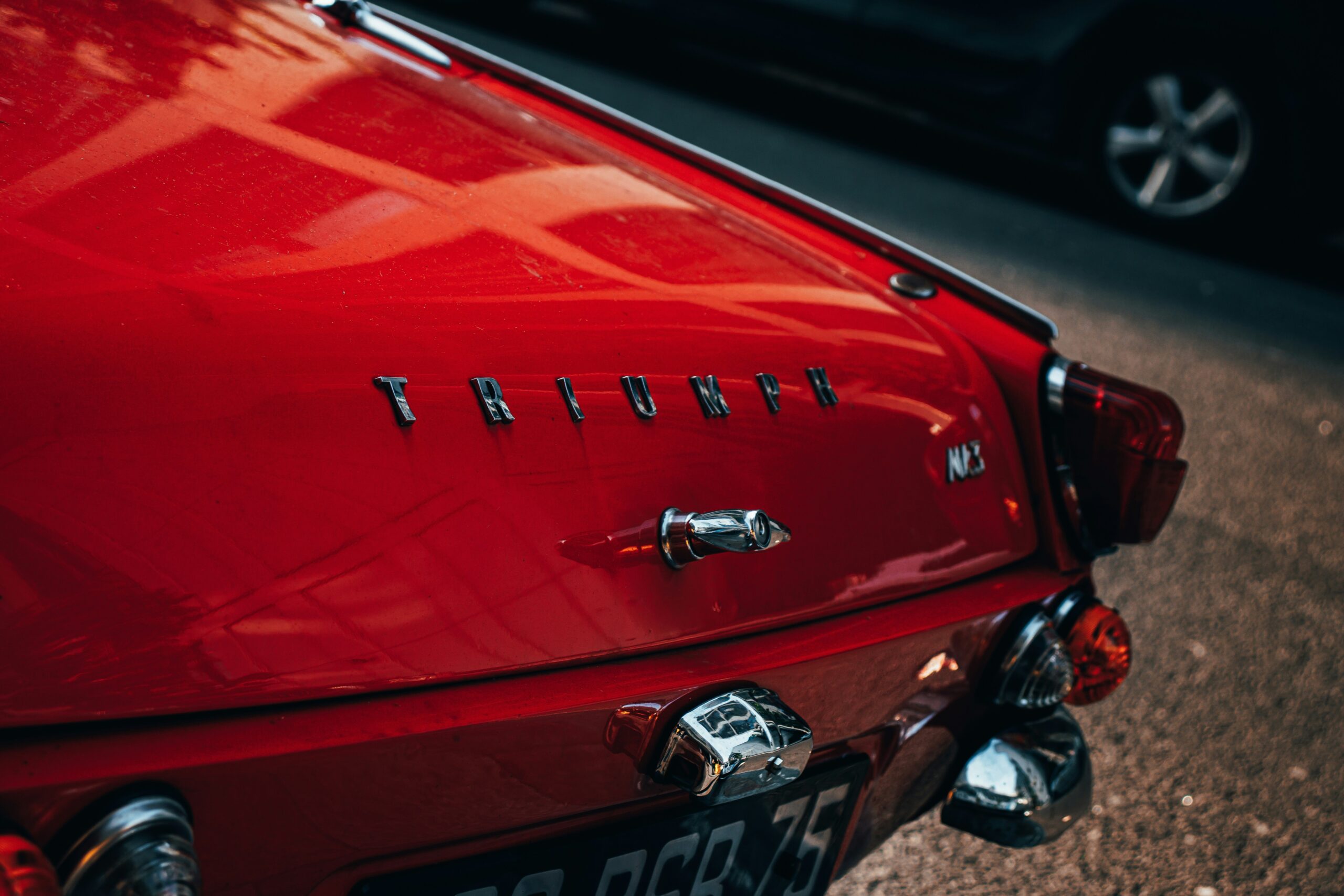
Some car companies make good cars. Some make great ones. Triumph, at its best, made cars that people truly fell in love with, which is an altogether different, and considerably harder, thing to achieve. From a bicycle workshop in Coventry to some of the most celebrated sports cars in British motoring history, the story of Triumph spans a century of ambition, ingenuity, industrial politics, and occasional catastrophe. It is a story that ends, as so many great British industrial stories do, not with a bang but with a rebadged Honda. But the journey there is worth every mile…
A German immigrant and a bicycle
The Triumph story begins, not in a factory, but in lodgings somewhere in Coventry in 1883. A young man from Nuremberg, named Siegfried Bettmann, arrived in England with little money and considerable ambition. He had been working for a sewing machine company, been made redundant, and decided that England offered far better prospects. He was right, though not immediately. He spent a period compiling foreign-language business directories before finding his way into the bicycle trade, which in the 1880s was one of the fastest growing industries in Britain.
In 1885 he founded S. Bettmann and Co, importing and selling bicycles from Europe under his own trade name. The name he chose was Triumph, partly for its positive associations and partly, as he later admitted, because it worked equally well in English, German, and French. A pragmatic choice from a pragmatic man. He was joined in 1887 by Moritz Schulte, also from Germany, and together they began manufacturing their own bicycles in Coventry from 1889. The Triumph Cycle Company, as it became in 1897, was established.
Bettmann was not merely an industrialist. He became the Mayor of Coventry in 1913 and 1914, the first non-British subject ever to hold that position. He built a reputation as a civic figure as well as a businessman, established the Annie Bettmann Foundation to support young entrepreneurs, and was a Justice of the Peace. He was also, eventually, forced out of his own company. But that comes later.
From bicycles to motorcycles
In 1902 the company fitted a Belgian Minerva engine to a bicycle frame and produced its first motorcycle at the Much Park Street works in Coventry. It was not an elegant beginning, but the business grew rapidly. By 1907 Triumph had expanded into a former spinning mill on Priory Street to meet demand, and by the time the First World War broke out the company was producing some of the most reliable motorcycles in Britain.
The war transformed Triumph’s fortunes. The War Office placed major orders for the 550cc Model H, a robust and dependable machine that became so trusted by the Allied forces that it earned a nickname that would define the brand for generations. Soldiers called it the Trusty Triumph. By 1918, the company had supplied over 30,000 motorcycles to the Allied forces and had become Britain’s largest motorcycle manufacturer. The Trusty Triumph had carried despatch riders across the mud of Flanders and back, covering hundreds of miles a day without mechanical failure. There was real substance behind the marketing.
The first cars: ambition and argument
After the war, a disagreement developed between Bettmann and Schulte about the company’s direction. Schulte wanted to move into car manufacturing. Bettmann was reluctant. The argument ended Schulte’s involvement with the company, and he left. Bettmann’s subsequent general manager, Claude Holbrook, proved more persuasive. In 1921 he managed to convince Bettmann to acquire the assets of the Dawson Car Company and begin producing cars.
The first Triumph car was the 10/20 of 1921, a 1.4-litre model designed by Lea-Francis, to whom Triumph paid a royalty on every car sold. This arrangement was not ideal, and the early cars were produced in modest numbers. The real breakthrough came in 1927 with the Triumph Super 7, a small, affordable car that sold in substantial numbers through to 1934 and established Triumph as a genuine car manufacturer rather than a motorcycle company with a side project.
In 1930 the company formally renamed itself the Triumph Motor Company. Holbrook, recognising that competing with the mass market was financially impossible, took the company upmarket, introducing the Gloria and Southern Cross ranges with stylish bodies and more powerful engines. Donald Healey, who would later become famous for his own eponymous sports cars, joined as Experimental Manager in 1934 and developed an extraordinarily ambitious project: a car with an Alfa Romeo-inspired straight-eight engine, named the Triumph Dolomite. Only three were built, one of which was destroyed in competition. The Dolomite name would reappear on a somewhat different car forty years later.
The financial problems that had been accumulating caught up with Triumph in 1936 when the bicycle and motorcycle businesses were sold off. The motorcycles went to Jack Sangster of Ariel, who formed the separate Triumph Engineering Company, beginning the lineage of Triumph motorcycles that continues to this day, separately and entirely independently, under BMW ownership. In July of 1939, the Triumph Motor Company itself went into receivership. A scrap metal company named T.W. Ward purchased it. Then the Second World War began, and in 1940 German bombing raids completely destroyed the Priory Street factory. Triumph’s pre-war chapter was over in the most definitive way imaginable.
Standard-Triumph: a new beginning with an old grudge
In November 1944, before the war had even ended, the Standard Motor Company bought what remained of the Triumph brand. The motivations of Standard’s managing director, Sir John Black, were not straightforwardly commercial. Standard had been supplying engines to Jaguar since 1938, and Black had developed a notable personal animosity towards William Lyons, Jaguar’s founder and driving force. When the relationship soured, Black’s acquisition of the Triumph name was specifically intended to create a car that would compete with Jaguar’s post-war models. Necessity and resentment, combined, can occasionally produce good results.
The post-war Triumph range was, initially, distinctive rather than dynamic. The 1946 Roadster used an aluminium body because steel was in short supply, while surplus aircraft aluminium from wartime production was plentiful. It seated three abreast on a single bench seat and had a dickey seat in the tail. It was not a sports car in any conventional sense, but it looked unlike anything else on the road, and John Nettles would later drive one extensively around Jersey in the television series Bergerac, giving the Roadster a cultural afterlife considerably longer than its production run.
The Triumph Renown saloon of the late 1940s is notable for its razor-edge styling, which was actually chosen by Sir John Black himself rather than by any design department. It was an unusual arrangement. The Mayflower, a small saloon with similarly distinctive styling, followed in 1949. Neither car is particularly remembered today, but they established the Triumph name in the post-war market while Standard’s engineers worked on something more significant.
The TR series: Britain’s affordable sports car
In 1953 Triumph unveiled the TR2 at the Geneva Motor Show, and British sports car history shifted. The TR2 was not beautiful in the way that a Jaguar XK was beautiful, but it was light, quick, rugged, and crucially, affordable. At a time when most sports cars were either expensive or unreliable or both, the TR2 offered genuine 100mph performance at a price within reach of ordinary enthusiasts. It was the first genuinely affordable British sports car capable of exceeding 100mph in standard form, and that distinction mattered enormously in the early 1950s.
The TR series evolved steadily from the TR2 through to the TR6, with each iteration refining rather than reinventing the formula. The TR3 of 1955 introduced disc brakes to the front wheels, making Triumph one of the first British manufacturers to offer disc brakes on a production car. The TR4 in 1961 brought proper wind-up windows and a more civilised interior. The TR5 of 1967 introduced the 2.5-litre six-cylinder engine with Lucas petrol injection, producing 150bhp, making it one of the fastest British production cars of its day. American market customers, constrained by tighter emissions regulations, received the carburetted TR250 with significantly less power. The injected TR5 was essentially a home-market secret.
The TR6, produced from 1969 to 1976, is probably the most recognised of the series. Its styling was a rework of the TR5 by the German coachbuilder Karmann, which transformed the car’s appearance at modest cost by reskinning the front and rear while keeping the doors, windscreen, and body tub from the previous model. Around 94,000 TR6s were built, more than any previous TR, and the car remains one of the most popular and practical classic sports cars available today.
The Italian connection: Michelotti and the small Triumphs
In the late 1950s Triumph formed a relationship with the Italian designer Giovanni Michelotti that would shape the company’s identity for the next two decades. Michelotti’s contribution to Triumph’s visual character cannot be overstated. The Herald, the Vitesse, the Spitfire, the GT6, the TR4, the TR5, the 2000, and the Dolomite all carry his signature. He also designed, among other things, the BMW 2002. He was, by any measure, one of the most influential automotive designers of the twentieth century, and Triumph had him essentially as a house designer for a large proportion of their best years.
The Triumph Herald of 1959 introduced Michelotti’s ideas to the family car buyer. It was unconventional in construction: the body panels were bolted rather than welded, which simplified repair and allowed easy panel replacement. The entire front end of the car unbolted in one piece, giving the kind of engine access that mechanics of the era found almost implausibly convenient. The Herald’s turning circle was twenty-five feet, tighter than most contemporary vehicles, which made it genuinely agile in city traffic. The six-cylinder Vitesse variant of 1962, with its twin headlamps and sharper performance, added glamour to the practical Herald formula.
The Triumph Spitfire of 1962 deserves its own paragraph if not its own library. Designed by Michelotti, produced for nineteen years and 314,000 examples, it was the accessible sports car that introduced a generation of British drivers to open-top motoring at a price that was genuinely within reach. The GT6, its six-cylinder coupe sibling, was sometimes unkindly described as the poor man’s E-Type, which is unfair to both cars but captures the GT6’s aspirations rather well. Our Triumph Spitfire buyers guide and GT6 buyers guide cover both in detail for anyone considering ownership.
The Stag: a great car that was also its own worst enemy
The Triumph Stag of 1970 is one of the most debated cars in British motoring history, and the debate usually runs as follows: it was beautiful, it was ambitious, it was let down by its engine, and it is deeply unfair that it is remembered primarily for that engine. All four statements are true simultaneously, which is part of what makes the Stag so interesting.
The Stag had been planned with the proven 2.5-litre six-cylinder engine from the TR5 and 2500 saloon, which would have given it a reliable and well-understood power unit. British Leyland management, who had taken over Triumph in 1968, insisted instead on a new 3-litre V8 developed specifically for the Stag. This V8 was not derived from any other engine in the BL range, shared no parts with either the Triumph six or the Rover V8 that was available within the same group, and had a known weakness: the timing chain tensioner could not be serviced without removing the entire engine. Overheating caused by blocked cooling passages, if not caught early, led to chain failure, which led to complete engine destruction. The Stag’s V8 made roughly 26,000 examples rather difficult cars to maintain.
The Stag appeared in the 1971 James Bond film Diamonds Are Forever, which in a just world would have launched it into the cultural stratosphere alongside the Aston Martin DB5. The Saffron-coloured car used in the film, commission number LD14, was subsequently sold at auction in 1998 for $35,000. Its reputation suffered from the V8’s problems even in the film: it overheated in the Nevada desert, which felt appropriate.
A well-sorted Stag, however, is something rather special. The body was styled by Michelotti, the handling was accomplished, and the soft top was one of the most elegantly engineered hoods fitted to any British convertible of the era. Owners who have converted their cars to run the Rover V8 report that the combination transforms the car entirely. The question of whether this constitutes heresy or common sense divides Stag enthusiasts into two camps that show no sign of reconciling.
The Dolomite Sprint: world’s first mass-produced 16-valve car
In 1973, at a time when British Leyland was descending into industrial disorder and financial chaos, Triumph produced one of the most technically remarkable saloon cars of the decade. The Dolomite Sprint was the world’s first mass-produced car with a 16-valve engine, featuring four valves per cylinder in a 2.0-litre unit that produced 127bhp, enough for a 0-60mph time of around 8.4 seconds and a top speed approaching 120mph. It was also the first British saloon to be sold with alloy wheels as standard equipment.
What made the Sprint’s engine particularly clever was how the 16 valves were operated. Rather than using the expensive twin-camshaft arrangement that most multi-valve engines employed, Triumph’s engineers, working with Harry Mundy and the team at Coventry Climax, devised a system where all sixteen valves were operated by a single overhead camshaft using long rockers for the exhaust valves. It delivered the benefits of a multi-valve head without the cost or complexity of twin cams. The Design Council gave it an award in 1974. BMW, who were paying attention, would use the principle as a reference point for what was possible in a compact performance saloon.
The Sprint was faster than most of its rivals at roughly two-thirds of their price. Contemporary road tests placed it ahead of the BMW 2002tii in straight-line performance at a considerably lower cost. It won the British Touring Car Championship in 1975 in the hands of Andy Rouse. It should, by rights, have been the foundation for a generation of performance saloons that would have kept Triumph competitive into the 1980s. British Leyland’s financial position and internal politics ensured it was not. The Sprint was discontinued in 1980 when the entire Dolomite range ended, and its 16-valve engine was never developed further. The opportunity was squandered completely.
The end: wedge, decline, and a Honda
The TR7 of 1975 was the car that was supposed to secure Triumph’s future in the American market, which by this point accounted for the majority of TR sales. It was a wedge-shaped coupe designed to meet anticipated American roll-over regulations that never actually came into force, built at a new factory in Speke, near Liverpool, that was plagued by industrial disputes. Initial production of the TR7 was so disrupted by strikes that dealers ran out of stock. When the convertible version finally arrived in 1979, four years after the original coupe, it was received with considerably more enthusiasm, but by then the damage was done.
The TR8, a development of the TR7 with the Rover V8 engine, was a genuinely exciting car that proved competitive in American racing. Production was limited to around 2,700 examples before it was cancelled in 1981. The Spitfire ended production the same year, having outlasted expectations considerably.
The last Triumph was the Acclaim of 1981, which was, in essence, a Honda Ballade built under licence in Coventry. It was reliable, well-equipped, and thoroughly inoffensive. It was also the final product of a marque that had produced the TR2, the Spitfire, the GT6, the Stag, and the Dolomite Sprint. When Acclaim production ended in June 1984, the Triumph name was retired. Its replacement, still Honda-based, was badged as a Rover. The marque was dormant for decades, owned by BMW since 1994, and has never been revived for cars.
Facts worth knowing: the pub quiz material
Triumph’s history is dense enough that some of the most interesting details tend to get lost in the broader narrative. A few worth knowing:
The founder of Triumph was also the Mayor of Coventry. Siegfried Bettmann, born in Nuremberg, Bavaria, served as Mayor of Coventry in 1913 and 1914. He was the first non-British subject ever to hold the position. He remained in Coventry after the First World War despite anti-German sentiment, and continued his civic work. He died in 1951, aged 88, and his estate in Coventry still stands, now converted to apartments.
The Triumph motorcycle and Triumph car companies are entirely separate and have been since 1936. When the car business sold the motorcycle division to Jack Sangster, the two marques went their own ways. The motorcycle company that still produces Bonnevilles in Hinckley, Leicestershire today has no historical connection to the car company beyond the shared name and Coventry origins. BMW owns the car name rights. The motorcycle company is entirely British-owned and unrelated.
The Standard-Triumph merger happened partly because of a personal feud. Sir John Black of the Standard Motor Company had supplied engines to Jaguar since 1938. When his relationship with William Lyons deteriorated, his response was to buy the Triumph brand and build a sports car to compete with Jaguar directly. The TR2 was, among other things, a vehicular argument between two proud men from the West Midlands.
The TR3 was one of the first British production cars with front disc brakes. When the TR3 received disc brakes in October 1956, it was ahead of most competitors. Most contemporary British cars were still relying entirely on drums. The decision came partly from Triumph’s involvement in motorsport, where the advantages of discs under hard use were already apparent.
The Spitfire was designed secretly. In the late 1950s, a small team of Triumph engineers designed the Spitfire without official authorisation, working on it in their own time and hiding it under a dust sheet in a corner of the Coventry factory. When the project was eventually presented to management, it was approved. The secrecy was necessary because resources were already committed to other projects and an unsanctioned sports car would have been cancelled before it could demonstrate its potential.
The Dolomite Sprint beat the BMW 2002tii in performance at two-thirds of the price. Contemporary road tests in 1973 confirmed that the Sprint, priced significantly below its German rival, matched or exceeded it in most performance metrics. BMW’s engineering team were reportedly paying close attention. Whether the multi-valve head concept was a direct influence on BMW’s subsequent engine development is a matter of some debate among engineers, but the timing is suggestive.
The Stag’s V8 was designed to share nothing with any other BL engine. The Rover V8, a proven and available unit within the same corporate group, was not used in the Stag because of interdepartmental rivalry within British Leyland. Triumph and Rover were competing entities even under the same roof, and using a Rover engine in a Triumph was considered politically unacceptable. The cost of this decision, in reputation and reliability, was considerable.
Giovanni Michelotti also designed the BMW 2002. The Italian designer who shaped the Herald, Spitfire, GT6, Vitesse, TR4, TR5, 2000, and Dolomite for Triumph also contributed to the BMW that became their most significant competitor in the saloon car market. The design world is a small place.
The legacy
Triumph’s legacy sits in a curious position. The cars it produced at its best are widely regarded as some of the most enjoyable British classics of the twentieth century. The Spitfire and TR6 remain among the most practical and popular open-top classics available, with strong club support, good parts availability, and a driving character that rewards rather than intimidates. The Dolomite Sprint is belatedly recognised as a significant technical achievement. The Herald is beloved for its practicality and character. The Stag, properly sorted, is one of the most visually striking British convertibles ever built.
What makes the story melancholy is how much was lost through mismanagement rather than through any failure of the engineers and designers at Canley and Coventry. The 16-valve Sprint engine was never developed for the next generation of cars. The Stag was never given a reliable engine to match its beautiful body. The TR7 was built in the wrong place at the wrong time under the wrong conditions. The talent was there. The institutional framework to support it was not.
Our Triumph paint codes guide covers the factory colour palette across the range if you are working on a restoration, and if you are looking at buying a classic Triumph our guides to the Spitfire, GT6, and Herald and Vitesse cover what to look for in detail. Triumph made cars that people loved. That is not a small thing, and it is why they are still on the roads today.
This page contains affiliate links. If you click a link and make a purchase, Classic Car Hub may earn a small commission at no extra cost to you.