
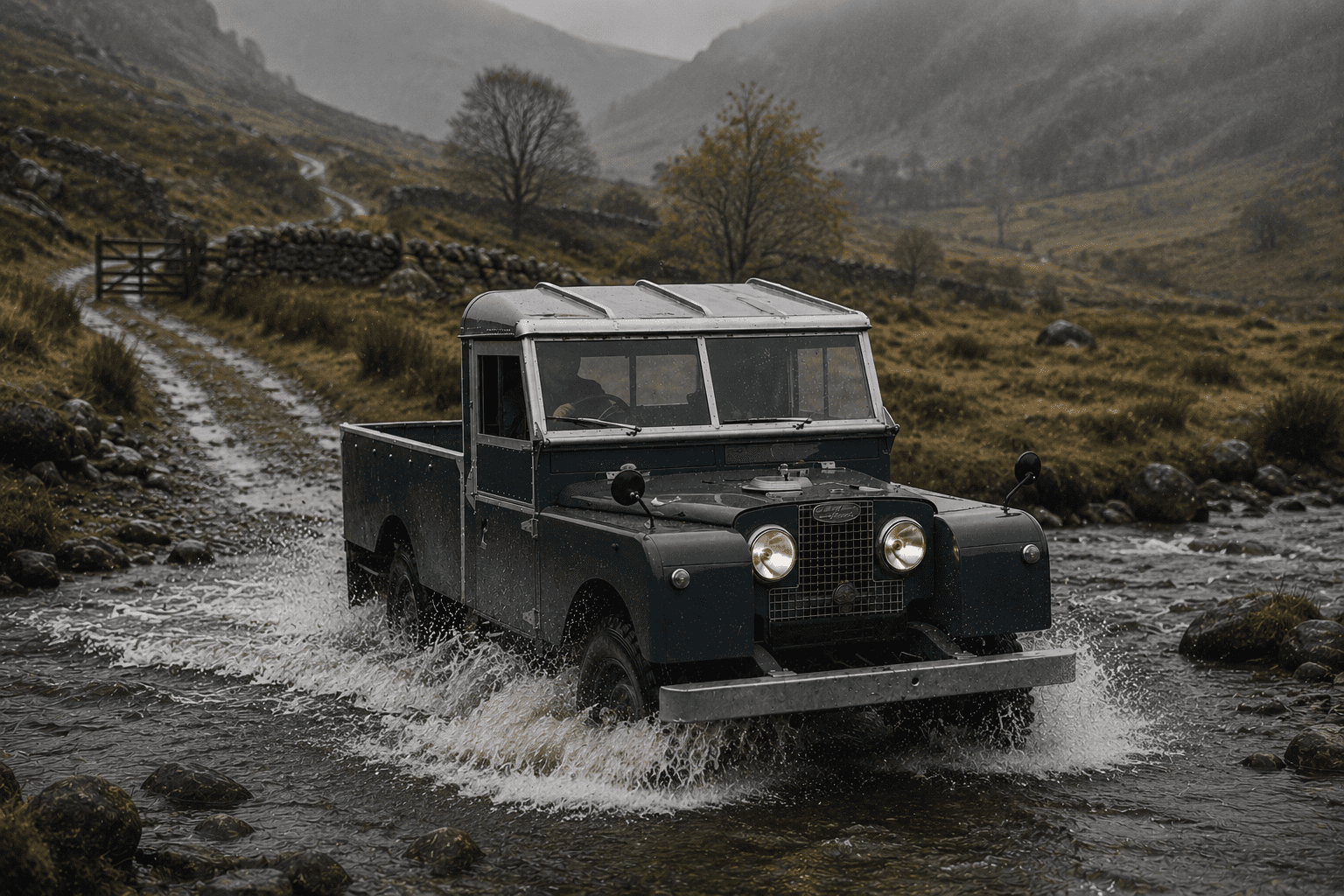
Over a million Series Land Rovers were built between 1948 and 1985. This makes the Series Land Rover one of the most successful British vehicles of the twentieth century by any measure, and it also makes it one of the most diverse: across thirty-seven years and three series, in wheelbase options of 80, 86, 88, 107, and 109 inches, with petrol and diesel engines, in open, soft-top, hard-top, pick-up, Station Wagon, and forward control body configurations, the Series Land Rover covered more ground in terms of specification variety than almost any other classic British vehicle. Finding the right example requires knowing which variant you actually want and what each one involves to own.
This guide covers the specifications, production history, and identifying characteristics of the Series I, II, IIA, and III, organised to help prospective buyers understand what they are looking at before a viewing rather than after.
Series I (1948 to 1958): the original
The original Land Rover was conceived by Rover’s Maurice Wilks as a stopgap product to keep the Solihull factory busy while the company recovered from the war. He used the chassis of a Willys Jeep left on his farm, a Rover P3 engine, and aluminium body panels because steel was rationed. The aluminium was surplus aircraft material and cost less than steel: an accidental decision that gave the Series Land Rover its long-term advantage over the rust that destroys conventional steel-bodied vehicles. The result was presented at the Amsterdam Motor Show in April 1948 and went on sale immediately.
The earliest Series I used an 80-inch wheelbase with a 1,595cc inlet-over-exhaust four-cylinder petrol engine producing 50 bhp. The four-wheel drive was selectable rather than permanent, with a free-wheel in the front drive allowing two-wheel drive operation on road. From 1954 the wheelbase options expanded to 86 and 107 inches, and from 1956 the now-standard 88 and 109-inch dimensions were established. A 1,997cc petrol engine replaced the original unit in 1955, and a 2,052cc diesel option arrived for the 109-inch models from 1957. Total Series I production: approximately 214,000.
Series II and IIA (1958 to 1971): the definitive shape
The Series II of 1958 introduced the rounded “barrel-sided” body styling that most people associate with the classic Land Rover. The wheel arches became more pronounced, the body sides more curved, and the overall appearance more resolved than the original flat-sided Series I. A new 2,286cc petrol engine producing 70 bhp replaced the 1,997cc unit, alongside a 2,052cc diesel. The headlamps were mounted in the front wings and a full-width grille gave the front a cleaner appearance.
The Series IIA followed in 1961 as a progressive update rather than a replacement. The diesel engine was enlarged to 2,286cc to match the petrol unit, and from 1967 a 2,625cc six-cylinder petrol engine became available for 109-inch long wheelbase models. In 1969 the headlamps moved from the grille panel into the front wings, a change that makes Series IIA and III identification straightforward when viewed from the front. The Series IIA is the most common Series Land Rover found today, with production across the II and IIA totalling over 300,000 examples.
Series III (1971 to 1985): the most usable
The Series III is identifiable by its plastic grille panel, replacing the earlier pressed steel item, and by the all-synchromesh gearbox introduced at launch. The dashboard moved from painted metal to a moulded plastic unit with a conventional instrument layout, and the interior was marginally more civilised than the earlier cars by the low standards set by its predecessors. The 2,286cc petrol and diesel engines continued. From 1979 a 3,528cc Rover V8 became available in 109-inch Station Wagon guise, producing considerably better performance than any four-cylinder Series had offered. The County Station Wagon of 1982 introduced cloth seats and improved soundproofing for buyers approaching the Land Rover from a lifestyle rather than a working perspective. Series III production: approximately 440,000.
How to tell the series apart
Series I: flat body sides without pronounced wheel arch flares, narrow body, horizontal slats in the grille area, headlamps integrated into the flat grille panel, and the distinctively narrow and upright proportions of the original design. The 80-inch wheelbase version is particularly short and compact.
Series II: rounded barrel-sided body with pronounced wheel arch flares, headlamps in the grille panel (not the wings), pressed steel grille, wider body than Series I.
Series IIA: visually identical to Series II until 1969, when headlamps moved to the front wings. From 1969 onward, headlamps in the wings are the key identification feature that distinguishes IIA from II.
Series III: plastic grille panel (usually black, sometimes body-coloured), headlamps in front wings (as late IIA), generally slightly larger windscreen, and the County Station Wagon’s distinctive vinyl roof panel from 1982.
Engine specifications
| Engine | Capacity | Type | Power | Fitted to |
|---|---|---|---|---|
| Rover IOE Petrol | 1,595cc | 4-cyl petrol | 50 bhp | Series I (1948–55) |
| Rover IOE Petrol | 1,997cc | 4-cyl petrol | 52 bhp | Series I (1955–58) |
| 2.25 Petrol | 2,286cc | 4-cyl petrol OHV | 70 bhp | Series II, IIA, III |
| 2.25 Diesel | 2,286cc | 4-cyl diesel OHV | 62 bhp | Series IIA, III |
| 2.6 Petrol | 2,625cc | 6-cyl petrol IOE | 83 bhp | Series IIA 109″ (1967–71) |
| Rover V8 | 3,528cc | V8 petrol OHV | 91 bhp | Series III 109″ (1979–85) |
Body configurations and wheelbase options
| Wheelbase | Common designation | Body options available |
|---|---|---|
| 88 inches | SWB (Short Wheelbase) | Open, Soft Top, Hard Top, Pick-up |
| 109 inches | LWB (Long Wheelbase) | Soft Top, Hard Top, Pick-up, Station Wagon |
| 107 inches | Series I LWB only | Station Wagon (rare) |
What the performance figures mean in context
The Series Land Rover’s performance figures are not the point. A 2,286cc four-cylinder diesel producing 62 bhp in a vehicle weighing approximately 1,500 kilograms does not produce numbers that a road test would celebrate. What it produces is an engine that will run reliably for extraordinary mileages with basic maintenance, pull its rated load in any terrain, and respond to competent servicing rather than specialist knowledge. A Land Rover 2.25 diesel that has had its oil changed regularly and not been overheated can cover 200,000 miles without significant work. Several have covered considerably more.
The V8 Series III is the performance outlier: the 3.5-litre engine transforms the long wheelbase Station Wagon’s road manners from functional to genuinely quick, and the combination of off-road capability with V8 refinement makes the V8 County Station Wagon one of the most sought-after Series III variants. The 2.6-litre six-cylinder IIA is similarly appreciated for its greater smoothness and torque compared to the four-cylinder alternative in the long wheelbase body.
Production overview
| Series | Production years | Approximate total built |
|---|---|---|
| Series I | 1948–1958 | ~214,000 |
| Series II | 1958–1961 | ~127,000 (combined II and IIA) |
| Series IIA | 1961–1971 | (included in above) |
| Series III | 1971–1985 | ~440,000 |
| All Series | 1948–1985 | Over 1,000,000 |
Values overview
Series Land Rover values vary enormously depending on series, wheelbase, body type, engine, and condition. The Series I commands significant premiums, particularly in restored condition, due to its historical significance and the relatively small surviving population of sound original examples. Series IIA values have been rising steadily as quality survivors become rarer. The V8 Series III Station Wagon occupies a specific premium position within the Series III range. The Series III 88-inch soft top remains the most accessible entry point to Series Land Rover ownership in terms of purchase price, though not necessarily in terms of ongoing maintenance costs.
The Land Rover market is particularly sensitive to originality and matching numbers, with unrestored original examples often commanding more than comparable but incorrectly restored cars. Our classic car valuation page provides current pricing data across all Series variants and condition grades.
Owners clubs and community
The Land Rover Series One Club is the dedicated organisation for Series I owners, maintaining a register of surviving cars, an extensive technical library, and a spares operation that holds parts specific to the early models. For Series II, IIA, and III owners the Land Rover Owners Club provides a broader community covering all Series variants alongside later models. The Series Land Rover community is one of the most practically knowledgeable in the classic car world: these vehicles were maintained for decades by people who needed them to work rather than admired them as collectibles, and the depth of practical experience available through the clubs reflects this history.
For related reading: our classic Land Rover buyers guide covers what to look for across all Series variants, our rust prevention guide covers treating and protecting the steel chassis and body sections despite the aluminium body advantage, and our cooling system guide covers the V8 and six-cylinder cooling system considerations relevant to the higher-output Series III variants.
This page contains affiliate links. If you click a link and make a purchase, Classic Car Hub may earn a small commission at no extra cost to you.