
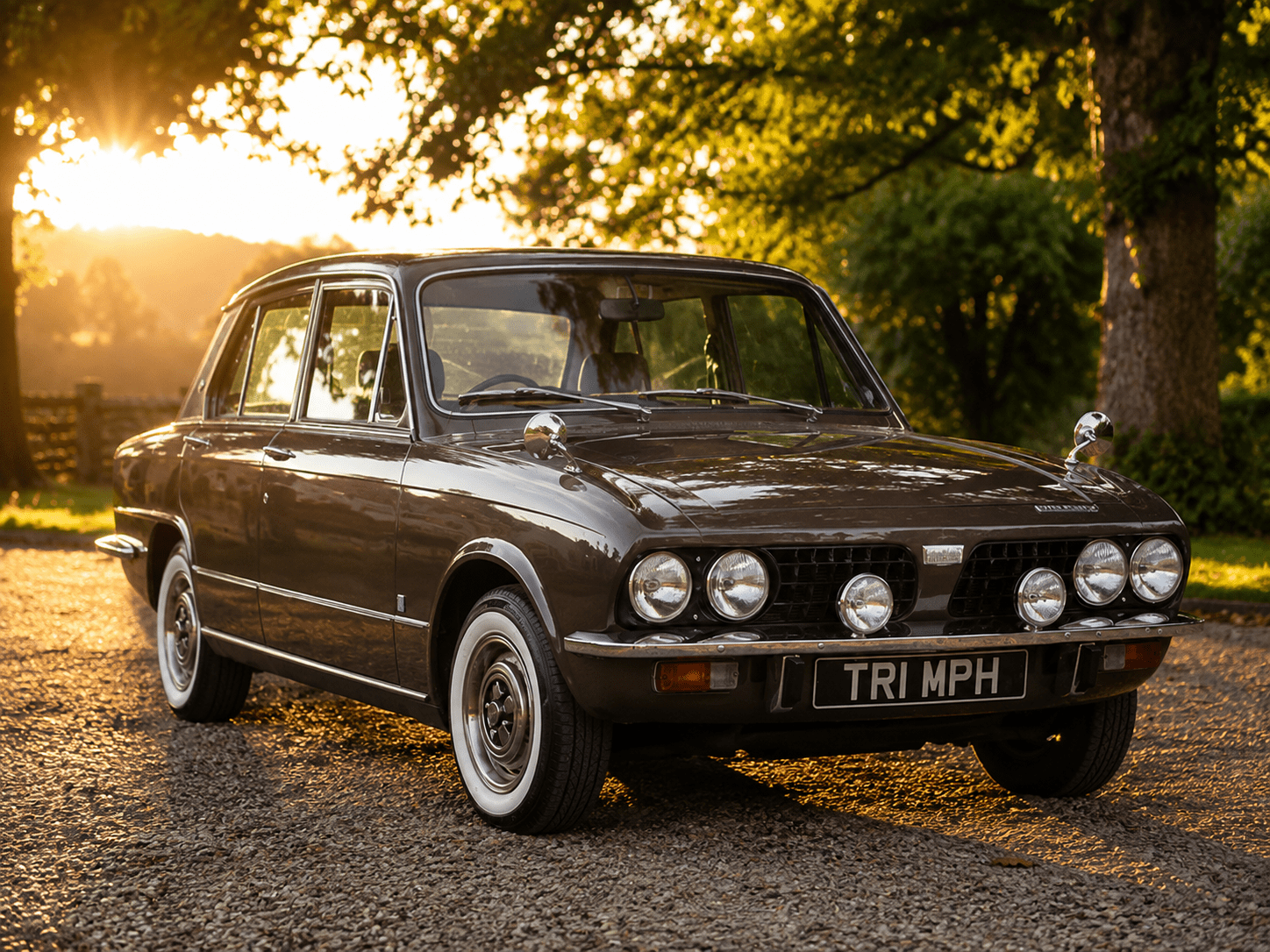
In 1973, Triumph put a 16-valve cylinder head on a 2.0-litre four-cylinder engine, fitted it to a four-door saloon, and sold it for a price that most buyers of the day considered ambitious but not outrageous. The Triumph Dolomite Sprint was, at the time of its launch, the first mainstream production car in the world to offer 16 valves. The fact that most people associate that distinction with hot hatchbacks that arrived a decade later is a measure of how comprehensively the Sprint has been overlooked in the popular history of fast saloons, and of how much value that has left on the table for buyers who know their history.
The 16-valve head was designed by Harry Mundy, the same engineer who created the Lotus twin-cam and who later developed the Jaguar V12. His solution for the Sprint was technically elegant: a single overhead camshaft operating all 16 valves via a combination of direct and indirect actuation, producing the multi-valve advantages without the cost and complexity of twin camshafts. The result was 127 brake horsepower from two litres in 1973, a 0-60 time of 8.7 seconds, and a top speed approaching 120 miles per hour in a four-door saloon. The GKN alloy wheels fitted as standard made the Sprint the first mass-produced British saloon to wear alloys as original equipment. Neither of these achievements gets the recognition they deserve.
The Dolomite family: who else is in it?
The Sprint was not built in isolation. The Triumph Dolomite range, launched in 1972, covered a spectrum from the modest to the rapid and the Sprint sat at the top of it. The engine underneath the range had an interesting history: the slant-four unit was originally funded by Saab, which needed a new engine for the Saab 99 and contracted Triumph to develop it. Saab’s period of exclusivity expired, Triumph retained the rights, and the engine went into a succession of Triumph products. It is why the Saab 99 and the Triumph Dolomite share an engine family, which is one of those pieces of automotive history that surprises people every time it is mentioned.
The Dolomite 1300 and 1500 used the pushrod engine from the Toledo rather than the Sprint’s overhead cam unit. They are modest cars, pleasant to drive at moderate speeds, and now very rare in good condition because they were not built to last and most did not. The 1500’s three-bearing crankshaft is a specific weak point that limits sustained high-speed cruising: the engine is happier with an overdrive fitted, and big-end bearing failures on unrestored 1500s are a known hazard. If offered a Dolomite 1500 at an attractively low price, the crankshaft is the reason.
The Dolomite 1850 used the 1,854cc version of the overhead cam slant-four producing 91 brake horsepower. It is a significantly better car than the 1300 or 1500, with genuine 100 miles per hour performance, a more refined driving experience, and the same basic architecture as the Sprint without the headline engine. The 1850 is the sensible Dolomite: quick enough to be entertaining, simple enough to maintain, and priced modestly enough that a good one can be found without a significant investment. The alloy head requires regular coolant changes; overheating will blow the gasket, and a Sprint or 1850 that has been allowed to boil at any point in its history should be inspected for head gasket condition before purchase.
The Sprint in detail
The Sprint’s 16-valve head is an alloy casting that requires specific attention and rewards careful maintenance. Coolant changes at the recommended intervals are not optional: the alloy head is less forgiving of neglect than a cast iron unit and more susceptible to the corrosion that results from old, depleted coolant. A timing chain that rattles on cold start is telling you it needs replacement before it causes more expensive damage. Oil leaks from the camshaft cover, front crankshaft seal, and various gaskets are common on high-mileage cars and are maintenance items rather than disasters, but a car that has been weeping oil for some time and not had it addressed may have accumulated secondary damage in the areas where oil has been running.
The twin SU carburettors fitted to the Sprint respond well to the setup described in our SU carburettor guide. A Sprint that has been incorrectly carburetted runs flat and uninspiring; one that is properly set up rewards the driver with a throttle response that feels surprisingly modern for a car of its era. The overdrive fitted to third and top gears from 1976 onwards is a significant benefit for regular road use and cars equipped with it are noticeably more relaxed at motorway speeds.
One specific warning about engine swaps: a proportion of Dolomite Sprints have had the 1500 engine fitted at some point in their lives, either as a temporary measure when a Sprint engine was unavailable or as a deliberate modification. The 1500 engine looks superficially similar in the bay but is a completely different unit with significantly less power and the weaker three-bearing crankshaft. It is a demotion in every meaningful sense. If the car presented as a Sprint does not feel like a 127 brake horsepower car when driven, check the engine number before proceeding.
Rust: the main chapter
The Triumph Dolomite rusts. This is not an unfair characterisation; it is a description of the car’s most consistent property in the absence of proper maintenance. The wheelarch lips go first, both inner and outer arches, and by the time the outer arch is visibly bubbling the inner arch has usually been bubbling quietly for some time beforehand. The door bottoms trap moisture and rust from the bottom up; the headlight surrounds rust in a way that is both visible and annoying to repair; the bonnet leading edge is vulnerable; the boot floor rots from water getting in through the boot seal, particularly if the bootlid seal has been allowed to deteriorate. This matters because second-hand Dolomite tanks are harder to find than you might expect.
The front bulkhead area, specifically around the brake and clutch reservoirs, is attacked by any brake fluid spillage that strips the paint and allows corrosion to take hold. Check this area with a mirror and a torch. The front subframe mountings and chassis legs need specific attention: serious corrosion here is a structural problem that affects the car’s safety and is costly to address properly. Footwells rot through; wet carpets are a warning sign rather than simply a comfort issue. The vinyl roof, fitted to many Dolomites as a popular 1970s option, retains moisture underneath it and rust develops unseen beneath what looks like a cosmetically sound roof covering. Run a hand firmly across any vinyl roof and feel for the rippling and softness that indicates corrosion beneath it.
Body repair panels are available for the most common rust areas, but original metal panels for the Dolomite are essentially unobtainable now. The Triumph Dolomite Club supplies front wings and the front panel in GRP (glass-reinforced plastic) for owners who are not committed to steel originality: these are a practical solution for cars being restored for regular use rather than concours.
On television: Bodie’s car
The Professionals aired its first series on ITV in December 1977, and in those early episodes CI5’s Bodie drove a Triumph Dolomite Sprint before the show’s production shifted to Ford product placement and the iconic Capris took over. The AROnline archive of cars from The Professionals notes that the Sprint suited Bodie’s character specifically: sharply dressed and always ready for action. It is a neat cultural observation and an accurate one. The Sprint in that context makes perfect sense: a fast, well-equipped British saloon that looks like a car for someone who takes their work seriously. When the Ford Capris arrived for later series they were faster and more flamboyant, but the Sprint was the more interesting car, and Bodie’s association with it in the first series is the kind of detail that Dolomite Sprint owners mention to anyone who will listen.
Andy Rouse won the 1975 British Saloon Car Championship in a Triumph Dolomite Sprint, demonstrating that the car’s competition credentials were not limited to its claimed 120 miles per hour top speed. The Sprint’s combination of light weight, a sophisticated engine, and handling that rewarded commitment made it more competitive in saloon car racing than its domestic-market positioning suggested it had any right to be.
The community
The Triumph Dolomite Club is the dedicated organisation for the full Dolomite range including the Sprint, with a technical register, a spares scheme, and the GRP panel supply mentioned above. The club also maintains build records that can confirm a Sprint’s original specification and help identify cars that have been modified or misrepresented. For a model where the difference between a properly specified Sprint and a Dolomite with a non-original engine significantly affects both value and the ownership experience, the club’s ability to confirm provenance is worth membership in itself. The wider Triumph Register and the Standard-Triumph owners community provide additional technical and social resources for Triumph owners generally.
What to pay
The Triumph Dolomite Sprint currently occupies a price range that makes it one of the most accessible genuinely interesting British classics available. Usable drivers from around £5,000 to £7,000; solid, well-maintained cars with good history from £8,000 to £12,000; excellent restored examples reaching £15,000 to £18,000. The ceiling has been rising as surviving good examples become rarer and awareness of the car’s technical significance grows. A properly sorted Sprint at £10,000 represents genuine value by the standards of comparable performance saloons of the era, and it is the kind of value that does not last indefinitely as the market catches up with the car’s historical importance. The Dolomite 1850 is available for considerably less and makes a sensible entry point for someone wanting the overhead cam engine without the Sprint’s premium.
For related reading: our Triumph TR6 buyers guide covers the contemporary Triumph sports car, our Triumph Herald and Vitesse buyers guide covers the earlier Triumph saloon range, our Triumph paint colour codes guide covers the full factory colour range for the Dolomite and Sprint, and our rust prevention guide covers the treatment and protection that will keep a Dolomite’s bodywork serviceable for considerably longer than neglect allows.
This page contains affiliate links. If you click a link and make a purchase, Classic Car Hub may earn a small commission at no extra cost to you.