
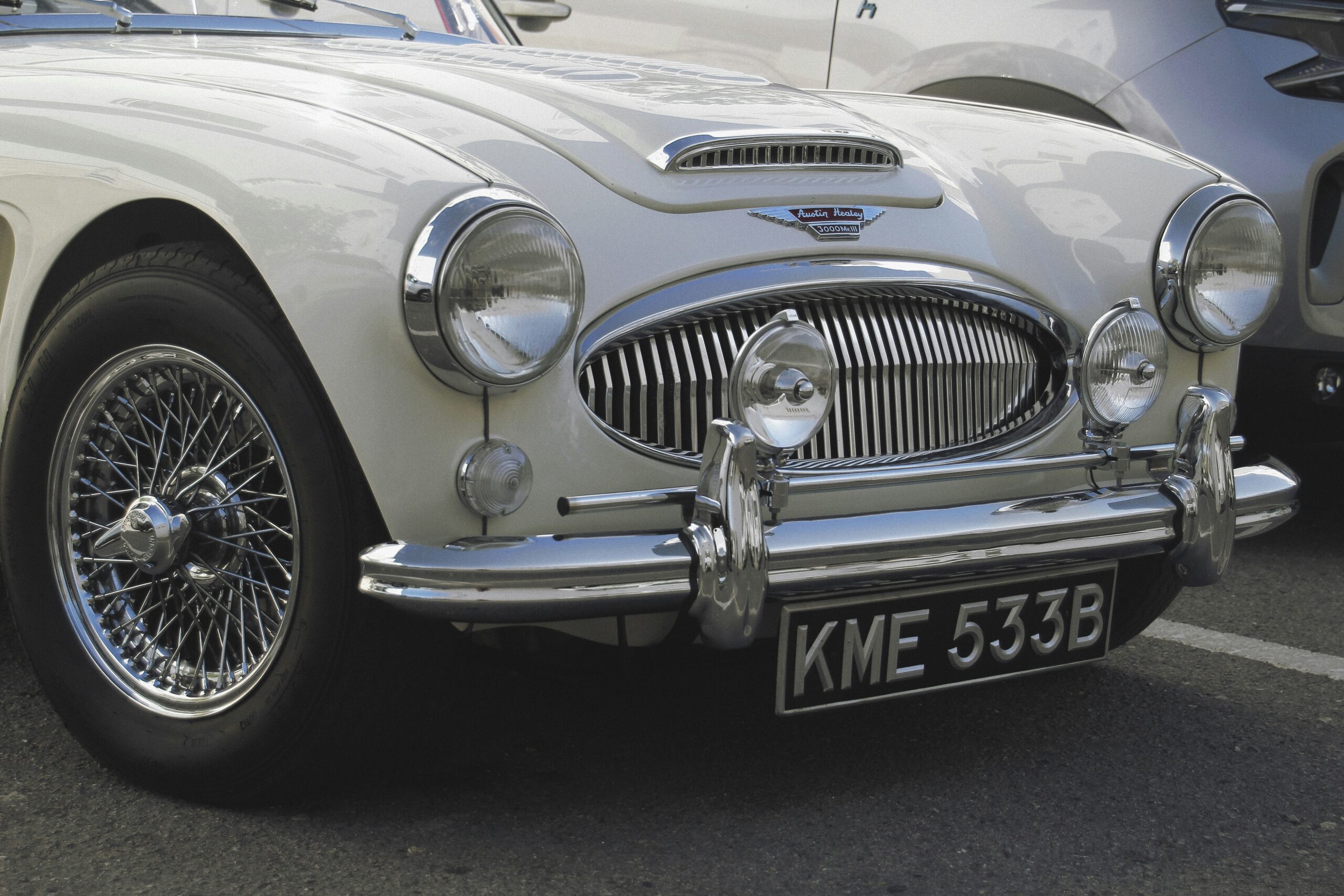
There is a sound that a well-tuned Austin-Healey 3000 makes at full throttle that is worth a considerable portion of the purchase price on its own. A deep, authoritative bark from the six-cylinder C-Series engine, the kind of sound that carries across a car park and causes people to stop whatever they are doing and look. The Big Healey does not announce itself subtly. It never did. In 1960, Pat Moss and co-driver Ann Wisdom drove one to outright victory in the Liège-Rome-Liège Rally, one of the toughest events in the European rally calendar, beating works cars from manufacturers with considerably more resources. They won in a car that, by the standards of serious rally machinery, was a large, heavy British roadster with a live rear axle. The fact that they did it anyway says something about both the car and the crew.
The Austin-Healey 3000 is one of those cars that rewards buying well and punishes buying badly in direct proportion to how well or badly you bought it. A sound, correct example is a genuinely wonderful machine. A poorly restored, heavily bodged example is an expensive and frustrating object lesson in doing the research before the purchase rather than after. The price differential between the two is real enough that the research is worth the effort.
The variants: which Big Healey do you want?
The Austin-Healey 3000 was produced from 1959 to 1967, replacing the 100-Six and using a 2,912cc version of the BMC C-Series six-cylinder engine. Within those eight years, the car went through several distinct variants that differ in meaningful ways.
The 3000 Mk I (BN7 and BT7, 1959 to 1961) was the original: 124 brake horsepower, disc brakes at the front with drums at the rear, and triple SU carburettors. The BN7 was a true two-seater; the BT7 offered a rudimentary 2+2 configuration. The triple SU installation is complicated to tune correctly and expensive to rebuild. BMC moved away from it for good reasons, and most experienced owners and specialists suggest that anyone buying a triple-carburettor car should budget for either the proper setup cost or the conversion to the later twin SU arrangement.
The 3000 Mk II (BJ7, 1962 to 1964) replaced the triple carburettors with a pair of larger HS4 SUs, raised power to 131 brake horsepower, and added wind-up side windows, which transformed the car’s habitability in a way that anyone who has tried to use a tonneau cover in the rain will appreciate. A brake servo was available as an option. Most specialists regard the BJ7 as the point where the Big Healey became a properly usable road car rather than an exciting but demanding sports car.
The 3000 Mk III (BJ8, 1964 to 1967) is the one to have. Two-stage twin HD8 SUs, 150 brake horsepower, a revised cylinder head, a standard brake servo, a wood-veneer dashboard, improved interior trim, and the most refined driving experience of any Big Healey. The BJ8 Phase I (1964 to 1965) had a fold-down hood; the Phase II from 1965 gained improved weather sealing. The final BJ8s, built in the run-up to the 1967 production end, are the most developed and most desirable Austin-Healeys of all, and their values reflect this. Around 10,800 BJ8s were built and good examples consistently reach £80,000 and above.
What to look for
The body and chassis: the main event
The Big Healey’s body was built by Jensen Motors of West Bromwich, and Jensen’s welding method for attaching the upper body panels to the floor creates a specific problem when serious rust arrives: the repair is more complex and more expensive than it would be on a conventionally constructed car, because the floor and the body sides are not independent components that can be addressed separately. When you inspect a Big Healey, the floor, sills, inner sills, A-posts, B-posts, and the body side swages all need careful checking. A magnet and a careful probe of anything that sounds hollow will tell you more than a visual inspection alone.
The ladder-frame chassis rusts in the main rails and the outriggers. Tap along the length of the main rails and listen for the change in resonance that indicates corrosion within the section. Chassis straightness matters: a car that pulls to one side with no steering input, or that shows inconsistent panel gaps across the two sides of the car, has either suffered an impact or has a chassis that has distorted with corrosion. Both are expensive problems. The factory applied no meaningful rustproofing, and decades of British and European road salt have done their predictable work on cars that were not subsequently treated. Any car being seriously considered for purchase warrants a proper inspection by a marque specialist with the car on a lift.
The suspension and brakes
Look at the rear of the car from a short distance and check the ride height. If the car sits noticeably high at the back, the springs have been replaced, probably recently, and new springs on a BJ8 take time to settle. This is not a serious problem but it is worth knowing and worth confirming. The ground clearance on the Big Healey is limited under the standard springs, and aftermarket replacements that sit the car too high make it look wrong and change the handling geometry. All 3000s have disc brakes at the front and drums at the rear. The BJ8 has a standard servo: check it works by pressing the brake pedal with the engine off, then starting the engine while maintaining foot pressure. The pedal should fall slightly as the servo assists. No movement indicates a failed servo. Check the wire wheels for loose spokes, corrosion at the hub splines, and security of the knock-off spinners. Grease the splines every 5,000 miles and this will be a minor maintenance item; neglect them and it becomes an expensive one.
The engine and drivetrain
The C-Series six-cylinder is a robust engine when maintained. Check the oil pressure: 50 to 60 psi at 3,000 rpm in a healthy engine. Oil leaks are common on older engines but significant leaks from the front or rear crankshaft seals deserve investigation. Blue smoke at startup or under load indicates bore or valve stem wear. The overdrive unit, where fitted, is a significant comfort improvement for motorway cruising and a desirable feature: ensure it engages cleanly and promptly, and does not slip or hunt between in and out. An overdrive that engages slowly or feels uncertain is usually the solenoid or the oil level, both of which are manageable. One that slips under load needs professional attention.
A music video worth knowing about
In 1985, Tears for Fears released the video for “Everybody Wants to Rule the World.” It is a charming piece of mid-1980s music television involving a great deal of open road, some appropriate hair, and a British Racing Green Austin-Healey 3000 as the car of choice. The video was shot in part on the roads of California, and the Big Healey looks entirely correct in that landscape: long, low, purposeful, and slightly out of place in the modern world in a way that has always been one of its attractions. The association has given the song and the car a useful cultural connection across two generations of listeners, and it is probably responsible for at least a handful of Big Healey purchases by people who watched it in the mid-1980s and never entirely forgot the car.
The community
The Austin Healey Club is the main UK organisation for all Austin-Healey models, with an extensive network of regional centres, a well-stocked technical advice service, and a membership that includes some of the most knowledgeable Big Healey owners and restorers in the country. The club runs a concours programme, a motorsport register, and events calendar that covers most of the year. For a car that requires the level of specialist knowledge the Big Healey demands, being part of the club before and after the purchase is sensible rather than optional. The technical helpline has solved problems that would otherwise have required a specialist visit, and the register maintains records of surviving cars that can help confirm a car’s history and previous ownership.
What to pay
Values in 2025: runners needing work from around £27,000 to £30,000. A solid, honest driver in good but not concours condition sits at £45,000 to £55,000. Excellent, properly restored BJ8 examples reach £80,000 to £96,000. True concours-specification cars with documented history and correct numbers exceed £100,000. The Hagerty Price Guide shows the BJ7 and BJ8 at closely comparable values to the BN1 and BN2 100s, which suggests the market values condition and correctness over heritage for the Big Healey. A well-bought BJ7 at a realistic price represents better value than a poorly-bought BJ8 at an ambitious one. The usual rule applies: buy the car, not the asking price, and have it inspected before commitment.
For related reading: our Frogeye Sprite buyers guide covers the smaller Austin-Healey, our SU carburettor guide is directly relevant to the HS4 and HD8 units on the 3000, and our positive to negative earth conversion guide covers one of the most common electrical upgrades on pre-1967 Big Healeys.
This page contains affiliate links. If you click a link and make a purchase, Classic Car Hub may earn a small commission at no extra cost to you.