
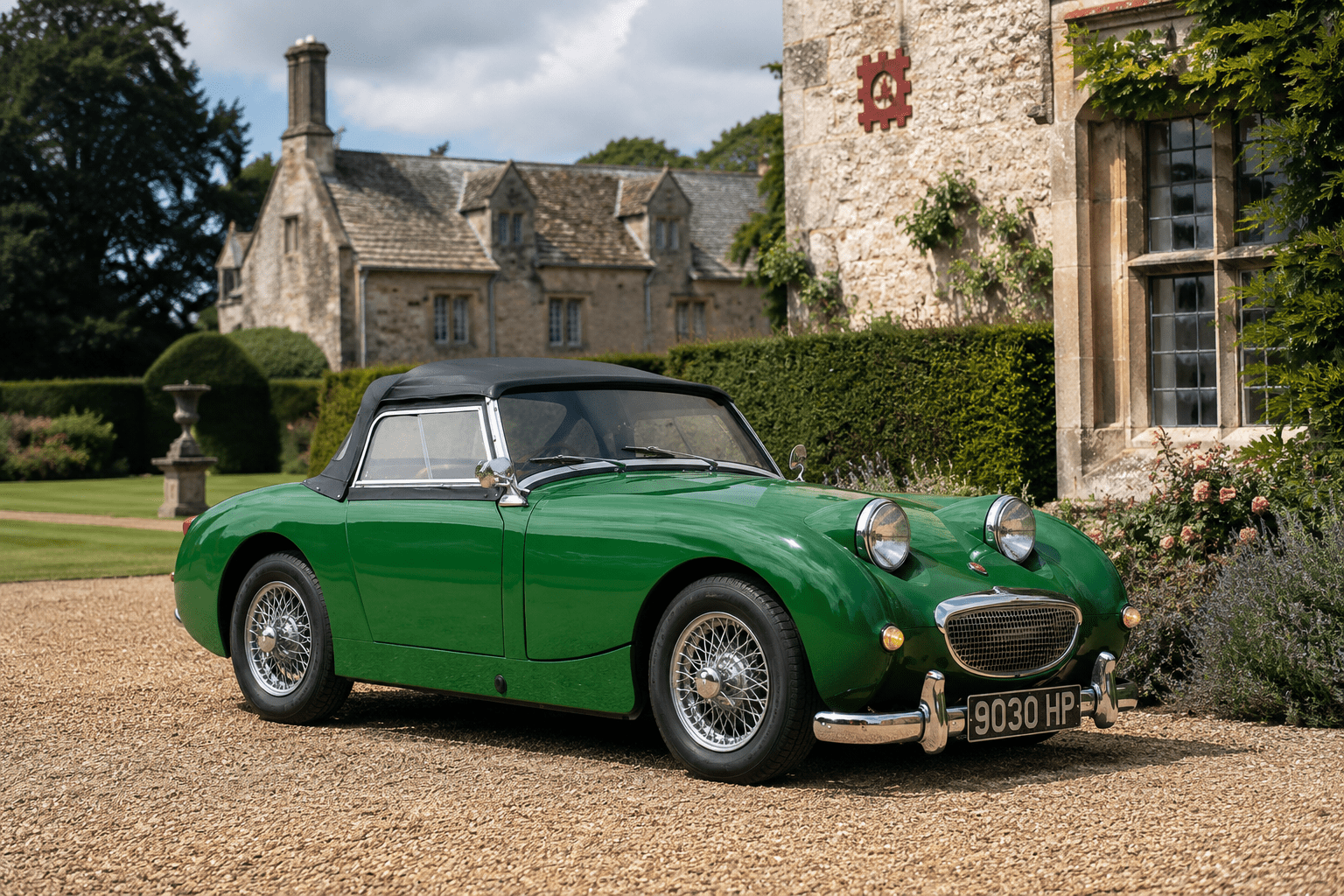
In May 1958 the Austin-Healey Sprite went on sale in Britain for £669. This was slightly less than the price of a Morris Minor Deluxe saloon at the time, which is remarkable when you consider that the Sprite was a proper sports car with a tuned twin-carburettor engine, a rack and pinion steering, independent front suspension, and handling that contemporary road testers described with genuine enthusiasm. The price was achieved by the simple method of leaving out anything that was not absolutely necessary. There were no outside door handles. There was no boot lid: luggage was accessed by folding the rear seat back. The hood mechanism was basic. The headlamps were fixed in position because the originally planned retractable headlamp system was too expensive to implement.
The result of this engineering parsimony was a car that weighed approximately 660 kilograms, handled with the directness that only very light cars achieve, and looked unlike anything else on the road. The headlamps, fixed in raised pods above the bonnet line to comply with lighting regulations, gave the car its permanent nickname: Frogeye in Britain, Bugeye in America. Production lasted just three years before the Sprite Mk2 of 1961 arrived with a conventional bonnet and repositioned headlamps. The 48,987 Frogeyes built represent the only three years in which Alec Issigonis’s intention for the car, in its most original and uncompromised form, was available to buy.
Specifications
| Specification | Detail |
|---|---|
| Production years | May 1958 to March 1961 |
| Total built | Approximately 48,987 |
| Engine | 948cc BMC A-Series 4-cylinder OHV |
| Carburettors | Twin SU H1 1.25 inch |
| Power | 43 bhp @ 5,200 rpm |
| Torque | 52 lb ft @ 3,300 rpm |
| Gearbox | 4-speed manual, synchromesh on 2nd, 3rd, top |
| Final drive | 4.22:1 |
| Suspension front | Independent, wishbone and coil spring (Austin A35 derived) |
| Suspension rear | Live axle, quarter-elliptic leaf springs |
| Steering | Rack and pinion (Morris Minor rack) |
| Brakes | Drum all round, 7 inch front, 7 inch rear |
| Kerb weight | Approximately 660 kg (1,456 lb) |
| 0–60 mph | Approximately 20 seconds |
| Top speed | Approximately 83 mph |
| Original price (1958) | £669 |
Dimensions
| Measurement | Dimension |
|---|---|
| Wheelbase | 2,032 mm (80 in) |
| Length | 3,353 mm (132 in) |
| Width | 1,346 mm (53 in) |
| Height (hood up) | 1,194 mm (47 in) |
What the numbers mean in practice
A 0-60 time of 20 seconds looks unimpressive on paper. In a car weighing 660 kilograms, it feels entirely different. The Autocar’s original road test in 1958 noted that “performance is definitely lively for a car of this engine size” and praised the handling as “excellent for a car in this price range.” Both observations remain accurate. The Frogeye’s performance is not about acceleration in absolute terms; it is about the quality of the interaction between driver, controls, and road at speeds that are entirely legal and entirely enjoyable. The steering is quick and direct, the gearchange is satisfying, and the quarter-elliptic rear springs, despite their agricultural simplicity, provide a ride that is firm without being punishing.
The engine, derived from the Austin A35 but running twin SU carburettors and stronger valve springs, is more characterful and willing than its modest output suggests. It rewards being kept in the power band and is one of the more appealing versions of the A-Series in any form. The lack of a boot lid is the only genuinely inconvenient original specification feature, and even this is mitigated by the reasonable capacity of the behind-the-seat storage space and the fact that most Frogeye owners are not using the car for airport runs.
Identifying an original Frogeye
The Frogeye is immediately identifiable by its single-piece front section: the bonnet, wings, and nose all hinge forward together as one unit, revealing the engine and front suspension simultaneously. This one-piece construction is unique to the Frogeye Sprite; all subsequent Sprites and MG Midgets have a conventional separate bonnet. The raised headlamp pods are integral to the bonnet pressing and cannot be retrofitted to a later car. The body itself is narrow, low, and has a particularly short tail with the characteristic upswept rear wings.
Early production cars (approximately the first 500) lack external door handles entirely: the doors were opened by reaching through the window aperture to the internal release. This was changed early in production when the obvious inconvenience became apparent. A car presented as an early Frogeye without door handles is either genuinely early production or has had the handles removed. Either way it is worth confirming the commission number against the production records held by the Austin Healey Club.
The Spridget lineage
The Frogeye’s chassis and mechanical package became the foundation for a production run that extended well beyond the original car’s three years. The Sprite Mk2 of 1961, with its conventional bonnet and repositioned headlamps, used the same basic floor pan and running gear with a larger 948cc engine in revised tune. The badge-engineered MG Midget arrived simultaneously, sharing everything mechanical with the Sprite Mk2 while wearing MG badging for customers who preferred Abingdon to Healey. The shared Sprite/Midget platform continued through four generations until 1979, giving the Frogeye a design lineage of over twenty years. The original car, however, is valued precisely because it predates that continuity and carries the character of the original uncomplicated intention.
Values overview
The Frogeye occupies a specific position in the classic car market: it is the only Sprite that commands a significant premium over the later Sprite and Midget variants on the basis of its unique body design and original character. Demand is strong and consistent, with the international market particularly active. Condition and originality matter considerably: a correct, unmodified Frogeye with its original body panels and mechanical specification is worth substantially more than a modified or incorrectly restored example. The one-piece bonnet and associated body panels are specific to the Frogeye and cannot be sourced from a later Sprite, which means good original body condition carries a premium over accident-damaged or poorly repaired examples.
For current market values, our classic car valuation page tracks what Frogeyes are actually selling for across condition grades and in the current market.
Owners club and community
The Austin Healey Club covers the Frogeye Sprite alongside the Big Healeys, with a Sprite and Midget register that maintains records of surviving cars and provides technical advice specific to the early cars. The club’s ability to cross-reference commission numbers with build records is particularly valuable for confirming a car’s original specification and early production detail. The Frogeye Sprite community is active internationally, with strong interest from the United States where the Bugeye has always had a significant following. Parts availability is generally good through Moss Europe, Rimmer Bros, and the TSSC, though some body-specific panels for the unique one-piece nose section require specialist sourcing.
For related reading: our Frogeye Sprite buyers guide covers what to look for in detail, our MG Midget buyers guide covers the related Midget range that shares the Frogeye’s mechanical heritage, and our SU carburettor guide covers the twin H1 units fitted to the Frogeye.
This page contains affiliate links. If you click a link and make a purchase, Classic Car Hub may earn a small commission at no extra cost to you.