
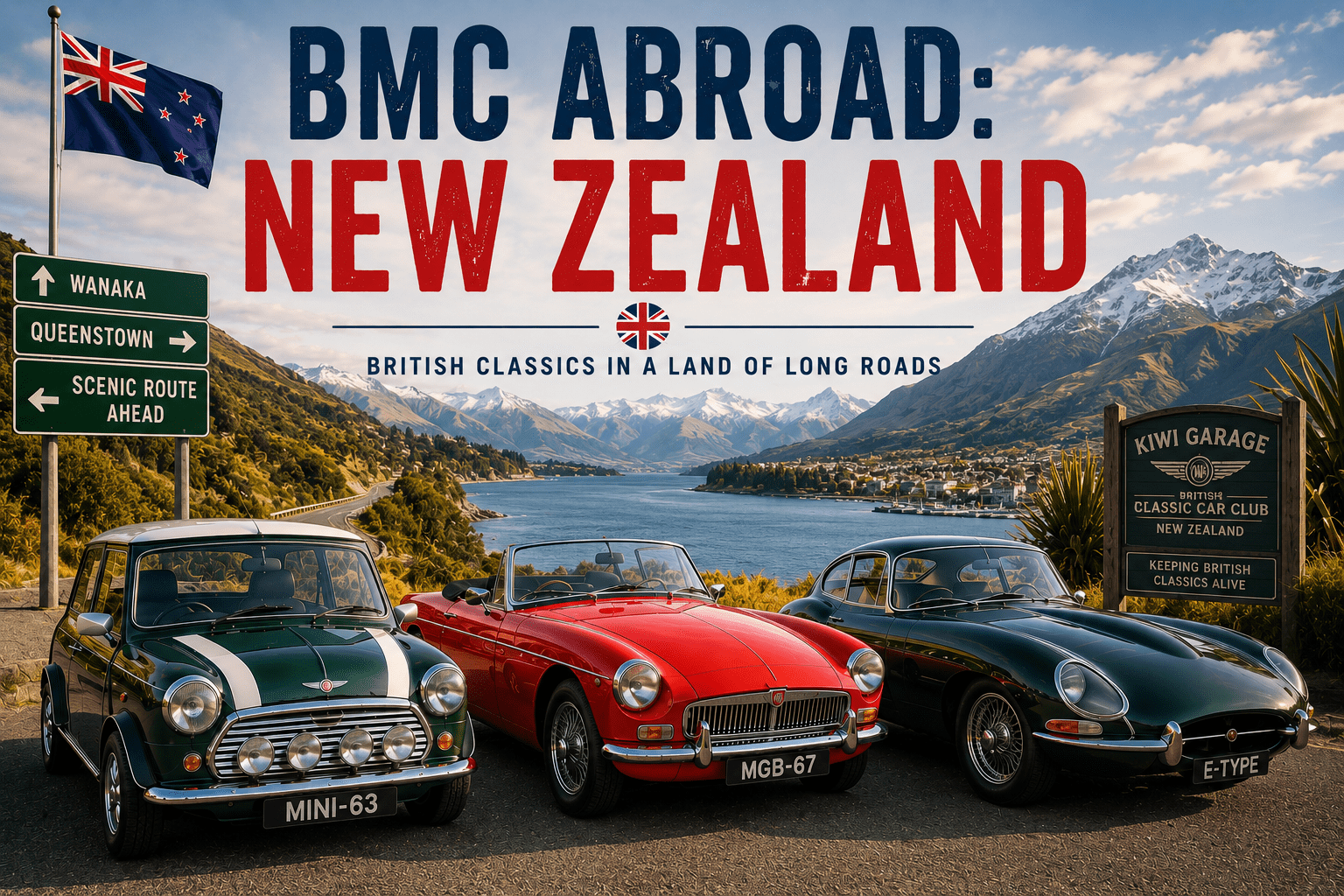
New Zealand and Britain have been sending things to each other since the 1840s: wool, butter, lamb, emigrants, and for much of the twentieth century a considerable quantity of British cars were shipped out and there was a considerable enthusiasm for them when they arrived. The Commonwealth connection meant that New Zealand drove on the left, used right-hand drive vehicles, and for several decades purchased British cars as the natural default rather than an imported eccentricity. Austin, Morris, Triumph, MG, and the broader BMC and British Leyland ranges were not exotic in New Zealand. They were simply what most people drove, assembled locally from kits shipped from Longbridge and Cowley, in factories that were producing cars in the Wellington region from as early as 1946.
The result is a country that has preserved a remarkable number of classic British cars, in condition that regularly astonishes British enthusiasts encountering them for the first time. The reason for that condition is simple and significant…
The factories at Petone
Lower Hutt, the suburban area north of Wellington that stretches along the floor of the Hutt Valley, was the centre of New Zealand’s car assembly industry for most of the postwar period. The Todd Motors plant in Petone dated from 1935, assembling Chrysler and Dodge products alongside Hillmans, Humbers, and Sunbeams for the Rootes Group. Austin opened their own dedicated plant on Western Hutt Road in Petone in 1946, assembling cars from CKD (Completely Knocked Down) kits shipped from Longbridge. It is a pleasing geographical footnote that Peter Jackson, director of the Lord of the Rings trilogy and a man whose relationship with New Zealand’s landscape is well documented, grew up in Pukerua Bay just north of Petone. The Austin factory was, quite literally, in his neighbourhood.
The New Zealand Motor Corporation (NZMC) was formed in 1970 when the Austin Distributors Federation merged with Dominion Motors, consolidating the local British car assembly operation under a single entity. The NZMC assembled ADO16 cars (the 1100 and 1300 range) at both Auckland and Petone, and the Triumph range had its own assembly facility in Nelson, established in 1965. At their peak in the early 1970s, Todd Motors, the NZMC, General Motors, and Ford together accounted for over 80 percent of new cars sold in New Zealand. The British component of that figure was substantial, and the cars that came off those local assembly lines are now the classics that fill the car parks at VCC events on Sunday mornings throughout the country.
The reason New Zealand classics look the way they do
New Zealand does not salt its roads. This statement, simple enough in itself, has consequences for classic car preservation that British enthusiasts find either deeply reassuring or mildly infuriating depending on whether they are buying or selling. In Britain, road salt applied between October and April attacks the sills, floors, and chassis of any car that is driven through winter. The cumulative effect of decades of salt exposure is the primary reason that finding a structurally sound classic British car in the UK requires patience, a good torch, and a willingness to probe things with a screwdriver. The cumulative effect of no salt exposure, combined with the generally dry climate of much of the South Island and the eastern North Island, is that classic British cars in New Zealand frequently retain the original body and floor condition that their UK counterparts lost thirty years ago.
A Morris Minor that has spent its life in Canterbury, garaged in winter and driven in summer, will typically have floors and sills in a condition that a UK Minor restorer would find implausible. The same applies to MGBs, Triumph Spitfires, Austin A40s, and any other classic British car that was assembled or imported new into New Zealand and kept there. The absence of salt corrosion means that the structural condition of the car often follows the paint and the mechanicals rather than preceding their collapse by a decade, which is a fundamentally different ownership experience.
This is not merely of academic interest to British owners. New Zealand and Australia have become source markets for UK enthusiasts and restorers specifically because the cars there have structural integrity that UK equivalents often lack. A New Zealand-sourced MGB shell in the right condition represents a restoration starting point that simply does not exist in many UK counterparts of the same age, and the specialist importers who have been shipping them back across the world for the past twenty years are doing a brisk trade due to precisely this understanding.
The landscape question
New Zealand is 1,600 kilometres long, has two main islands with entirely different characters, and contains within those islands a range of scenery that takes some adjusting to when encountered in person after a lifetime of the English Home Counties. The Waikato region of the North Island, with its rolling green hills and the kind of pastoral perfection that looks slightly too good to be real, is familiar to a global audience as the Shire from Peter Jackson’s Lord of the Rings films, shot at Hobbiton near Matamata. Driving through those hills in a classic Morris Minor, which is an entirely achievable thing to do, produces a specific variety of contentment that the Morris’s designers in Cowley probably did not specifically anticipate but would have appreciated.
The South Island provides the dramatic alternative: the Southern Alps, the Canterbury Plains, the Otago Peninsula, and the Mackenzie Country, where the scale of the landscape makes even the most confident British classic feel small in the best possible way. The roads that cross the South Island’s mountain passes were not designed with soft suspension in mind, and a well-sorted Triumph or MGB on the Crown Range Road between Queenstown and Wanaka is involved in a conversation with the landscape that cannot be replicated anywhere in Britain. The distance between petrol stations in some parts of the South Island does introduce a certain discipline to fuel planning that somewhat adds to the adventure.
The regulations: Warrants, the VCC, and an ongoing conversation
New Zealand’s approach to classic car regulation has historically been more prescriptive than Australia’s Club Permit scheme or Britain’s MoT exemption for pre-1977 vehicles, and the classic car community has been making this point to successive governments with increasing emphasis. Classic vehicles in New Zealand currently require an annual Warrant of Fitness (WoF), the NZ equivalent of a roadworthiness certificate. For a car that is driven fewer than 5,000 kilometres a year, the annual WoF frequency is disproportionate to the actual road time involved, and the VCC has long argued that the requirement reflects regulations designed for daily drivers rather than for vehicles that are maintained to a high standard and used occasionally.
In early 2025 the NZ government opened a consultation on extending WoF intervals for vehicles over 40 years old, which the classic car community received with cautious optimism. The VCC’s position, supported by the LVVTA (Low Volume Vehicle Technical Association) and the Federation of Motoring Clubs, is that the appropriate regulation for a well-maintained historic vehicle maintained by a knowledgeable owner in a specialist club environment is different from the regulation appropriate for a twenty-year-old hatchback driven daily by someone with no mechanical interest. This is a conversation that will continue, and the outcome of the 2025 consultation is awaited with interest.
The Vintage Car Club of New Zealand is also the Historic Motoring Authority of New Zealand: it issues the Date of Manufacture and Authenticity Statements that NZTA recognises for vehicle classification purposes, which gives the club a formal role in the regulatory framework rather than simply an advocacy position. For imported classic British cars, the VCC’s processes for establishing original specification and manufacture date are the starting point for any registration and compliance work.
The community
The Vintage Car Club of New Zealand (VCC), self-described as the Historic Motoring Authority of New Zealand, is one of the largest motoring clubs in the country with over 8,000 members and 36 branches from Northland to Southland. The club covers all vehicles over 30 years old: cars, motorcycles, commercial vehicles, and historic racing machinery, in a non-one-make philosophy that produces events with the kind of variety that single-marque clubs rarely match. The Canterbury Branch at Cutler Park, the North Shore Vintage and Classic Car Club in Auckland, and the Hawke’s Bay branch at Napier are among the most active regional organisations. The Banks Peninsula branch has a particular focus on competitive events and hillclimbs that has attracted members from across the South Island.
NZ Classic Car magazine, published monthly since December 1990 and based in Grey Lynn, Auckland, is recognised by the NZ government as an authority for defining a classic or special interest vehicle: a status that gives it a formal regulatory role alongside its editorial one. For British classic owners in New Zealand, it is the primary print resource for events, technical advice, and the ongoing regulatory situation.
The cars today
The Morris Minor is the most numerous classic British car in New Zealand, which is exactly what you would expect from a car that was assembled locally from 1946 and sold in large numbers throughout the 1950s and 1960s. The NZ Minor community is substantial, active, and in possession of a significant number of unrestored original examples that would be the envy of any UK owner. The MGB and Midget range, the Triumph Spitfire, the Austin-Healey Sprite variants, and the broader BMC/BL saloon range are all well represented and well supported through the VCC’s branch network and the marque-specific registers that operate within it.
The ADO16 cars assembled at the NZMC’s Petone and Auckland plants are a specific New Zealand story: locally assembled from Longbridge kits, many of them have remained in New Zealand throughout their lives and represent a lineage that connects the Wellington valley directly to the Cowley design offices and the Longbridge production lines. They are, in the most literal sense, British cars that became New Zealand cars, and the community that keeps them running is a long way from Longbridge but doing so with considerable dedication and no road salt whatsoever to complicate the project.
For technical guidance on the cars most commonly found in New Zealand: our Morris Minor buyers guide covers the most numerous survivor, our rust prevention guide is relevant to any NZ classic being imported to the UK where conditions are considerably less forgiving, and our SU carburettor guide covers the fuel system used across the BMC range assembled at Petone. For the wider series: the BMC Abroad landing page covers all entries to date.
This page contains affiliate links. If you click a link and make a purchase, Classic Car Hub may earn a small commission at no extra cost to you.