
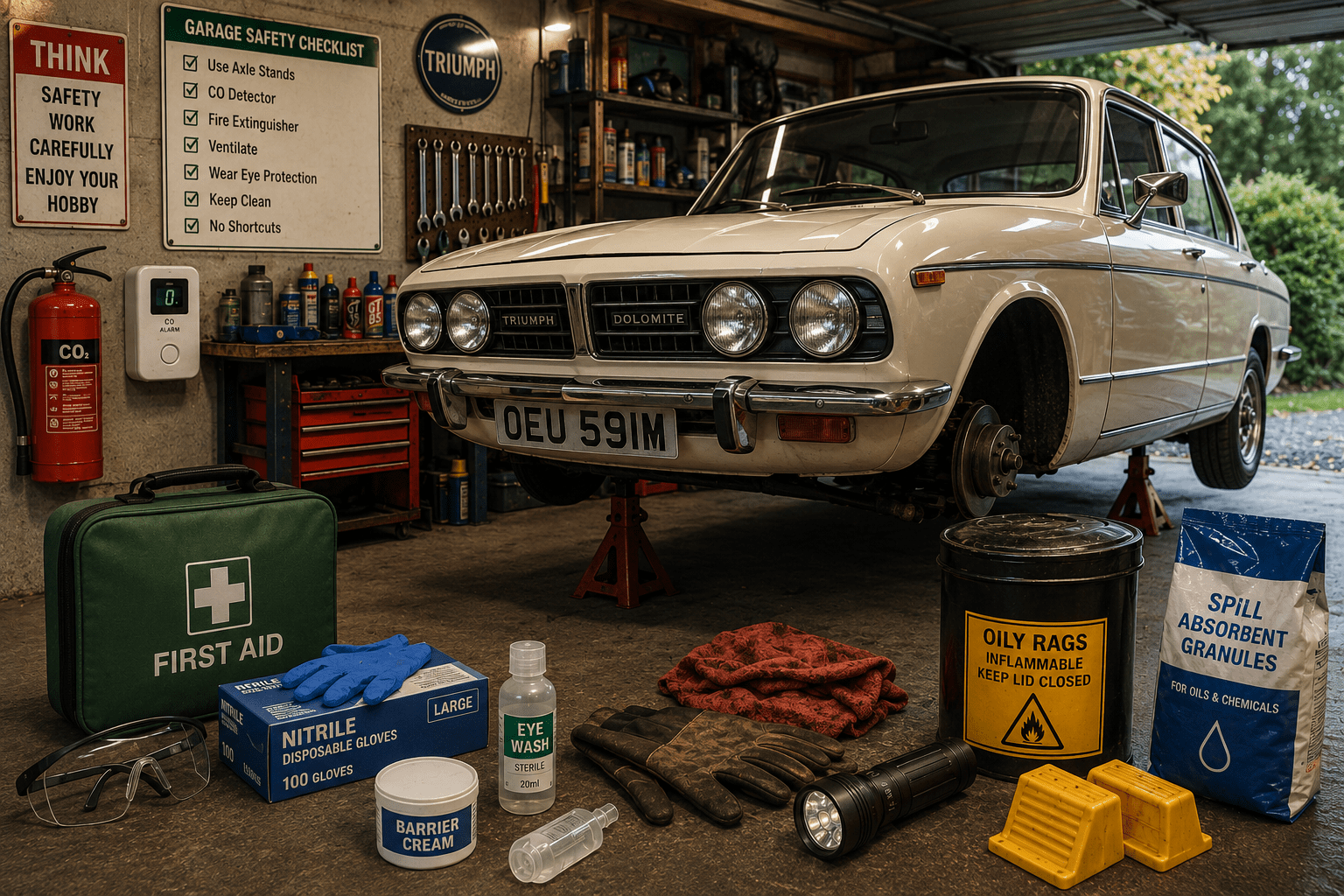
The classic car garage is a wonderful place. It smells of oil and history, it contains things that need attention and the means to attend to them, and it represents the kind of focused, purposeful solitude that is increasingly hard to find in the modern world. It is also, if you are not paying attention, a very efficient way to hurt yourself. Petrol, electricity, chemicals, heavy objects at considerable height, and power tools that do not understand the difference between metal and fingers: all of these are present in most classic car garages, and most of the time they coexist without incident. The times they do not are, unfortunately, entirely preventable in hindsight.
This guide is not a lecture. It is a practical inventory of the things worth having, the habits worth forming, and the situations worth avoiding, written for people who use their garage regularly and would like to continue doing so without interruption. Most of it is common sense. Some of it will be new. All of it takes less time to implement than a trip to A&E, which remains, as ever, the only meaningful benchmark.
Lifting the car: the most important section in this guide
More workshop injuries involving classic cars come from lifting and supporting them incorrectly than from any other single cause. A car falling off a jack or inadequate support is not a minor incident. It is a life-changing one. This is the section to read most carefully.
The trolley jack that came with the car, or the small scissor jack from the boot, is for changing a wheel at the roadside. It is not a workshop jack. It provides a single, unstable contact point, has a low safety factor, and is not designed for work that requires the car to remain raised for more than a few minutes. Buy a proper workshop trolley jack with a minimum capacity of 2 tonnes and a saddle that sits stably under the car’s jacking points. A decent low-profile trolley jack from Toolstation or Machine Mart costs around £40 to £80 and is one of the most worthwhile tools in the garage.
The jack raises the car. Axle stands hold it there. These are two separate tools with separate functions and both are required. Never work under a car supported only by a jack. Hydraulic jacks can and do fail, seals leak, and the consequences of a car falling while you are beneath it are not compatible with continued participation in the hobby. A set of four axle stands costs around £25 to £40 from Toolstation or Screwfix. Buy the correct weight rating for your car, place them under the vehicle’s designated support points (consult the workshop manual if unsure), and lower the car onto them before going anywhere near the underside.
Drive-on ramps are a practical alternative for oil changes and exhaust work where full access beneath the car is not required. They are stable, simple to use, and require no secondary support. Check the weight rating before purchase: most classic British cars are well within the capacity of standard ramps, but verify rather than assume. Ensure the ramps are on a flat surface, the car is in gear with the handbrake applied, and wheel chocks are placed behind the rear wheels before going beneath.
A brief but important note on improvised supports: concrete blocks, bricks, wooden pallets, piles of wheels, and the engine block from the previous project have all been used to support cars at some point in the history of classic car ownership. None of them is appropriate for this purpose. The failure mode of a crushed brick or a split pallet under a car’s weight is not gradual. Use axle stands.
Fire: prevention first, response second
The classic car garage contains petrol in fuel tanks, in carburettors, and often in tins and containers used during carburettor work and cleaning. It contains engine oil, gear oil, brake fluid, and aerosol sprays. Most of these are flammable or combustible, and all of them become significantly more dangerous when combined with a spark, a hot surface, or an open flame in the wrong place.
Petrol deserves particular attention because petrol vapour is heavier than air: it settles at floor level and accumulates in low points, drains, and inspection pits. A pool of spilled petrol you cannot smell may still have vapour present in the surrounding area. Any ignition source, including the starter motor on a poorly running engine, the static discharge from a synthetic fleece, or a power tool that produces sparks, is sufficient. Clean up spills immediately, ventilate the garage before any sparks are possible, and store petrol in an approved metal container with a proper lid, away from ignition sources.
Keep a fire extinguisher in the garage. The correct type for a workshop with petrol, oils, and electrical equipment is either a CO2 extinguisher (clean, no residue, suitable for all three hazard types) or an ABC dry powder extinguisher (effective on all classes of fire but leaves significant residue that damages everything it touches). A CO2 extinguisher is the better choice for a workshop containing a car you care about. A 2kg CO2 extinguisher costs around £25 from Toolstation and covers the typical garage adequately. Mount it near the exit door so it is accessible from outside in the event of a fire that blocks the interior.
Oily rags are a specific and frequently underestimated hazard. Rags soaked in linseed oil or certain other drying oils can self-ignite through oxidation exothermic reaction: the oil oxidises slowly and generates heat, which can reach ignition temperature if the rags are bunched together in a warm environment. Keep oily rags in a metal bin with a lid, or in a sealed metal container, and dispose of them regularly rather than allowing a collection to build up.
Carbon monoxide: the invisible problem
Running a car’s engine in an enclosed garage, even briefly, produces carbon monoxide in quantities that can reach dangerous concentrations within a few minutes. Carbon monoxide is colourless and odourless: you cannot detect it without a monitor, and its first meaningful symptom is impaired judgement, which is precisely the wrong time to notice something is wrong. People have died in their own garages from carbon monoxide poisoning while running engines for entirely routine purposes, including warming up after a cold start or listening for a fault. The garage door must be fully open, not ajar. Fit a carbon monoxide detector in the garage. They cost under £20 from most hardware retailers and will alarm before concentrations reach dangerous levels. Do not run the engine at all in an enclosed space without this protection in place.
Chemicals and hazardous materials
The working classic car garage accumulates a collection of substances that require some thought about handling, storage, and disposal.
Brake fluid is hygroscopic (absorbs moisture from the air), which is relevant to maintenance, but it is also a paint stripper. If brake fluid contacts painted bodywork, wash it off with cold water immediately. It will soften and lift paint within minutes if left. Old brake fluid drained during a change must not go down the drain. Take it to a local household recycling centre or an oil bank: it is classed as hazardous waste.
Battery acid (sulphuric acid) from old or leaking lead-acid batteries causes chemical burns to skin and eyes. Wear gloves and eye protection when handling batteries, particularly when removing a battery that shows signs of leakage. Neutralise any spills with bicarbonate of soda (baking soda) and water before cleaning up. Modern sealed batteries are significantly less likely to vent acid than older types, but the risk is not zero, particularly on a deeply discharged or overcharged battery.
Coolant (antifreeze) is toxic to animals and has a sweet smell and taste that makes it attractive to pets and wildlife. Do not leave drained coolant in open containers in the garage. Dispose of it correctly at a recycling centre and clean up any spills from the floor before allowing animals into the workspace.
Asbestos warrants a specific mention for classic car owners. Brake linings and clutch friction materials on many British cars produced before the mid-1980s may contain asbestos. This is not a reason for alarm in normal driving conditions, where the material is safely bonded within the friction surface. It is a reason for care when grinding, cutting, or machining old brake components, or when blowing out brake drums with compressed air. Do not use compressed air to clean old brake assemblies. Use a damp cloth, work outdoors, and wear a proper P3-rated respirator. If in doubt about whether a component contains asbestos, treat it as though it does and handle accordingly.
Electrical safety: 12 volts and 240 volts
The 12-volt electrical system of a classic car feels safe by comparison with mains voltage, and in most respects it is. However, a car battery can deliver very high short-circuit currents, and a spanner or ring that bridges the battery terminals or touches a live terminal against the car’s bodywork will heat to red in seconds, causing serious burns and potentially igniting nearby fuel or material. Remove rings, watches, and metal bracelets before working near the battery or doing any electrical work on the car. Disconnect the battery when carrying out any work that involves extended access to the vehicle’s wiring.
Mains electrical equipment in the garage requires the same thought as in any workshop environment. Extension leads should be rated for workshop use and fully unwound before use: a coiled extension lead carrying significant current generates heat in the coil that can cause the cable to fail. Use RCD-protected sockets for all mains equipment in the garage: a residual current device trips in milliseconds if current leaks to earth, limiting the risk of electrocution from a faulty tool or damaged cable. RCD adapters for standard sockets cost around £10 to £15 and are a worthwhile addition to any garage.
Use low-voltage or battery-powered inspection lights rather than mains-voltage fluorescent tubes on extension cables under the car. A dropped mains-voltage fluorescent tube that breaks in petrol vapour has obvious potential consequences. LED inspection lights that run from a USB power bank or rechargeable batteries are inexpensive, produce excellent light, and carry none of the same risk.
Eye, hand, and body protection
Safety glasses cost around £3 at Toolstation. An eye injury that removes you from work, driving, and the workshop for weeks costs considerably more than that in every meaningful dimension. Wear safety glasses for angle grinding, drilling, wire brushing, working under the car, and any job where debris or fluid could reach the eyes. A surprising number of serious eye injuries in home workshops happen not from obvious high-speed tasks but from mundane ones: removing a spring clip that pings unpredictably, using a wire brush on a rusty component, or draining a coolant hose with more pressure remaining in the system than expected.
Nitrile gloves protect hands from oils, solvents, brake fluid, and coolant during most workshop tasks. Keep a box of disposable nitrile gloves (available in bulk from Toolstation for around £10 per 100) and use them for any task involving sustained chemical contact. Barrier cream applied to bare hands before workshop tasks provides an additional layer of protection and makes cleaning up significantly easier. Prolonged skin contact with used engine oil is a known skin cancer risk: this is not scaremongering, it is the reason engineers developed barrier cream.
For angle grinding, welding, and any task generating significant sparks or heat, wear appropriate protection as covered in our welding guide. A leather apron or welding jacket, heavy gloves, and the correct face protection are not optional for these tasks.
What to keep in the garage
Beyond the tools specific to the work in hand, the following items earn their shelf or wall space in any classic car garage:
- CO2 fire extinguisher (2kg minimum): mounted near the exit. Checked annually for pressure and condition.
- Carbon monoxide detector: fitted and tested. Battery replaced annually.
- Axle stands (two pairs of four): rated for your vehicle’s weight. Never used as storage furniture.
- Workshop trolley jack (2-tonne minimum): hydraulic fluid checked periodically, stored with the ram lowered.
- Safety glasses: at least two pairs, kept clean. They are no use in the drawer.
- Nitrile gloves (box of 100): correct size so they are actually worn.
- Barrier cream: used before jobs, not as an afterthought.
- Eye wash station or sealed eyewash bottles: within reach of any area where chemicals are handled.
- Metal bin with lid: for oily rags. Emptied regularly.
- Wheel chocks (two pairs): used every time the car is raised. Not optional because the handbrake works.
- RCD adapters: on all mains socket extensions used in the garage.
- Torch or LED inspection light: battery-powered, for under-car use.
- Spill absorbent granules or cat litter: for dealing with fluid spills on the floor quickly and cleanly.
The first aid kit
A first aid kit in the workshop is not a legal requirement for a private individual, but it is a reasonable precaution given what garages contain and what happens in them. The kit should be stocked for the actual risks present: cuts, burns, eye contamination, and chemical contact. A standard BS 8599-1 compliant first aid kit covers most of this, but the following specific additions are worth including for a classic car environment:
Workshop First Aid Kit: What to Include
Keep this in a clearly labelled, waterproof container mounted on the wall at eye level. Everyone who uses the garage should know where it is.
Cuts and wounds
- Assorted waterproof plasters (blue workshop plasters are recommended as they are visible if they fall into a component)
- Non-adhesive wound dressings (medium and large)
- Sterile gauze pads
- Conforming bandages (two or three)
- Micropore tape
- Disposable gloves for treating others
- Wound closure strips
Burns (heat and chemical)
- Burnshield gel sachets or burn dressings (cool the burn, do not use butter, oil, or toothpaste)
- Sterile burn dressings (two sizes)
- Cling film (clean, unused roll) (an effective emergency burn covering while seeking further treatment)
Eye contamination
- Sealed single-use eyewash pods (minimum 4 x 20ml): for flushing chemicals, brake fluid, or battery acid from the eye
- Eye dressing pad
- Note: for chemical eye contamination, flush with water or eyewash continuously for at least 10-15 minutes and seek medical attention regardless of how the eye feels afterward
General
- Scissors (blunt-ended)
- Tweezers (for splinters and debris)
- Triangular bandage and safety pins
- Foil emergency blanket
- First aid guidance card
- Notepad and pen (for recording time of injury, treatment given)
Useful additions specific to workshop use
- Bicarbonate of soda (for neutralising battery acid spills on skin: make a paste with water, apply, rinse thoroughly)
- Small bottle of clean water (for rinsing before eyewash is used)
- Ibuprofen or paracetamol (for after the incident, not instead of treatment)
Check the kit every six months. Replace anything used, anything past its expiry date, and anything that has been damaged by damp or heat. A first aid kit that has not been checked since the previous owner installed it is not meaningfully different from not having one at all.
Working alone
The reality of most classic car work is that it is done alone, often in the evening, often when no one else is in the house or nearby. This is fine for the vast majority of tasks. It is less fine for the specific situations where something going wrong quickly leads somewhere serious: working under a raised car, working near a running engine in an enclosed space, and any task involving high-voltage electrical equipment.
The practical measures are straightforward. Tell someone when you are working in the garage, particularly for extended sessions. Keep your phone within reach, not in a jacket pocket in the house. If you are working under the car alone, make a point of confirming your location with someone before starting. These are minor inconveniences that carry disproportionate value in the event of something going wrong. The other thing that carries disproportionate value is not being the sort of person who dismisses this paragraph as excessive, because statistically speaking the people who dismiss it most confidently are the ones who have not yet had the experience that changes their view.
Organisation, housekeeping, and the floor
A tidy workshop is a safer workshop. This is not a lifestyle observation: it is a practical one. Tools left on the floor are tripped over. Trailing cables catch feet and pull equipment off benches. Fluid spills that are not cleaned up immediately become slip hazards, particularly in an unheated garage in winter where any oily patch becomes unpredictable when cold. Clutter around a raised car limits the speed at which you can move away from it if something shifts.
Floor paint or sealed concrete reduces the slip hazard from spills and makes cleaning significantly easier. Rubber anti-fatigue matting at the workbench reduces the strain of standing on a concrete floor for extended periods and provides better grip underfoot than bare concrete. Good lighting is not optional: a poorly lit garage causes eye strain during precision work and means hazards, both physical and mechanical, are harder to see. LED strip lighting across the full ceiling area, supplemented by a directional LED work light for close work, is the standard setup for a workshop where detail matters.
Dispose of waste fluids correctly. Used engine oil, brake fluid, coolant, and solvent waste should go to your local household recycling centre. Pouring them down the drain is illegal, causes genuine environmental harm, and will bring you into contact with the local water authority in circumstances you would prefer to avoid. Most recycling centres have a dedicated oil and fluid bank that takes all of these without any formality.
A brief list of things not worth doing
Things Not Worth Doing. Ever.
- Working under a car supported only by a jack
- Running the engine in a closed garage without a CO detector
- Using petrol as a parts-washing solvent near any ignition source
- Blowing brake dust out of old drums with compressed air indoors
- Using a naked flame to check for fuel leaks
- Leaving the battery connected while doing electrical work
- Storing petrol in a plastic container not rated for fuel
- Grinding without eye protection because it is only a quick pass
- Charging a battery in an enclosed space without ventilation (hydrogen gas is produced during charging)
- Welding near fuel lines, tanks, or anything that has ever contained petrol without confirming it is safe
- Using wooden blocks, bricks, or the stack of wheels in the corner instead of axle stands
None of the above is on this list because someone invented it for completeness. Each one is there because it has caused a serious injury or worse at some point in someone’s garage. Classic car ownership is one of the genuinely enjoyable things a person can spend their time and money on, and the precautions in this guide exist to keep it that way. They take minutes to implement and a lifetime to be glad you did.
For further reading on specific workshop tasks: our beginner’s guide to MIG welding covers welding-specific safety in detail, our electrical fault finding guide covers working safely on classic car wiring, and our springtime safety check guide covers the annual inspection that keeps the car safe on the road as well as the garage safe while it is being worked on.
This page contains affiliate links. If you click a link and make a purchase, Classic Car Hub may earn a small commission at no extra cost to you.