
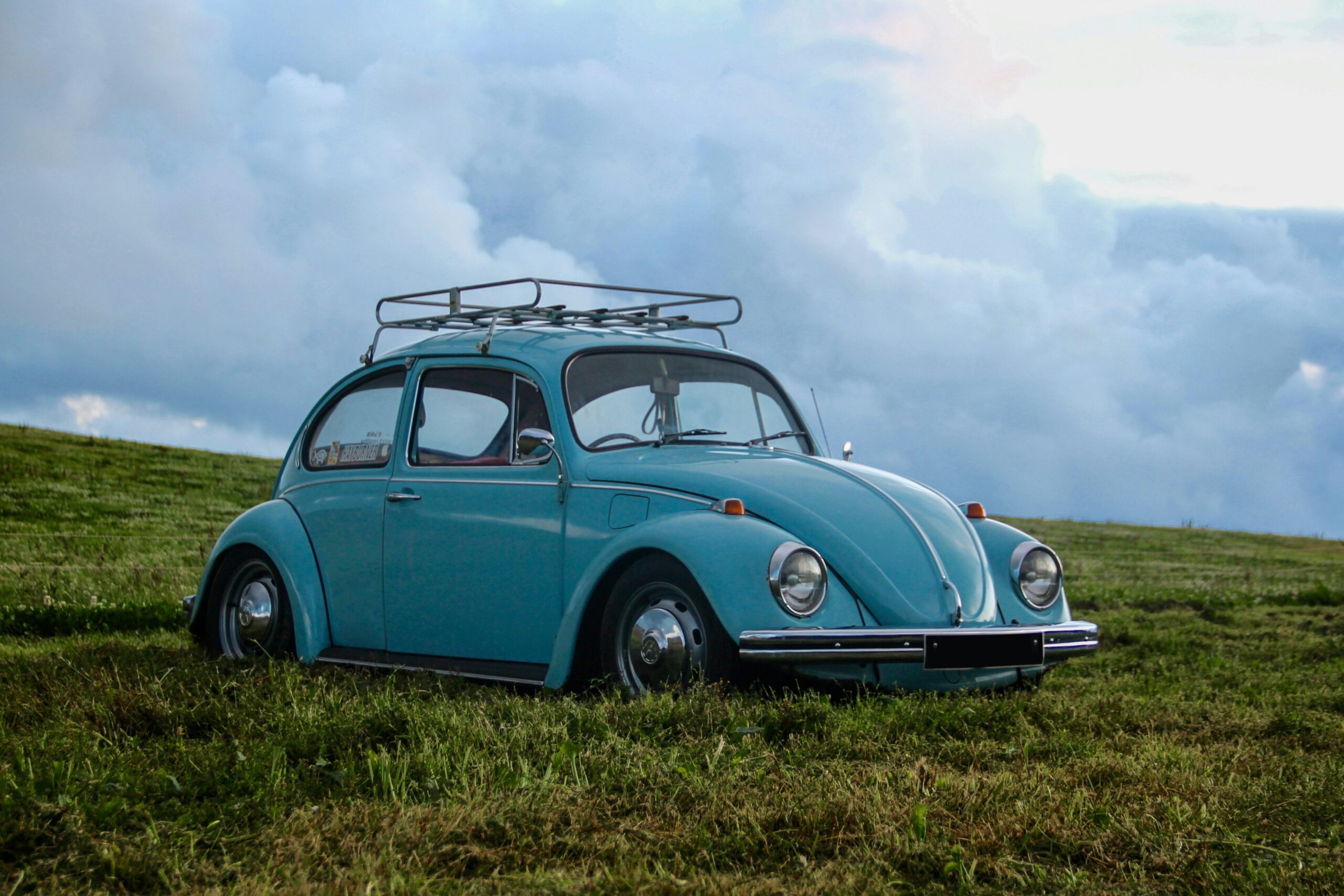
Few cars in history have achieved the cultural status of the Volkswagen Beetle. Originally conceived in 1930s Germany and developed into a practical, affordable people’s car, the Beetle became one of the most produced automobiles ever made. Over 21 million were built across its production life, a figure that no other single car model has surpassed. In the UK, the Beetle arrived in meaningful numbers during the 1950s and became a familiar and much-loved sight on British roads for four decades.
The classic air-cooled Beetle, produced from 1945 to 1979 in Germany (and continuing in Mexico until 2003), is the car that enthusiasts pursue today. Its rear-mounted air-cooled flat-four engine, torsion bar suspension, and bodyshell that barely changed across three decades made it simple, durable, and mechanically predictable. It is also, it must be said, one of the most charming and distinctive vehicles ever to emerge from any factory anywhere.
Buyers today are drawn by the Beetle’s iconic appearance, its simplicity, its strong international community, and values that remain accessible relative to other classics of equivalent cultural significance. The right car, properly maintained, is a genuinely enjoyable and reliable classic.
Quick Facts
| Detail | Information |
|---|---|
| Years produced | 1945 to 1979 (Germany); 1980 to 2003 (Mexico) |
| Manufacturer | Volkswagen |
| Body styles | 2-door saloon, convertible (Karmann) |
| Engine options | 1131cc, 1192cc, 1285cc, 1493cc, 1584cc air-cooled flat-four |
| Power range | Approximately 25bhp to 50bhp |
| Transmission | 4-speed manual; automatic option on later models |
| Drive layout | Rear-wheel drive |
| Approx. UK value range | £4,000 to £35,000 depending on year and condition |
Specifications
| Specification | 1200 (1192cc) | 1300 / 1500 (later models) |
|---|---|---|
| Engine | 1192cc air-cooled flat-four | 1285cc or 1493cc air-cooled flat-four |
| Power | Approx. 34bhp | Approx. 40 to 44bhp |
| Torque | Approx. 56lb/ft | Approx. 69 to 78lb/ft |
| Gearbox | 4-speed manual | 4-speed manual |
| Suspension | Torsion bar front and rear | Torsion bar front and rear |
| Brakes | Drum all round | Drum all round (disc front optional on 1500) |
| Kerb weight | Approx. 750kg | Approx. 820kg |
| Top speed | Approx. 72mph | Approx. 78 to 82mph |
| 0 to 60 mph | Approx. 27 seconds | Approx. 20 to 24 seconds |
Model Variants
| Variant | Years | Engine | Power | Key Differences | Typical UK Value |
|---|---|---|---|---|---|
| Split-Screen (Type 1) | 1945 to 1953 | 1131cc or 1192cc | 25 to 30bhp | Two-piece rear window, oval dashboard | £18,000 to £40,000+ |
| Oval Window | 1953 to 1957 | 1192cc | 30bhp | Single oval rear window, distinctive profile | £12,000 to £30,000 |
| Standard 1200 | 1957 to 1965 | 1192cc | 34bhp | Larger rear window, revised interior | £6,000 to £18,000 |
| 1300 / 1500 | 1966 to 1970 | 1285cc or 1493cc | 40 to 44bhp | More practical engine options, upright headlamps | £5,000 to £16,000 |
| 1302 / 1303 Super Beetle | 1970 to 1975 | 1584cc | Approx. 50bhp | MacPherson strut front suspension, curved windscreen on 1303 | £5,000 to £15,000 |
| Karmann Cabriolet | 1949 to 1980 | Various | Various | Factory convertible by Karmann, strong demand | £10,000 to £35,000 |
For best value, a solid 1300 or 1500 from the late 1960s offers the most practical combination of usable performance and accessible pricing. The most desirable cars are the Split-Screen and Oval Window models from the early 1950s, which command significant premiums for original examples. The Karmann Cabriolet is the most sought-after open car. For a beginner classic, a clean 1302 or 1303 from the early 1970s represents the most mechanically straightforward starting point.
Common Problems
- Floorpan and chassis tunnel rust: The steel floorpan is the primary structural element on the Beetle and is highly vulnerable to rust, particularly along the outer edges and around the chassis tunnel. This is the most important structural check on any Beetle purchase.
- Rear beam and torsion housing corrosion: The rear torsion bar housings rot from the outside. Check carefully as replacement is involved and expensive on older cars.
- Front beam corrosion: The front torsion bar beam corrodes similarly. Check the beam carefully and look for previous repair work or fresh paint concealing problems.
- Heater channel rust: The heater channels running along each side of the floor are a notorious rust location. They also form part of the body structure. Rotten heater channels are a significant and expensive repair.
- Engine oil leaks: The air-cooled engine leaks from the pushrod tubes and crankshaft seals as a matter of course on older examples. Some seepage is normal. Heavy leaks or oil reaching the exhaust indicate more serious attention is needed.
- Valve adjustment neglect: The air-cooled engine requires regular valve clearance adjustment. Neglected valve clearances cause top-end noise and reduce engine life. Ask about service history and check for any tapping from the engine.
- Electrical simplicity issues: The Beetle’s electrical system is basic but the single-wire earth return system causes problems when earth connections corrode. Test all electrical components.
- Interior deterioration: Original interior trim is increasingly scarce for earlier cars. Reproduction items are available but quality varies significantly.
Running and Maintenance
The air-cooled Beetle engine is among the simplest automotive engines ever fitted to a mass-produced car. Regular valve adjustments, oil changes, and attention to the carburettor are the primary maintenance requirements. Any mechanically competent owner can carry out most routine work.
Parts availability is excellent. The Beetle’s enormous production numbers and long production life mean that mechanical components are widely available from VW specialists and general suppliers. Body panels for later cars are available as reproductions. Earlier cars require more specialist sourcing.
Vehicles of this age qualify for free historic vehicle road tax, covering the entire German production run and the earliest Mexican cars.
UK Values
| Condition | Standard 1200/1300 | 1302 / 1303 | Karmann Cabriolet | Split / Oval |
|---|---|---|---|---|
| Project | £1,500 to £3,500 | £2,000 to £4,500 | £4,000 to £8,000 | £8,000 to £16,000 |
| Usable | £4,000 to £8,000 | £5,000 to £10,000 | £10,000 to £18,000 | £18,000 to £30,000 |
| Good | £8,000 to £14,000 | £10,000 to £16,000 | £18,000 to £28,000 | £28,000 to £40,000 |
| Excellent or concours | £14,000 to £22,000 | £14,000 to £22,000 | £28,000 to £38,000 | £40,000+ |
The Beetle market is broadly stable with stronger movement at the top end. Unrestored original cars in solid condition are increasingly sought after. Split-Screen and Oval Window cars continue to appreciate. Cabriolets in good condition hold value consistently. Condition, originality, and documented history are the main value drivers.
Buyer’s Tips
- The floorpan is the most important structural element. Inspect underneath carefully and probe along the outer edges and heater channels with a screwdriver.
- Check the front and rear torsion bar housings for corrosion. These are structural and expensive to replace correctly.
- Start the engine from cold and listen for tapping, which indicates overdue valve adjustment. A healthy air-cooled engine starts readily and settles to a smooth idle.
- Check the date codes on major components if originality matters to you. Numbers-matching cars command a premium.
- For pre-1967 cars, check whether the car has been converted from 6-volt to 12-volt electrical system. This is a common and generally sensible modification but worth knowing about.
- The VW Owners Club and the Historic Volkswagen Club can both assist with pre-purchase advice and valuations.
- An independent inspection by a VW specialist before purchase is strongly recommended for any car where the asking price is significant.
Current Listings and Parts
Use the links below to browse current UK listings, parts and spares for the Volkswagen Beetle.
- Browse Volkswagen Beetle classic cars for sale on eBay
- Browse Volkswagen Beetle parts and spares on eBay
- Browse Volkswagen Beetle restoration parts on eBay
Find More Classic Car Information
Looking for buyers guides, workshop advice, paint codes or restoration tips for your favourite classic? Search the Classic Car Hub below.
Frequently Asked Questions
Is the Volkswagen Beetle a good classic car?
Yes. The Beetle’s combination of simplicity, strong parts availability, enormous community support, and undeniable visual appeal makes it one of the most accessible and enjoyable classics available. It is not a fast car but it is a rewarding and characterful one.
Is the Volkswagen Beetle reliable?
The air-cooled engine is simple and durable with regular maintenance. Reliability depends primarily on valve adjustment intervals and oil change frequency. A well-maintained Beetle is straightforward and dependable. Neglected examples develop predictable and generally manageable problems.
What are the main problems with the Volkswagen Beetle?
Floorpan and heater channel rust are the primary structural concerns. Torsion bar housing corrosion front and rear is a secondary structural issue. Neglected valve clearances cause engine wear. The single-wire earth electrical system causes gremlins when connections corrode.
Are parts easy to find for the Volkswagen Beetle?
Generally yes. The Beetle’s extraordinary production numbers mean mechanical parts are widely available. Body panels for later cars are produced as reproductions. Earlier Split-Screen and Oval cars require more specialist sourcing but the global community means parts can usually be found.
Is the Volkswagen Beetle a good investment?
Early Split-Screen and Oval Window cars have appreciated consistently. Karmann Cabriolets hold value well. Standard saloons are broadly stable. Original unrestored cars in solid condition are increasingly desirable. The Beetle’s global recognition means demand is unlikely to diminish.
This page contains affiliate links. If you click a link and make a purchase, Classic Car Hub may earn a small commission at no extra cost to you.