
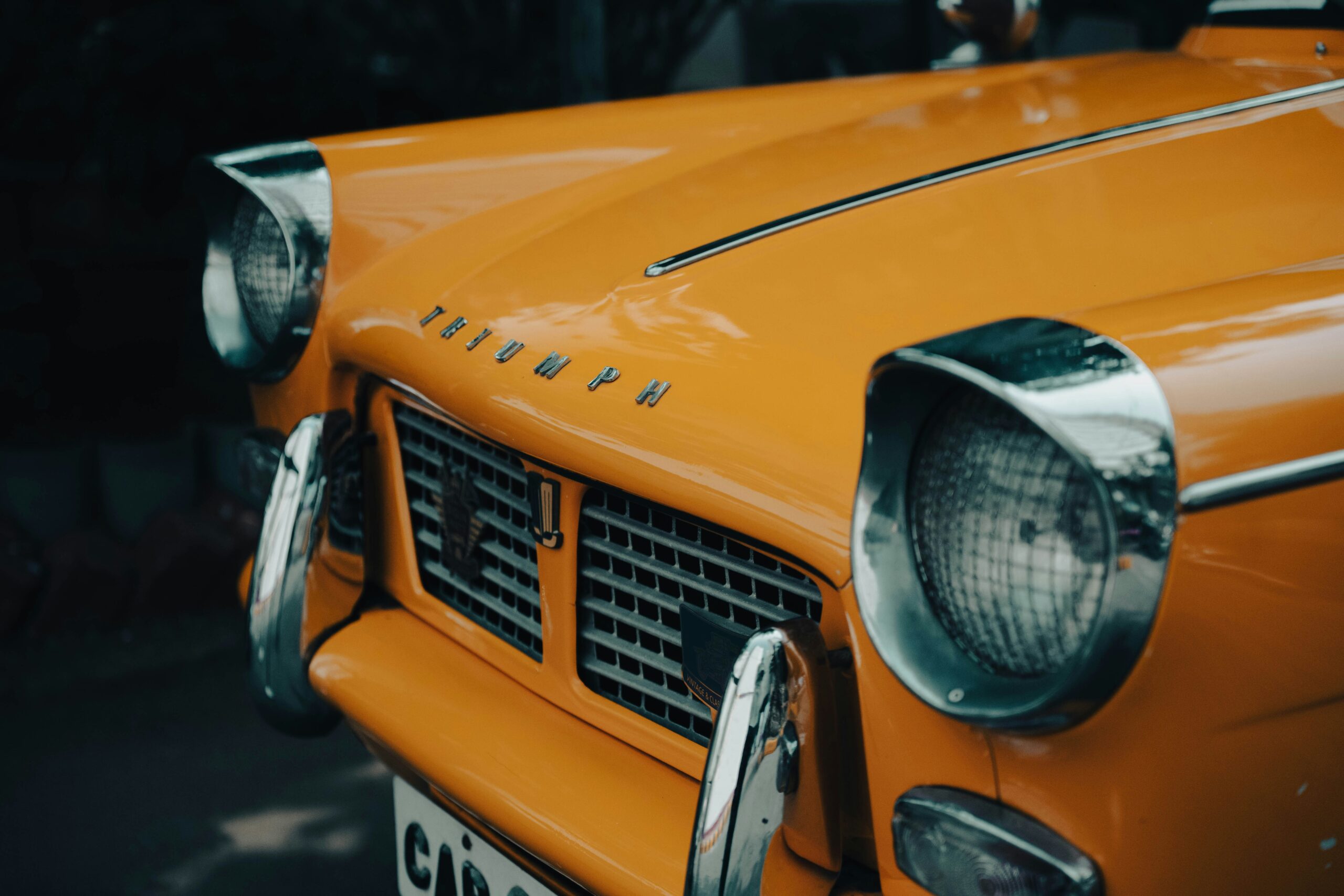
The Triumph Herald and its six cylinder sibling the Vitesse represent something genuinely unusual in the classic car market: cars where the engineering is the selling point rather than an afterthought. The separate chassis, the fully independent suspension all round, the bolt-on body panels, the near-perfect turning circle that puts London taxis to shame. These are not accidents of design. They are the result of a very clever Italian stylist working to a brief from a very clever engineer, and the result is a car that is significantly more interesting than its modest reputation suggests. If you are considering a first classic and want the full picture, our guide to choosing your first British classic covers the Herald alongside four other strong contenders.
The story behind the Herald
The Herald’s development was driven partly by necessity and partly by ambition. Standard-Triumph in the late 1950s could not afford the press tooling for a conventional monocoque body, which required enormously expensive stamping dies for each panel. The solution, arrived at by chief engineer Harry Webster, was to use a separate backbone chassis with simple, largely flat body panels that could be produced with relatively modest tooling investment. Giovanni Michelotti was commissioned to style the body around this engineering constraint and produced something that looked considerably more expensive than it was, which is one of the more impressive feats of automotive design of the era.
The Herald launched in 1959 with a 948cc four cylinder engine and an independent rear suspension system using swing axles, the same arrangement that would later appear in the Spitfire and GT6. The turning circle of 25 feet was extraordinary for a car of any size and remains remarkable today. The complete body could be unbolted from the chassis, which made major repairs significantly more accessible than on any monocoque car. These were not incidental qualities. They were deliberate design decisions that have made the Herald one of the most practical classics to restore and maintain fifty years later.
Herald or Vitesse?
The Vitesse was introduced in 1962 as a sporting development of the Herald using a 1596cc six cylinder engine in place of the Herald’s four. Where the Herald is the sensible, practical, endearing choice, the Vitesse is the one that makes you grin slightly more on a country road. Both share the same basic chassis, body structure, suspension design, and general architecture. The choice between them comes down primarily to how much performance you want and how much you are prepared to pay for it, since the Vitesse commands a meaningful premium over equivalent Heralds.
Herald variants
The Herald was produced in saloon, convertible, estate and coupe body styles, though the coupe was discontinued in 1964. The saloon is the most common and most affordable. The convertible is the most desirable and the most expensive. The estate is the most practical and slightly undervalued relative to its usefulness. The Herald 1200, introduced in 1961 with a 1147cc engine, is the most commonly available variant and the best starting point for most buyers. The 13/60, introduced in 1967 with a 1296cc engine and a revised interior, is the most refined and the easiest to live with on modern roads.
Vitesse variants
The Vitesse Mk1 used a 1596cc six producing 70bhp. The Mk2 of 1968 enlarged this to 1998cc and 95bhp, and crucially addressed the swing axle rear suspension’s handling tendencies with a revised rear suspension that significantly improved the car’s behaviour at the limit. The Mk2 is the more usable of the two Vitesse variants and the one most experienced buyers seek out. The Vitesse was produced only as a saloon and convertible, both of which are desirable with the convertible commanding a considerable premium in good condition.
The swing axle: what it means in practice
The Herald and early Vitesse share the swing axle rear suspension that also appeared in the Spitfire, and the same comments apply. Under hard cornering the outside rear wheel can change its angle relative to the road, reducing the contact patch at the worst possible moment and producing a snap oversteer that requires quick reactions. On the Herald, with its relatively modest power output, this characteristic is much less pronounced than on the more powerful Spitfire and very much less so than on the GT6 Mk1. Most Herald owners drive through their entire ownership without encountering the limits. The Vitesse Mk1 with 70bhp warrants slightly more respect. The Vitesse Mk2 with its revised rear suspension is substantially improved.
This is not a reason to avoid either car. It is useful information about how to drive them. Our Triumph Spitfire buyers guide covers the swing axle question in more detail for anyone considering the Spitfire alongside the Herald.
The panel replacement advantage
The Herald’s separate chassis and bolt-on body panels are worth dwelling on because they genuinely change the calculus of restoration compared to any monocoque car. On a monocoque car a rotten wing requires welding. On a Herald it requires a spanner. The front wings, bonnet, boot lid, doors and rear wings all bolt on and off. The complete body can be separated from the chassis by removing a relatively modest number of bolts, which allows chassis repairs to be carried out with full access and body repairs to be done on a separate rotisserie if required.
In practical terms this means that a Herald with a rotten body but a sound chassis can be significantly cheaper and more accessible to restore than equivalent structural rot on a monocoque car. It also means that a car bought as a restoration project can be assessed more accurately, since nothing is hidden behind welded-on panels that require destructive removal to inspect.
What to look for: chassis and structure
The chassis is the Herald’s most critical structural element and must be inspected properly before any purchase. Get underneath the car with a torch and probe the main chassis rails, the outriggers, and the crossmembers with a screwdriver. Sound metal resists. Rotten metal crumbles. Pay particular attention to the outrigger ends where they meet the body mounting points, which are a known rust location and expensive to repair if seriously compromised.
The front chassis rails rot behind the front crossmember where road debris accumulates. The rear chassis section rots around the spring mounting points and the differential mounting. A chassis with serious structural rot is a significant project but is repairable, unlike the equivalent damage on a monocoque car. Replacement chassis sections and complete replacement chassis are available for the Herald.
Body panels and sills
Because the panels bolt on, rust in a wing or a door is a relatively minor problem on a Herald compared to most other classics. What matters more is the state of the structural sill sections, the floor pans, and the bulkhead. These are welded rather than bolted and require conventional repair if rotten. Check the floors under the mats, the sills along the outer edges of the floor, and the area around the footwells for any signs of rot or previous repair work.
What to look for: mechanicals
Herald engines
The four cylinder engines in the Herald are shared with the Spitfire and are straightforward and well understood. The 1296cc unit in the 13/60 is the most robust and the most usable. A healthy engine starts readily, idles evenly, and runs without smoke. Listen for any bottom end noise on a warm engine at idle. Blue smoke on the overrun indicates valve stem wear. The SU carburettors are simple to maintain and tune — our SU carburettor guide covers setup and tuning in detail.
Vitesse six cylinder engines
The six cylinder Vitesse engines are shared with the GT6 and Triumph 2000 and are generally robust if maintained. Check the temperature gauge carefully during a test drive. The cooling system is adequate rather than generous and a thermostat or water pump past its best can cause overheating, particularly in traffic. Overheating is one of the most common causes of head gasket failure on these engines. Our cooling system guide covers what to check and how to maintain it properly.
Gearbox and overdrive
The gearbox should change cleanly through all gears. Overdrive was a factory option on some Herald and Vitesse models and is worth having for relaxed modern road use. Test it thoroughly if fitted. Check for baulking on second gear and any tendency to jump out of gear on the overrun.
Trunnions and front suspension
The Herald’s front suspension uses trunnions that require regular lubrication with engine oil rather than grease. This is one of the most commonly neglected maintenance items on these cars and neglected trunnions wear rapidly. Worn trunnions produce imprecise steering and a clonking sensation over bumps. Ask specifically about the front suspension maintenance history and inspect the trunnions for wear. Replacement parts are available but fitting them correctly requires proper dismantling of the front suspension.
What to pay
Herald saloons in solid, usable condition start at around £3,500 to £6,000. Good restored examples ask £7,000 to £10,000. Herald convertibles command a premium with usable examples from £6,000 and good cars at £10,000 to £15,000. Vitesse Mk2 saloons in good condition ask £7,000 to £12,000. Vitesse convertibles in good condition start around £12,000 and the best examples considerably exceed that. Restoration projects should be priced well below these figures to make financial sense.
Before you buy
The Triumph Sports Six Club covers the Herald and Vitesse alongside the Spitfire and GT6 and the knowledge base is excellent. Parts availability through Rimmer Bros, Canley Classics and TSSC member suppliers is good for most mechanical and body components. A Heritage Certificate from the British Motor Museum is recommended for any significant purchase and is essential if you are paying a premium based on a specific factory specification.
Classic car insurance on an agreed value policy is strongly recommended, and both the Herald and Vitesse qualify for historic vehicle road tax exemption. The Herald in particular is one of the most financially accessible classics available, with modest purchase prices, low running costs, and repair bills that are kept reasonable by the bolt-on body construction. It is not a glamorous car. It is a genuinely good one, which in the long run is considerably more useful. For a companion guide covering a similar first classic from the MG stable, our Morris Minor buyers guide is worth reading alongside this one.
Before you make an offer, check current market values with our free classic car price checker — estimated UK values by condition grade with live eBay listings alongside, so you can see what cars are actually selling for right now.
This page contains affiliate links. If you click a link and make a purchase, Classic Car Hub may earn a small commission at no extra cost to you.