
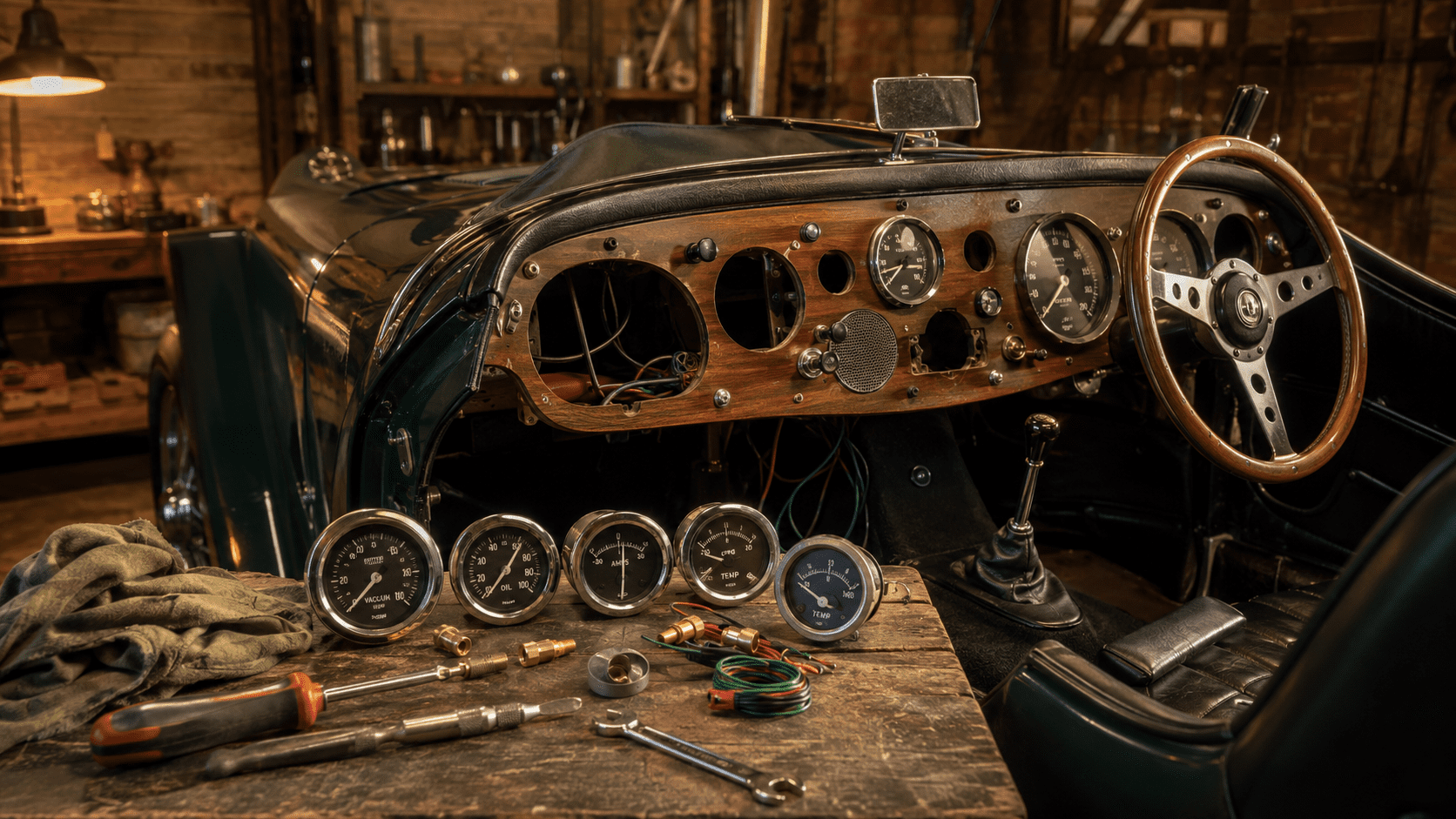
Most classic British cars left the factory with the legally required minimum of instrumentation and not a great deal more. A speedometer, because the law insisted on one. A fuel gauge and a water temperature gauge, because running out of either is the kind of mistake that only needs to happen once. Beyond that, the manufacturer’s enthusiasm for telling the driver what was actually happening inside the engine tended to vary by how much the car cost and how seriously the company expected its owner to take the business of driving it. The result is that a significant number of classic British cars are currently being driven with no more insight into their own internal workings than a speedometer and a fuel gauge provide, which is roughly the same level of diagnostic information available to a Victorian.
Adding instrumentation, whether to restore a car to its original specification or to add genuinely useful diagnostic capability that the factory never bothered with, is one of the more satisfying upgrades available to a classic car owner. None of it is complicated. All of it requires doing properly, because a badly fitted gauge tells you nothing useful and a badly fitted oil pressure line has the potential to put hot oil somewhere you would specifically prefer it did not go. This guide covers the vacuum gauge in detail, because it is the most useful and most underrated diagnostic instrument available for the money, and then works through oil pressure, oil temperature, ammeters, voltmeters, and rev counters, with the fitting practicalities for each.
The vacuum gauge: the £15 diagnostic tool nobody fits
A vacuum gauge measures the depression in the intake manifold relative to atmospheric pressure, expressed in inches of mercury (inHg). This single reading, and more importantly the way the needle behaves rather than just where it settles, tells you an enormous amount about the mechanical health of an engine, the quality of the carburation, and the state of the ignition timing, all from a single connection and a gauge that costs less than a tank of fuel. It is, without much competition, the most informative instrument per pound that a classic car owner can fit.
The principle is straightforward. A healthy engine with good compression, correctly seated valves, and properly set ignition timing draws a strong and stable vacuum at idle. Anything that compromises any of those things shows up as either a lower reading, an unstable reading, or both, and the specific character of the instability points toward the specific cause. Reading a vacuum gauge well is the kind of skill that takes an afternoon to learn and a lifetime to fully appreciate, in the way that all genuinely useful diagnostic skills tend to.
Connecting the gauge
The gauge needs a connection to a source of genuine manifold vacuum, which means a port downstream of the carburettor throttle butterfly, not an inlet trumpet or air filter connection. Most classic British engines have an existing vacuum take-off somewhere on the inlet manifold: a port for the brake servo, the distributor vacuum advance, or a blanking plug left for exactly this purpose. A T-piece spliced into an existing vacuum line is the simplest connection and avoids drilling anything. Where no suitable port exists, the manifold can be drilled and tapped for a small adaptor, which is a five-minute job with the manifold off the car and considerably less appealing with it still bolted in place above a hot exhaust.
Route the hose away from hot exhaust components and away from anything that moves, in the same way you would route a throttle cable. A vacuum hose that has been quietly melting against the exhaust manifold for two years produces readings that are, at best, an abstract art project rather than a diagnosis. For a temporary test gauge used for tuning sessions rather than a permanent dash fitting, a simple length of vacuum hose connected at the manifold and run through the open bonnet to a hand-held gauge on the wing is entirely adequate and considerably less effort than panel-mounting anything.
What a healthy reading looks like
With the engine warm and idling, a healthy four-cylinder classic British engine should show a steady reading of 18 to 22 inHg. A six-cylinder engine typically reads slightly higher and more consistently, around 19 to 21 inHg, owing to the smoothing effect of the additional cylinders on the induction pulses. A low-compression engine, or one running a long-overlap performance camshaft, may settle lower still, around 15 to 18 inHg, and this is entirely normal for that specific combination rather than a fault. The number alone means relatively little without context. The steadiness of the needle means considerably more.
A rock-steady needle at a slightly lower than ideal reading describes a healthy engine that simply is not the highest-compression example of its type. A needle that wanders, flickers, or drops in a specific rhythm describes a problem, and the character of that problem is diagnosable from the pattern alone, which is the entire point of owning the instrument.
Reading the patterns
Steady but low reading: a uniformly low reading that holds steady, rather than fluctuating, generally points to worn piston rings allowing blow-by, retarded ignition timing, or an air leak somewhere in the induction system rather than a single dramatic fault. Check the timing first, since it is the quickest thing to correct, then investigate for induction leaks before assuming the worst about the rings.
Needle drifts slowly up and down across a wide band: a rich or lean carburettor mixture, or an incorrectly adjusted idle speed, is the usual cause of a slow oscillating drift. This is the fault that the vacuum gauge is most directly useful for correcting, because the correction method is built into the diagnosis: adjust the mixture screw on each carburettor in small increments until the needle settles at its highest and steadiest point. On a twin-SU installation, this needs to be done in conjunction with balancing the two carburettors against each other, because an unbalanced pair will never settle cleanly regardless of how the mixture is adjusted on either one individually.
Rapid, narrow flutter, roughly half an inch either side of the main reading: worn valve guides allowing the valve stems to wobble slightly in their guides as the engine runs. The faster and more pronounced the flutter, the greater the wear, broadly speaking. This is a wear pattern that develops gradually and the vacuum gauge will often pick it up before the symptom becomes audible or otherwise noticeable from the driver’s seat.
Needle swings widely as the engine is revved, rather than at idle: weak valve springs that cannot keep the valves following the cam profile accurately at higher engine speeds. This is more commonly encountered on an engine that has had a performance camshaft fitted without the corresponding uprated springs, which is exactly the kind of mismatched modification that the rest of this site has spent some considerable time warning against in other contexts. The valve springs and the camshaft are a pair. Treat them as one.
Regular, rhythmic drop at idle, the needle falling sharply and recovering: a burnt or leaking valve on a specific cylinder, with the drop occurring once per engine cycle as that cylinder fails to seal correctly on its compression and exhaust strokes. A compression test will confirm which cylinder and to what degree, but the vacuum gauge is usually the instrument that first raises the question.
Reading drops as engine speed rises above idle, rather than staying level or improving: excessive exhaust back pressure, most commonly from a partially blocked silencer or a collapsed section of pipe restricting flow. The engine is, in effect, fighting to push its own exhaust gas out of the way, and the vacuum gauge shows the consequence of that fight directly. This is one of the less obvious uses of the instrument and one of the more useful, since a partially blocked exhaust is not always obvious from the outside.
A genuinely useful habit, once a vacuum gauge is fitted, is to note the reading and behaviour when the car is known to be running well, and refer back to that benchmark periodically. An engine’s vacuum signature drifts gradually as wear accumulates, and having a known-good baseline from eighteen months ago makes the gradual drift considerably easier to notice than relying on memory alone.
For the full carburettor balancing and mixture adjustment procedure that complements vacuum gauge tuning, our SU carburettor setup guide covers the complete process in detail.
Oil pressure gauges: mechanical versus electrical, and the capillary tube horror story
Oil pressure can be displayed by either a mechanical gauge, which uses a sealed capillary tube running directly from the engine block to a Bourdon tube mechanism behind the dial, or an electrical gauge, which uses a sender at the engine and a wire running to the gauge. Both have been original equipment on classic British cars at various points and both have genuine advantages, alongside one specific and genuinely worth-knowing disadvantage on the mechanical side.
The mechanical gauge is simple, requires no electrical power, and is generally very accurate and long-lived, since there is no electronics involved and nothing to drift out of calibration. The disadvantage is the capillary tube itself: a fine, oil-filled pipe running from the sender at the block, through the engine bay, through the bulkhead, and into the back of the dash-mounted gauge. This tube is filled with oil under pressure, and it runs directly into the cabin, close to the driver’s legs. Sharp bends in the capillary tube during fitting are the specific thing to avoid, because a tube that has been kinked or bent too tightly during installation can fracture internally from vibration fatigue over time, and a fractured capillary tube delivers a small but determined spray of hot engine oil into the footwell at a moment of the tube’s choosing rather than yours. This is not a hypothetical concern invented to make the guide more entertaining: it is a documented and recurring failure mode of mechanical oil pressure gauges, and it is entirely avoidable with correct routing.
The fitting rule that prevents this: never make a sharp bend in the capillary tube, never remove or shorten it, and route it with the largest practical radius at every turn, secured along its length so it cannot vibrate against anything sharp or hot. If the capillary tube supplied with the gauge is longer than needed, coil the excess gently rather than cutting it. Manufacturers explicitly warn against shortening capillary tubing because doing so voids the sealed system and the gauge will not read correctly afterward in any case.
The electrical oil pressure gauge avoids the capillary tube question entirely. A variable-resistance sender at the engine block sends a signal down an ordinary wire to the gauge, and the only thing running into the cabin is the wire itself, which does not spray hot oil on anyone regardless of how badly it is routed. The sender screws into the same port a mechanical sender would use, typically via a T-piece adaptor if the factory oil pressure warning light switch also needs to remain connected at the same location. This is the simpler and lower-risk option for anyone adding an oil pressure gauge to a car that did not originally have one, and it is why most aftermarket gauge kits sold today are electrical rather than mechanical.
Whichever type is fitted, retain the original low pressure warning light circuit if the car has one. A gauge gives you the actual number, which is genuinely useful, but a warning light gives you an unmissable signal at the exact moment pressure drops to a dangerous level, and the two are complementary rather than redundant. A T-piece at the sender allows both to be run from the same point.
Oil temperature gauges
An oil temperature gauge, less commonly fitted than oil pressure but increasingly popular among owners who drive their classics with some enthusiasm, uses a sender either screwed into the sump via a dedicated boss or fitted via an adaptor plate under the oil filter housing. The sump-mounted sender gives a reading closer to the bulk oil temperature; the filter-adaptor sender gives a reading closer to the oil temperature as it returns from the engine, which responds slightly faster to changes in load. Either is genuinely useful on a car that sees track days or sustained high-speed motorway use, where oil temperature can climb well beyond what the water temperature gauge suggests is happening, particularly on a car with an undersized or aging oil cooler. For a car used gently on classic runs and shows, it is a nice-to-have rather than a necessity, and most owners in that category find the existing water temperature gauge tells them everything they actually need to know.
Ammeters and voltmeters: not the same instrument, and the polarity trap
The ammeter, fitted as standard to a great many classic British cars, measures the rate of current flow into or out of the battery: a healthy charging system shows a positive reading after starting, dropping back toward zero as the battery returns to a full state of charge. The voltmeter, which gradually replaced the ammeter on later cars and is now a popular retrofit upgrade, instead measures the battery’s voltage directly, giving a more immediately useful indication of the battery’s actual state of charge without requiring the driver to interpret a current flow reading in context.
Both are legitimate choices and the decision is largely one of preference and originality. For a car being kept to original specification, the factory-fitted instrument is the correct one regardless of which it happens to be. For a car where originality is a lower priority than simply wanting the clearest possible information, a voltmeter is generally considered the more immediately useful instrument, since a reading of around 14 volts with the engine running confirms the charging system is working correctly, and a reading of around 12 volts with the engine off confirms the battery itself is in a healthy state, without any further interpretation required.
One point worth flagging specifically, because it catches out a reasonable number of owners who have converted their car from positive to negative earth: an ammeter wired for one earth polarity will read backwards if the polarity is reversed and the ammeter’s own connections are not corrected at the same time. The result is an ammeter that shows charge when the battery is actually discharging, and vice versa, which is precisely the kind of inverted reality that defeats the entire purpose of having the instrument in the first place. Our positive to negative earth conversion guide covers the specific fix, which is simply to swap the two wires on the back of the ammeter. It takes thirty seconds and is the single most commonly forgotten step in that entire conversion.
Rev counters: cable-driven, electronic, and the compatibility question
A mechanical, cable-driven rev counter takes its signal directly from a gearbox-driven cable in the same way a mechanical speedometer does, and is largely fit-and-forget: connect the cable, calibrate if the instrument allows it, done. These were standard on many performance-oriented classic British cars from the factory and remain straightforward to retrofit where the gearbox already has the necessary drive provision.
An electronic rev counter instead counts ignition pulses, typically taken from the negative side of the ignition coil, and calculates engine speed from the pulse frequency. This is the more common retrofit option on a car that did not originally have a rev counter, since it requires no mechanical drive provision at the gearbox at all. The compatibility point worth knowing: electronic rev counters are calibrated for a specific number of cylinders and, on some installations, for a specific type of ignition system, because the pulse pattern from a four-cylinder distributor differs from a six-cylinder one, and the pattern from a points-and-condenser ignition system can differ from an electronic ignition conversion. Fitting a rev counter calibrated for the wrong cylinder count produces a reading that is a clean multiple or fraction of the true figure, which is a confusing thing to discover only after the instrument is already wired in and mounted. Confirm the correct cylinder calibration before purchase, and if the car has had an electronic ignition conversion fitted (covered in our electronic ignition conversion guide), check the rev counter manufacturer’s compatibility with that specific system before wiring anything together.
Fitting practicalities: dash holes, illumination, and not looking like an afterthought
Classic British dash-mounted gauges are commonly available in 52mm and 80mm diameters, with 52mm being the standard size for secondary instruments and 80mm reserved for primary instruments such as the speedometer and main tachometer. Confirm the diameter before cutting anything: a hole cut for an 80mm gauge does not become a smaller hole again afterward, and a 52mm gauge rattling around inside an 80mm aperture with a hopeful amount of filler around the edge is the kind of detail that undermines an otherwise careful restoration immediately.
Always disconnect the battery before wiring any new gauge into the dash. Run a dedicated, fused supply to any new electrical gauge rather than tapping into an existing circuit that may not have the spare capacity or the appropriate fuse rating, and connect the gauge illumination to the existing panel light circuit so the new instrument dims and illuminates in sympathy with the rest of the dash rather than glowing at a different brightness that makes it obviously an addition rather than part of the original specification. A genuinely well-fitted auxiliary gauge, correctly sized, correctly illuminated, and sensibly positioned, looks as though the factory simply changed its mind partway through the model run. A badly fitted one looks like exactly what it is.
Where to mount additional gauges depends entirely on the car and the available space, but the centre console or a dedicated pod beneath the main dash are the two most common solutions on classic British cars that did not originally have provision for extra instruments. Avoid mounting anything in the direct line of sight needed for the primary speedometer and any warning lights: a vacuum gauge is a wonderful diagnostic tool but it is not more important than seeing the road, and it should be positioned accordingly.
A final word on instrument originality
Before fitting anything new, it is worth establishing what your specific car had from the factory, because a perfectly executed auxiliary gauge installation on a car that should have had no such thing is a different kind of detail mistake from the ones covered in our engine bay detailing guide, but it is a detail mistake all the same to anyone showing the car for originality. For a daily-use classic or one being upgraded with the explicit goal of better information rather than concours accuracy, none of this matters and a vacuum gauge is simply a good idea that the factory never got around to having. For a car heading toward a concours field, check the original specification first and treat any addition as a deliberate departure from it rather than an oversight.
For related reading: our fuel gauge and sender diagnosis guide covers the same sender-and-variable-resistance principle used in oil pressure and oil temperature senders, our electrical fault finding guide covers the multimeter techniques relevant to diagnosing any electrical gauge that is reading incorrectly, and our positive to negative earth conversion guide covers the ammeter polarity fix referenced above in full.
This page contains affiliate links. If you click a link and make a purchase, Classic Car Hub may earn a small commission at no extra cost to you.