
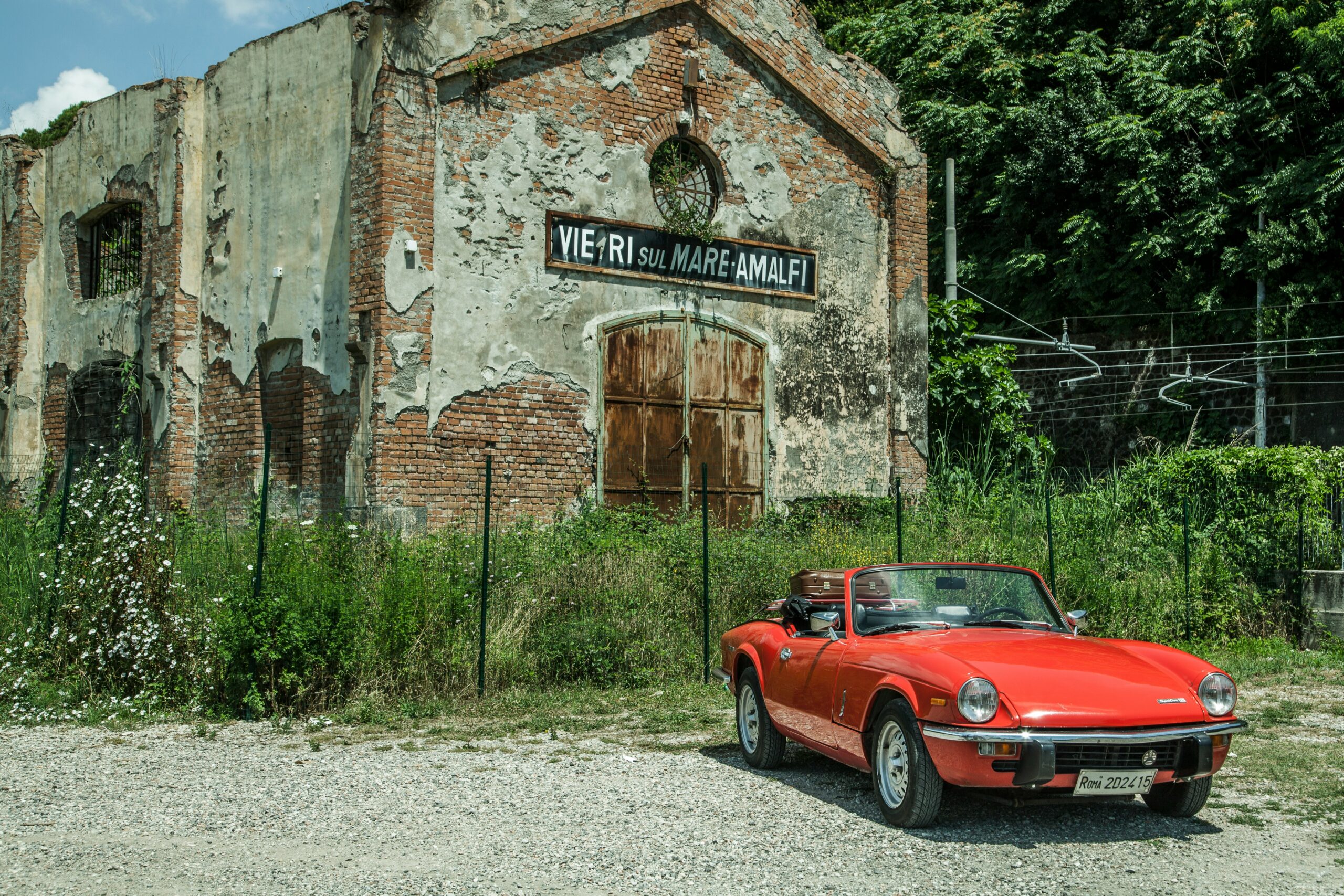
The Triumph Spitfire was produced across five distinct variants over eighteen years, which is a longer and more varied production run than most people realise when they first encounter one. The car that rolled out of Canley in 1962 and the car that rolled out in 1980 share the same basic chassis, the same general proportions, and the same fundamental intention, but they differ in engine, suspension, performance, body treatment, and character to a degree that makes variant identification genuinely important before any purchase decision. This guide covers all five variants, their specifications, how to tell them apart at a glance, and what the market currently thinks each one is worth.
How to identify each variant
The Spitfire’s five variants can be identified visually before opening the bonnet. The Mk1 and Mk2 (originally badged Spitfire 4 and Spitfire 4 Mk2) are the prettiest and most delicate-looking, with slim chrome bumpers, separate headlight nacelles sitting flush within the front wings, and a narrow body with an uncluttered purity of line. The Mk1 and Mk2 are difficult to distinguish from each other at a glance; the Mk2 gained windscreen washers, slightly revised instruments, and modest trim improvements. Mechanically, the Mk2 runs in a marginally higher state of tune but the difference is not significant.
The Mk3 is identified by its raised front bumper, which moved upward to meet new impact regulations, and by its revised rear lights. The front treatment looks slightly different as a result of the bumper position. On the positive side, the Mk3 received the 1296cc engine and is the quickest of the slim-bumper cars. The Mk4 is the most visually different: Michelotti restyled the body in line with the Triumph Stag treatment, giving it a cut-off tail, recessed door handles, and a more modern appearance that divides opinion. Rostyle steel wheels replaced the earlier pressed steel type on standard cars. The 1500 looks similar to the Mk4 but gained the larger engine and, on US-market cars, rubber overriders on the bumpers. UK-market 1500s retained chrome bumpers.
Specifications by variant
| Variant | Years | Engine | Power | 0–60 mph | Top Speed | Weight | Built |
|---|---|---|---|---|---|---|---|
| Mk1 | 1962–1964 | 1,147cc 4-cyl | 63 bhp | ~16.4 sec | 92 mph | 711 kg | ~45,753 |
| Mk2 | 1964–1967 | 1,147cc 4-cyl | 67 bhp | ~15.5 sec | 93 mph | 720 kg | ~37,409 |
| Mk3 | 1967–1970 | 1,296cc 4-cyl | 75 bhp | ~13.5 sec | 100 mph | 730 kg | ~65,320 |
| Mk4 | 1970–1974 | 1,296cc 4-cyl | 63 bhp | ~16.0 sec | 100 mph | 770 kg | ~70,021 |
| 1500 | 1974–1980 | 1,493cc 4-cyl | 71 bhp | ~12.5 sec | 100 mph | 793 kg | ~95,829 |
Dimensions (all variants)
| Measurement | Mk1–Mk3 | Mk4–1500 |
|---|---|---|
| Wheelbase | 2,108 mm (83.0 in) | 2,108 mm (83.0 in) |
| Length | 3,683 mm (145.0 in) | 3,785 mm (149.0 in) |
| Width | 1,448 mm (57.0 in) | 1,486 mm (58.5 in) |
| Height (hood up) | 1,219 mm (48.0 in) | 1,219 mm (48.0 in) |
What the numbers mean in practice
The Spitfire’s performance figures require context. A 0-60 time of 16 seconds sounds slow by modern standards, but the Mk1 weighs just over 700 kilograms and responds to its controls with an immediacy and precision that heavier, faster cars cannot replicate. The Spitfire is not about the numbers. It is about the experience of a small, light car on an interesting road, which is something the figures cannot adequately represent. The Mk3 is the best balance of performance and original character in the range, combining the prettier slim-bumper body treatment with the stronger 1296cc engine. The 1500 is the most usable on modern roads despite its power being constrained by emissions requirements: it pulls more strongly at low revs and feels less strained on a motorway run.
One important engine note: Mk4s with the FH engine prefix are UK specification. FK prefix indicates a US-market car with a detuned engine. If a Mk4 is unusually slow, confirm the engine number begins with FH rather than FK. Similarly, 1500s for the UK begin FH; US-specification cars begin FM and produce less power due to emissions equipment. An FM-engined car sold as a UK-specification 1500 is not correctly represented.
The suspension development story
The Spitfire’s rear suspension changed significantly across its production life. Mk1, Mk2, and Mk3 cars used a swing-axle independent rear suspension derived from the Herald saloon. At the limit of adhesion this system produces significant camber change and a tendency for the rear to tuck under in a way that requires driver awareness. It is manageable on the road at sensible speeds and many owners drive early Spitfires for years without incident, but it is the reason the car’s handling reputation has historically been mixed.
The Mk4 received Triumph’s swing-spring modification, which reduced camber change significantly by using a transverse single leaf spring arrangement. The handling improvement was real and meaningful: the Mk4 and 1500 are considerably more forgiving at the limit than the earlier cars. This does not make the early cars dangerous in normal use, but it makes the Mk4 and 1500 more suited to owners who want to drive confidently without thinking about rear axle geometry.
Values overview
Spitfire values broadly follow the variant hierarchy, with early slim-bumper cars commanding the most interest from collectors and the Mk4 and 1500 representing the most accessible entry points for drivers. Condition and originality matter more than variant in most cases: a clean, correct Mk4 is worth considerably more than a poorly restored Mk1 regardless of the premium the earlier model carries in principle. The gap between a usable driver and a properly restored example is significant across all variants and consistently exceeds the cost of the restoration itself, which is the usual argument for buying the best available example rather than a project.
For current market values across all Spitfire variants, our classic car valuation guide tracks live pricing data and gives a reliable picture of what cars are actually selling for rather than what sellers are asking.
Owners club and community
The Triumph Sports Six Club (TSSC) covers the Spitfire alongside the GT6, Vitesse, and Herald, with a national network of regional centres, an extensive technical advice service, and a spares operation that holds a comprehensive range of parts. The TSSC’s Spitfire Register maintains documentation of surviving cars and can assist with commissioning number research. For a car where variant identification and correct specification genuinely affect both value and the ownership experience, the club’s technical resources are worth membership well in advance of any purchase. Parts availability for the Spitfire is excellent across the full range through Rimmer Bros, Moss Europe, and the TSSC spares operation.
For related reading: our Triumph Spitfire buyers guide covers what to look for when purchasing, our Triumph GT6 buyers guide covers the six-cylinder sibling, and our Triumph paint colour codes guide covers the full factory colour range across all Spitfire variants.
This page contains affiliate links. If you click a link and make a purchase, Classic Car Hub may earn a small commission at no extra cost to you.