
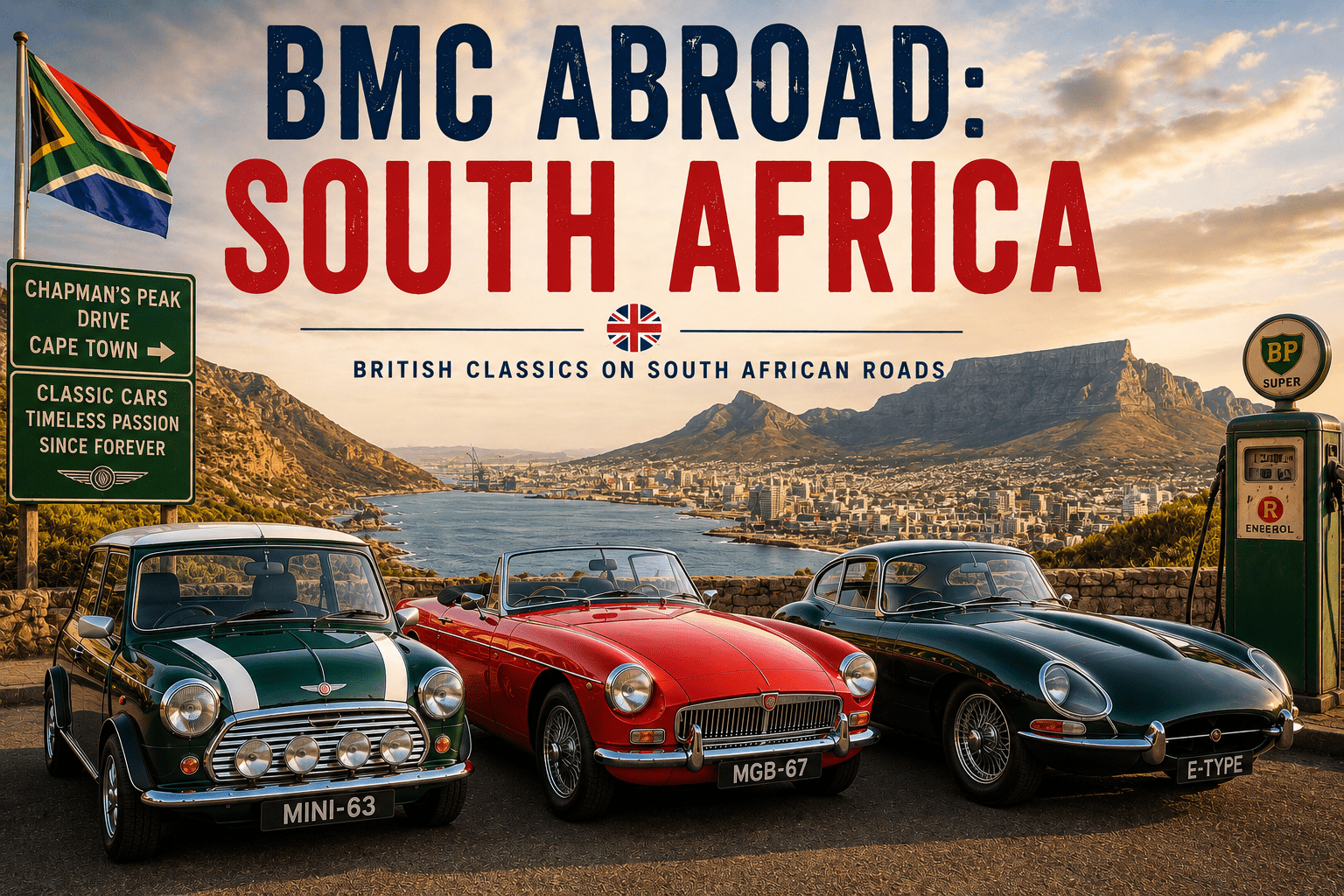
South Africa is a large country with a complicated history, a varied climate, and a specific relationship with British cars that goes back to the very beginning of the industry. The first Morris Minors arrived in 1948. Within a decade there was a factory near Cape Town assembling them from kits. Within two decades that factory was building cars that had no equivalent anywhere else in the world, with bodywork designed by one of Italy’s greatest automotive stylists and taillights borrowed from the Triumph 2000. The British car industry came to South Africa with modest ambitions and left behind a heritage that the country’s enthusiast community has been maintaining, debating, and occasionally restoring ever since.
The climate does not make this easy. South Africa is not one climate but several, arranged across a country the size of Western Europe, ranging from the subtropical KwaZulu-Natal coast to the high, dry Highveld plateau around Johannesburg to the Mediterranean-leaning Western Cape to the vast, temperature-extreme Karoo. A British classic car surviving in good condition in any of these environments is either very well maintained or very well stored, and occasionally both. The ones that have survived tell a story about the resourcefulness of their owners, the quality of some of the original steel, and the specific relationship between South African classic car owners and the machines they have chosen to preserve.
The factory at Blackheath
The Blackheath plant, situated in the Cape Flats area southeast of Cape Town, was the centre of British car production in South Africa for most of the postwar period. Leyland’s presence there dated from 1955 with the opening of a truck and bus assembly facility. By the time BMC’s car production was in full swing at the site, Blackheath was producing ADO16s (the 1100 and 1300 range), Minis, Austin-Healeys, and later the Marina, all assembled from Completely Knocked Down (CKD) kits shipped from the UK and put together with an increasing proportion of locally manufactured components.
The CKD model was a standard approach for British Leyland’s international operations: manufacture the major components in the UK, ship them to the local market for assembly, reduce import duties by adding local content progressively, and build a captive market in the process. The theory was sound. The execution was typically British Leyland, which is to say that the product range in South Africa by the mid-1970s included several cars that were underperforming in their home market, a factory trying to build them with limited investment, and management in Johannesburg writing optimistic projections for a market that was quietly choosing Volkswagens and Toyotas instead. By 1976, total British Leyland car sales in South Africa across the entire range, including the Mini, the Apache, the Marina, the Triumph, and the Jaguar, amounted to 9,846 vehicles. The market sold considerably more than that. The remainder went to other manufacturers, largely because they were offering something that started reliably in the morning and did not require a working knowledge of the Lucas electrical system to own.
The Austin Apache: the car most British enthusiasts have never heard of
In the late 1960s, sales of the ADO16 range in South Africa were declining. The 1100 and 1300 were well-proven cars on sound mechanicals, but the body was beginning to look dated in a market that was developing cosmopolitan tastes. Peter Ray, the Sales Director in Johannesburg, reviewed the situation and concluded that what was needed was not a replacement for the ADO16 but a restyled version of it: the same reliable floor pan, the same A-Series engine, the same front subframe and suspension, but a completely new body that looked fresh and modern.
The man asked to provide that body was Giovanni Michelotti, the Italian designer whose studio had been responsible for, among other things, the Triumph 2000, the TR4, and the Herald. Michelotti’s brief was to restyle the ADO16 into something that could be sold in South Africa as a distinct and desirable product. He delivered a notchback saloon that was genuinely handsome: clean lines, a proper boot, and a rear end that looked considerably more sophisticated than the original. The interior was locally produced vinyl that, according to contemporary accounts, withstood the rigours of the African sun considerably better than the original British trim would have.
The car went into production at Blackheath in November 1971 as the Austin Apache. It shared its glass, doors, and floor pan with the ADO16 but was otherwise a different car. The connection to Triumph was visible in the taillight units: they were the same components used on the Triumph 2000 and 2500, which meant that a specifically South African derivative of a British compact family car shared its rear lighting with one of Coventry’s finest saloons. This is either a pleasing piece of parts-bin creativity or an alarming insight into how British Leyland managed its international operations, depending on your perspective. The Apache remained in production until 1978, when Blackheath’s capacity was redirected toward the Marina. It was the last ADO16 derivative built anywhere in the world.
The Apache is almost completely unknown in the UK. South African owners are justifiably proud of it. It represents something genuinely unusual in automotive history: a locally developed bodyshell on a proven British platform, designed by one of Italy’s most significant stylists, built in Africa for an African market. There is no equivalent in any other country in the BMC Abroad series, which makes South Africa’s contribution to the British classic car story more distinctive than it might initially appear.
The Mini 1275 GTS and other South African specials
The Apache was not the only South African-specific variation on a British theme. The Mini 1275 GTS was a performance version of the Mini developed specifically for the South African market: a 1275cc A-Series engine, wider wheels, a spoiler, and a trim level that gave it a genuinely sporting character. This was not a factory standard UK product with a badge change. It was a locally developed performance variant, produced at Blackheath, that has no direct UK equivalent and is now actively collected by South African Mini enthusiasts who understand its specific significance.
The Triumph 2000 and 2500 were sold in South Africa under the name Triumph Chicane, which is a name that raises immediate questions about the marketing department’s reasoning and has never been satisfactorily explained. The Chicane was an entirely standard Triumph saloon underneath the nomenclature, and its owners presumably managed to overlook the name in favour of the car’s considerable merits, which included one of the better British six-cylinder engines of the era and a level of refinement that the local Austin Marina could not approach.
The ADO16 range was also briefly sold in South Africa under the unique badge Austin 11/55 from 1968, which was a local designation that never appeared anywhere else. The 11/55 designation referred to the horsepower outputs of the 1100 and 1300 variants, which is a straightforward enough naming convention but one that British Leyland’s central marketing team had evidently not felt the need to apply anywhere else in the world. South Africa, in short, had its own specific British Leyland product range, with its own names, its own variants, and in the case of the Apache, its own body.
Land Rover: the car that became part of the landscape
No account of British cars in South Africa is complete without the Land Rover, which occupies a position in the country’s automotive culture that goes considerably beyond transport. The Series Land Rovers arrived in South Africa in the early 1950s and found a country that was, in large parts, exactly what they had been designed for: farms with distances that made the question of road surface academic, game reserves where the terrain was not merely challenging but specifically hostile, and a working population that required a vehicle to carry equipment, pull things, and occasionally be repaired with what was available rather than what was ideal.
Land Rovers were assembled at Blackheath alongside the car range, with locally-built versions ultimately receiving the R6 six-cylinder engine developed from the Australian E-Series unit. This gave South African Land Rovers a powertrain specification that was unique to the country and reflects the pattern of local adaptation that characterised British Leyland’s South African operation more broadly. The result was a vehicle that was recognisably a Land Rover but had been modified to suit the specific demands of the market, which included towing loads at altitude on the Highveld and surviving the deep sand tracks of the Northern Cape without complaint.
The Series Land Rover community in South Africa is substantial, active, and has a specific relationship with their vehicles that is different in character from the British equivalent. In the UK a Series Land Rover is a cherished restoration project or an occasional rural working vehicle. In parts of South Africa it was the primary transport until well into the 1980s, and the mechanical knowledge of how to maintain one exists in the farming community through direct practical experience rather than the learned enthusiasm of a hobby. This is a different kind of expertise from the workshop manual approach, and it has kept a significant number of Land Rovers running in conditions that would have finished a lesser vehicle.
The climate: four countries in one
Owning a classic British car in South Africa requires understanding which of the country’s several distinct climates you are actually in, because the challenges vary significantly by region and a car that survives well in one area may deteriorate rapidly in another.
The Highveld, which includes Johannesburg and Pretoria at an altitude of around 1,500 to 1,700 metres, has a climate that is dry and temperate for most of the year, with warm summers and cool winters. This sounds ideal for classic car preservation and in many respects it is: the dry conditions mean that rust is less of a chronic problem than in the UK. The catch is the summer thunderstorm season, which brings spectacular electrical storms and hail that arrives with very little warning and produces dents with considerable enthusiasm. UV radiation at altitude is significantly more intense than at sea level, which accelerates paint oxidation, rubber degradation, and interior fading in ways that their Coventry designers did not anticipate when they were watching rain fall on the Midlands.
The Western Cape operates on a Mediterranean cycle: wet winters, dry summers. The Cape Town area’s combination of moisture in winter and intense UV in summer is hard on both paint and rubber. The proximity to two oceans introduces salt air as an additional consideration, particularly near the coast. A classic British car garaged in Constantia or Stellenbosch has a better life than one parked near the Waterfront, and considerably better than one left outdoors in Hermanus, where the Atlantic makes its presence felt on anything made of ferrous metal with democratic thoroughness.
KwaZulu-Natal provides subtropical conditions on the coast and more temperate conditions inland. The coastal humidity is the primary challenge: Durban’s combination of warm temperatures and consistent moisture is not a kind environment for unprotected steel. The cars that survive in good condition in Durban have typically been garaged consistently, waxed regularly, and maintained with the specific attention that a coastal salt-air environment demands.
The Karoo, that vast semi-desert interior, is the most extreme: temperature swings of 30 degrees between day and night are not unusual, rainfall is minimal, and the dust is omnipresent. Rubber seals that would crack in Yorkshire after twenty years crack in the Karoo after five. Fuel system components that last indefinitely in the temperate UK may need replacing on a much shorter cycle. The Karoo is hard on cars. It is also extraordinarily beautiful, and the classic car owner who has driven across it on a clear winter morning with the Swartberg Mountains ahead and nothing else in any direction has had an experience that compensates for the subsequent seal replacement.
The community
The Southern African Veteran and Vintage Association (SAVVA), formed in 1968, is the umbrella body for South Africa’s classic vehicle clubs, currently representing around forty affiliated organisations across the country. SAVVA holds membership of FIVA, the international federation that connects historic vehicle preservation organisations worldwide, and provides the regulatory framework within which member clubs operate. Under the SAVVA umbrella sits a network of regional clubs that between them covers every part of South Africa’s considerable geography.
The Veteran Car Club of South Africa (VCCSA) is one of the most established organisations in the country, organising breakfast runs, trials, and exhibition events throughout the year. The Vintage and Veteran Club (VVC) in Johannesburg serves the Highveld community with regular Friday evening gatherings and monthly Sunday events. The Crankhandle Club in the Western Cape, launched in 1955, has the distinction of running the first old car rally in South Africa and remains one of the most active clubs in the country. The Eastern Province Veteran Car Club in Port Elizabeth, founded in 1969, runs the Milligan Trial Rally each year in memory of the founder of the vintage car movement in the Eastern Cape, a timed trial against a route schedule that has been running since 1970 and remains one of the country’s most characterful classic car events.
One club listing encountered in research identifies a group of British car enthusiasts operating under the description “Powered by tea, propelled by cake,” which captures something essential about the British classic car community’s character regardless of which hemisphere it happens to be operating in.
The cars today
The British cars that survive in South Africa in good condition occupy a specific position in the local classic market. Examples from the drier Highveld and inland provinces tend to have better body condition than coastal examples, which may have better paint but less sound metalwork in the lower sections. The Austin Apache, being a South African-only model, is both rare and highly valued within the country: examples in good condition command significant prices from a community that understands their specific heritage and has no alternative source of supply.
Morris Minors, MGBs, Triumph TR series, and the Land Rover range are all well represented in the South African classic scene, with active marque-specific ownership and the kind of parts supply network that develops wherever a significant community maintains a specific type of car over several decades. The Blackheath connection gives some South African examples a local history that collectors find interesting: a car assembled at the Cape from British components, driven in South African conditions, maintained by South African mechanics, is a different object from an identical car that spent its life in Worcestershire, and the community recognises and values that difference.
For technical guidance on common South African British classics: our rust prevention guide covers coastal and humid climate protection, our cooling system guide covers the high-altitude and extreme heat considerations relevant to Highveld and Karoo operation, our tyre safety guide covers rubber degradation in high UV environments, and the BMC Abroad landing page covers the full series. The Austin Apache, incidentally, takes an A-Series engine and all associated service components: our SU carburettor guide is as relevant in Cape Town as it is in Cowley.
This page contains affiliate links. If you click a link and make a purchase, Classic Car Hub may earn a small commission at no extra cost to you.