
The Sunbeam Alpine and its ferocious sibling the Tiger represent one of the more interesting chapters in British sports car history. The Alpine is a proper, elegant little roadster from the Rootes Group that has spent sixty years being slightly underappreciated in comparison to the MGB and Spitfire it competed against. The Tiger is something else entirely: a small British sports car with a large American V8 crammed into it by Carroll Shelby and Ken Miles, which is not a sentence that requires any further explanation of why you might want one. This guide covers both cars, because understanding the Alpine is essential to understanding the Tiger, and because many Alpine buyers eventually end up asking themselves the Tiger question regardless.
The Alpine: a brief history
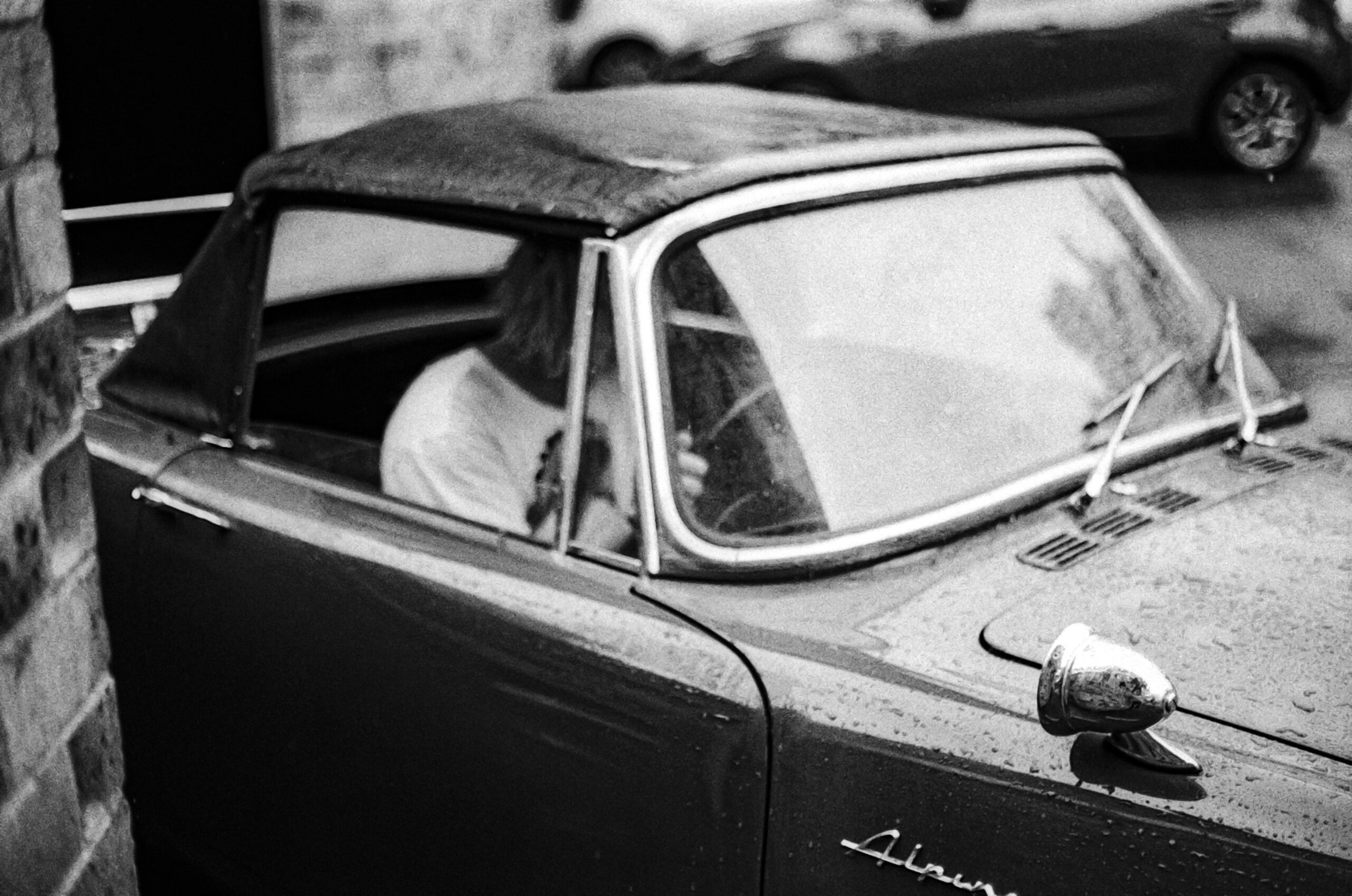
The Series Alpine that most collectors know was launched in 1959, the result of a 1956 brief to designer Kenneth Howes to create a dedicated sports car aimed principally at the American market. Howes had previously worked at Loewy Studios and at Ford in Detroit, which explains why the Alpine’s styling has a transatlantic flavour that sits slightly apart from its British contemporaries. The car was built on a modified version of the Hillman Husky’s floorpan with running gear largely derived from the Sunbeam Rapier, but it was a genuinely sporting machine rather than a badge-engineered saloon. Notably, it was the first British sports car to offer wind-up side windows as standard, which seems a small thing until you have driven an MG Midget in the rain.
The Alpine ran through five series from 1959 to 1968, with a total production of around 69,000 cars. The majority went to North America where the car sold well and earned a devoted following. In the UK the Alpine has always been slightly undervalued relative to its merits, which currently makes it an interesting buy.
Which Alpine?
Series I (1959 to 1960)
The original car used Rootes’ 1494cc engine in Sunbeam Rapier specification, producing around 78bhp. Early Series I cars were assembled by Armstrong Siddeley at their Coventry facility. 11,904 were built. The tail fins are at their most pronounced on the Series I, which some find period-charming and others consider excessive. Good original examples are relatively rare and command a premium.
Series II (1960 to 1963)
The Series II received an enlarged 1592cc engine producing 80bhp along with revised rear suspension and various detail improvements. Production transferred to Rootes’ own Ryton facility during the Series II’s run. Just under 20,000 were built, making this the most plentiful of the early cars. The Series II is also historically notable as the car James Bond drove in Dr. No in 1962, borrowed for filming from a local resident in Jamaica as the only suitable sports car available on the island.
Series III (1963 to 1964)
The Series III introduced a revised interior and a roomier boot. Two specifications were offered for the first time: the Sports, which retained the folding hood with an optional hardtop, and the GT, which came with a hardtop as standard but no folding hood at all. The GT’s absence of a soft top allowed a roomier interior and a slightly detuned engine for relaxed touring. The Series III also received quarter-light windows. Around 5,800 were built.
Series IV (1964 to 1965)
The Series IV is identifiable by the significantly reduced tail fins, which most people consider an improvement. The lower-output engine option was dropped and all cars used the 82bhp single carburettor unit. Automatic transmission became available as an option though it was not popular. A new fully synchronised gearbox was adopted during the run. 12,406 were built.
Series V (1965 to 1968)
The final and arguably best Alpine received a new five-bearing 1725cc engine with twin Zenith-Stromberg carburettors producing 93bhp. The five-bearing crankshaft was a significant improvement over the earlier three-bearing unit in terms of smoothness and longevity. 19,122 Series V cars were built and this is the most commonly available Alpine on the market today. For anyone wanting a usable, enjoyable classic without concours budget concerns, the Series V is the sensible starting point.
The Harrington Alpine
Coachbuilder Thomas Harrington produced a fastback coupe version of the Alpine that was officially supported by Rootes and sold through their dealer network. The Harrington Alpine, particularly the Harrington Le Mans version with its tuned engine, achieved a notable result at Le Mans in 1961 when it won the Thermal Index of Efficiency. Factory-built Harrington cars are rare, desirable and significantly more valuable than standard Alpines. Be cautious of any car presented as a Harrington that cannot be verified with proper documentation, as the conversion has been replicated over the years.
What to look for on the Alpine
Bodywork and rust
The Alpine rusts in the places you would expect from any British car of the era and a few places specific to its own construction. The sills are the primary concern. Probe both the outer and inner sill structure carefully, as outer sills are frequently replaced over rotten inners. The floor pans rust from inside, particularly under the mats. The area around the battery tray corrodes badly on older cars if batteries have leaked. Check the front footwells where water collects if the windscreen seal or hood seal has been leaking, which is common on cars of this age.
The rear fins on early cars are a known rust trap where they meet the main body, particularly inside the fin structure where moisture accumulates and cannot escape. Any fin that sounds hollow when tapped or shows surface bubbling under the paint needs proper investigation before purchase. The boot floor and rear valance are also worth checking carefully, as are the inner wing areas behind the front wheels.
The hood and hardtop
Check the soft top carefully for tears, crazing in the rear window, and mildew. A hood that has been stored damp for years can look acceptable from a distance and be in poor condition on closer inspection. The hood frame should be checked for bent or broken bows. Replacement hoods are available but fitting one that seals properly at the windscreen rail and rear quarters requires care. The factory hardtop is a desirable option that adds usability and value. Check that any hardtop fits the car correctly and seals properly, and inspect the sealing rubbers which harden with age.
The engine
The Rootes four cylinder engines in the Alpine are generally robust if properly maintained. The earlier three-bearing engines in the Series I through IV cars can be prone to crankshaft wear on high mileage examples. The Series V five-bearing 1725cc unit is the more durable of the two families. On any Alpine check the oil level and condition before starting, listen for any bottom end noise on a warm engine at idle, and watch the temperature gauge during a test drive. The cooling system on these cars is adequate rather than generous and a thermostat or water pump past its best will cause problems fairly quickly.
Rootes engine parts are less universally available than A-series or B-series BMC components, so check with the Sunbeam Alpine Owners Club before buying a car in unknown mechanical condition to understand what you are likely to need.
Gearbox and overdrive
Overdrive was a factory option on the Alpine and is well worth having for comfortable modern use, particularly on the lower powered earlier cars. Check the overdrive engages and disengages cleanly at speed. The gearbox should change cleanly through all gears without baulking or jumping out of gear under load.
The Tiger: a completely different animal
The Tiger’s origin story is one of the better ones in classic car history and it involves a wooden yardstick, $800, Carroll Shelby, Ken Miles, and a secret kept from the head of the Rootes Group until it was too late to stop it.
In 1963 Ian Garrad, Rootes’ West Coast sales manager in the United States, decided that the Alpine needed more power to compete effectively in the American market. He and his service manager Walter McKenzie measured the Alpine’s engine bay with, according to contemporary accounts, a wooden yardstick of uncertain precision, and concluded that Ford’s new 260 cubic inch V8 might just fit. Garrad contracted Carroll Shelby to build a proper prototype for $10,000, with funds quietly borrowed from the American marketing budget. Simultaneously, he gave Ken Miles a Series II Alpine, a Ford V8, and $800, and asked him to build a quick proof-of-concept mule to confirm the idea worked. Miles had the V8 running in the Alpine within a week.
Lord Rootes, head of the Rootes Group, was kept in the dark throughout the development process. When the Shelby prototype was shipped to England for evaluation he was reportedly extremely unhappy at the work that had been done without his knowledge. He then insisted on driving the car himself. He was so impressed that shortly after his test drive he telephoned Henry Ford II personally to negotiate an engine supply agreement. That is not a bad outcome for a project that was initially funded by quietly redirecting the advertising budget.
Production Tigers were assembled by Jensen Motors at West Bromwich, with bodies from Pressed Steel and Ford V8 engines and transmissions shipped from America. Shelby received a royalty on every car produced. The Tiger was priced at under $3,500 in the American market, positioning it directly against cars considerably larger and heavier. It was comprehensively faster than any Alpine and changed the car’s market positioning entirely.
Tiger Mark I and Mark II
Mark I (1964 to 1967)
The Mark I used Ford’s 260 cubic inch (4.3 litre) V8 producing 164bhp, roughly double the power of the Alpine it replaced. The body was based on the Series IV Alpine panels on early cars and Series V panels on later examples, the latter sometimes referred to by enthusiasts as the Mark IA. The Mark I accounts for the majority of the 7,085 Tigers built. Performance was genuinely impressive for the era and the price: the Tiger could reach 60mph in around 8.5 seconds and had a top speed approaching 120mph, figures that put it in the company of much more expensive machinery.
Mark II (1967)
The Mark II received the larger Ford 289 cubic inch (4.7 litre) engine producing around 200bhp. It is significantly rarer than the Mark I with just over 500 examples built before production ended. The Tiger’s demise was directly caused by the Chrysler Corporation’s takeover of the Rootes Group in 1967. Chrysler had no intention of selling a sports car with a Ford engine, and their own small-block V8 had its distributor at the rear of the engine rather than the front, meaning it would not fit in the Tiger’s engine bay. The Tiger was discontinued immediately. Mark II cars are considerably more valuable than Mark Is and authentication is important given the rarity premium involved.
What to look for on the Tiger
Authenticity: the fake Tiger problem
This is the most important section in this guide and it needs reading carefully. Because the Tiger and Alpine share the same bodyshell, and because Tigers are worth considerably more than Alpines, fake Tigers exist. An Alpine fitted with a V8 engine is not a Tiger. A genuine Tiger was built by Jensen, has its own specific chassis number sequence, and can be verified against factory records. The Sunbeam Tiger Owners Association maintains records and can authenticate cars from the chassis number. Do not buy any car presented as a Tiger without first verifying the chassis number through the club. A genuine Tiger is a significant investment. A fake one is an Alpine with an engine swap, worth considerably less.
Specific identification points on genuine Tigers include the chassis number prefix, the strengthened bodyshell modifications made to accommodate the V8, the access hole in the driver’s footwell that was cut to allow servicing of the front of the engine, and the specific steering rack and suspension modifications. None of these are impossible to replicate but together they form a picture that an expert can verify.
Bodywork and structure
All the Alpine rust checks apply equally to the Tiger, with one addition. The Tiger’s bodyshell was modified by Jensen to accommodate the V8 engine, which involved cutting and reinforcing the engine bay and firewall. Check these areas carefully for signs of poor previous repairs, accident damage or non-original modifications. A Tiger that has been in a front end collision may have had these structural modifications compromised or incorrectly repaired.
The engine and cooling
Ford’s small block V8 is a robust and well understood engine with excellent parts availability on both sides of the Atlantic. The fundamental concern on the Tiger is cooling. The V8 produces considerably more heat than the four cylinder it replaced, and the Alpine’s original cooling system was not designed for the task. Tigers are known to run warm, particularly in traffic or in hot weather. A Tiger that has been allowed to overheat repeatedly will likely have head gasket issues or worse. Check the coolant carefully for signs of contamination, watch the temperature gauge throughout a test drive, and ask detailed questions about the cooling system’s history and any modifications made to address the known tendency to run warm.
The Ford V8 fits into the engine bay with, as Carroll Shelby himself noted, not an inch to spare. This makes routine maintenance more involved than it would be on a car designed around the engine from the outset. The access hole in the driver’s footwell for reaching the front of the engine was a factory solution to this problem. Check that this access hole has not been bodged closed on any car you are considering.
Genuine V8 conversions versus Tigers
A word on V8-converted Alpines, because they are common and some are very well done. A properly engineered V8 conversion on an Alpine is an enjoyable and relatively affordable way to get the Tiger experience without the Tiger price. It is not a Tiger and should not be represented as one, but as a driver it can be excellent. If a converted Alpine appeals, have it thoroughly inspected and be honest with yourself about what you are buying. The price should reflect an Alpine, not a Tiger.
The pop culture connection
Both cars have genuine screen pedigree worth knowing about. The Series II Alpine was one of the earliest Bond cars, driven by James Bond in Dr. No in 1962, borrowed from a local resident for filming as the only suitable sports car available in Jamaica. The Tiger was Maxwell Smart’s car of choice in the 1960s American TV spy comedy Get Smart, with an Alpine pressed into service for the shots requiring gadgets to emerge from the bonnet, since nobody wanted to cut holes in an actual Tiger. Both cars appeared in an era when sports cars were genuinely exciting objects of popular culture, and that association has done no harm to either car’s desirability.
What to pay
Alpine prices have been gradually firming in recent years as the car’s qualities attract more attention. A solid usable Series V in average condition typically asks between £10,000 and £18,000. Good restored examples command £20,000 to £28,000. Earlier Series cars in good condition sit in similar territory with a modest premium for originality. Harrington cars command significantly more and need specialist valuation.
Tiger values are in a entirely different league. Genuine Mark I Tigers in good condition start at around £45,000 to £55,000 and well presented examples can exceed £70,000. Mark II cars are rarer and priced accordingly. The significant premium over a converted Alpine reflects the rarity, the provenance, and the Carroll Shelby connection rather than any dramatic difference in the driving experience. For many buyers a well built conversion on a good Alpine body will provide ninety percent of the experience for a fraction of the price. For collectors the authentic Tiger is the only option.
Before you buy
The Sunbeam Alpine Owners Club and the Sunbeam Tiger Owners Association are both active organisations with knowledgeable memberships and the ability to assist with pre-purchase checks, chassis number verification and specialist inspection referrals. For any Tiger purchase the STOA verification process is essential, not optional. For Alpine purchases the SAOC is a valuable resource for identifying model-specific issues and locating parts before you commit.
Classic car insurance on an agreed value policy is strongly recommended for both cars. Get a quote before you buy rather than after, and make sure the agreed value for a Tiger is based on authenticated status rather than assumption. An unverified car insured as a Tiger at Tiger values would be an uncomfortable position to be in if a claim ever arose.
Before you make an offer, check current market values with our free classic car price checker — estimated UK values by condition grade with live eBay listings alongside, so you can see what cars are actually selling for right now.
This page contains affiliate links. If you click a link and make a purchase, Classic Car Hub may earn a small commission at no extra cost to you.